Recognition: unknown
Beyond Static Collision Handling: Adaptive Semantic ID Learning for Multimodal Recommendation at Industrial Scale
Pith reviewed 2026-05-08 05:37 UTC · model grok-4.3
The pith
AdaSID adaptively regulates semantic ID overlaps by relaxing repulsion for compatible multimodal items and dynamically allocating pressure based on collision load and training progress.
A machine-rendered reading of the paper's core claim, the machinery that carries it, and where it could break.
Core claim
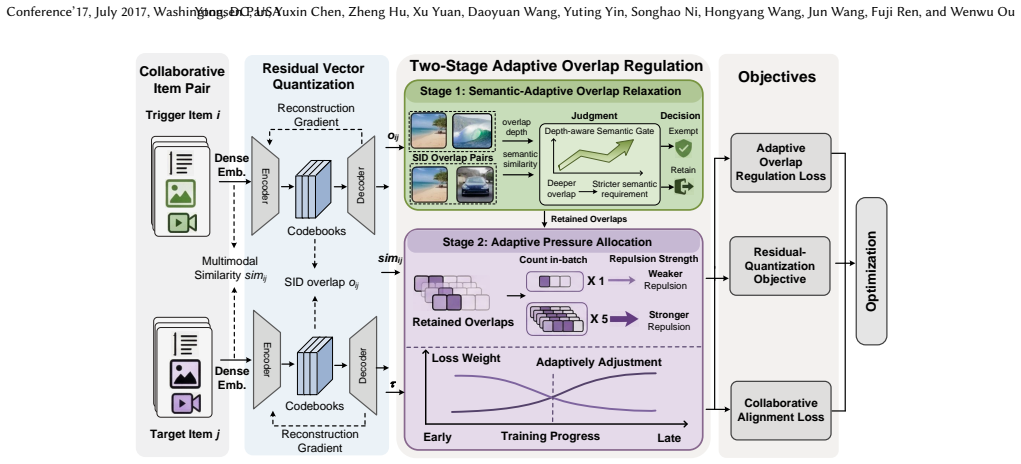
AdaSID regulates SID overlaps through a two-stage process. First, it relaxes repulsion for observed overlaps when the involved items are semantically compatible, preserving admissible sharing rather than uniformly separating all collisions. Second, it allocates the remaining regulation pressure according to local collision load and training progress, strengthening control in congested regions while gradually rebalancing optimization toward recommendation alignment. This design adaptively decides which overlaps to penalize, how strongly to regulate them, and when to shift the learning focus.
What carries the argument
The AdaSID framework, which employs semantic compatibility detection from multimodal signals to selectively relax overlap repulsion and dynamic allocation of regulation pressure based on local load and training progress.
If this is right
- Improved Recall and NDCG by approximately 4.5% on public multimodal recommendation benchmarks compared to strong baselines.
- Better codebook utilization and increased SID diversity.
- Statistically significant improvements in online A/B tests, including 0.98% GMV lift in e-commerce short-video retrieval.
- Consistent AUC gains in industrial ranking evaluations.
Where Pith is reading between the lines
- If the compatibility inference works well, AdaSID could allow smaller codebooks for the same performance level in very large catalogs.
- The dynamic rebalancing might help in other sequential or generative recommendation setups by focusing optimization better over time.
- This adaptive idea might apply to other discrete tokenization tasks in recommendation or retrieval systems.
Load-bearing premise
That semantic compatibility between items can be reliably inferred from their multimodal signals to correctly decide when overlaps should be preserved rather than penalized.
What would settle it
A test showing that items incorrectly identified as compatible lead to lower recommendation accuracy than a uniform repulsion baseline, or evidence of training instability from the dynamic pressure allocation.
Figures


read the original abstract
Modern recommendation systems involve massive catalogs of multimodal items, where scalable item identification must balance compactness, semantic fidelity, and downstream effectiveness. Semantic IDs (SIDs) address this need by representing items as short discrete token sequences derived from multimodal signals, providing a compact interface for retrieval, ranking, and generative recommendation. However, effective SID learning is hindered by collisions, where different items are assigned identical or highly confusable codes. Existing methods mainly rely on improved quantization or fixed overlap regularization, but they do not adaptively distinguish whether an overlap should be suppressed or preserved. We propose AdaSID, an adaptive semantic ID learning framework for recommendation. AdaSID regulates SID overlaps through a two-stage process. First, it relaxes repulsion for observed overlaps when the involved items are semantically compatible, preserving admissible sharing rather than uniformly separating all collisions. Second, it allocates the remaining regulation pressure according to local collision load and training progress, strengthening control in congested regions while gradually rebalancing optimization toward recommendation alignment. This design adaptively decides which overlaps to penalize, how strongly to regulate them, and when to shift the learning focus. Extensive offline and online experiments validate AdaSID. On two public benchmarks, AdaSID improves Recall and NDCG by about 4.5% on average over strong baselines, while improving codebook utilization and SID diversity. In Kuaishou e-commerce, an online A/B test on short-video retrieval covering tens of millions of users achieves statistically significant gains, including a 0.98% GMV improvement, and industrial ranking evaluation shows consistent AUC improvements.
Editorial analysis
A structured set of objections, weighed in public.
Referee Report
Summary. The paper proposes AdaSID, an adaptive framework for learning Semantic IDs (SIDs) from multimodal item signals in large-scale recommendation systems. It addresses SID collisions via a two-stage regulation process: (1) relaxing repulsion on observed overlaps when items are deemed semantically compatible (inferred from multimodal signals), and (2) dynamically allocating remaining regulation pressure according to local collision load and training progress. The method is claimed to improve codebook utilization and SID diversity while boosting downstream performance, with reported average gains of ~4.5% on Recall/NDCG over strong baselines on two public benchmarks and a statistically significant 0.98% GMV lift plus AUC gains in an industrial online A/B test on Kuaishou covering tens of millions of users.
Significance. If the two-stage adaptive mechanism can be shown to preserve admissible sharing without circularity or instability, AdaSID would advance scalable discrete item representations beyond static quantization or fixed regularization in multimodal recsys. The inclusion of large-scale online A/B testing with GMV and ranking metrics is a concrete strength that grounds practical relevance. The work could influence industrial pipelines for compact, semantically faithful IDs if the compatibility inference is externally validated.
major comments (2)
- [§3.2] §3.2 (Adaptive Overlap Regulation): The relaxation rule for 'semantically compatible' overlaps is derived from the same multimodal signals used to construct the SIDs. This creates a load-bearing circularity risk—the decision to preserve an overlap may simply reflect the model's own embedding clusters rather than an independent semantic fact—undermining the claim that AdaSID adaptively distinguishes admissible from harmful collisions. An external anchor (e.g., held-out ontology, human labels, or causal test) is needed to substantiate the central adaptive advantage.
- [§4.1–4.3] §4.1–4.3 (Offline and Online Experiments): The reported 4.5% average Recall/NDCG gains and 0.98% GMV lift are presented without sufficient detail on exact baselines, ablation results isolating the two regulation stages, statistical significance tests, or controls for optimization instability from the dynamic pressure allocation. These omissions prevent verification that improvements arise from adaptive preservation rather than reduced effective regularization, which is central to the paper's contribution.
minor comments (2)
- [Abstract] Abstract: The phrase 'strong baselines' and 'statistically significant gains' should be expanded with at least the names of the primary competing methods and the exact p-value thresholds used in the online test.
- [§3] Notation and reproducibility: Define 'local collision load' and the hyperparameters controlling regulation allocation more explicitly (including any free parameters) to support replication of the dynamic allocation stage.
Simulated Author's Rebuttal
We thank the referee for the constructive and detailed feedback on our work. We address each major comment point by point below, providing clarifications and indicating where revisions have been made to strengthen the manuscript.
read point-by-point responses
-
Referee: [§3.2] §3.2 (Adaptive Overlap Regulation): The relaxation rule for 'semantically compatible' overlaps is derived from the same multimodal signals used to construct the SIDs. This creates a load-bearing circularity risk—the decision to preserve an overlap may simply reflect the model's own embedding clusters rather than an independent semantic fact—undermining the claim that AdaSID adaptively distinguishes admissible from harmful collisions. An external anchor (e.g., held-out ontology, human labels, or causal test) is needed to substantiate the central adaptive advantage.
Authors: We acknowledge the referee's concern regarding potential circularity. In AdaSID, compatibility inference operates on raw multimodal feature embeddings prior to codebook quantization and SID assignment, using a separate similarity threshold computed across modalities that is independent of the discrete token outputs. This temporal and architectural separation allows the model to identify admissible overlaps based on continuous feature similarity rather than post-hoc code clusters. Nevertheless, we agree that external validation would provide stronger substantiation. In the revised manuscript, §3.2 has been expanded with a formal description of this separation and an additional ablation using a temporally held-out data split to validate compatibility decisions. Full human annotation or causal testing remains outside the scope of the present industrial-scale study. revision: partial
-
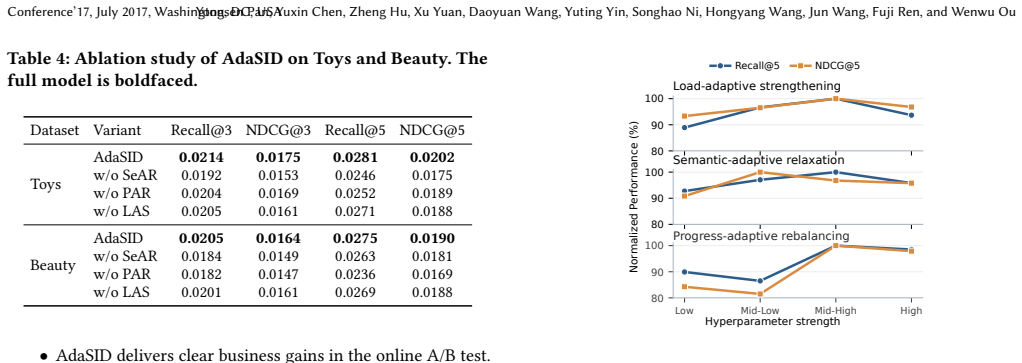
Referee: [§4.1–4.3] §4.1–4.3 (Offline and Online Experiments): The reported 4.5% average Recall/NDCG gains and 0.98% GMV lift are presented without sufficient detail on exact baselines, ablation results isolating the two regulation stages, statistical significance tests, or controls for optimization instability from the dynamic pressure allocation. These omissions prevent verification that improvements arise from adaptive preservation rather than reduced effective regularization, which is central to the paper's contribution.
Authors: We appreciate this observation and have revised the experimental sections accordingly. The updated §4.1–4.3 now include: (i) exhaustive specifications of all baselines with hyperparameter settings and implementation details, (ii) dedicated ablations that isolate the relaxation stage from the dynamic pressure allocation stage with incremental performance breakdowns, (iii) paired statistical significance tests (including p-values and confidence intervals) for all offline and online metrics, and (iv) controls for optimization stability comprising training dynamics plots, sensitivity analysis on the load-based allocation schedule, and comparisons against fixed-regularization variants. These additions confirm that the observed gains derive from the adaptive distinction of admissible overlaps rather than from an overall reduction in regularization strength. revision: yes
- Providing an external anchor such as human labels, a held-out ontology, or dedicated causal tests for semantic compatibility would require new data collection and annotation efforts beyond the resources and scope of the current study.
Circularity Check
No significant circularity detected; framework presented as empirical design without self-referential reductions
full rationale
The abstract describes AdaSID's two-stage overlap regulation (relaxing repulsion for semantically compatible items, then allocating pressure by load and progress) but provides no equations, loss functions, or derivation steps. No self-citation chains, fitted parameters renamed as predictions, or ansatzes are quoted that would reduce the adaptive decisions to tautologies with the multimodal inputs. The method is validated via offline benchmarks and online A/B tests showing gains in Recall, NDCG, and GMV, indicating an independent empirical contribution rather than a closed loop. The potential dependence of compatibility inference on the same signals is a design assumption, not a demonstrated reduction by construction.
Axiom & Free-Parameter Ledger
free parameters (1)
- regulation allocation parameters
axioms (1)
- domain assumption Semantic compatibility of items can be determined from multimodal signals to decide whether an overlap is admissible.
Reference graph
Works this paper leans on
-
[1]
Prabhat Agarwal, Anirudhan Badrinath, Laksh Bhasin, Jaewon Yang, Jiajing Xu, and Charles Rosenberg. 2025. Autoregressive Generative Retrieval for Industrial- Scale Recommendations at Pinterest. InProceedings of the 34th ACM International Conference on Information and Knowledge Management(Seoul, Republic of Ko- rea)(CIKM ’25). Association for Computing Mac...
-
[2]
Yoshua Bengio, Nicholas Léonard, and Aaron Courville. 2013. Estimating or propagating gradients through stochastic neurons for conditional computation. arXiv preprint arXiv:1308.3432(2013)
work page internal anchor Pith review arXiv 2013
- [3]
-
[4]
Gaode Chen, Ruina Sun, Yuezihan Jiang, Jiangxia Cao, Qi Zhang, Jingjian Lin, Han Li, Kun Gai, and Xinghua Zhang. 2024. A Multi-modal Modeling Framework for Cold-start Short-video Recommendation. InProceedings of the 18th ACM Confer- ence on Recommender Systems(Bari, Italy)(RecSys ’24). Association for Computing Machinery, New York, NY, USA, 391–400. doi:1...
-
[5]
Zhangtao Cheng, Jienan Zhang, Xovee Xu, Goce Trajcevski, Ting Zhong, and Fan Zhou. 2024. Retrieval-Augmented Hypergraph for Multimodal Social Media Popularity Prediction. InProceedings of the 30th ACM SIGKDD Conference on Knowledge Discovery and Data Mining(Barcelona, Spain)(KDD ’24). Association for Computing Machinery, New York, NY, USA, 445–455. doi:10...
-
[6]
Dengzhao Fang, Jingtong Gao, Chengcheng Zhu, Yu Li, Xiangyu Zhao, and Yi Chang. 2025. HiD-VAE: Interpretable Generative Recommendation via Hierarchi- cal and Disentangled Semantic IDs.CoRRabs/2508.04618 (2025). arXiv:2508.04618 doi:10.48550/ARXIV.2508.04618
-
[7]
Christopher Fifty, Ronald Guenther Junkins, Dennis Duan, Aniketh Iyengar, Jerry Weihong Liu, Ehsan Amid, Sebastian Thrun, and Christopher Ré. 2025. Restructuring Vector Quantization with the Rotation Trick. InThe Thirteenth International Conference on Learning Representations, ICLR 2025, Singapore, April 24-28, 2025. OpenReview.net. https://openreview.net...
2025
-
[8]
Shijie Geng, Shuchang Liu, Zuohui Fu, Yingqiang Ge, and Yongfeng Zhang. 2022. Recommendation as Language Processing (RLP): A Unified Pretrain, Personalized Prompt & Predict Paradigm (P5). InRecSys ’22: Sixteenth ACM Conference on Recommender Systems, Seattle, W A, USA, September 18 - 23, 2022. ACM, 299–315. doi:10.1145/3523227.3546767
-
[9]
Ruining He and Julian McAuley. 2016. VBPR: visual Bayesian Personalized Ranking from implicit feedback. InProceedings of the Thirtieth AAAI Conference on Artificial Intelligence(Phoenix, Arizona)(AAAI’16). AAAI Press, 144–150
2016
-
[10]
Yupeng Hou, Zhankui He, Julian McAuley, and Wayne Xin Zhao. 2023. Learn- ing Vector-Quantized Item Representation for Transferable Sequential Rec- ommenders. InProceedings of the ACM Web Conference 2023(Austin, TX, USA)(WWW ’23). Association for Computing Machinery, New York, NY, USA, 1162–1171. doi:10.1145/3543507.3583434
-
[11]
Yupeng Hou, Jiacheng Li, Ashley Shin, Jinsung Jeon, Abhishek Santhanam, Wei Shao, Kaveh Hassani, Ning Yao, and Julian McAuley. 2025. Generating Long Semantic IDs in Parallel for Recommendation. InProceedings of the 31st ACM SIGKDD Conference on Knowledge Discovery and Data Mining V.2(Toronto ON, Canada)(KDD ’25). Association for Computing Machinery, New Y...
-
[12]
Zheng Hu, Yuxin Chen, Yongsen Pan, Xu Yuan, Yuting Yin, Daoyuan Wang, Boyang Xia, Zefei Luo, Hongyang Wang, Songhao Ni, et al. 2026. Stop Treating Collisions Equally: Qualification-Aware Semantic ID Learning for Recommenda- tion at Industrial Scale.arXiv preprint arXiv:2603.00632(2026)
-
[13]
Siyuan Huang, Jiahui Jin, Xin Lin, Xigang Sun, and Yukun Ban. 2025. IM-POI: Bridging ID and Multi-modal Gaps in Next POI Recommendation. InProceedings of the 33rd ACM International Conference on Multimedia(Dublin, Ireland)(MM ’25). Association for Computing Machinery, New York, NY, USA, 5979–5987. doi:10.1145/3746027.3754937
-
[14]
Bowen Jin, Hansi Zeng, Guoyin Wang, Xiusi Chen, Tianxin Wei, Ruirui Li, Zhengyang Wang, Zheng Li, Yang Li, Hanqing Lu, Suhang Wang, Jiawei Han, and Xianfeng Tang. 2024. Language models as semantic indexers. InProceedings of the 41st International Conference on Machine Learning(Vienna, Austria)(ICML’24). JMLR.org, Article 894, 16 pages
2024
-
[15]
Doyup Lee, Chiheon Kim, Saehoon Kim, Minsu Cho, and Wook-Shin Han. 2022. Autoregressive Image Generation using Residual Quantization. InIEEE/CVF Conference on Computer Vision and Pattern Recognition, CVPR 2022, New Orleans, LA, USA, June 18-24, 2022. IEEE, 11513–11522. doi:10.1109/CVPR52688.2022.01123
-
[16]
Xiaopeng Li, Bo Chen, Junda She, Shiteng Cao, You Wang, Qinlin Jia, Haiying He, Zheli Zhou, Zhao Liu, Ji Liu, et al. 2025. A survey of generative recommendation from a tri-decoupled perspective: Tokenization, architecture, and optimization. (2025)
2025
-
[17]
Enze Liu, Bowen Zheng, Cheng Ling, Lantao Hu, Han Li, and Wayne Xin Zhao
-
[18]
Generative Recommender with End-to-End Learnable Item Tokenization. InProceedings of the 48th International ACM SIGIR Conference on Research and De- velopment in Information Retrieval(Padua, Italy)(SIGIR ’25). Association for Com- puting Machinery, New York, NY, USA, 729–739. doi:10.1145/3726302.3729989
-
[19]
Qijiong Liu, Jieming Zhu, Yanting Yang, Quanyu Dai, Zhaocheng Du, Xiao-Ming Wu, Zhou Zhao, Rui Zhang, and Zhenhua Dong. 2024. Multimodal Pretraining, Adaptation, and Generation for Recommendation: A Survey. InProceedings of the 30th ACM SIGKDD Conference on Knowledge Discovery and Data Mining (Barcelona, Spain)(KDD ’24). Association for Computing Machiner...
-
[20]
Zhuang Liu, Yunpu Ma, Matthias Schubert, Yuanxin Ouyang, and Zhang Xiong
-
[21]
Multi-Modal Contrastive Pre-training for Recommendation. InProceedings of the 2022 International Conference on Multimedia Retrieval(Newark, NJ, USA) (ICMR ’22). Association for Computing Machinery, New York, NY, USA, 99–108. doi:10.1145/3512527.3531378
-
[22]
Xinchen Luo, Jiangxia Cao, Tianyu Sun, Jinkai Yu, Rui Huang, Wei Yuan, Hezheng Lin, Yichen Zheng, Shiyao Wang, Qigen Hu, Changqing Qiu, Jiaqi Zhang, Xu Zhang, Zhiheng Yan, Jingming Zhang, Simin Zhang, Mingxing Wen, Zhaojie Liu, and Guorui Zhou. 2025. QARM: Quantitative Alignment Multi-Modal Recom- mendation at Kuaishou. InProceedings of the 34th ACM Inter...
-
[23]
Zheqi Lv, Shaoxuan He, Tianyu Zhan, Shengyu Zhang, Wenqiao Zhang, Jingyuan Chen, Zhou Zhao, and Fei Wu. 2024. Semantic Codebook Learning for Dynamic Recommendation Models. InProceedings of the 32nd ACM International Conference on Multimedia(Melbourne VIC, Australia)(MM ’24). Association for Computing Machinery, New York, NY, USA, 9611–9620. doi:10.1145/36...
- [24]
-
[25]
https://doi.org/10.18653/v1/2022.findings- acl.272
Jianmo Ni, Gustavo Hernández Ábrego, Noah Constant, Ji Ma, Keith B. Hall, Daniel Cer, and Yinfei Yang. 2022. Sentence-T5: Scalable Sentence Encoders from Pre-trained Text-to-Text Models. InFindings of the Association for Computational Linguistics: ACL 2022, Dublin, Ireland, May 22-27, 2022 (Findings of ACL, Vol. ACL 2022), Smaranda Muresan, Preslav Nakov,...
-
[26]
Shashank Rajput, Nikhil Mehta, Anima Singh, Raghunandan Hulikal Keshavan, Trung Vu, Lukasz Heldt, Lichan Hong, Yi Tay, Vinh Tran, Jonah Samost, et al
-
[27]
Conference’17, July 2017, Washington, DC, USA Yongsen Pan, Yuxin Chen, Zheng Hu, Xu Yuan, Daoyuan Wang, Yuting Yin, Songhao Ni, Hongyang Wang, Jun Wang, Fuji Ren, and Wenwu Ou
Recommender systems with generative retrieval.Advances in Neural Information Processing Systems36 (2023), 10299–10315. Conference’17, July 2017, Washington, DC, USA Yongsen Pan, Yuxin Chen, Zheng Hu, Xu Yuan, Daoyuan Wang, Yuting Yin, Songhao Ni, Hongyang Wang, Jun Wang, Fuji Ren, and Wenwu Ou
2023
-
[28]
Anima Singh, Trung Vu, Nikhil Mehta, Raghunandan Keshavan, Maheswaran Sathiamoorthy, Yilin Zheng, Lichan Hong, Lukasz Heldt, Li Wei, Devansh Tandon, Ed Chi, and Xinyang Yi. 2024. Better Generalization with Semantic IDs: A Case Study in Ranking for Recommendations(RecSys ’24). Association for Computing Machinery, New York, NY, USA, 1039–1044. doi:10.1145/3...
-
[29]
Aäron van den Oord, Yazhe Li, and Oriol Vinyals. 2018. Representation Learning with Contrastive Predictive Coding.CoRRabs/1807.03748 (2018). arXiv:1807.03748 http://arxiv.org/abs/1807.03748
work page internal anchor Pith review arXiv 2018
-
[30]
Aaron Van Den Oord, Oriol Vinyals, et al. 2017. Neural discrete representation learning.Advances in neural information processing systems30 (2017)
2017
-
[31]
Wenjie Wang, Honghui Bao, Xinyu Lin, Jizhi Zhang, Yongqi Li, Fuli Feng, See- Kiong Ng, and Tat-Seng Chua. 2024. Learnable Item Tokenization for Generative Recommendation. InProceedings of the 33rd ACM International Conference on Information and Knowledge Management(Boise, ID, USA)(CIKM ’24). Association for Computing Machinery, New York, NY, USA, 2400–240...
-
[32]
Yinwei Wei, Xiang Wang, Liqiang Nie, Xiangnan He, Richang Hong, and Tat-Seng Chua. 2019. MMGCN: Multi-modal Graph Convolution Network for Personalized Recommendation of Micro-video. InProceedings of the 27th ACM International Conference on Multimedia(Nice, France)(MM ’19). Association for Computing Machinery, New York, NY, USA, 1437–1445. doi:10.1145/3343...
-
[33]
Binrui Wu, Shisong Tang, Fan Li, Bing Han, Chang Meng, Jingyu Xiao, and Jiechao Gao. 2025. Aligning and Balancing ID and Multimodal Representations for Recommendation. InProceedings of the 31st ACM SIGKDD Conference on Knowledge Discovery and Data Mining V.2(Toronto ON, Canada)(KDD ’25). Association for Computing Machinery, New York, NY, USA, 5029–5038. d...
-
[34]
Jinfeng Xu, Zheyu Chen, Shuo Yang, Jinze Li, and Edith C. H. Ngai. 2025. The Best is Yet to Come: Graph Convolution in the Testing Phase for Multimodal Recommendation. InProceedings of the 33rd ACM International Conference on Multimedia(Dublin, Ireland)(MM ’25). Association for Computing Machinery, New York, NY, USA, 6325–6334. doi:10.1145/3746027.3755781
-
[35]
Dongchao Yang, Songxiang Liu, Rongjie Huang, Jinchuan Tian, Chao Weng, and Yuexian Zou. 2023. HiFi-Codec: Group-residual Vector quantization for High Fidelity Audio Codec.CoRRabs/2305.02765 (2023). arXiv:2305.02765 doi:10.48550/ARXIV.2305.02765
-
[36]
Wei Yang, Rui Zhong, Yiqun Chen, Shixuan Li, Heng Ping, Chi Lu, and Peng Jiang
-
[37]
FITMM: Adaptive Frequency-Aware Multimodal Recommendation via Information-Theoretic Representation Learning. InProceedings of the 33rd ACM International Conference on Multimedia(Dublin, Ireland)(MM ’25). Association for Computing Machinery, New York, NY, USA, 6193–6202. doi:10.1145/3746027. 3755540
- [38]
-
[39]
Wencai Ye, Mingjie Sun, Shaoyun Shi, Peng Wang, Wenjin Wu, and Peng Jiang
-
[40]
Association for Computing Machinery, New York, NY, USA, 6217–6224
DAS: Dual-Aligned Semantic IDs Empowered Industrial Recommender System(CIKM ’25). Association for Computing Machinery, New York, NY, USA, 6217–6224. doi:10.1145/3746252.3761529
-
[41]
Jiahui Yu, Xin Li, Jing Yu Koh, Han Zhang, Ruoming Pang, James Qin, Alexander Ku, Yuanzhong Xu, Jason Baldridge, and Yonghui Wu. 2022. Vector-quantized Image Modeling with Improved VQGAN. InThe Tenth International Conference on Learning Representations, ICLR 2022, Virtual Event, April 25-29, 2022. OpenRe- view.net. https://openreview.net/forum?id=pfNyExj7z2
2022
-
[42]
Jinghao Zhang, Yanqiao Zhu, Qiang Liu, Shu Wu, Shuhui Wang, and Liang Wang
-
[43]
InProceedings of the 29th ACM International Conference on Multimedia(Virtual Event, China) (MM ’21)
Mining Latent Structures for Multimedia Recommendation. InProceedings of the 29th ACM International Conference on Multimedia(Virtual Event, China) (MM ’21). Association for Computing Machinery, New York, NY, USA, 3872–3880. doi:10.1145/3474085.3475259
-
[44]
Lingzi Zhang, Xin Zhou, Zhiwei Zeng, and Zhiqi Shen. 2024. Multimodal Pre- training for Sequential Recommendation via Contrastive Learning.ACM Trans. Recomm. Syst.3, 1, Article 9 (Oct. 2024), 23 pages. doi:10.1145/3682075
-
[45]
Rui Zhao, Rui Zhong, Haoran Zheng, Wei Yang, Chi Lu, Beihong Jin, Peng Jiang, and Kun Gai. 2025. Hierarchical Sequence ID Representation of Large Language Models for Large-scale Recommendation Systems. InCompanion Pro- ceedings of the ACM on Web Conference 2025(Sydney NSW, Australia)(WWW ’25). Association for Computing Machinery, New York, NY, USA, 641–65...
-
[46]
Bowen Zheng, Yupeng Hou, Hongyu Lu, Yu Chen, Wayne Xin Zhao, Ming Chen, and Ji-Rong Wen. 2024. Adapting Large Language Models by Integrating Collaborative Semantics for Recommendation. In2024 IEEE 40th International Conference on Data Engineering (ICDE). 1435–1448. doi:10.1109/ICDE60146.2024. 00118
-
[47]
Carolina Zheng, Minhui Huang, Dmitrii Pedchenko, Kaushik Rangadurai, Siyu Wang, Fan Xia, Gaby Nahum, Jie Lei, Yang Yang, Tao Liu, Zutian Luo, Xiaohan Wei, Dinesh Ramasamy, Jiyan Yang, Yiping Han, Lin Yang, Hangjun Xu, Rong Jin, and Shuang Yang. 2025. Enhancing Embedding Representation Stability in Recommendation Systems with Semantic ID. InProceedings of ...
-
[48]
Xin Zhou, Hongyu Zhou, Yong Liu, Zhiwei Zeng, Chunyan Miao, Pengwei Wang, Yuan You, and Feijun Jiang. 2023. Bootstrap Latent Representations for Multi- modal Recommendation. InProceedings of the ACM Web Conference 2023(Austin, TX, USA)(WWW ’23). Association for Computing Machinery, New York, NY, USA, 845–854. doi:10.1145/3543507.3583251
-
[49]
Yongxin Zhu, Bocheng Li, Yifei Xin, Zhihua Xia, and Linli Xu. 2025. Addressing representation collapse in vector quantized models with one linear layer. In Proceedings of the IEEE/CVF International Conference on Computer Vision. 22968– 22977
2025
discussion (0)
Sign in with ORCID, Apple, or X to comment. Anyone can read and Pith papers without signing in.