Defining the Magnetization State of LCF Magnets: From Material Properties to Motor-Level Metrics
Pith reviewed 2026-05-08 05:28 UTC · model grok-4.3
The pith
The paper proposes four definitions of magnetization state for LCF magnets to connect material properties with motor-level measurements in variable flux motors.
A machine-rendered reading of the paper's core claim, the machinery that carries it, and where it could break.
Core claim
The authors establish that the magnetization state can be defined consistently using B and J at the material level or fundamental flux linkage and back-EMF components at the motor level, with finite element analysis revealing their relationships across the id-iq plane in an interior permanent magnet synchronous motor with hybrid LCF and HCF magnets.
What carries the argument
Four magnetization state definitions—material-based on B and J, motor-based on flux linkage and back-EMF—evaluated via finite element analysis on a hybrid-magnet interior PMSM.
If this is right
- The four definitions allow consistent comparison of magnetization state from material properties to system-level observables.
- Metric choice depends on the objective: material analysis uses B or J, while control and monitoring use flux linkage or back-EMF.
- Finite-element mapping shows how material-level behavior translates to measurable motor quantities across the operating plane.
- Variable-flux machines gain clearer guidance for achieving extended high-efficiency operation through controllable magnetization.
Where Pith is reading between the lines
- These definitions could support real-time estimation of magnet state in motor controllers without direct access to the magnets.
- Extending the definitions to include temperature effects would likely improve practical accuracy in operating motors.
- Hybrid LCF-HCF designs could be optimized by weighting the motor-level metrics to balance the two magnet types.
Load-bearing premise
The finite element model with its defined circuit setup faithfully represents the physical relationship between material magnetization and motor-level quantities.
What would settle it
Laboratory measurements of actual flux linkage and back-EMF on a physical variable-flux motor under controlled changes in magnetization state, compared directly against the four proposed definitions.
Figures




read the original abstract
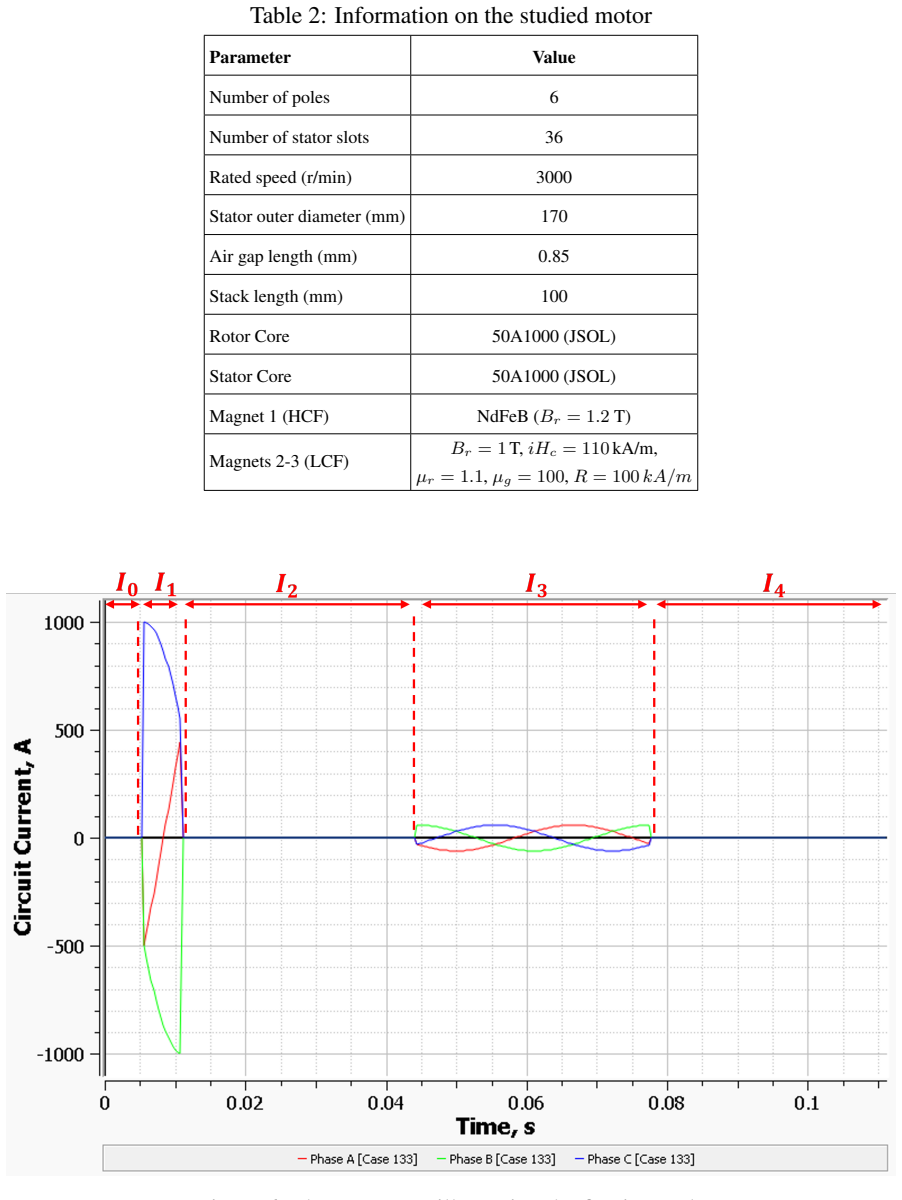
Variable flux memory motors, which employ Low Coercive Force (LCF) magnets, achieve extended high-efficiency operation through controllable magnetization states. To address the need for a unified approach to defining and comparing the magnetization state (MS) across material and motor levels, this paper proposes four MS definitions: two based on intrinsic material properties-magnetic flux density B and magnetic polarization J-and two based on motor-level quantities-fundamental flux linkage and back-EMF components. These definitions are evaluated across the id, iq operating plane using finite element analysis on an interior PMSM with a hybrid magnet configuration (LCF and HCF: High Coercive Force) and a defined circuit setup. The results clarify the relationship between material-level behavior and measurable motor quantities. The proposed framework provides guidance for selecting appropriate MS metrics depending on the application objective, whether for material analysis, control implementation, or condition monitoring in variable flux machines.
Editorial analysis
A structured set of objections, weighed in public.
Referee Report
Summary. The manuscript proposes four magnetization state (MS) definitions for Low Coercive Force (LCF) magnets in variable flux memory motors: two intrinsic material-level definitions based on magnetic flux density B and magnetic polarization J, and two motor-level definitions based on fundamental flux linkage and back-EMF components. These are evaluated across the id-iq operating plane via finite-element analysis (FEA) on an interior PMSM with a hybrid LCF/HCF magnet configuration and a defined circuit setup. The results are used to clarify relationships between material behavior and measurable motor quantities and to provide guidance on metric selection for material analysis, control, or condition monitoring.
Significance. If the FEA-based relationships hold under real conditions, the framework offers a useful bridge between material properties and motor observables for variable-flux machines, potentially aiding metric selection in design and control. The hybrid-magnet IPMSM case study and explicit circuit definition are concrete strengths that allow direct comparison of the four definitions.
major comments (2)
- [FEA evaluation and results sections] The evaluation of the four MS definitions (material B/J vs. motor flux-linkage/back-EMF) rests entirely on FEA without mesh-convergence data, error bars on the reported quantities, or sensitivity studies on material recoil curves and temperature. This is load-bearing for the claim that the definitions clarify relationships and guide metric selection, because discrepancies in real LCF hysteresis or cross-coupling could alter which motor-level metric best tracks material MS.
- [Evaluation methodology] No experimental measurements on a physical prototype are provided to confirm that the chosen FEA model and circuit setup accurately map material-level magnetization to motor-level observables. The central claim therefore depends on unverified simulation assumptions about partial demagnetization and load-dependent behavior.
minor comments (2)
- [Introduction and definitions] Notation for the four MS definitions should be introduced with explicit equations early in the manuscript to avoid ambiguity when comparing B, J, flux linkage, and back-EMF across the id-iq plane.
- [Results figures] Figure captions for the id-iq plane plots should state the exact operating conditions (speed, temperature, magnet grade) used in the FEA.
Simulated Author's Rebuttal
We thank the referee for the detailed and constructive feedback on our manuscript. We address each major comment below, providing honest responses and indicating planned revisions to the manuscript where appropriate.
read point-by-point responses
-
Referee: [FEA evaluation and results sections] The evaluation of the four MS definitions (material B/J vs. motor flux-linkage/back-EMF) rests entirely on FEA without mesh-convergence data, error bars on the reported quantities, or sensitivity studies on material recoil curves and temperature. This is load-bearing for the claim that the definitions clarify relationships and guide metric selection, because discrepancies in real LCF hysteresis or cross-coupling could alter which motor-level metric best tracks material MS.
Authors: We agree that the absence of explicit mesh-convergence data, error bars, and sensitivity studies on recoil curves limits the robustness assessment of the FEA results. The study employs a consistent FEA setup to compare the relative behaviors of the four MS definitions across the id-iq plane, which mitigates some absolute error concerns for the comparative claims. In the revised manuscript, we will add a mesh-convergence study demonstrating stabilization of flux linkage and back-EMF values, include quantitative error estimates from successive refinements, and provide a sensitivity analysis on key recoil curve parameters (e.g., variations in knee-point position). Temperature effects on LCF behavior will be noted as a limitation and recommended for future investigation, as the current scope focuses on nominal-temperature definitions and relationships. revision: partial
-
Referee: [Evaluation methodology] No experimental measurements on a physical prototype are provided to confirm that the chosen FEA model and circuit setup accurately map material-level magnetization to motor-level observables. The central claim therefore depends on unverified simulation assumptions about partial demagnetization and load-dependent behavior.
Authors: The manuscript is explicitly a simulation-based investigation that uses FEA with a defined hybrid-magnet IPMSM model and circuit setup to establish links between material-level (B/J) and motor-level (flux linkage/back-EMF) MS metrics. Standard LCF magnet models with partial demagnetization are employed, as described in the methods section. We acknowledge that direct experimental confirmation on a prototype would strengthen confidence in the mapping under real conditions. However, providing such measurements is outside the scope of this work, which aims to deliver a numerical framework and guidance on metric selection. The explicit circuit definition supports reproducibility of the simulations. In revision, we will add a statement clarifying the simulation assumptions and recommending experimental validation for practical deployment. revision: no
- Absence of experimental measurements on a physical prototype to verify FEA assumptions on partial demagnetization and load-dependent behavior
Circularity Check
No circularity: definitions are explicitly proposed from standard EM quantities and evaluated via independent FEA
full rationale
The paper explicitly proposes four magnetization state definitions (B/J at material level, flux linkage/back-EMF at motor level) as a unified framework and then evaluates their behavior across the id-iq plane using finite-element analysis on a hybrid-magnet IPMSM model with a defined circuit. No load-bearing step reduces a claimed prediction or result to its own inputs by construction, nor does any derivation rely on self-citation chains, fitted parameters renamed as predictions, or ansatzes smuggled from prior work. The central claims remain definitional and comparative, self-contained against the stated FEA setup and operating-plane sweeps; absence of experimental validation affects external validity but does not create circularity within the presented derivation.
Axiom & Free-Parameter Ledger
Reference graph
Works this paper leans on
-
[1]
T. El Hajji, S. Hlioui, F. Louf, M. Gabsi, G. Mermaz-Rollet, and M. Belhadi. Optimal de- sign of high-speed electric machines for electric vehicles: A case study of 100 kw v-shaped interior PMSM.Machines, 11(1):57, 2023. doi: 10.3390/machines11010057
-
[2]
Clean earth magnets.https://www.nironmagnetics.com/, 2025
Niron Magnetics. Clean earth magnets.https://www.nironmagnetics.com/, 2025
work page 2025
-
[3]
R. Jayarajan, N. Fernando, and I. U. Nutkani. A review on variable flux machine technology: Topologies, control strategies and magnetic materials.IEEE Access, 7:70141–70156, 2019. doi: 10.1109/ACCESS.2019.2918953
-
[4]
H. Hua, Z. Q. Zhu, A. Pride, R. P. Deodhar, and T. Sasaki. Comparative study on variable flux memory machines with parallel or series hybrid magnets.IEEE Transactions on Industry Applications, 55(2):1408–1419, March 2019. doi: 10.1109/TIA.2018.2879858
-
[5]
Basnet.Modeling, Analysis and Control of a V ariable Flux Machine
B. Basnet.Modeling, Analysis and Control of a V ariable Flux Machine. PhD thesis, Dept. of Electrical and Computer Engineering, Concordia University, Montréal, QC, Canada, 2021
work page 2021
-
[6]
R. L. Owen, Z. Q. Zhu, J. Wang, D. A. Stone, and I. Urquhart. Review of variable-flux permanent magnet machines. InProc. 2011 Int. Conf. Electrical Machines and Systems (ICEMS), pages 1–6, Beijing, China, 2011
work page 2011
-
[7]
Z. Zhou, H. Hua, and Z. Q. Zhu. Flux-adjustable permanent magnet machines in traction applications.World Electric V ehicle Journal, 13(4):60, 2022. doi: 10.3390/wevj13040060
-
[8]
G. S. L’Abbate. Design of IPM machines for traction using rare-earth-free iron-nitride mag- nets. Master’s thesis, Politecnico di Torino, Turin, Italy, 2023
work page 2023
-
[9]
B. Arribas, G. Almandoz, A. Egea, P. Madina, and I. Iturbe. Adoption of multiphase and variable flux motors in automotive applications.Applied Sciences, 14(23):10932, 2024. doi: 10.3390/app142310932
-
[10]
M.-F. Hsieh, D. K. Ngo, et al. Flux intensifying feature of permanent magnet assisted syn- chronous reluctance motor with high torque density.Electronics, 11(3):397, 2022. doi: 10.3390/electronics11030397. 16
-
[11]
T. Fukushige, N. Limsuwan, T. Kato, K. Akatsu, and R. D. Lorenz. Efficiency contours and loss minimization over a driving cycle of a variable flux-intensifying machine.IEEE Transactions on Industry Applications, 51(4):2986–2995, Jul./Aug. 2015
work page 2015
-
[12]
V . V . Do, T.-A. Huynh, and M.-F. Hsieh. Design and analysis of flux-intensifying spoke-type IPM motor for improving output torque and flux-weakening performance. InProc. 2022 25th Int. Conf. Electrical Machines and Systems (ICEMS), pages 1–6, Chiang Mai, Thailand, 2022
work page 2022
-
[13]
X. Liu, G. Guo, L. Du, and W. Zhu. Multi-objective optimal design and analysis of variable leakage flux IPM motors for improve flux-weakening ability.Progress In Electromagnetics Research C, 113:147–160, 2021
work page 2021
- [14]
-
[15]
Farshid Mahmouditabar, Abolfazl Vahedi, and Fabrizio Marignetti. The demagnetization phenomenon in pm machines: Principles, modeling, and design considerations.IEEE Access, 11:47750–47773, 2023. doi: 10.1109/ACCESS.2023.3274701
-
[16]
L. Ding, Y . Cheng, et al. Design and optimization of an asymmetric rotor IPM motor with high demagnetization prevention capability and robust torque performance.Energies, 16(9): 3635, 2023. doi: 10.3390/en16093635
-
[17]
M. Jang and K. Akatsu. Magnet operating point estimation using flux linkage observer and magnetic and thermal equivalent circuit in PMSM.IEEJ Journal of Industry Applications, 2021. 17
work page 2021
discussion (0)
Sign in with ORCID, Apple, or X to comment. Anyone can read and Pith papers without signing in.