Recognition: unknown
Data-driven reconstruction of spatiotemporal phase dynamics for traveling and oscillating patterns via Bayesian inference
Pith reviewed 2026-05-08 04:52 UTC · model grok-4.3
The pith
A Bayesian method reconstructs the phase equations for the position and oscillation of traveling patterns directly from time-series data.
A machine-rendered reading of the paper's core claim, the machinery that carries it, and where it could break.
Core claim
The central claim is that Bayesian inference applied to time-series data can accurately reconstruct the deterministic part of the spatiotemporal phase equations describing traveling breathers in the weak-noise regime, where the phase dynamics converge to a linearly stable fixed point, for reaction-diffusion systems possessing spatial translational symmetry.
What carries the argument
Bayesian inference used to reconstruct coupled spatial and temporal phase equations from time-series data, relying on phase reduction theory for translationally symmetric systems.
If this is right
- The deterministic phase equations for traveling breathers are recoverable from noisy simulation data when noise remains weak.
- The reconstruction isolates the deterministic dynamics once phases relax to a stable fixed point.
- The method applies to any traveling or oscillating pattern that satisfies the symmetry and weak-noise conditions of phase reduction theory.
- Reconstructed equations can be used to predict the long-term position and oscillation behavior of the pattern.
Where Pith is reading between the lines
- The same inference procedure could be tested on experimental video recordings of chemical or biological waves to obtain reduced models without knowing the microscopic kinetics.
- If extended to stronger noise, the method might still capture average phase drift even when the fixed-point assumption is relaxed.
- Application to other pattern types such as spiral waves would require checking whether their phase variables remain well-defined under the same symmetry.
Load-bearing premise
The patterns must possess spatial translational symmetry and the system must operate in the weak-noise regime where phase dynamics converge to a linearly stable fixed point.
What would settle it
Applying the method to data from a system lacking spatial translational symmetry or in a strong-noise regime where phase dynamics do not converge to a stable fixed point and observing that the reconstructed equations fail to match the observed pattern evolution.
Figures





read the original abstract
Building on the phase reduction theory formulated for reaction-diffusion systems with spatial translational symmetry, we develop a data-driven method that reconstructs the spatiotemporal phase dynamics of traveling and oscillating patterns. Spatiotemporal phase dynamics are described by spatial and temporal phases that represent the position and oscillation of the pattern, respectively. Using Bayesian inference, our method directly reconstructs phase equations from time-series data. When tested on simulation data from coupled Gray-Scott models exhibiting traveling breathers, the method accurately reconstructs the deterministic part of the phase equations in the weak-noise regime, in which the phase dynamics converge to a linearly stable fixed point.
Editorial analysis
A structured set of objections, weighed in public.
Referee Report
Summary. The manuscript develops a data-driven method based on Bayesian inference to reconstruct the spatiotemporal phase dynamics (spatial position and temporal oscillation phases) of traveling and oscillating patterns in reaction-diffusion systems possessing spatial translational symmetry. It builds directly on phase reduction theory to infer the deterministic phase equations from time-series data. Validation is reported on simulation data generated from coupled Gray-Scott models that produce traveling breathers, with the central claim being accurate recovery of the deterministic component of the phase equations in the weak-noise regime where the phase dynamics converge to a linearly stable fixed point.
Significance. If the reconstruction is shown to be quantitatively accurate, the work would provide a practical bridge between phase reduction theory and data-driven modeling for complex spatiotemporal systems. The Bayesian formulation offers a natural route to uncertainty quantification, which is valuable when applying the method to noisy experimental data. The use of independent simulation data from a known model (Gray-Scott) for validation is a positive feature that supports reproducibility and avoids circularity.
major comments (2)
- Abstract: the claim that the method 'accurately reconstructs the deterministic part of the phase equations' is not supported by any quantitative error metrics (e.g., L2 error on recovered phase velocities, coupling coefficients, or fixed-point stability), nor by explicit comparison against the analytically known phase equations of the Gray-Scott system; without these, the strength of the central claim cannot be assessed.
- The manuscript provides no details on how noise strength is quantified or controlled in the validation, nor on the sensitivity of the Bayesian posterior to deviations from the weak-noise assumption; because the entire scope is restricted to the regime where phase dynamics converge to a linearly stable fixed point, explicit checks or bounds on this assumption are load-bearing for the reported accuracy.
minor comments (1)
- Notation for the spatial phase (position) and temporal phase (oscillation) should be introduced with explicit symbols and consistently referenced in all equations and figures.
Simulated Author's Rebuttal
We thank the referee for the constructive and detailed report. The comments highlight important aspects for strengthening the quantitative support and methodological transparency of our work. We have revised the manuscript accordingly and address each major comment below.
read point-by-point responses
-
Referee: Abstract: the claim that the method 'accurately reconstructs the deterministic part of the phase equations' is not supported by any quantitative error metrics (e.g., L2 error on recovered phase velocities, coupling coefficients, or fixed-point stability), nor by explicit comparison against the analytically known phase equations of the Gray-Scott system; without these, the strength of the central claim cannot be assessed.
Authors: We agree that explicit quantitative metrics and direct comparison to the known analytical phase equations would better substantiate the claim. Although the original manuscript presented visual agreement between inferred and true phase dynamics in Section 4, we have added L2 error norms for the recovered phase velocities, coupling coefficients, and fixed-point stability in a new table. We also include an explicit side-by-side comparison with the analytically derived phase equations for the Gray-Scott traveling-breather case. The abstract has been revised to state that the method reconstructs the deterministic phase equations 'with low L2 error (under 5% relative) in the weak-noise regime'. revision: yes
-
Referee: The manuscript provides no details on how noise strength is quantified or controlled in the validation, nor on the sensitivity of the Bayesian posterior to deviations from the weak-noise assumption; because the entire scope is restricted to the regime where phase dynamics converge to a linearly stable fixed point, explicit checks or bounds on this assumption are load-bearing for the reported accuracy.
Authors: We appreciate this observation, as the weak-noise assumption is central to the validity of the phase reduction and the convergence to a stable fixed point. The original text did not specify the noise amplitude or perform sensitivity tests. In the revision we have added: (i) the precise noise model (additive Gaussian white noise with variance parameter σ² scaled to the pattern amplitude), (ii) the range of σ values used in the Gray-Scott simulations, and (iii) a new subsection with numerical experiments showing posterior robustness and the noise threshold beyond which the fixed-point stability assumption begins to degrade. These additions are supported by additional figures and are now load-bearing for the accuracy claims. revision: yes
Circularity Check
No significant circularity; derivation self-contained
full rationale
The paper develops a Bayesian inference procedure to reconstruct phase equations directly from independent time-series data generated by coupled Gray-Scott simulations. The underlying phase reduction framework supplies the functional form but is not used to define or fit the target quantities; the reconstruction is performed on external simulation trajectories and validated against the known deterministic dynamics in the weak-noise regime. No step equates a prediction to a fitted parameter by construction, imports uniqueness via self-citation, or renames an input as an output. The central claim therefore remains independent of its own fitted values.
Axiom & Free-Parameter Ledger
axioms (1)
- domain assumption Phase reduction theory formulated for reaction-diffusion systems with spatial translational symmetry
Reference graph
Works this paper leans on
-
[1]
The vector of Fourier basis functions is given by gi,n := 1 gi1,n
[(2Ms + 1)(2Mt + 1) − 1] + 1 is the number of param- eters in each phase equation of the spatial and temporal phases. The vector of Fourier basis functions is given by gi,n := 1 gi1,n . . . gi i− 1,n gi i+1,n . . . giJ,n ∈ CR, (47) where gij,n := (gij, m,n )m∈ M with gij, m,n := gm(Φ ∗ i,n − Φ ∗ j,n , Θ ∗ i,n − ...
-
[2]
The system has a size of 2 L = 250, which is sufficiently large compared to that of the breather
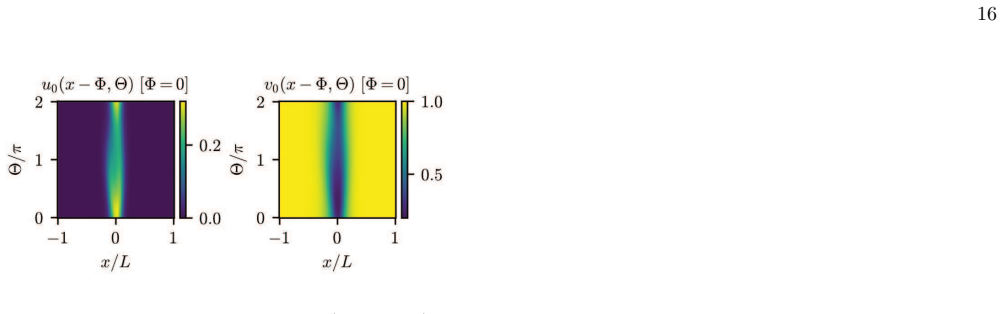
described by Xi(x, t ) = ( ui vi ) , (59) Fi(Xi(x, t )) = ( u2 i vi − (f + k)ui − u2 i vi + f (1 − vi) ) , (60) ǫGij(Xi(x, t ), Xj(x, t )) = ǫ(Xj(x, t ) − Xi(x, t )), (61) where ui := ui(x, t ) and vi := vi(x, t ). The system has a size of 2 L = 250, which is sufficiently large compared to that of the breather. The diffusion coefficient is D i = diag(1. 0, 1. ...
-
[3]
The time series of ˜Bi(Θ i(t)) accounts for the fast oscillation in L π arg ˜Ai(t) − ˆcit (Fig
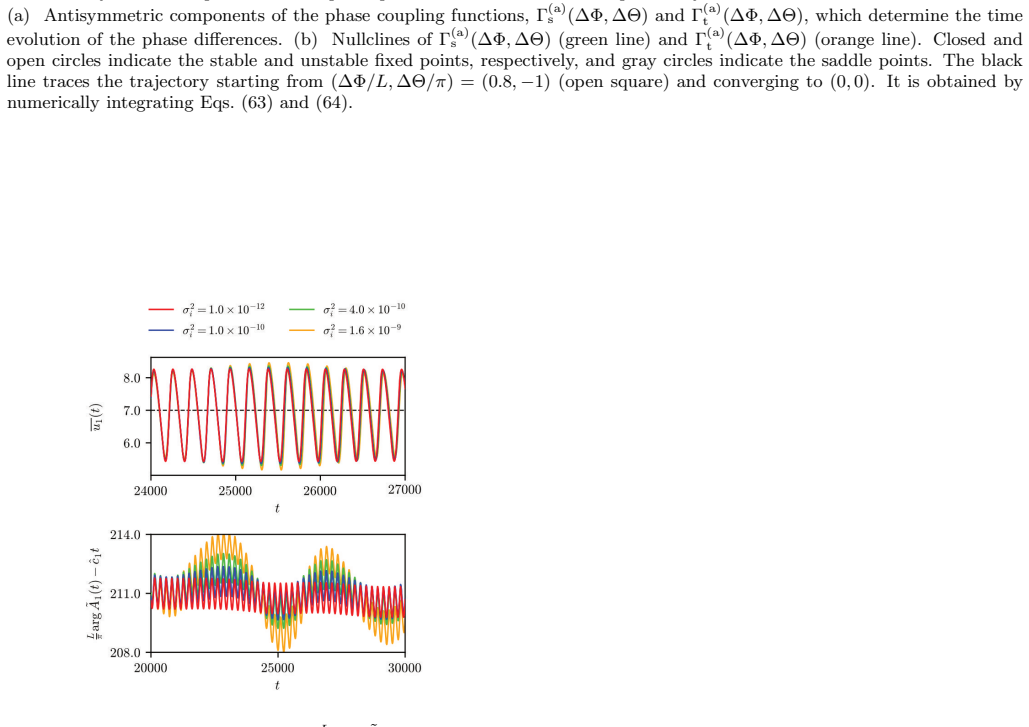
0× 10− 12 coincides with B(Θ i) obtained from the limit- torus solution; moreover, ˜Bi(Θ i) is essentially identical for all values of σ 2 i . The time series of ˜Bi(Θ i(t)) accounts for the fast oscillation in L π arg ˜Ai(t) − ˆcit (Fig. 6). Once ˜Bi(Θ i(t)) is obtained, the spatial phase is calcu- lated as described in Eq. (39). Figure 8 shows the time ...
-
[4]
Kuramoto, Chemical Oscillations, Waves, and Tur- bulence (Springer, New York, 1984)
Y. Kuramoto, Chemical Oscillations, Waves, and Tur- bulence (Springer, New York, 1984)
1984
-
[5]
A. T. Winfree, The Geometry of Biological Time (Springer, New York, 1980)
1980
-
[6]
Pikovsky, M
A. Pikovsky, M. Rosenblum, and J. Kurths, Synchro- nization: A Universal Concept in Nonlinear Sciences (Cambridge University Press, Cambridge, 2001)
2001
-
[7]
S. C. Manrubia, A. S. Mikhailov, and D. H. Zanette, Emergence of Dynamical Order: Synchronization Phe- nomena in Complex Systems (World Scientific, Singa- pore, 2004)
2004
-
[8]
G. V. Osipov, J. Kurths, and C. Zhou, Synchronization in Oscillatory Networks (Springer, New York, 2007)
2007
-
[9]
Kuramoto, J
Y. Kuramoto, J. Stat. Mech. 2026, 044001 (2026)
2026
-
[10]
Brown, J
E. Brown, J. Moehlis, and P. Holmes, Neural Comput. 16, 673 (2004)
2004
-
[11]
Ermentrout, Neural Comput
B. Ermentrout, Neural Comput. 8, 979 (1996)
1996
-
[12]
Nakao, Contemp
H. Nakao, Contemp. Phys. 57, 188 (2016)
2016
-
[13]
Pietras and A
B. Pietras and A. Daffertshofer, Phys. Rep. 819, 1 (2019)
2019
-
[14]
Ermentrout and D
B. Ermentrout and D. H. Terman, Mathematical Foun- dations of Neuroscience (Springer, New York, 2010)
2010
-
[15]
F. C. Hoppensteadt and E. M. Izhikevich, Weakly Con- nected Neural Networks (Springer, New York, 1997)
1997
-
[16]
E. M. Izhikevich, Dynamical Systems in Neuroscience: The Geometry of Excitability and Bursting (MIT Press, Cambridge, 2007)
2007
-
[17]
Kuramoto and H
Y. Kuramoto and H. Nakao, Phil. Trans. R. Soc. A 377, 20190041 (2019)
2019
-
[18]
J. A. Acebr´ on, L. L. Bonilla, C. J. P´ erez Vicente, F. Ri- tort, and R. Spigler, Rev. Mod. Phys. 77, 137 (2005)
2005
-
[19]
Arenas, A
A. Arenas, A. D ´ ıaz-Guilera, J. Kurths, Y. Moreno, and C. Zhou, Phys. Rep. 469, 93 (2008)
2008
-
[20]
Ashwin, S
P. Ashwin, S. Coombes, and R. Nicks, J. Math. Neu- rosci. 6, 2 (2016)
2016
-
[21]
Pikovsky and M
A. Pikovsky and M. Rosenblum, Chaos 25, 097616 (2015)
2015
-
[22]
Stankovski, T
T. Stankovski, T. Pereira, P. V. E. McClintock, and A. Stefanovska, Rev. Mod. Phys. 89, 045001 (2017)
2017
-
[23]
S. H. Strogatz, Physica D 143, 1 (2000)
2000
-
[24]
F. A. Rodrigues, T. K. DM. Peron, P. Ji, and J. Kurths, Phys. Rep. 610, 1 (2016)
2016
-
[25]
M. G. Rosenblum and A. S. Pikovsky, Phys. Rev. E 64, 045202(R) (2001)
2001
-
[26]
R. F. Gal´ an, G. B. Ermentrout, and N. N. Urban, Phys. Rev. Lett. 94, 158101 (2005)
2005
-
[27]
G. B. Ermentrout, R. F. Gal´ an, and N. N. Urban, Phys. Rev. Lett. 99, 248103 (2007)
2007
-
[28]
K. Ota, M. Nomura, and T. Aoyagi, Phys. Rev. Lett. 103, 024101 (2009)
2009
-
[29]
T. Imai, K. Ota, and T. Aoyagi, J. Phys. Soc. Jpn. 86, 024009 (2017)
2017
-
[30]
Cestnik and M
R. Cestnik and M. Rosenblum, Phys. Rev. E 96, 012209 (2017)
2017
-
[31]
Cestnik and M
R. Cestnik and M. Rosenblum, Sci. Rep. 8, 13606 (2018)
2018
-
[32]
Miyazaki and S
J. Miyazaki and S. Kinoshita, Phys. Rev. Lett. 96, 194101 (2006)
2006
-
[33]
I. T. Tokuda, S. Jain, I. Z. Kiss, and J. L. Hudson, Phys. Rev. Lett. 99, 064101 (2007)
2007
-
[34]
Kralemann, L
B. Kralemann, L. Cimponeriu, M. Rosenblum, A. Pikovsky, and R. Mrowka, Phys. Rev. E 76, 055201(R) (2007)
2007
-
[35]
Kralemann, L
B. Kralemann, L. Cimponeriu, M. Rosenblum, A. Pikovsky, and R. Mrowka, Phys. Rev. E 77, 066205 (2008)
2008
-
[36]
Stankovski, A
T. Stankovski, A. Duggento, P. V. E. McClintock, and A. Stefanovska, Phys. Rev. Lett. 109, 024101 (2012)
2012
-
[37]
Duggento, T
A. Duggento, T. Stankovski, P. V. E. McClintock, and A. Stefanovska, Phys. Rev. E 86, 061126 (2012)
2012
-
[38]
Kralemann, M
B. Kralemann, M. Fr¨ uhwirth, A. Pikovsky, M. Rosen- blum, T. Kenner, J. Schaefer, and M. Moser, Nat. Com- mun. 4, 2418 (2013)
2013
- [39]
-
[40]
T. Arai, Y. Kawamura, and T. Aoyagi, J. Phys. Soc. Jpn. 91, 124001 (2022)
2022
-
[41]
Y. Y. Yamaguchi and Y. Terada, Phys. Rev. E 109, 024217 (2024)
2024
-
[42]
Matsuki, H
A. Matsuki, H. Kori, and R. Kobayashi, PLoS Complex Syst. 2, e0000063 (2025)
2025
-
[43]
Y. Kato, S. Kashiwamura, E. Watanabe, M. Okada, and H. Kori, Phys. Rev. E 112, 034215 (2025)
2025
- [44]
-
[45]
Revzen and J
S. Revzen and J. M. Guckenheimer, Phys. Rev. E 78, 051907 (2008)
2008
-
[46]
Namura, S
N. Namura, S. Takata, K. Yamaguchi, R. Kobayashi, and H. Nakao, Phys. Rev. E 106, 014204 (2022)
2022
-
[47]
Rosenblum, A
M. Rosenblum, A. Pikovsky, A. A. K¨ uhn, and J. L. Busch, Sci. Rep. 11, 18037 (2021)
2021
-
[48]
Yamamoto, H
T. Yamamoto, H. Nakao, and R. Kobayashi, Chaos Soli- tons Fractals 191, 115913 (2025)
2025
-
[49]
Wilshin, M
S. Wilshin, M. D. Kvalheim, C. Scott, and S. Revzen, Neural Comput. 37, 2158 (2025)
2025
-
[50]
Gengel and A
E. Gengel and A. Pikovsky, Physica D 429, 133070 (2022)
2022
-
[51]
Matsuki, H
A. Matsuki, H. Kori, and R. Kobayashi, Sci. Rep. 13, 3535 (2023)
2023
-
[52]
Shirasaka, W
S. Shirasaka, W. Kurebayashi, and H. Nakao, Chaos 27, 023119 (2017)
2017
-
[53]
Mauroy and I
A. Mauroy and I. Mezi´ c, Chaos 28, 073108 (2018)
2018
-
[54]
Fukami, H
K. Fukami, H. Nakao, and K. Taira, J. Fluid Mech. 992, A17 (2024)
2024
-
[55]
Yawata, K
K. Yawata, K. Fukami, K. Taira, and H. Nakao, Chaos 34, 063111 (2024)
2024
-
[56]
Cestnik and M
R. Cestnik and M. Abel, Chaos 29, 063128 (2019)
2019
-
[57]
T. Arai, K. Ota, T. Funato, K. Tsuchiya, T. Aoyagi, and S. Aoi, Commun. Biol. 7, 1152 (2024)
2024
-
[58]
Furukawa, T
H. Furukawa, T. Arai, T. Funato, S. Aoi, and T. Aoyagi, Neurosci. Res. 215, 47 (2025)
2025
-
[59]
Funato, Y
T. Funato, Y. Yamamoto, S. Aoi, T. Imai, T. Aoyagi, N. Tomita, and K. Tsuchiya, PLoS Comput. Biol. 12, e1004950 (2016)
2016
- [60]
-
[61]
Onojima, T
T. Onojima, T. Goto, H. Mizuhara, and T. Aoyagi, PLoS Comput. Biol. 14, e1005928 (2018)
2018
-
[62]
K. Ota, I. Aihara, and T. Aoyagi, R. Soc. Open Sci. 7, 191693 (2020)
2020
- [63]
-
[64]
Ishimaru and I
T. Ishimaru and I. Aihara, J. Exp. Biol. 228, jeb249399 (2025). 14
2025
-
[65]
Cessi, Science 374, 259 (2021)
P. Cessi, Science 374, 259 (2021)
2021
-
[66]
Kohyama, Y
T. Kohyama, Y. Yamagami, H. Miura, S. Kido, H. Tatebe, and M. Watanabe, Science 374, 341 (2021)
2021
-
[67]
T. Kohyama, Y. Yamagami, S. Kido, F. Ogawa, and H. Miura, EarthArXiv:10.31223/X5742Q
-
[68]
Y. Yamagami, H. Tatebe, T. Kohyama, S. Kido, and S. Okajima, arXiv:2503.01117
-
[69]
Yasuda and T
Y. Yasuda and T. Kohyama, J. Clim. 38, 1573 (2025)
2025
-
[70]
M. Dong, C. Sun, L. Shi, W. Lou, Z. Song, Y. He, and Y. Tong, Clim. Dyn. 64, 184 (2026)
2026
-
[71]
Tachibana, Y
Y. Tachibana, Y. Inoue, K. K. Komatsu, T. Nakamura, M. Honda, K. Ogata, and K. Yamazaki, Geophys. Res. Lett. 45, 13477 (2018)
2018
-
[72]
Hildebrand, J
M. Hildebrand, J. Cui, E. Mihaliuk, J. Wang, and K. Showalter, Phys. Rev. E 68, 026205 (2003)
2003
-
[73]
Kawamura and H
Y. Kawamura and H. Nakao, Chaos 23, 043129 (2013)
2013
-
[74]
Kawamura and H
Y. Kawamura and H. Nakao, Phys. Rev. E 89, 012912 (2014)
2014
-
[75]
Nakao, T
H. Nakao, T. Yanagita, and Y. Kawamura, Phys. Rev. X 4, 021032 (2014)
2014
-
[76]
Kawamura, S
Y. Kawamura, S. Shirasaka, T. Yanagita, and H. Nakao, Phys. Rev. E 96, 012224 (2017)
2017
-
[77]
Taira and H
K. Taira and H. Nakao, J. Fluid Mech. 846, R2 (2018)
2018
-
[78]
Iima, Phys
M. Iima, Phys. Rev. E 99, 062203 (2019)
2019
-
[79]
Iima, Phys
M. Iima, Phys. Rev. E 103, 053303 (2021)
2021
-
[80]
Kawamura, V
Y. Kawamura, V. Godavarthi, and K. Taira, Phys. Rev. Fluids 7, 104401 (2022)
2022
discussion (0)
Sign in with ORCID, Apple, or X to comment. Anyone can read and Pith papers without signing in.