Recognition: unknown
GLIER: Generative Legal Inference and Evidence Ranking for Legal Case Retrieval
Pith reviewed 2026-05-08 05:23 UTC · model grok-4.3
The pith
GLIER reformulates legal case retrieval as inference over latent legal variables like charges and elements to improve ranking.
A machine-rendered reading of the paper's core claim, the machinery that carries it, and where it could break.
Core claim
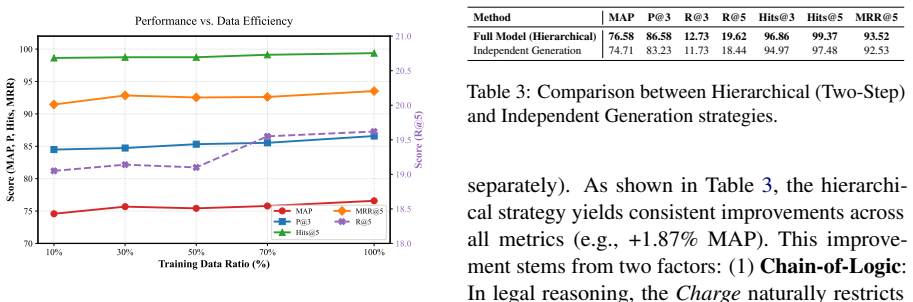
GLIER decomposes legal case retrieval into two stages: a Joint Generative Inference module that translates raw queries into latent legal indicators including charges and legal elements via unified sequence-to-sequence generation to enforce logical consistency, and a Multi-View Evidence Fusion mechanism that aggregates generative confidence with structural and lexical signals to produce the final ranking. Experiments on LeCaRD and LeCaRDv2 show this outperforms baselines such as SAILER and KELLER while remaining robust when trained on only 10 percent of the data.
What carries the argument
The Joint Generative Inference module, which jointly generates charges and legal elements from queries using sequence-to-sequence modeling to enforce logical consistency, combined with Multi-View Evidence Fusion that ranks cases by combining generative confidence scores with structural and lexical features.
If this is right
- Outperforms strong baselines such as SAILER and KELLER on the LeCaRD and LeCaRDv2 datasets.
- Maintains strong retrieval performance even when trained with only 10 percent of the available data.
- Produces more interpretable results by explicitly generating legal indicators rather than relying solely on opaque vector matching.
Where Pith is reading between the lines
- The explicit modeling of domain-specific latent variables could extend to retrieval tasks in other fields with similar semantic gaps, such as medical records or technical documentation.
- Reducing dependence on large training sets through structured inference might help specialized retrieval systems operate in data-scarce professional domains.
- Integrating the generated legal variables directly into downstream legal reasoning tools could create more coherent end-to-end systems.
Load-bearing premise
That jointly generating charges and legal elements via sequence-to-sequence modeling enforces logical consistency and that fusing the resulting generative confidence with structural and lexical signals produces more precise rankings than existing dense retrieval methods.
What would settle it
An ablation experiment on LeCaRD where the joint generation step is replaced by independent generation of charges and elements, checking whether retrieval metrics fall to or below baseline levels.
Figures


read the original abstract
The semantic gap between colloquial user queries and professional legal documents presents a fundamental challenge in Legal Case Retrieval (LCR). Existing dense retrieval methods typically treat LCR as a black-box semantic matching process, neglecting the explicit juridical logic that underpins legal relevance. To address this, we propose GLIER (Generative Legal Inference and Evidence Ranking), a framework that reformulates retrieval as an inference process over latent legal variables. GLIER decomposes the task into two interpretability-driven stages. First, a Joint Generative Inference module translates raw queries into latent legal indicators, including charges and legal elements, using a unified sequence-to-sequence strategy that jointly generates charges and elements to enforce logical consistency. Second, a Multi-View Evidence Fusion mechanism aggregates generative confidence with structural and lexical signals for precise ranking. Extensive experiments on LeCaRD and LeCaRDv2 demonstrate that GLIER outperforms strong baselines such as SAILER and KELLER. Notably, GLIER exhibits strong data efficiency, maintaining robust performance even when trained with only 10% of the data.
Editorial analysis
A structured set of objections, weighed in public.
Referee Report
Summary. The paper proposes GLIER, a two-stage generative framework for legal case retrieval that reformulates the task as inference over latent legal variables. The first stage is a Joint Generative Inference module that employs a unified sequence-to-sequence model to jointly generate charges and legal elements from raw queries, aiming to enforce logical consistency. The second stage is a Multi-View Evidence Fusion mechanism that aggregates generative confidence scores with structural and lexical signals to produce the final ranking. Experiments on the LeCaRD and LeCaRDv2 benchmarks are reported to show outperformance over strong baselines including SAILER and KELLER, together with robust performance when trained on only 10% of the data.
Significance. If the empirical results hold, the work offers a concrete way to inject explicit juridical structure into retrieval rather than relying solely on black-box dense matching. The data-efficiency finding is particularly relevant for legal domains where labeled data are scarce. The framework is consistent with prior generative-retrieval literature yet applies the idea to legal logic in a joint-inference setting; reproducible code or parameter-free derivations are not claimed.
minor comments (3)
- Abstract: the claim of outperformance is stated without any numerical values (e.g., MAP, NDCG@10, or Recall improvements). Adding one or two headline metrics would strengthen the abstract while remaining within the 150-word limit.
- Section 3 (method): the aggregation rule inside the Multi-View Evidence Fusion mechanism is described at a high level; a short equation or pseudocode block showing how generative, structural, and lexical scores are combined would improve reproducibility.
- Section 5 (experiments): the 10%-data regime is highlighted as a strength, yet no ablation table isolating the contribution of the joint-generation stage versus the fusion stage is referenced. A single additional row or column in an existing table would clarify whether the data-efficiency gain is attributable to the proposed components.
Simulated Author's Rebuttal
We thank the referee for the positive summary of our work and for recommending minor revision. We appreciate the recognition that GLIER offers a way to inject explicit juridical structure into retrieval and that the data-efficiency results are relevant for legal domains with scarce labels. No major comments were raised in the report.
Circularity Check
No significant circularity in derivation chain
full rationale
The paper describes GLIER as a two-stage framework that reformulates LCR via joint seq2seq generation of charges/elements followed by multi-view fusion of generative, structural, and lexical signals. No equations, fitted parameters, or derivations are presented in the abstract or summary that reduce by construction to inputs, self-definitions, or prior self-citations. Central claims rest on empirical outperformance and data efficiency on LeCaRD/LeCaRDv2, which are externally falsifiable. The approach references prior generative-retrieval concepts but does not import uniqueness theorems, smuggle ansatzes, or rename known results as novel derivations within the provided text. The derivation remains self-contained against external benchmarks.
Axiom & Free-Parameter Ledger
axioms (1)
- domain assumption Legal relevance is underpinned by explicit juridical logic that can be captured as latent variables such as charges and legal elements.
invented entities (2)
-
Joint Generative Inference module
no independent evidence
-
Multi-View Evidence Fusion mechanism
no independent evidence
Reference graph
Works this paper leans on
-
[1]
Chenlong Deng, Zhicheng Dou, Yujia Zhou, Peitian Zhang, and Kelong Mao. 2024 a . https://doi.org/10.18653/v1/2024.findings-acl.139 An element is worth a thousand words: Enhancing legal case retrieval by incorporating legal elements . In Findings of the Association for Computational Linguistics: ACL 2024, pages 2354--2365, Bangkok, Thailand. Association fo...
- [2]
-
[3]
Jacob Devlin, Ming-Wei Chang, Kenton Lee, and Kristina Toutanova. 2019. https://doi.org/10.18653/v1/N19-1423 BERT : Pre-training of deep bidirectional transformers for language understanding . In Proceedings of the 2019 Conference of the North A merican Chapter of the Association for Computational Linguistics: Human Language Technologies, Volume 1 (Long a...
-
[4]
Yi Feng, Chuanyi Li, and Vincent Ng. 2024. https://doi.org/10.18653/v1/2024.acl-long.350 Legal case retrieval: A survey of the state of the art . In Proceedings of the 62nd Annual Meeting of the Association for Computational Linguistics (Volume 1: Long Papers), pages 6472--6485, Bangkok, Thailand. Association for Computational Linguistics
-
[5]
Cheng Gao, Chaojun Xiao, Zhenghao Liu, Huimin Chen, Zhiyuan Liu, and Maosong Sun. 2024. https://doi.org/10.18653/v1/2024.emnlp-main.402 Enhancing legal case retrieval via scaling high-quality synthetic query-candidate pairs . In Proceedings of the 2024 Conference on Empirical Methods in Natural Language Processing, pages 7086--7100, Miami, Florida, USA. A...
- [6]
-
[7]
Haitao Li, Qingyao Ai, Jia Chen, Qian Dong, Yueyue Wu, Yiqun Liu, Chong Chen, and Qi Tian. 2023 a . Sailer: structure-aware pre-trained language model for legal case retrieval. In Proceedings of the 46th International ACM SIGIR Conference on Research and Development in Information Retrieval, pages 1035--1044
2023
- [8]
- [9]
- [10]
-
[11]
Yixiao Ma, Yunqiu Shao, Yueyue Wu, Yiqun Liu, Ruizhe Zhang, Min Zhang, and Shaoping Ma. 2021. https://doi.org/10.1145/3404835.3463250 Lecard: A legal case retrieval dataset for chinese law system . In Proceedings of the 44th International ACM SIGIR Conference on Research and Development in Information Retrieval, SIGIR '21, page 2342–2348, New York, NY, US...
-
[12]
Yanran Tang, Ruihong Qiu, and Xue Li. 2023. Prompt-based effective input reformulation for legal case retrieval. In Australasian database conference, pages 87--100. Springer
2023
- [13]
-
[14]
Yi Tay, Vinh Q. Tran, Mostafa Dehghani, Jianmo Ni, Dara Bahri, Harsh Mehta, Zhen Qin, Kai Hui, Zhe Zhao, Jai Gupta, Tal Schuster, William W. Cohen, and Donald Metzler. 2022. https://arxiv.org/abs/2202.06991 Transformer memory as a differentiable search index . Preprint, arXiv:2202.06991
-
[15]
Santosh T.y.s.s and Elvin Quero Hernandez. 2025. https://doi.org/10.18653/v1/2025.acl-short.32 L ex K ey P lan: Planning with keyphrases and retrieval augmentation for legal text generation: A case study on E uropean court of human rights cases . In Proceedings of the 63rd Annual Meeting of the Association for Computational Linguistics (Volume 2: Short Pa...
-
[16]
Yujing Wang, Yingyan Hou, Haonan Wang, Ziming Miao, Shibin Wu, Hao Sun, Qi Chen, Yuqing Xia, Chengmin Chi, Guoshuai Zhao, Zheng Liu, Xing Xie, Hao Allen Sun, Weiwei Deng, Qi Zhang, and Mao Yang. 2023. https://arxiv.org/abs/2206.02743 A neural corpus indexer for document retrieval . Preprint, arXiv:2206.02743
-
[17]
Chaojun Xiao, Xueyu Hu, Zhiyuan Liu, Cunchao Tu, and Maosong Sun. 2021. Lawformer: A pre-trained language model for chinese legal long documents. AI Open, 2:79--84
2021
- [18]
-
[19]
online" 'onlinestring :=
ENTRY address archivePrefix author booktitle chapter edition editor eid eprint eprinttype howpublished institution journal key month note number organization pages publisher school series title type volume year doi pubmed url lastchecked label extra.label sort.label short.list INTEGERS output.state before.all mid.sentence after.sentence after.block STRING...
-
[20]
write newline
" write newline "" before.all 'output.state := FUNCTION n.dashify 't := "" t empty not t #1 #1 substring "-" = t #1 #2 substring "--" = not "--" * t #2 global.max substring 't := t #1 #1 substring "-" = "-" * t #2 global.max substring 't := while if t #1 #1 substring * t #2 global.max substring 't := if while FUNCTION word.in bbl.in capitalize " " * FUNCT...
discussion (0)
Sign in with ORCID, Apple, or X to comment. Anyone can read and Pith papers without signing in.