Recognition: unknown
Contact flexibility and rigidity for toric Gorenstein prequantizations and Ehrhart theory of toric diagrams
Pith reviewed 2026-05-08 04:41 UTC · model grok-4.3
The pith
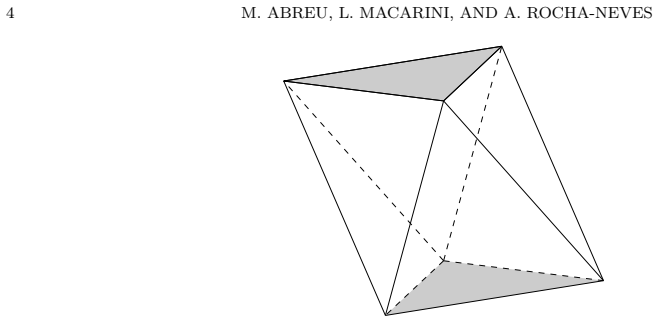
The small cross-polytope is the unique toric diagram sharing the Ehrhart polynomial of the cross-polytope, making the primitive prequantization of P^1 × ⋯ × P^1 rigid among Gorenstein toric contact manifolds.
A machine-rendered reading of the paper's core claim, the machinery that carries it, and where it could break.
Core claim
Gorenstein toric contact manifolds are determined by toric diagrams whose Ehrhart polynomials encode the contact Betti numbers. While the family of toric diagrams arising from monotone iterated P^1-bundles share the Ehrhart polynomial of the cross-polytope, the small cross-polytope is the unique toric diagram with this polynomial in each dimension, so the primitive prequantization of P^1 × ⋯ × P^1 is rigidly determined by its contact Betti numbers. The same rigidity holds for the family of primitive prequantizations of monotone P^1-bundles over P^{n-1}.
What carries the argument
Toric diagram, the integral convex polytope that encodes a Gorenstein toric contact manifold and whose Ehrhart polynomial determines the contact Betti numbers.
If this is right
- In each dimension the small cross-polytope is the only toric diagram with its Ehrhart polynomial.
- Contact Betti numbers determine the Gorenstein toric contact manifold uniquely for the primitive prequantization of the product of projective lines.
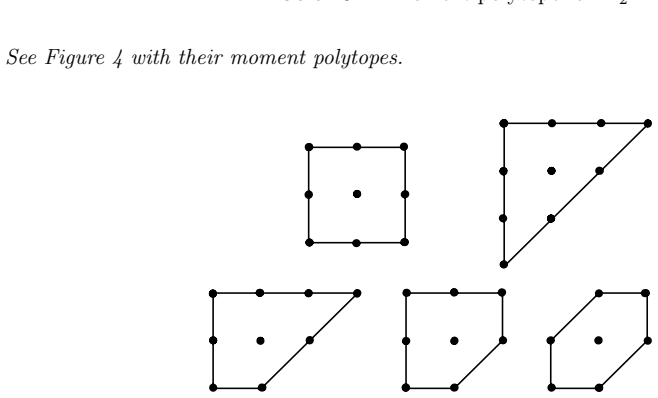
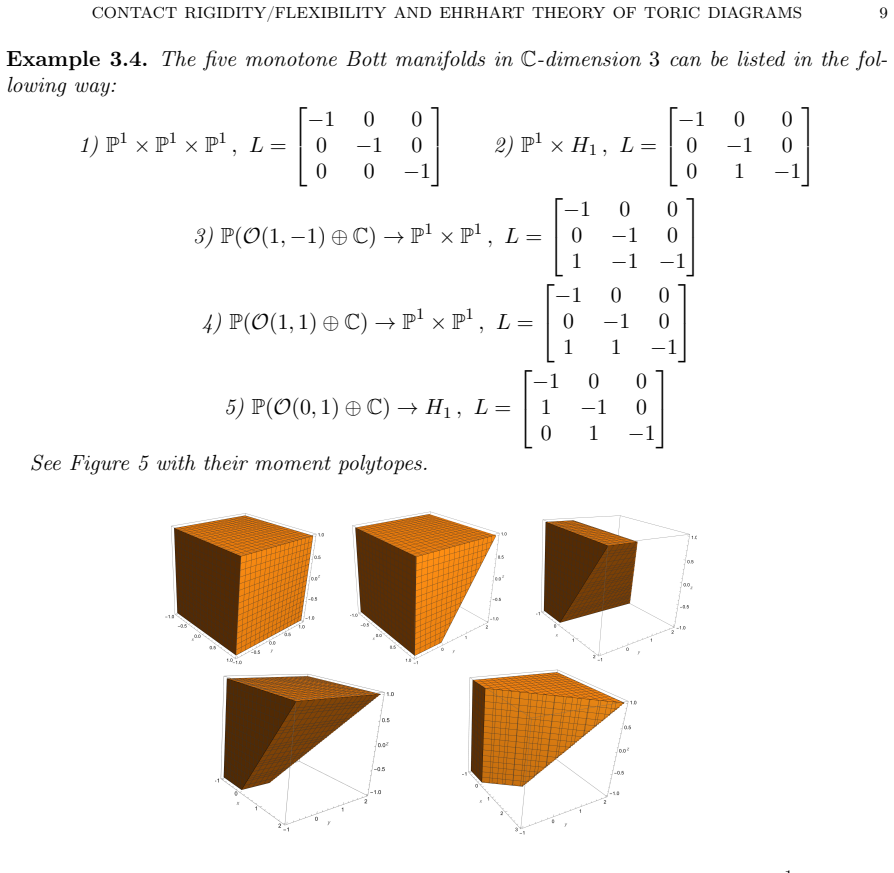
- The toric diagrams of monotone Bott manifolds are classified up to unimodular equivalence by their shared Ehrhart polynomial.
- Rigidity holds for the family of primitive prequantizations of monotone P^1-bundles over P^{n-1}.
Where Pith is reading between the lines
- The result suggests that Ehrhart polynomials can serve as complete invariants for certain classes of toric diagrams in contact geometry.
- Similar rigidity statements might be provable for other distinguished toric diagrams beyond the small cross-polytope.
- The flexibility shown for the Bott manifold family indicates that many geometrically distinct prequantizations can share the same combinatorial contact invariants.
Load-bearing premise
Gorenstein toric contact manifolds with zero first Chern class are completely determined by their toric diagrams, and the Ehrhart polynomial of the diagram exactly determines the contact Betti numbers.
What would settle it
Discovery of any toric diagram in some dimension that has the same Ehrhart polynomial as the small cross-polytope but is not unimodularly equivalent to it.
Figures




read the original abstract
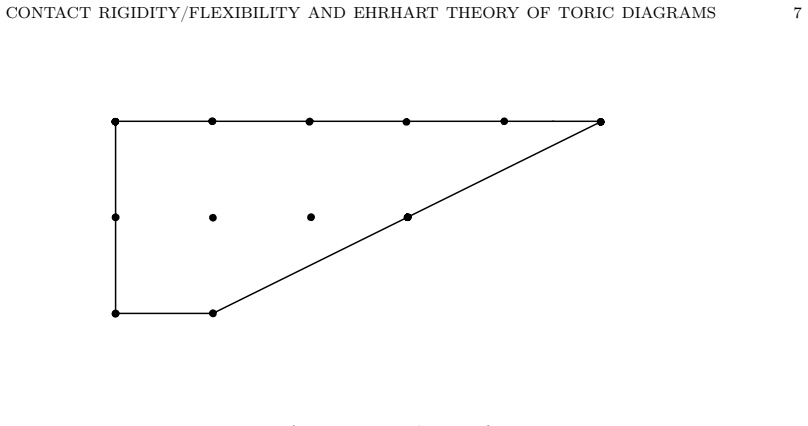
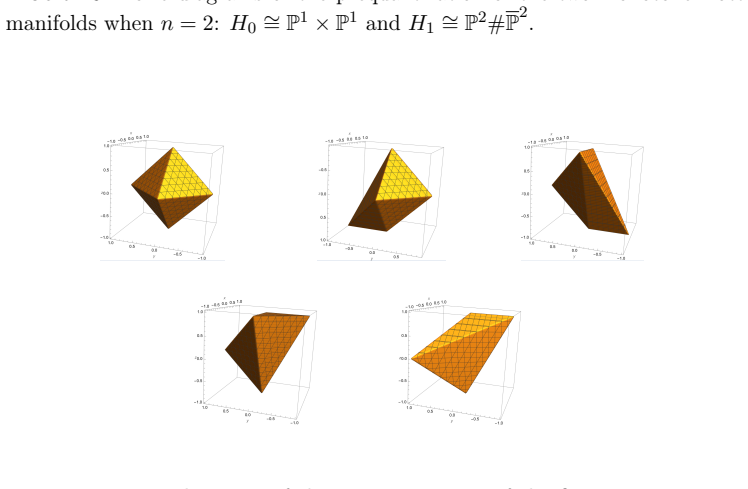
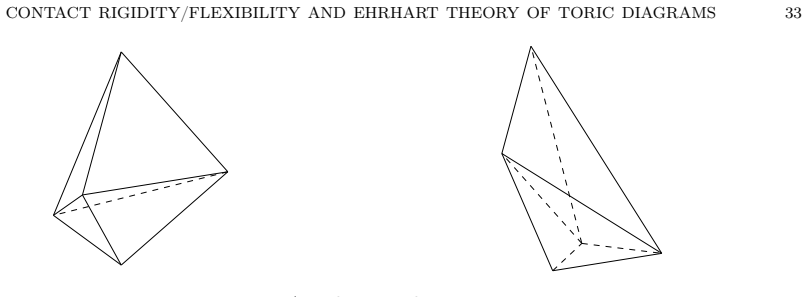
Gorenstein toric contact manifolds are good toric contact manifolds with zero first Chern class that are completely determined by certain integral convex polytopes called toric diagrams. The Ehrhart polynomial of these toric diagrams determines and is determined by the contact Betti numbers of the corresponding contact manifolds, i.e. the dimension of their cylindrical contact homology in eachdegree. In this paper we look into the following natural question: to what extent do these contact invariants determine the Gorenstein toric contact manifold? Flexibility is the norm and we illustrate it with the family of Gorenstein toric contact manifolds that arise as the prequantization of monotone iterated ${\mathbb P}^1$-bundles, i.e. monotone Bott manifolds. In each dimension, the Ehrhart polynomial of their toric diagrams is equal to the Ehrhart polynomial of the cross-polytope, corresponding to the monotone prequantization of ${\mathbb P}^1 \times \cdots \times {\mathbb P}^1$, and we describe the unimodular classification of these toric diagrams. On the rigidity side, we will show that the primitive prequantization of ${\mathbb P}^1 \times \cdots \times {\mathbb P}^1$ is rigid, i.e. completely determined as a Gorenstein toric contact manifold by its contact Betti numbers. More precisely, in each dimension, we show that its toric diagram, which we name small cross-polytope, is the unique toric diagram with its particular Ehrhart polynomial. We will also prove a rigidity result for a family of Gorenstein toric contact manifolds that arise as the primitive prequantization of monotone ${\mathbb P}^1$-bundles over ${\mathbb P}^{n-1}$.
Editorial analysis
A structured set of objections, weighed in public.
Referee Report
Summary. The paper establishes that the Ehrhart polynomial of a toric diagram determines the contact Betti numbers of the associated Gorenstein toric contact manifold (and conversely). It exhibits flexibility by constructing infinite families of distinct toric diagrams arising from monotone iterated P^1-bundles (Bott manifolds) that all share the Ehrhart polynomial of the cross-polytope corresponding to the primitive prequantization of (P^1)^n. On the rigidity side, it proves that the small cross-polytope is the unique toric diagram with this Ehrhart polynomial in each dimension, and establishes a parallel uniqueness result for the toric diagrams of primitive prequantizations of monotone P^1-bundles over P^{n-1}.
Significance. If the combinatorial uniqueness statements hold, the work supplies a precise dictionary between Ehrhart data and contact invariants for Gorenstein toric contact manifolds, together with explicit flexible families and rigid examples. The direct combinatorial arguments (unimodular classification for flexibility, lattice-point counting forcing vertex/facet equality for rigidity) constitute a concrete contribution at the interface of toric contact geometry and Ehrhart theory.
major comments (2)
- [§4] §4 (rigidity of the small cross-polytope): the proof that any toric diagram with the same Ehrhart polynomial must coincide with the small cross-polytope relies on the Gorenstein condition (origin in strict interior, dual also integral) and the specific degree-by-degree lattice-point counts; it would be useful to see an explicit statement of the induction or enumeration argument that rules out all other vertex configurations in dimension n.
- [§3] §3 (flexible families): while the unimodular classification of iterated P^1-bundle diagrams is stated to produce all diagrams sharing the cross-polytope Ehrhart polynomial, the manuscript should clarify whether this classification is exhaustive or whether additional non-unimodular diagrams could exist with the same Ehrhart data.
minor comments (2)
- [§2] The notation for the small cross-polytope and its Ehrhart polynomial should be introduced with a displayed equation or table in §2 to facilitate comparison with the later rigidity statements.
- [Introduction] A brief reminder of the precise definition of contact Betti numbers (dimensions of cylindrical contact homology) would help readers who are primarily combinatorial.
Simulated Author's Rebuttal
We thank the referee for the positive assessment and the detailed comments, which help improve the clarity of the manuscript. We address each major comment below and will incorporate the suggested revisions.
read point-by-point responses
-
Referee: [§4] §4 (rigidity of the small cross-polytope): the proof that any toric diagram with the same Ehrhart polynomial must coincide with the small cross-polytope relies on the Gorenstein condition (origin in strict interior, dual also integral) and the specific degree-by-degree lattice-point counts; it would be useful to see an explicit statement of the induction or enumeration argument that rules out all other vertex configurations in dimension n.
Authors: We agree that an explicit outline of the enumeration argument would enhance readability. In the revised manuscript we will insert a dedicated paragraph in §4 that states the induction on dimension n, beginning from the Gorenstein condition (origin in the strict interior and integral dual) and proceeding degree-by-degree via the Ehrhart coefficients. At each step we enumerate the possible vertex placements compatible with the lattice-point counts, showing that any deviation from the small cross-polytope vertices forces a mismatch in at least one coefficient. This makes the ruling-out of alternative configurations fully explicit. revision: yes
-
Referee: [§3] §3 (flexible families): while the unimodular classification of iterated P^1-bundle diagrams is stated to produce all diagrams sharing the cross-polytope Ehrhart polynomial, the manuscript should clarify whether this classification is exhaustive or whether additional non-unimodular diagrams could exist with the same Ehrhart data.
Authors: The manuscript presents the unimodular classification specifically for the toric diagrams arising from monotone iterated P^1-bundles (Bott manifolds), which realize the flexible families. It does not assert that these are the only possible diagrams (unimodular or otherwise) sharing the Ehrhart polynomial. We will revise §3 to state explicitly that the classification is restricted to the unimodular case within this geometric construction, and that our arguments do not exclude the theoretical possibility of non-unimodular diagrams with identical Ehrhart data. The flexibility result is thereby limited to the exhibited families, which is sufficient for the paper’s purposes. revision: yes
Circularity Check
No significant circularity
full rationale
The paper establishes its flexibility result by explicit unimodular classification of toric diagrams arising from monotone iterated P^1-bundles, all sharing the Ehrhart polynomial of the cross-polytope. Its rigidity result is a direct combinatorial uniqueness proof: any toric diagram matching the Ehrhart polynomial of the small cross-polytope must reproduce identical lattice-point counts in every degree and therefore coincide with it under the stated Gorenstein and toric-diagram axioms (origin in strict interior, integral vertices, dual integral). These arguments rely on lattice enumeration and polytope properties rather than self-referential definitions, parameters fitted to a subset and renamed as predictions, or load-bearing self-citations whose content reduces to the target claim. The bidirectional relation between Ehrhart polynomials and contact Betti numbers is invoked as a foundational fact of the setup, not derived within the paper, and the new uniqueness and classification statements remain independent of it.
Axiom & Free-Parameter Ledger
axioms (2)
- domain assumption Gorenstein toric contact manifolds with zero first Chern class are completely determined by integral convex polytopes called toric diagrams
- domain assumption The Ehrhart polynomial of the toric diagram determines the contact Betti numbers of the corresponding contact manifold
Reference graph
Works this paper leans on
-
[1]
Abreu and L
M. Abreu and L. Macarini,Contact homology of good toric contact manifolds.Compositio Mathematica 148(2012), 304–334
2012
-
[2]
Abreu and L
M. Abreu and L. Macarini,On the mean Euler characteristic of Gorenstein toric contact manifolds. International Mathematics Research Notices14(2020), 4465-4495
2020
-
[3]
Abreu, L
M. Abreu, L. Macarini and M Moreira,On contact invariants of non-simply connected Gorenstein toric contact manifolds.Mathematical Research Letters29(2022), 1–42
2022
-
[4]
Abreu, L
M. Abreu, L. Macarini and M Moreira,Contact invariants ofQ-Gorenstein toric contact manifolds, the Ehrhart polynomial and Chen-Ruan cohomology.Advances in Mathematics429(2023), 50 pp
2023
-
[5]
Beck and S
M. Beck and S. Robins,Computing the continuous discretely, 2nd edition.Undergraduate Texts in Math- ematics, Springer-Verlag, 2015
2015
-
[6]
C. Bey, M. Henk, and J. Wills,Notes on the roots of Ehrhart polynomials.Discrete and Computational Geometry38(2007), 81–98
2007
-
[7]
Bourgeois,A Morse-Bott approach to contact homology.PhD thesis, Stanford University, 2002
F. Bourgeois,A Morse-Bott approach to contact homology.PhD thesis, Stanford University, 2002
2002
-
[8]
Bump, K.-K
D. Bump, K.-K. Choi, P. Kurlberg, and J. Vaaler,A local riemann hypothesis, i.Mathematische Zeitschrift 233(2000), 1–18
2000
-
[9]
Y. Cho, E. Lee, M. Masuda and S. Park,Unique toric structure on a Fano Bott manifold.Journal of Symplectic Geometry21(2023), 439–462
2023
-
[10]
Y. Cho, E. Lee, M. Masuda and S. Park,On the enumeration of Fano Bott manifolds.InToric Topology and Polyhedral Products, Fields Institute Communications, Springer, 2024
2024
-
[11]
Delzant,Hamiltoniens périodiques et images convexes de l’application moment.Bulletin de la Société Mathématique de France116(1988), 315–339
T. Delzant,Hamiltoniens périodiques et images convexes de l’application moment.Bulletin de la Société Mathématique de France116(1988), 315–339
1988
-
[12]
Grossberg and Y
M. Grossberg and Y. Karshon,Bott towers, complete integrability, and the extended character of repre- sentations.Duke Mathematical Journal76(1994), 23–58
1994
-
[13]
Haase, B
C. Haase, B. Nill, and A. Paffenholz,Lecture notes on lattice polytopes.Draft of June 28, 2021, available online
2021
-
[14]
Higashitani and K
A. Higashitani and K. Kurimoto,Cohomological rigidity for Fano Bott manifolds.Mathematische Zeitschrift301(2022), 2369–2391
2022
-
[15]
Kirschenhofer, A
P. Kirschenhofer, A. Pethö and R. Tichy,On analytical and diophantine properties of a family of counting polynomials.Acta Scientiarum Mathematicarum65(1999), 47–60
1999
-
[16]
Lerman,Contact toric manifolds.Journal of Symplectic Geometry1(2003), 785–828
E. Lerman,Contact toric manifolds.Journal of Symplectic Geometry1(2003), 785–828
2003
-
[17]
Obro,An algorithm for the classification of smooth Fano polytopes.Preprint
M. Obro,An algorithm for the classification of smooth Fano polytopes.Preprint. arXiv:0704.0049v1 (2007)
-
[18]
The On-Line Encyclopedia of Integer Sequences, https://oeis.org/A003080, OEIS Foundation Inc. (2026)
2026
-
[19]
Rodriguez-Villegas,On the zeros of certain polynomials.Proceedings of the American Mathematical Society130(2002), 2251–2254
F. Rodriguez-Villegas,On the zeros of certain polynomials.Proceedings of the American Mathematical Society130(2002), 2251–2254
2002
-
[20]
Suyama,Fano generalized Bott manifolds.Manuscripta Mathematica163(2020), 427–435
Y. Suyama,Fano generalized Bott manifolds.Manuscripta Mathematica163(2020), 427–435
2020
-
[21]
Ziegler,Lectures on polytopes.Springer-Verlag, 1995
G. Ziegler,Lectures on polytopes.Springer-Verlag, 1995. 36 M. ABREU, L. MACARINI, AND A. ROCHA-NEVES Center for Mathematical Analysis, Geometry and Dynamical Systems, Instituto Superior Técnico, Universidade de Lisboa, A v. Rovisco Pais, 1049-001 Lisboa, Portugal Email address:miguel.abreu@tecnico.ulisboa.pt, antonio.r.neves@tecnico.ulisboa.pt IMPA, Estra...
1995
discussion (0)
Sign in with ORCID, Apple, or X to comment. Anyone can read and Pith papers without signing in.