Recognition: unknown
Generalized Aubry-Andr\'e formula and continuity of the intersection spectrum of the Almost Mathieu operator
Pith reviewed 2026-05-08 04:49 UTC · model grok-4.3
The pith
The moments of the Lebesgue measure on the intersection spectrum of the Almost Mathieu operator are polynomials in the coupling λ with trigonometric polynomial coefficients in the frequency α.
A machine-rendered reading of the paper's core claim, the machinery that carries it, and where it could break.
Core claim
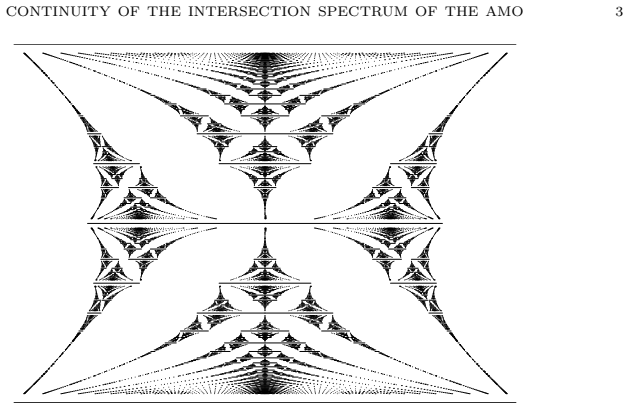
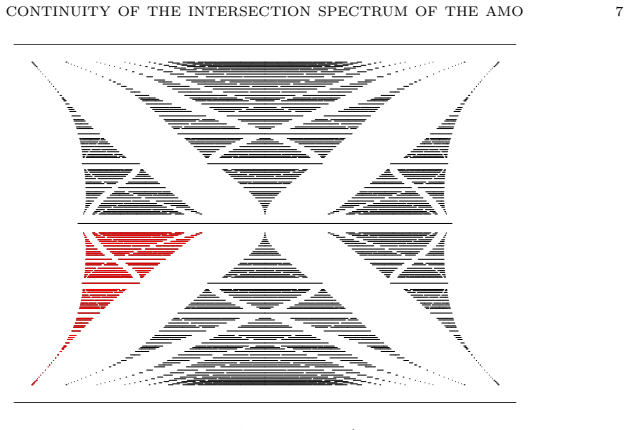
We consider the spectrum of the Almost Mathieu operator and show that the moments of the restriction of the Lebesgue measure to the intersection spectrum are polynomials in coupling λ with coefficients that are trigonometric polynomials in frequency α. This can be considered as a generalization of the Aubry-André formula for the measure of the spectrum of AMO. As a corollary, the restriction of the Lebesgue measure to the intersection spectrum depends continuously on the parameters in weak-* topology. Moreover, the dependence is analytic in λ and C^∞ in α for integrals of analytic test functions, implying that the Lebesgue measure of the part of the spectrum that lies between two gaps does.
What carries the argument
The intersection spectrum Σ_{α,λ} of the Almost Mathieu operator, defined as the common part of all phase-shifted spectra, together with the restriction of Lebesgue measure to it and gap labeling to extract its moments.
If this is right
- The restricted measure μ⁻_{α,λ} is continuous in the weak-* topology as α and λ vary.
- Integrals of analytic test functions against the restricted measure are analytic in λ and C^∞ in α.
- The Lebesgue measure of any interval of the spectrum between two fixed gaps is analytic in λ and C^∞ in α away from λ=1.
- The zeroth moment recovers the classical Aubry-André formula for the total measure of the spectrum.
Where Pith is reading between the lines
- The explicit polynomial form may permit closed-form averages over the spectrum when α is approximated by rationals.
- The smoothness could be used to differentiate the measure with respect to λ and track individual gap widths continuously.
- Parameter continuity suggests that the distribution of spectral measure remains stable under small perturbations of frequency or coupling.
Load-bearing premise
The Almost Mathieu operator admits stable gap labeling and continuous spectrum dependence on parameters so that the moments reduce to polynomials in λ for irrational α away from the critical coupling.
What would settle it
For the golden mean frequency, compute the second moment of the restricted Lebesgue measure at several λ values between 0 and 2 and test whether the values lie exactly on a quadratic polynomial curve.
Figures





read the original abstract
We consider the spectrum of the Almost Mathieu operator (AMO) and show that the moments of the restriction of the Lebesgue measure to the intersection spectrum $\text{Leb}|_{\Sigma_{\alpha,\lambda}}$ are polynomials in coupling $\lambda$ with coefficients that are trigonometric polynomials in frequency $\alpha$. The statement can be considered as a generalization of the Aubry-Andr\'e formula for the measure of the spectrum of AMO. As a corollary, we obtain that the restriction of the Lebesgue measure to the intersection spectrum that we denote by $\mu^{-}_{\alpha, \lambda}$ depends continuously on the parameters (frequency $\alpha$ and coupling $\lambda$) in weak-* topology. Moreover, we prove that the dependence is not just continuous but analytic in $\lambda$ and $C^{\infty}$ in $\alpha$ in a sense that an integral of an analytic test function $\varphi(x)$ with respect to $\mu^{-}_{\alpha, \lambda}$ has the same kind of dependence. In particular, this implies that the Lebesgue measure of the part of the spectrum $\Sigma_{\alpha,\lambda}$ that lies between two gaps depends analytically on the coupling constant $\lambda$ and $C^{\infty}$ on the frequency $\alpha$ in an open domain (away from the critical coupling $\lambda=1$) where these gaps do not bifurcate.
Editorial analysis
A structured set of objections, weighed in public.
Referee Report
Summary. The paper claims that for the Almost Mathieu operator, the moments of the Lebesgue measure restricted to the intersection spectrum Σ_{α,λ} are polynomials in the coupling λ whose coefficients are trigonometric polynomials in the frequency α. This is presented as a generalization of the Aubry-André formula (the 0th moment being independent of α). Corollaries include weak-* continuity of the restricted measure μ^-_{α,λ} in the parameters (α,λ), and that integrals of analytic test functions against this measure are analytic in λ and C^∞ in α; in particular, the Lebesgue measure of spectral intervals between gaps depends analytically on λ and C^∞ on α in open domains away from the critical value λ=1 where gaps do not bifurcate.
Significance. If the central claims hold, the result supplies explicit polynomial/trigonometric-polynomial expressions for all moments of the restricted Lebesgue measure on the AMO spectrum and establishes strong regularity (analyticity in λ, C^∞ in α) for the parameter dependence of spectral measures away from criticality. These properties rest on standard structural facts for the AMO (continuity of the spectrum, gap labeling for irrational α, band-edge analyticity) and would furnish concrete, falsifiable predictions for the Cantor spectrum that could be checked numerically or used in further analytic work on quasiperiodic operators.
major comments (2)
- [Theorem 1.1 / §3] The abstract and introduction state that the polynomial form follows from gap labeling and continuity of the spectrum in (α,λ), but the precise inductive or recursive step that converts the gap-labeling integers into trigonometric-polynomial coefficients for the higher moments is not visible in the provided summary; a concrete reference to the section or equation where this conversion is carried out (e.g., the expression for the k-th moment in terms of the integrated density of states) is needed to verify that no hidden λ-dependent denominators appear.
- [Corollary 1.3 / §4] The domain of validity is repeatedly described as “open domains away from λ=1 where gaps do not bifurcate.” Because the critical line λ=1 is where the spectrum changes from absolutely continuous to singular continuous, it is essential to confirm that the polynomial expressions remain valid uniformly up to but not including λ=1 and that the constants in the estimates do not blow up as λ approaches 1 from either side.
minor comments (2)
- [Abstract] The notation μ^-_{α,λ} for the restricted measure is introduced without an explicit definition in the abstract; a one-sentence reminder of its construction (Lebesgue measure restricted to Σ_{α,λ} and normalized or not) would improve readability.
- [Corollary 1.2] The statement that the dependence is “analytic in λ and C^∞ in α” for integrals against analytic test functions should be accompanied by a brief indication of the function space in which the test functions live (e.g., analytic on a fixed complex neighborhood of the spectrum).
Simulated Author's Rebuttal
We thank the referee for the careful reading of the manuscript and the recommendation for minor revision. We address the two major comments point by point below.
read point-by-point responses
-
Referee: [Theorem 1.1 / §3] The abstract and introduction state that the polynomial form follows from gap labeling and continuity of the spectrum in (α,λ), but the precise inductive or recursive step that converts the gap-labeling integers into trigonometric-polynomial coefficients for the higher moments is not visible in the provided summary; a concrete reference to the section or equation where this conversion is carried out (e.g., the expression for the k-th moment in terms of the integrated density of states) is needed to verify that no hidden λ-dependent denominators appear.
Authors: We appreciate the referee highlighting the need for greater explicitness. The conversion from gap-labeling integers to the trigonometric-polynomial coefficients is carried out in the proof of Theorem 1.1 in Section 3. There we start from the expression for the k-th moment as the integral of x^k over the spectrum (which equals the difference of the k+1 moments of the integrated density of states at the band edges) and use the fact that the gap labels are integers independent of λ together with the continuity of the spectrum in (α,λ) to obtain a recursive relation whose solution is manifestly a polynomial in λ with trigonometric-polynomial coefficients in α; no λ-dependent denominators arise because the recursion only involves additions and multiplications by the integer labels and the explicit Aubry-André-type total-measure factor. We will insert a forward reference to the precise recursive formula (currently Equation (3.4)) already in the statement of Theorem 1.1 and add one clarifying sentence in the introduction. revision: yes
-
Referee: [Corollary 1.3 / §4] The domain of validity is repeatedly described as “open domains away from λ=1 where gaps do not bifurcate.” Because the critical line λ=1 is where the spectrum changes from absolutely continuous to singular continuous, it is essential to confirm that the polynomial expressions remain valid uniformly up to but not including λ=1 and that the constants in the estimates do not blow up as λ approaches 1 from either side.
Authors: The polynomial expressions themselves are identities that hold for every fixed λ (including the limit as λ approaches 1 from either side), since their derivation relies only on gap labeling and continuity of the spectrum, both of which remain valid at |λ|=1. The C^∞ and analyticity statements in Corollary 1.3, however, are stated only on open domains away from λ=1 precisely because the constants appearing in the estimates for the derivatives grow as the distance to λ=1 tends to zero; this growth is expected and consistent with the change in spectral type at criticality. We will add a short remark after Corollary 1.3 clarifying that the polynomial identities extend continuously up to |λ|=1 while the regularity estimates are uniform only on compact subsets of the stated domains (hence may diverge as λ→1). revision: partial
Circularity Check
No significant circularity; derivation rests on standard AMO properties
full rationale
The paper generalizes the known Aubry-André formula (0th moment of Leb on Σ_{α,λ} independent of α) to higher moments being polynomials in λ with trigonometric polynomial coefficients in α. This follows from established structural facts: gap labeling for irrational α, continuity of the spectrum in (α,λ), and analyticity of band edges in open domains away from λ=1. These are external, well-verified properties of the Almost Mathieu operator (not derived or fitted within the paper). The claimed polynomial/trigonometric form is a direct consequence of these properties plus the measure restriction, without any reduction of outputs to inputs by construction, self-definition, or load-bearing self-citation chains. The weak-* continuity and analyticity corollaries are likewise consequences rather than tautological. No equations or steps in the provided abstract or claims exhibit the enumerated circularity patterns.
Axiom & Free-Parameter Ledger
axioms (1)
- domain assumption The Almost Mathieu operator possesses the standard gap-labeling and continuity properties used in prior literature on quasiperiodic Schrödinger operators.
Reference graph
Works this paper leans on
-
[1]
I Arnold, Small denominators
V. I Arnold, Small denominators. I. Mapping the circle onto itself,Izvestiya Rossiiskoi Akademii Nauk. Seriya Matematicheskaya, vol. 25 (1961), pp. 21–86
1961
-
[2]
Aubry, G
S. Aubry, G. Andre, Analyticity breaking and Anderson localization in incommensurate lat- tices,Ann. Israel Phys. Soc.3(1980), 133–164. CONTINUITY OF THE INTERSECTION SPECTRUM OF THE AMO 37
1980
-
[3]
Avila, Density of positive Lyapunov exponents for SL(2,R)-cocycles,Amer
A. Avila, Density of positive Lyapunov exponents for SL(2,R)-cocycles,Amer. Math. Soc. 24(2011), pp. 999–1014
2011
-
[4]
Avila, D
A. Avila, D. Damanik, Absolute continuity of the integrated density of states for the almost Mathieu operator with non-critical coupling,Invent. Math.,172(2008), pp. 439–453
2008
-
[5]
Avila, S
A. Avila, S. Jitomirskaya, The Ten Martini Problem,Ann. of Math. (2),170(2009), pp. 303–342
2009
-
[6]
Avila, S
A. Avila, S. Jitomirskaya, Almost localization and almost reducibility,J. Eur. Math. Soc. (JEMS),12(2010), pp. 93–131
2010
-
[7]
Avila, S
A. Avila, S. Jitomirskaya, C. Sadel, Complex one-frequency cocycles,J. Eur. Math. Soc. (JEMS)16(2014), pp. 1915–1935
2014
-
[8]
Avila, R
A. Avila, R. Krikorian, Reducibility or nonuniform hyperbolicity for quasiperiodic Schr¨ odinger cocycles,Annals of Mathematics,164(2006), pp. 911–940
2006
- [9]
-
[10]
Avron, B
J. Avron, B. Simon, Almost periodic Schr¨ odinger operators. II. The integrated density of states,Duke Math. J.,50(1983), pp. 369–391
1983
-
[11]
Avron, P
J. Avron, P. H. M. v. Mouche, B. Simon, On the measure of the spectrum for the almost Mathieu operator,Comm. Math. Phys., vol. 132 (1990), pp. 103–118
1990
-
[12]
M. Y. Azbel, Energy spectrum of a conduction electron in a magnetic field,Sov. Phys. JETP, 19(1964), pp. 634–645
1964
-
[13]
Bellissard, R
J. Bellissard, R. Lima, D. Testard, A metal-insulator transition for the Almost Mathieu model,Comm. Math. Phys.,88(1983), pp. 207–234
1983
-
[14]
Bellissard, R
J. Bellissard, R. Lima, D. Testard, Almost periodic Schr¨ odinger operators,Mathematics + physics,1, pp. 1–64, World Sci. Publishing, Singapore, 1985
1985
-
[15]
Bellissard, B
J. Bellissard, B. Simon, Cantor spectrum for the almost Mathieu equation,J. Funct. Anal., 48(1982), pp. 408–419
1982
-
[16]
Chambers, Linear network model for magnetic breakdown in two dimensions,Phys
W. Chambers, Linear network model for magnetic breakdown in two dimensions,Phys. Rev. A,140(1965), pp. 135–143
1965
-
[17]
M. D. Choi, G. A. Elliott, N. Yui, Gauss polynomials and the rotation algebra,Invent. Math., 99(1990), pp. 225–246
1990
-
[18]
Chulaevsky, F
V. Chulaevsky, F. Delyon, Purely absolutely continuous spectrum for almost Mathieu oper- ators,J. Statist. Phys.,55(1989), pp. 1279–1284
1989
-
[19]
J. M. Combes, L. Thomas, Asymptotic behaviour of eigenfunctions for multiparticle Schr¨ odinger operators,Commun. Math. Phys.,34(1973), pp. 251-270
1973
-
[20]
Damanik, J
D. Damanik, J. Fillman,One-Dimensional Ergodic Schr¨ odinger Operators – I. General The- ory, Graduate Studies in Mathematics221, American Mathematical Society, Providence, RI, 2022
2022
-
[21]
Damanik, J
D. Damanik, J. Fillman,One-Dimensional Ergodic Schr¨ odinger Operators – II. Specific Classes, Graduate Studies in Mathematics249, American Mathematical Society, Provi- dence, RI, 2024
2024
-
[22]
Delyon, Absence of localization in the almost Mathieu equation,J
F. Delyon, Absence of localization in the almost Mathieu equation,J. Phys. A: Math. Gen., 20(1987), L21
1987
-
[23]
R. T. Durrett,Probability—theory and examples, fifth edition, Cambridge Series in Statis- tical and Probabilistic Mathematics, 49, Cambridge Univ. Press, Cambridge, 2019
2019
-
[24]
N. Goncharuk, M. Yampolsky, Renormalization of circle maps and smoothness of Arnold tongues, preprint, arXiv:2307.15195
-
[25]
Gordon, S
A. Gordon, S. Jitomirskaya, Y. Last, B. Simon, Duality and singular continuous spectrum in the almost Mathieu equation,Acta Mathematica,178(1997), pp. 169–183
1997
-
[26]
Harper, Single Band Motion of Conduction Electrons in a Uniform Magnetic Field,Pro- ceedings of the Physical Society
P. Harper, Single Band Motion of Conduction Electrons in a Uniform Magnetic Field,Pro- ceedings of the Physical Society. Section A,68(1955), pp. 874–878
1955
-
[27]
Helffer, J
B. Helffer, J. Sj¨ ostrand, Semiclassical analysis for Harper’s equation. III. Cantor structure of the spectrum,M´ em. Soc. Math. France (N.S.), No. 39 (1989), pp. 1–124
1989
-
[28]
M. W. Hirsch, C. C. Pugh and M. Shub,Invariant manifolds, Lecture Notes in Mathematics, Vol. 583, Springer, Berlin-New York, 1977
1977
-
[29]
Hofstadter, Energy levels and wavefunctions of Bloch electrons in rational and irrational magnetic fields,Physical Review B,14(1976), pp
D. Hofstadter, Energy levels and wavefunctions of Bloch electrons in rational and irrational magnetic fields,Physical Review B,14(1976), pp. 2239–2249. 38 A. GORODETSKI AND V. KLEPTSYN
1976
-
[30]
Jitomirskaya, One-dimensional quasi-periodic operators: global theory, duality, and sharp analysis of small denominators,ICM 2022 —International Congress of Mathematicians
S. Jitomirskaya, One-dimensional quasi-periodic operators: global theory, duality, and sharp analysis of small denominators,ICM 2022 —International Congress of Mathematicians. Vol. 2. Plenary lectures, pp. 1090–1120,EMS Press, Berlin
2022
-
[31]
Jitomirskaya, Metal-Insulator Transition for the Almost Mathieu Operator,Annals of Mathematics,150(1999), pp.1159–1175
S. Jitomirskaya, Metal-Insulator Transition for the Almost Mathieu Operator,Annals of Mathematics,150(1999), pp.1159–1175
1999
-
[32]
Jitomirskaya, I
S. Jitomirskaya, I. Krasovsky, Continuity of the measure of the spectrum for discrete quasiperiodic operators,Math. Res. Lett.,9(2001), pp. 413–421
2001
-
[33]
Jitomirskaya, C
S. Jitomirskaya, C. Marx, Analytic quasi-periodic Schrodinger operators and rational fre- quency approximants,Geom. Funct. Anal.,22(2012), pp. 1407–1443
2012
-
[34]
Jitomirskaya, R
S. Jitomirskaya, R. Mavi, Continuity of the measure of the spectrum for quasiperiodic Schr¨ odinger operators with rough potentials,Comm. Math. Phys.,325(2014), pp. 585– 601
2014
-
[35]
R. A. Johnson, Exponential dichotomy, rotation number, and linear differential operators with bounded coefficients,J. Differential Equations61(1986), pp. 54–78
1986
-
[36]
Kirsch, An Invitation to Random Schr¨ odinger operators
W. Kirsch, An Invitation to Random Schr¨ odinger operators. With an appendix by Frederic Klopp,Panor. Syntheses, 25,Random Schr¨ odinger operators, pp. 1–119, Soc. Math. France, Paris, 2008
2008
-
[37]
Last, A relation between a.c
Y. Last, A relation between a.c. spectrum of ergodic Jacobi matrices and the spectra of periodic approximants,Comm. Math. Phys., vol 151 (1993), pp. 183–192
1993
-
[38]
Last, Zero measure spectrum for the almost Mathieu operator,Commun
Y. Last, Zero measure spectrum for the almost Mathieu operator,Commun. Math. Phys., vol 164 (1994), pp. 421–432
1994
-
[39]
Y. Last, M. Wilkinson, A sum rule for the dispersion relations of the rational Harper equa- tion,J. Phys. A25(1992), pp. 6123–6133
1992
-
[40]
Mathieu, Cours de physique math´ ematique, Paris, 1873
E. Mathieu, Cours de physique math´ ematique, Paris, 1873
-
[41]
P¨ oschel and E
J. P¨ oschel and E. Trubowitz,Inverse spectral theory, Pure and Applied Mathematics, 130, Academic Press, Boston, MA, 1987
1987
-
[42]
Puig, Cantor spectrum for the almost Mathieu operator,Comm
J. Puig, Cantor spectrum for the almost Mathieu operator,Comm. Math. Phys.,244(2004), pp. 297–309
2004
-
[43]
Puig, C.Simo, Analytic families of reducible linear quasi-periodic differential equations, Ergodic Theory and Dynamical Systems,26(2006), pp
J. Puig, C.Simo, Analytic families of reducible linear quasi-periodic differential equations, Ergodic Theory and Dynamical Systems,26(2006), pp. 481–524
2006
-
[44]
Shamis, Some connections between almost periodic and periodic discrete Schr¨ odinger operators with analytic potentials,Journal of Spectral Theory,1(2011), pp
M. Shamis, Some connections between almost periodic and periodic discrete Schr¨ odinger operators with analytic potentials,Journal of Spectral Theory,1(2011), pp. 349–362
2011
-
[45]
Simon, Almost periodic Schr¨ odinger operators: A Review,Advances in Applied Mathe- matics,3(1982), pp
B. Simon, Almost periodic Schr¨ odinger operators: A Review,Advances in Applied Mathe- matics,3(1982), pp. 463–490
1982
-
[46]
Simon, Schr¨ odinger operators in the twenty-first century,Mathematical physics 2000, pp
B. Simon, Schr¨ odinger operators in the twenty-first century,Mathematical physics 2000, pp. 283–288, Imp. Coll. Press, London, 2000
2000
-
[47]
Sinai, Anderson localization for one-dimensional difference Schr¨ odinger operator with quasiperiodic potential,J
Y. Sinai, Anderson localization for one-dimensional difference Schr¨ odinger operator with quasiperiodic potential,J. Statist. Phys.,46(1987), pp. 861–909
1987
-
[48]
Slammert,C 1-smoothness of Liouville arcs in Arnol’d tongues,Proc
L. Slammert,C 1-smoothness of Liouville arcs in Arnol’d tongues,Proc. Amer. Math. Soc. 129(2001), 1817–1823
2001
-
[49]
Zhang, Uniform hyperbolicity and its relation with spectral analysis of 1D discrete Schr¨ odinger operators,J
Z. Zhang, Uniform hyperbolicity and its relation with spectral analysis of 1D discrete Schr¨ odinger operators,J. Spectr. Theory10(2020), pp. 1471–1517
2020
-
[50]
Zhao, On Last’s intersection spectrum conjecture,Nonlinearity,32(2019), pp
X. Zhao, On Last’s intersection spectrum conjecture,Nonlinearity,32(2019), pp. 2352– 2364. Department of Mathematics, University of California, Irvine, CA 92697, USA Email address:asgor@uci.edu CNRS, University of Rennes, IRMAR, UMR 6625 du CNRS Email address:victor.kleptsyn@univ-rennes.fr
2019
discussion (0)
Sign in with ORCID, Apple, or X to comment. Anyone can read and Pith papers without signing in.