Recognition: unknown
A Descriptive Perspective on Devaney's Chaos and Some Results on Topologically Conjugate Systems
Pith reviewed 2026-05-07 17:27 UTC · model grok-4.3
The pith
Devaney's chaos loses its standard implication chain when translated into descriptive proximity.
A machine-rendered reading of the paper's core claim, the machinery that carries it, and where it could break.
Core claim
The central claim is that Banks' theorem does not hold in the descriptive-proximity setting: a descriptively transitive map with dense descriptive periodic points need not be descriptively sensitive. The authors introduce the three descriptive versions of the Devaney conditions and supply counterexamples to the expected hierarchy while proving that, under suitable conditions, the descriptive properties survive replacement of the system by any topologically conjugate copy.
What carries the argument
The descriptive versions of transitivity, periodic-point density, and sensitivity, which replace classical open sets by descriptive neighborhoods to express the three Devaney conditions.
Load-bearing premise
The descriptive versions of transitivity, periodic density, and sensitivity are meaningful extensions of the classical notions rather than artificial re-labelings.
What would settle it
A descriptive proximity space in which every descriptively transitive map with dense descriptive periodic points is also descriptively sensitive would show that the claimed failure of Banks' theorem is not general.
Figures


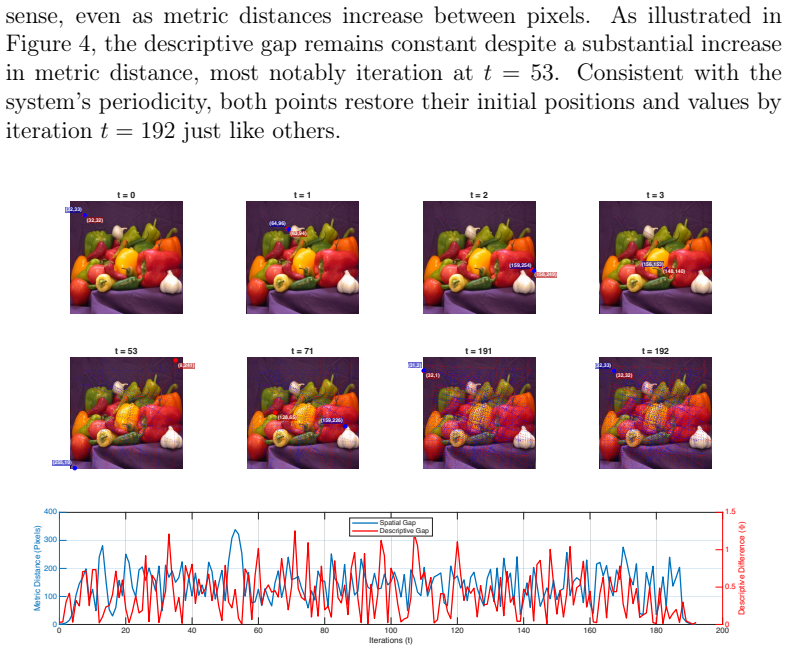

read the original abstract
In this study, Devaney's chaos conditions are revisited within the framework of descriptive proximity. The concepts of descriptive transitivity, the density of descriptive periodic objects, and descriptive sensitivity are defined. The most notable finding of the study is that Banks Theorem, which establishes the hierarchy among these conditions in classical topology, does not generally hold in the descriptive perspective, and some of the concepts above remain invariant under topological conjugacy certain conditions.
Editorial analysis
A structured set of objections, weighed in public.
Referee Report
Summary. The paper introduces notions of descriptive transitivity, density of descriptive periodic objects, and descriptive sensitivity within descriptive proximity spaces. It claims that the classical Banks theorem (transitivity plus dense periodic points implying sensitivity) fails to hold in general under these descriptive definitions, while certain of the new properties remain invariant under topological conjugacy under specified conditions.
Significance. If the descriptive notions are shown to coincide with their classical counterparts when the proximity reduces to a standard topology or metric, the reported failure of Banks' theorem would constitute a meaningful distinction between the descriptive and classical settings, potentially clarifying the role of proximity in chaotic dynamics. The conjugacy-invariance results, if rigorously established, would add to the structural understanding of these properties. The work introduces new definitions in a specialized framework (math.GN), but its impact hinges on the naturalness and consistency of those definitions rather than on parameter-free derivations or machine-checked proofs.
major comments (3)
- [§2] §2 (or equivalent definitions section): The central claim that Banks' theorem fails in the descriptive setting is load-bearing on the new definitions; the manuscript must explicitly verify that descriptive transitivity, descriptive periodic density, and descriptive sensitivity reduce exactly to the classical notions when the descriptive proximity is the standard one induced by the topology/metric. Without this reduction property, the observed non-implication does not directly illuminate the descriptive framework but may instead reflect a mismatch in the definitions.
- [Main result section] Main result section (presumably §3 or §4): The counter-example or construction showing that descriptive transitivity plus density of descriptive periodic objects does not imply descriptive sensitivity must be checked for internal consistency with the proximity axioms; if the construction relies on a proximity that never reduces to a classical metric, the comparison to Banks' theorem remains indirect.
- [Conjugacy section] Conjugacy-invariance theorem: The statement that 'some of the concepts remain invariant under topological conjugacy certain conditions' requires a precise formulation of the conditions and a proof that the invariance holds only for the descriptive versions and not trivially for the classical ones; the current abstract phrasing leaves the scope unclear.
minor comments (2)
- [Abstract] Abstract: the phrase 'remain invariant under topological conjugacy certain conditions' is grammatically incomplete and should be rephrased for clarity.
- Notation: ensure that the descriptive proximity relation is denoted distinctly from the classical topology throughout, and that all new terms are defined before their first use in theorems.
Simulated Author's Rebuttal
We thank the referee for the detailed and constructive report. The comments highlight important points for strengthening the manuscript's clarity and rigor. We address each major comment below, indicating planned revisions where appropriate.
read point-by-point responses
-
Referee: [§2] The manuscript must explicitly verify that descriptive transitivity, descriptive periodic density, and descriptive sensitivity reduce exactly to the classical notions when the descriptive proximity is the standard one induced by the topology/metric.
Authors: We agree that this reduction property is essential to ensure the non-implication result meaningfully distinguishes the descriptive setting. In the revised version, we will add a new proposition in §2 that directly verifies the coincidence: when the descriptive proximity δ is induced by a standard topology (or metric), the descriptive notions coincide with their classical counterparts by substituting the proximity definition into the descriptive conditions and recovering the usual open-set formulations. revision: yes
-
Referee: [Main result section] The counter-example showing that descriptive transitivity plus density of descriptive periodic objects does not imply descriptive sensitivity must be checked for internal consistency with the proximity axioms; if the construction relies on a proximity that never reduces to a classical metric, the comparison to Banks' theorem remains indirect.
Authors: The counterexample in §3 is constructed on a descriptive proximity space that satisfies all proximity axioms (including the descriptive axioms) and is internally consistent. We will revise the section to include an explicit verification that the chosen proximity satisfies the axioms and to add a remark explaining that the example is deliberately non-classical to illustrate the failure in the broader descriptive framework. While we acknowledge the comparison is indirect for this particular space, the result still demonstrates that the implication does not hold generally under the new definitions. revision: partial
-
Referee: [Conjugacy section] The statement that 'some of the concepts remain invariant under topological conjugacy certain conditions' requires a precise formulation of the conditions and a proof that the invariance holds only for the descriptive versions and not trivially for the classical ones.
Authors: We will revise both the abstract and the statement of the conjugacy theorem to give a precise formulation of the conditions (specifically, when the conjugacy is a descriptive proximity isomorphism). The proof will be expanded to show that the invariance is non-trivial for the descriptive notions by contrasting with the classical case, where invariance is already known but follows from different arguments; we will include a short comparison paragraph. revision: yes
Circularity Check
No circularity: new descriptive definitions yield independent non-implication for Banks theorem
full rationale
The paper introduces descriptive transitivity, descriptive periodic density, and descriptive sensitivity via new definitions in the descriptive proximity framework, then directly exhibits that the classical Banks implication fails for these notions. No step reduces a result to a fitted parameter, self-citation chain, or definitional tautology; the non-implication is a consequence of the explicit definitions rather than an artifact of renaming or smuggling prior results. The derivation chain is self-contained against the introduced concepts and does not rely on load-bearing self-citations or uniqueness theorems from the authors' prior work.
Axiom & Free-Parameter Ledger
axioms (1)
- standard math Standard axioms of general topology and dynamical systems
invented entities (3)
-
Descriptive transitivity
no independent evidence
-
Density of descriptive periodic objects
no independent evidence
-
Descriptive sensitivity
no independent evidence
Reference graph
Works this paper leans on
-
[1]
Devaney, An introduction to chaotic dynamical systems, CRC press, 2018
R. Devaney, An introduction to chaotic dynamical systems, CRC press, 2018
2018
-
[2]
R.Liang, Q.Wang, Y.Li, Anewhigh-dimensionaldigitalchaoticsystem and its s-box application, Chaos, Solitons & Fractals 199 (2025) 116826
2025
-
[3]
Mezzi, K
S. Mezzi, K. Ben Rejeb, Chaos of trajectories, Topology and its Appli- cations 375 (2025) 109571. 14
2025
-
[4]
Banks, J
J. Banks, J. Brooks, G. Cairns, G. Davis, P. Stacey, On devaney’s def- inition of chaos, The American mathematical monthly 99 (4) (1992) 332–334
1992
-
[5]
V. I. Arnold, A. Avez, Ergodic Problems of Classical Mechanics, W. A. Benjamin, New York, 1968, english translation of the original French edition
1968
-
[6]
S. A. Morris, Topology without tears, University of New England, 1989
1989
-
[7]
J. F. Peters, et al., Near sets. general theory about nearness of objects, Applied Mathematical Sciences 1 (53) (2007) 2609–2629
2007
-
[8]
J. F. Peters, Near sets: An introduction, Mathematics in Computer Science 7 (1) (2013) 3–9
2013
-
[9]
Naimpally, J
S. Naimpally, J. Peters, M. Wolski, Foreword [near set theory and ap- plications], Math. Comput. Sci 7 (1) (2013) 1–2
2013
-
[10]
Peters, Computational Proximity
J. Peters, Computational Proximity. Excursions in the Topology of Dig- ital Images., 2016
2016
-
[11]
S. A. Naimpally, J. F. Peters, Topology with applications: topological spaces via near and far, World Scientific, 2013
2013
-
[12]
Di Concilio, C
A. Di Concilio, C. Guadagni, J. F. Peters, S. Ramanna, Descriptive proximities: Properties and interplay between classical proximities and overlap, Mathematics in Computer Science 12 (1) (2018) 91–106
2018
-
[13]
M. S. Haider, J.F. Peters, Temporal proximities: Self-similar temporally close shapes, Chaos, Solitons & Fractals 151 (2021) 111237
2021
-
[14]
Alexan, N
W. Alexan, N. H. E. Shabasy, N. Ehab, E. A. Maher, A secure and effi- cient image encryption scheme based on chaotic systems and nonlinear transformations, Scientific Reports 15 (1) (2025) 31246
2025
-
[15]
F. J. Dyson, H. Falk, The period of arnold’s cat map, The American Mathematical Monthly 99 (7) (1992) 603–614
1992
-
[16]
G. Chen, Y. Mao, C. K. Chui, A symmetric image encryption scheme based on 3d chaotic cat maps, Chaos, Solitons & Fractals 21 (3) (2004) 749–761. 15
2004
discussion (0)
Sign in with ORCID, Apple, or X to comment. Anyone can read and Pith papers without signing in.