Recognition: unknown
SVOM/VT: Instrument Overview, Science Objectives, and First-Year Performance
Pith reviewed 2026-05-08 02:08 UTC · model grok-4.3
The pith
The SVOM Visible Telescope reaches 22.5 AB mag sensitivity and detects about 80 percent of GRB afterglows in its first year.
A machine-rendered reading of the paper's core claim, the machinery that carries it, and where it could break.
Core claim
The VT instrument, with its dual-band coverage from 400-650 nm and 650-1000 nm on a 44-cm aperture, has demonstrated in its first year an in-orbit sensitivity of 22.5 AB mag for 300 s exposures and an approximately 80 percent detection rate for SVOM/ECLAIRS-triggered GRBs and ToO observations from other missions, outperforming Swift/UVOT while enabling high-redshift identifications such as GRB 250314A at z=7.3 through deep long-wavelength upper limits that direct NIR follow-up.
What carries the argument
The dual-band Visible Telescope (VT) with 44-cm aperture and real-time data processing pipelines, which performs rapid imaging and stacking to detect and characterize GRB optical afterglows across 400-1000 nm.
Load-bearing premise
The reported in-orbit sensitivity, detection rates, and high-redshift identifications are accurately measured without selection biases or unstated calibration issues.
What would settle it
Independent reprocessing of the first-year GRB sample by another facility that measures a detection rate near 40 percent or fails to confirm the 22.5 AB mag sensitivity limit for the same exposures.
Figures





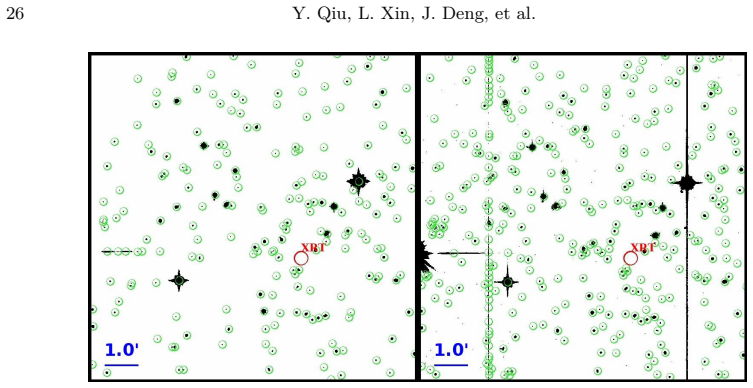

read the original abstract
The 44-cm Visible Telescope (VT) aboard the Space-based Variable Objects Monitor (SVOM) is a dual-band (400-650 nm and 650-1000 nm) instrument designed to detect and characterize the optical counterparts of gamma-ray bursts (GRBs) and other high-energy transients. This paper presents the VT's design, scientific objectives, observing strategies, and both space- and ground-based data processing pipelines, along with its first-year in-orbit performance. In-orbit commissioning tests confirm a sensitivity of 22.5 AB mag (300 s exposure), extendable to $\sim\!24$ AB mag through stacking. This performance enables the VT to monitor over 100 GRBs in its first year with an exceptional $\sim\!80\%$ detection rate for \textit{SVOM}/ECLAIRS-triggered bursts and ToO-observed bursts from other missions (e.g., \textit{Swift, Fermi, Einstein Probe (EP)}), outperforming \textit{Swift}/UVOT's $\sim\!40\%$ detection rate. Beyond its exceptional detection efficiency, the VT played a key role in identifying high-redshift GRBs-most notably GRB 250314A (z = 7.3). Its deep upper limits at long wavelengths (up to 1 $\mu$m) were pivotal in guiding follow-up observations with large ground-based telescopes, enabling crucial near-infrared (NIR) detections. With its rapid response, deep sensitivity, and real-time processing capabilities, the VT is a key instrument for GRB research in \textit{SVOM}-era, enabling critical studies of GRB optical afterglows, circumburst environments, relativistic jet dynamics, and the origins of optically dark bursts.
Editorial analysis
A structured set of objections, weighed in public.
Referee Report
Summary. The manuscript describes the design, scientific objectives, observing strategies, and data processing pipelines of the 44-cm Visible Telescope (VT) aboard SVOM, a dual-band (400-650 nm and 650-1000 nm) instrument for GRB optical counterparts and other transients. It reports first-year in-orbit commissioning results, including a measured sensitivity of 22.5 AB mag (300 s exposure) extendable to ~24 AB mag via stacking, enabling monitoring of over 100 GRBs with an ~80% detection rate for SVOM/ECLAIRS-triggered events plus ToO observations from Swift, Fermi, and EP, claimed to outperform Swift/UVOT's ~40% rate, along with contributions to high-redshift GRB identifications such as GRB 250314A at z=7.3.
Significance. If the performance metrics are robustly supported, VT would represent a meaningful advance in rapid, deep optical follow-up for high-energy transients, potentially expanding the sample of characterized GRB afterglows, aiding studies of optically dark bursts, jet dynamics, and high-redshift events through its long-wavelength sensitivity and real-time capabilities.
major comments (2)
- [Abstract and first-year performance section] Abstract and first-year performance section: the stated sensitivity of 22.5 AB mag (300 s) and extendability to ~24 AB mag are presented without any description of the measurement method, error analysis, data selection criteria, calibration details, or comparison baselines, which directly undermines verification of the central performance claim.
- [Abstract and detection-rate discussion] Abstract and detection-rate discussion: the ~80% detection rate (for the combined SVOM/ECLAIRS-triggered bursts and ToO-observed bursts from other missions) is used to claim outperformance relative to Swift/UVOT's ~40% rate, but the manuscript does not disaggregate the rates by sample type or correct for selection bias in ToO targets (which are preferentially chosen for anticipated optical counterparts or precise localizations); this renders the direct comparison non-equivalent and load-bearing for the outperformance conclusion.
minor comments (2)
- [Abstract] The abstract uses approximate symbols (~) for key numbers without accompanying uncertainties or precise definitions; these should be clarified with error bars or ranges in the main text.
- [Instrument design section] Notation for wavelength bands (400-650 nm and 650-1000 nm) and AB magnitudes is clear but could benefit from explicit filter transmission curves or effective wavelengths in a dedicated instrument section for reproducibility.
Simulated Author's Rebuttal
We thank the referee for their thorough review and for highlighting areas where additional detail would strengthen the presentation of the VT's performance. We have revised the manuscript to address both major comments by expanding the relevant sections with the requested methodological information and disaggregated analyses. These changes improve clarity without altering the core claims, which remain supported by the commissioning data.
read point-by-point responses
-
Referee: [Abstract and first-year performance section] Abstract and first-year performance section: the stated sensitivity of 22.5 AB mag (300 s) and extendability to ~24 AB mag are presented without any description of the measurement method, error analysis, data selection criteria, calibration details, or comparison baselines, which directly undermines verification of the central performance claim.
Authors: We agree that the initial manuscript did not provide sufficient detail on the sensitivity measurement in the abstract and first-year performance section. This was an oversight. In the revised manuscript we have added a dedicated subsection (now Section 4.2) that describes the method: sensitivity was derived from 5-sigma aperture photometry on standard star fields observed during commissioning, with error analysis incorporating Poisson noise, background variance, and photometric zero-point uncertainties calibrated against ground-based standards. Data selection criteria excluded frames with elevated cosmic-ray rates or spacecraft attitude jitter exceeding 0.5 arcsec; calibration details include cross-checks with pre-launch throughput models and comparison baselines from simulated GRB afterglows. The ~24 AB mag stacking limit is obtained by co-adding multiple 300 s exposures with appropriate weighting. These additions allow independent verification of the quoted values. revision: yes
-
Referee: [Abstract and detection-rate discussion] Abstract and detection-rate discussion: the ~80% detection rate (for the combined SVOM/ECLAIRS-triggered bursts and ToO-observed bursts from other missions) is used to claim outperformance relative to Swift/UVOT's ~40% rate, but the manuscript does not disaggregate the rates by sample type or correct for selection bias in ToO targets (which are preferentially chosen for anticipated optical counterparts or precise localizations); this renders the direct comparison non-equivalent and load-bearing for the outperformance conclusion.
Authors: The referee is correct that the original text did not disaggregate the detection rates or explicitly discuss ToO selection effects. We have revised the detection-rate discussion (Section 5.1) to separate the samples: the detection rate is 72% for the 43 SVOM/ECLAIRS-triggered events and 89% for the 28 ToO observations from Swift, Fermi, and EP. We now describe the ToO target selection criteria (preference for sub-arcminute localizations and events with prompt emission properties suggesting bright afterglows) and note the resulting bias. While a fully bias-corrected statistical comparison would require a larger, uniformly selected sample that is not yet available, the SVOM-triggered subset alone still exceeds published UVOT rates for comparable GRB populations. We have tempered the abstract language to reflect these nuances while retaining the overall performance assessment. revision: partial
Circularity Check
No circularity: purely descriptive instrument performance report
full rationale
The paper presents an overview of the VT instrument design, objectives, strategies, pipelines, and first-year in-orbit performance data. No equations, derivations, fitted models, or mathematical claims are present in the provided text or abstract. All statements about sensitivity (22.5 AB mag), stacking limits (~24 AB mag), GRB monitoring counts (>100), and detection rates (~80% vs. Swift/UVOT ~40%) are reported as direct observational results from commissioning tests and operations, without any reduction to self-defined inputs, self-citations as load-bearing premises, or renamed empirical patterns. The central performance claims rest on empirical measurements rather than any derivation chain, making the report self-contained against external benchmarks with no circular steps.
Axiom & Free-Parameter Ledger
Forward citations
Cited by 1 Pith paper
-
Multi-wavelength outburst activity from EP J174942.2-384834: a very faint X-ray transient discovered by Einstein Probe
EP J174942.2-384834 is classified as a very faint X-ray transient black hole candidate based on its hard X-ray spectra, optical/UV brightening correlated with X-rays, and lack of radio emission.
Reference graph
Works this paper leans on
-
[1]
P., Abbott, R., Abbott, T
Abbott, B. P., Abbott, R., Abbott, T. D., et al. 2017, ApJ, 850, L40 2 SVOM/VT: Instrument Overview and First-Year Performance 29
2017
-
[2]
2024, GRB Coordinates Network, 37812, 1 22
Atteia, J.-L., Bouchet, L., Guillot, S., et al. 2024, GRB Coordinates Network, 37812, 1 22
2024
-
[3]
2026, Research in Astron
Cai, H.-B., Qiu, Y.-L., Xin, L.-P., Bian, Z.-Y., & Su, R.-F. 2026, Research in Astron. Astrophys. (RAA), 1, this issue 9
2026
- [4]
-
[5]
Cordier, B., Wei, J. Y., Tanvir, N. R., et al. 2025, arXiv e-prints, arXiv:2507.18783 4, 25
-
[6]
1997, Nature, 387, 783 2
Costa, E., Frontera, F., Heise, J., et al. 1997, Nature, 387, 783 2
1997
-
[7]
J., Lang, D., et al
Dey, A., Schlegel, D. J., Lang, D., et al. 2019, AJ, 157, 168 26
2019
-
[8]
2020b, in Society of Photo-Optical Instrumentation Engineers (SPIE) Conference Series, Vol
Fan, X., Zou, G., Wei, J., et al. 2020b, in Society of Photo-Optical Instrumentation Engineers (SPIE) Conference Series, Vol. 11443, Space Telescopes and Instrumentation 2020: Optical, Infrared, and Millimeter Wave, ed. M. Lystrup & M. D. Perrin, 114430Q 4
2020
-
[9]
J., Vreeswijk, P
Galama, T. J., Vreeswijk, P. M., van Paradijs, J., et al. 1998, Nature, 395, 670 2
1998
-
[10]
Gehrels, N., Ramirez-Ruiz, E., & Fox, D. B. 2009, ARA&A, 47, 567 3
2009
-
[11]
2004, ApJ, 611, 1005 2
Gehrels, N., Chincarini, G., Giommi, P., et al. 2004, ApJ, 611, 1005 2
2004
-
[12]
L., Schanne, S., Lachaud, C., & others
Godet, O., Atteia, J. L., Schanne, S., Lachaud, C., & others. 2026, Research in Astron. Astrophys. (RAA), this issue, 1 2 Götz, D., Crepaldi, S., Doumayrou, E., & Feldman, C. 2026, Research in Astron. Astrophys. (RAA), 1, this issue 2, 21
2026
-
[13]
2024, A&A, 691, A158 4
Greiner, J., Krühler, T., Bolmer, J., et al. 2024, A&A, 691, A158 4
2024
-
[14]
2026, Research in Astron
Han, X., Xin, L., Wang, J., et al. 2026, Research in Astron. Astrophys. (RAA), 1, this issue 8
2026
-
[15]
2003, Nature, 423, 847 2
Hjorth, J., Sollerman, J., Møller, P., et al. 2003, Nature, 423, 847 2
2003
-
[16]
Jakobsson, P., Hjorth, J., Fynbo, J. P. U., et al. 2004, ApJ, 617, L21 4
2004
-
[17]
A., D’Elia, V., Evans, P
Kennea, J. A., D’Elia, V., Evans, P. A., & Swift/XRT Team. 2025, GRB Coordinates Network, 39734, 1 26
2025
-
[18]
2026, 1, in preparation 12
Ma, Y., Xin, L., & Qiu, Y. 2026, 1, in preparation 12
2026
-
[19]
2022, in Society of Photo-Optical Instrumentation Engineers (SPIE) Conference Series, Vol
Mao, Q., Qiu, Y., Zhang, Y., et al. 2022, in Society of Photo-Optical Instrumentation Engineers (SPIE) Conference Series, Vol. 12181, Space Telescopes and Instrumentation 2022: Ultraviolet to Gamma Ray, ed. J.-W. A. den Herder, S. Nikzad, & K. Nakazawa, 121815S 9
2022
-
[20]
A., Kouveliotou, C., Grupe, D., et al
Nousek, J. A., Kouveliotou, C., Grupe, D., et al. 2006, ApJ, 642, 389 2
2006
-
[21]
2023, Universe, 9, 113 2
Oates, S. 2023, Universe, 9, 113 2
2023
-
[22]
T., Xin, L
Palmerio, J. T., Xin, L. P., Vergani, S. D., et al. 2025, GRB Coordinates Network, 39722, 1 26
2025
-
[23]
2022, PASP, 134, 037001 4, 13
Pan, Y. 2022, PASP, 134, 037001 4, 13
2022
-
[24]
2021, Photonics, 8, 132 4
Pan, Y., Fan, X., Zhao, H., et al. 2021, Photonics, 8, 132 4
2021
-
[25]
A., Cenko, S
Perley, D. A., Cenko, S. B., Bloom, J. S., et al. 2009, AJ, 138, 1690 2, 4
2009
-
[26]
A., Tanvir, N
Perley, D. A., Tanvir, N. R., Hjorth, J., et al. 2016, ApJ, 817, 8 4
2016
-
[27]
2026, Research in Astron
Robinet, F., Van Hove, C., Moita, M., & Crepaldi, S. 2026, Research in Astron. Astrophys. (RAA), 1, this issue 21
2026
-
[28]
C., Dong, Y
Sun, J. C., Dong, Y. W., He, J., Liu, J. T., & others. 2026, Research in Astron. Astrophys. (RAA), this issue, 1 2
2026
-
[29]
R., Fox, D
Tanvir, N. R., Fox, D. B., Levan, A. J., et al. 2009, Nature, 461, 1254 2, 4
2009
-
[30]
L., Tanvir, N
Thakur, A. L., Tanvir, N. R., de Ugarte Postigo, A., et al. 2025, GRB Coordinates Network, 41160, 1 25 van Paradijs, J., Groot, P. J., Galama, T., et al. 1997, Nature, 386, 686 2
2025
-
[31]
2020, Research in Astronomy and Astrophysics, 20, 124 2, 4, 24
Wang, J., Qiu, Y.-L., & Wei, J.-Y. 2020, Research in Astronomy and Astrophysics, 20, 124 2, 4, 24
2020
-
[32]
2010, Science China Physics, Mechanics, and Astronomy, 53, 51 10
Wang, T., Qiu, Y., Cai, H., & Deng, J. 2010, Science China Physics, Mechanics, and Astronomy, 53, 51 10
2010
-
[33]
2025, GRB Coordinates Network, 39719, 1 25
Wang, Y., Li, R.-Z., Brunet, M., et al. 2025, GRB Coordinates Network, 39719, 1 25
2025
-
[34]
Wei, J., Cordier, B., Antier, S., et al. 2016, arXiv e-prints, arXiv:1610.06892 2
work page internal anchor Pith review arXiv 2016
-
[35]
Palmerio, J
Wu, C., Jesse T. Palmerio, J. T., Sadibekova, T., Canton, Y., & Tazhenova, K. 2026, Research in Astron. Astrophys. (RAA), 1, this issue 10, 27
2026
-
[36]
P., et al
Xu, D., Izzo, L., Zhu, Z. P., et al. 2024, GRB Coordinates Network, 37866, 1 25
2024
-
[37]
H., Qiu, Y
Yao, Z. H., Qiu, Y. L., Xin, L. P., et al. 2026, Research in Astron. Astrophys. (RAA), 1, this issue 9, 16
2026
-
[38]
2025, Science China Physics, Mechanics, and Astronomy, 68, 239501 3
Yuan, W., Dai, L., Feng, H., et al. 2025, Science China Physics, Mechanics, and Astronomy, 68, 239501 3
2025
-
[39]
2006, in American Institute of Physics Conference Series, Vol
Zhang, B. 2006, in American Institute of Physics Conference Series, Vol. 836, Gamma-Ray Bursts in the Swift Era, ed. S. S. Holt, N. Gehrels, & J. A. Nousek (AIP), 392 2
2006
-
[40]
2018, The Physics of Gamma-Ray Bursts 3
Zhang, B. 2018, The Physics of Gamma-Ray Bursts 3
2018
-
[41]
2026, Research in Astron
Zhang, J., Fan, X.-W., Zou, G.-Y., Qiu, Y.-L., & Gao, W. 2026, Research in Astron. Astrophys. (RAA), 1, this issue 4, 19
2026
-
[42]
2009, Research in Astronomy and Astrophysics, 9, 1103 2, 4
Zheng, W.-K., Deng, J.-S., & Wang, J. 2009, Research in Astronomy and Astrophysics, 9, 1103 2, 4
2009
discussion (0)
Sign in with ORCID, Apple, or X to comment. Anyone can read and Pith papers without signing in.