Recognition: unknown
Multi-wavelength outburst activity from EP J174942.2-384834: a very faint X-ray transient discovered by Einstein Probe
Pith reviewed 2026-05-08 15:46 UTC · model grok-4.3
The pith
A faint Galactic X-ray transient exhibits repeated outbursts whose hard spectra and optical correlations indicate a black hole accretor with a cool truncated disk.
A machine-rendered reading of the paper's core claim, the machinery that carries it, and where it could break.
Core claim
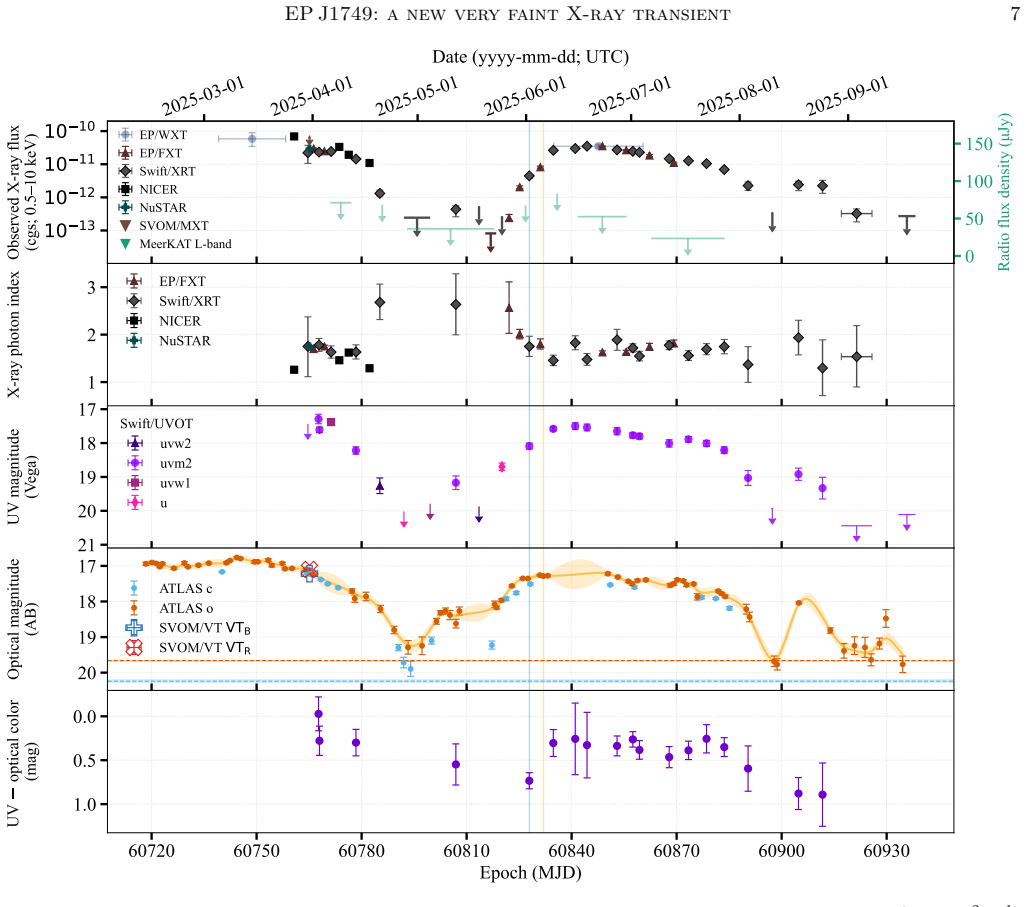
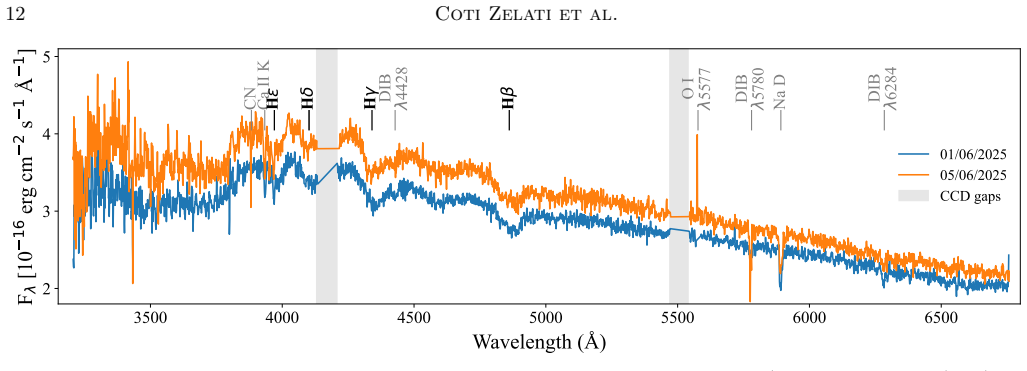
Multi-wavelength observations of the repeated outbursts reveal consistently hard X-ray spectra from thermal Comptonization of very soft seed photons, with no detected thermal disk component and a low seed-photon temperature that together imply a cool and possibly truncated accretion disk. The optical and ultraviolet counterpart brightens in tandem with the X-rays, showing a blue continuum and broad Balmer absorption features that support a disk-dominated origin with viscous heating as the primary mechanism and possible irradiation in the ultraviolet. No radio emission is detected. Taken together, these properties support classifying the source as a very faint X-ray transient black hole.
What carries the argument
Thermal Comptonization of soft seed photons in hard X-ray spectra without a detectable disk blackbody, paired with the optical/UV-X-ray luminosity correlation that traces disk emission.
If this is right
- Very faint transients can display hard spectra from Comptonization even when the accretion disk is cool and truncated.
- Optical and ultraviolet monitoring provides essential evidence for the disk origin of the outburst emission in these low-luminosity events.
- Jet activity appears suppressed, as shown by the lack of detectable radio emission during the outbursts.
- Such systems add to the known population of black hole candidates at the faint end of the X-ray transient distribution.
Where Pith is reading between the lines
- Higher-sensitivity soft X-ray observations could test whether a faint disk component appears at still lower fluxes.
- Long-term monitoring in quiescence might allow radial-velocity measurements to obtain a dynamical mass and confirm the compact-object type.
- The truncation radius inferred from the seed-photon temperature offers a way to map inner-disk behavior across a range of low accretion rates.
- Similar faint hard-spectrum transients without radio counterparts may represent a larger hidden population accessible to wide-field surveys.
Load-bearing premise
The black hole classification rests on interpreting the missing thermal disk component, low seed-photon temperature, and optical/UV correlation as incompatible with a neutron star without direct mass measurement or detection of pulsations or bursts.
What would settle it
Detection of coherent X-ray pulsations or a thermonuclear type-I burst in future observations would indicate a neutron star and rule out the black hole candidate status.
Figures






read the original abstract
We report the discovery and multi-wavelength characterization of the Galactic transient EP J174942.2$-$384834, first detected by the Einstein Probe during a faint X-ray outburst in March 2025. Coordinated follow-up observations revealed two major outbursts and a rebrightening over a seven-month period. Broadband X-ray spectral modeling shows that the outburst emission was dominated by thermal Comptonization of very soft seed photons. The absence of a detected thermal disk component, together with the low inferred seed-photon temperature, is consistent with a cool and possibly truncated accretion disk. The X-ray spectrum remained consistently hard throughout the outburst activity, with a power-law photon index of $\Gamma \approx 1$-2, gradually softening as the flux declined. The optical/UV counterpart brightened in tandem with the X-ray emission and exhibited a blue continuum with broad Balmer absorption features. Together with the optical/UV - X-ray luminosity correlation, this supports a disk-dominated origin of the optical/UV outburst emission, with viscous heating likely playing a major role and irradiation possibly contributing, especially in the UV. No radio counterpart was detected, implying at most very faint jet activity. Taken together, the observed properties support the classification of EP J174942.2$-$384834 as a very faint X-ray transient black hole candidate. This study demonstrates the ability of Einstein Probe to uncover and characterize the faintest accreting compact objects in the Galaxy.
Editorial analysis
A structured set of objections, weighed in public.
Referee Report
Summary. The manuscript reports the discovery of the Galactic X-ray transient EP J174942.2-384834 by the Einstein Probe in March 2025, followed by coordinated multi-wavelength observations over seven months that captured two major outbursts and a rebrightening. Broadband X-ray spectra are modeled as thermal Comptonization of soft seed photons with consistently hard power-law indices (Γ ≈ 1-2) that soften as flux declines; no thermal disk component is detected and seed-photon temperatures are low, consistent with a cool/truncated disk. Optical/UV photometry and spectroscopy show correlated brightening with a blue continuum and broad Balmer absorption, supporting a disk-dominated origin with possible viscous heating and irradiation contributions. No radio counterpart is detected. These properties are interpreted as supporting classification of the source as a very faint X-ray transient black hole candidate.
Significance. If the classification holds, the result adds a new member to the sparse population of very faint X-ray transients and illustrates the Einstein Probe's ability to detect and enable characterization of the faintest accreting compact objects in the Galaxy. The multi-wavelength dataset provides a coherent observational picture of hard-state accretion at low luminosities, with the hard spectra, luminosity correlations, and non-detections aligning with expectations for a truncated disk in a black-hole system.
major comments (1)
- [§3] §3 (X-ray spectral analysis): the central claim that the data support a truncated-disk black-hole interpretation rests on the non-detection of a thermal disk component and the low seed-photon temperature; however, the manuscript does not report quantitative upper limits on any disk normalization or formal model-comparison statistics (e.g., Δχ² or BIC) between Comptonization-only and Comptonization-plus-disk models, which weakens the load-bearing step from 'no detected component' to 'truncated disk'.
minor comments (3)
- [Abstract] Abstract: the statement that the spectrum 'gradually softened as the flux declined' is qualitative; the text should report the actual range of Γ values and the corresponding flux levels at which the softening occurs.
- [Optical/UV analysis] Optical/UV section: the claimed optical/UV–X-ray luminosity correlation is invoked to argue for a disk-dominated origin, but the manuscript should state the fitted slope, Pearson coefficient, or p-value so that readers can assess the strength of the correlation.
- [Table 1] Table 1 or equivalent: ensure all reported luminosities include the exact distance assumption and the 1σ uncertainties propagated from the spectral fits.
Simulated Author's Rebuttal
We thank the referee for their constructive review and recommendation for minor revision. We address the major comment below.
read point-by-point responses
-
Referee: [§3] §3 (X-ray spectral analysis): the central claim that the data support a truncated-disk black-hole interpretation rests on the non-detection of a thermal disk component and the low seed-photon temperature; however, the manuscript does not report quantitative upper limits on any disk normalization or formal model-comparison statistics (e.g., Δχ² or BIC) between Comptonization-only and Comptonization-plus-disk models, which weakens the load-bearing step from 'no detected component' to 'truncated disk'.
Authors: We agree that quantitative upper limits on disk normalization and formal model-comparison statistics would strengthen the interpretation. In the revised manuscript we have added diskbb+nthcomp fits to all spectra, reporting 90% upper limits on the disk normalization (typically <10-20 in XSPEC units, consistent with a truncated disk). We also tabulate Δχ² and BIC differences, confirming that adding the disk component yields no statistically significant improvement (Δχ² < 2-4 in most cases, with BIC favoring the single-component model). These results are now included in Section 3 and the spectral tables. revision: yes
Circularity Check
No significant circularity in observational classification
full rationale
The paper reports multi-wavelength observations of a transient source and classifies it as a very faint X-ray transient black hole candidate based on direct empirical properties: hard X-ray spectra (Γ≈1-2), absence of detected thermal disk, low seed-photon temperature, optical/UV-X-ray correlations, blue continuum with Balmer features, and non-detection in radio. These are compared to known systems without any claimed first-principles derivation, fitted-parameter prediction, or self-referential uniqueness theorem. No equations or models reduce to the target classification by construction; the conclusion is framed as 'supports the classification' from standard observational criteria. This is a self-contained empirical analysis with no load-bearing self-citations or ansatz smuggling.
Axiom & Free-Parameter Ledger
free parameters (2)
- photon index Gamma
- seed photon temperature
axioms (2)
- domain assumption Hard X-ray spectra with Gamma ~1-2 and absence of thermal disk component indicate truncated accretion disk in black hole systems
- domain assumption Optical/UV-X-ray luminosity correlation implies disk-dominated emission with viscous heating
Reference graph
Works this paper leans on
-
[1]
2024, RMxAA, 60, 403, doi: 10.22201/ia.01851101p.2024.60.02.18
Ahmed, O., Degenaar, N., Wijnands, R., & Armas Padilla, M. 2024, RMxAA, 60, 403, doi: 10.22201/ia.01851101p.2024.60.02.18
-
[2]
2023, ARA&A, 61, 329, doi: 10.1146/annurev-astro-052920-103508
Aigrain, S., & Foreman-Mackey, D. 2023, ARA&A, 61, 329, doi: 10.1146/annurev-astro-052920-103508
-
[3]
1997, in Astrophysics and Space Science
Alexander, T. 1997, in Astrophysics and Space Science
1997
-
[4]
218, Astronomical Time Series, ed
Library, Vol. 218, Astronomical Time Series, ed. D. Maoz, A. Sternberg, & E. M. Leibowitz, 163, doi: 10.1007/978-94-015-8941-3 14
-
[5]
Alexander, T. 2013, arXiv e-prints, arXiv:1302.1508, doi: 10.48550/arXiv.1302.1508 Ar´ evalo, P., & Uttley, P. 2006, MNRAS, 367, 801, doi: 10.1111/j.1365-2966.2006.09989.x Armas Padilla, M., Corral-Santana, J. M., Borghese, A., et al. 2023, A&A, 677, A186, doi: 10.1051/0004-6361/202346797 Armas Padilla, M., Degenaar, N., Russell, D. M., &
-
[6]
Wijnands, R. 2013, MNRAS, 428, 3083, doi: 10.1093/mnras/sts255 Armas Padilla, M., Wijnands, R., Altamirano, D., et al. 2014, MNRAS, 439, 3908, doi: 10.1093/mnras/stu243
-
[7]
Arnaud, K. A. 1996, in Astronomical Society of the Pacific Conference Series, Vol. 101, Astronomical Data Analysis Software and Systems V, ed. G. H. Jacoby & J. Barnes, 17
1996
-
[8]
Asquini, L., Baglio, M. C., Campana, S., et al. 2024, A&A, 692, A16, doi: 10.1051/0004-6361/202450816 Astropy Collaboration, Robitaille, T. P., Tollerud, E. J., et al. 2013, A&A, 558, A33, doi: 10.1051/0004-6361/201322068 Astropy Collaboration, Price-Whelan, A. M., Sip˝ ocz, B. M., et al. 2018, aj, 156, 123, doi: 10.3847/1538-3881/aabc4f Astropy Collabora...
-
[9]
2023, A&A, 675, A199, doi: 10.1051/0004-6361/202346522
Avakyan, A., Neumann, M., Zainab, A., et al. 2023, A&A, 675, A199, doi: 10.1051/0004-6361/202346522
-
[10]
Bachetti, M., Huppenkothen, D., Stevens, A., et al. 2024, Journal of Open Source Software, 9, 7389, doi: 10.21105/joss.07389
-
[11]
Baglio, M. C., Alabarta, K., Russell, D. M., et al. 2025, A&A, 704, A198, doi: 10.1051/0004-6361/202556699
-
[13]
2022, bersavosh/XRB-LrLx pub: update 20220908, v220908 Zenodo, doi: 10.5281/zenodo.7059313
Bahramian, A., & Rushton, A. 2022, bersavosh/XRB-LrLx pub: update 20220908, v220908 Zenodo, doi: 10.5281/zenodo.7059313
-
[14]
Bahramian, A., Heinke, C. O., Kennea, J. A., et al. 2021, MNRAS, 501, 2790, doi: 10.1093/mnras/staa3868
-
[15]
2021, AJ, 161, 147, doi: 10.3847/1538-3881/abd806
Demleitner, M., & Andrae, R. 2021, AJ, 161, 147, doi: 10.3847/1538-3881/abd806
work page internal anchor Pith review doi:10.3847/1538-3881/abd806 2021
-
[16]
1990, A&A, 227, L33
Belloni, T., & Hasinger, G. 1990, A&A, 227, L33
1990
-
[17]
Belloni, T. M. 2010, in Lecture Notes in Physics, Berlin Springer Verlag, ed. T. Belloni, Vol. 794, 53, doi: 10.1007/978-3-540-76937-8 3
-
[18]
Belloni, T. M., & Motta, S. E. 2016, in Astrophysics and Space Science Library, Vol. 440, Astrophysics of Black Holes: From Fundamental Aspects to Latest Developments, ed. C. Bambi, 61, doi: 10.1007/978-3-662-52859-4 2
-
[19]
Buckley, D. A. H., Swart, G. P., & Meiring, J. G. 2006, in Society of Photo-Optical Instrumentation Engineers (SPIE) Conference Series, Vol. 6267, Ground-based and Airborne Telescopes, ed. L. M. Stepp, 62670Z, doi: 10.1117/12.673750
-
[20]
Burgh, E. B., Nordsieck, K. H., Kobulnicky, H. A., et al. 2003, in Proc. SPIE, Vol. 4841, Instrument Design and Performance for Optical/Infrared Ground-based Telescopes, ed. M. Iye & A. F. M. Moorwood, 1463–1471, doi: 10.1117/12.460312
-
[21]
J., Gilfanov, M., & Sunyaev, R
Burke, M. J., Gilfanov, M., & Sunyaev, R. 2017, MNRAS, 466, 194, doi: 10.1093/mnras/stw2514
-
[22]
Burrows, D. N., Hill, J. E., Nousek, J. A., et al. 2005, SSRv, 120, 165, doi: 10.1007/s11214-005-5097-2
-
[23]
Callanan, P. J., Garcia, M. R., McClintock, J. E., et al. 1995, ApJ, 441, 786, doi: 10.1086/175402 CASA Team, Bean, B., Bhatnagar, S., et al. 2022, PASP, 134, 114501, doi: 10.1088/1538-3873/ac9642
-
[24]
Cash, W. 1979, ApJ, 228, 939, doi: 10.1086/156922
-
[25]
2020, in Society of Photo-Optical Instrumentation Engineers (SPIE) Conference Series, Vol
Chen, Y., Cui, W., Han, D., et al. 2021, in Society of Photo-Optical Instrumentation Engineers (SPIE) Conference Series, Vol. 11444, Society of Photo-Optical Instrumentation Engineers (SPIE) Conference Series, ed. J.-W. A. den Herder, S. Nikzad, & K. Nakazawa, 114445B, doi: 10.1117/12.2562311
-
[26]
2025, Radiation Detection Technology and Methods, doi: 10.1007/s41605-025-00558-0
Chen, Y., Wang, J., Yang, Y., et al. 2025, Radiation Detection Technology and Methods, doi: 10.1007/s41605-025-00558-0
-
[27]
2025, Experimental Astronomy, 60, 15, doi: 10.1007/s10686-025-10025-9
Cheng, H., Zhang, C., Ling, Z., et al. 2025, Experimental Astronomy, 60, 15, doi: 10.1007/s10686-025-10025-9
-
[28]
Cheng, H. Q., Zhao, Q. C., Tao, L., et al. 2025, ApJL, 991, L41, doi: 10.3847/2041-8213/adf104
-
[29]
Corbel, S., Coriat, M., Brocksopp, C., et al. 2013, MNRAS, 428, 2500, doi: 10.1093/mnras/sts215
-
[30]
Corbel, S., Nowak, M. A., Fender, R. P., Tzioumis, A. K., & Markoff, S. 2003, A&A, 400, 1007, doi: 10.1051/0004-6361:20030090 28Coti Zelati et al
-
[31]
Corbel, S., Tomsick, J. A., & Kaaret, P. 2006, ApJ, 636, 971, doi: 10.1086/498230
-
[32]
The SVOM mission, its profile and its system
Cordier, B., Wei, J. Y., Zhang, S. N., et al. 2026, arXiv e-prints, arXiv:2604.24257. https://arxiv.org/abs/2604.24257
work page internal anchor Pith review Pith/arXiv arXiv 2026
-
[33]
2009, MNRAS, 396, 1383, doi:10.1111/j.1365-2966.2009.14843.x
Coriat, M., Corbel, S., Buxton, M. M., et al. 2009, MNRAS, 400, 123, doi: 10.1111/j.1365-2966.2009.15461.x
-
[34]
M., Casares, J., Mu˜ noz-Darias, T., et al
Corral-Santana, J. M., Casares, J., Mu˜ noz-Darias, T., et al. 2016, A&A, 587, A61, doi: 10.1051/0004-6361/201527130
-
[35]
M., Rodr´ ıguez-Gil, P., Torres, M
Corral-Santana, J. M., Rodr´ ıguez-Gil, P., Torres, M. A. P., et al. 2025, A&A, 702, A225, doi: 10.1051/0004-6361/202556452
-
[37]
7737, Observatory Operations: Strategies, Processes, and Systems III, ed
Crawford, S. M., Still, M., Schellart, P., et al. 2010b, in Society of Photo-Optical Instrumentation Engineers (SPIE) Conference Series, Vol. 7737, Observatory Operations: Strategies, Processes, and Systems III, ed. D. R. Silva, A. B. Peck, & B. T. Soifer, 773725, doi: 10.1117/12.857000 C´ uneo, V. A., Alabarta, K., Zhang, L., et al. 2020, MNRAS, 496, 100...
-
[38]
2023, MNRAS, 521, 2692, doi: 10.1093/mnras/stad714
Dai, X., Kong, L., Bu, Q., et al. 2023, MNRAS, 521, 2692, doi: 10.1093/mnras/stad714
-
[39]
Decleir, M., Gordon, K. D., Andrews, J. E., et al. 2022, The Astrophysical Journal, 930, 15, doi: 10.3847/1538-4357/ac5dbe
-
[40]
Deeming, T. J. 1975, Ap&SS, 36, 137, doi: 10.1007/BF00681947
-
[41]
2009, A&A, 495, 547, doi: 10.1051/0004-6361:200810654
Degenaar, N., & Wijnands, R. 2009, A&A, 495, 547, doi: 10.1051/0004-6361:200810654
-
[42]
Degenaar, N., Wijnands, R., Cackett, E. M., et al. 2012, A&A, 545, A49, doi: 10.1051/0004-6361/201219470
-
[43]
Degenaar, N., Wijnands, R., Miller, J. M., et al. 2015, Journal of High Energy Astrophysics, 7, 137, doi: 10.1016/j.jheap.2015.03.005 Del Santo, M., Sidoli, L., Mereghetti, S., et al. 2007, A&A, 468, L17, doi: 10.1051/0004-6361:20077536 Di Salvo, T., Papitto, A., Marino, A., Iaria, R., & Burderi, L. 2023, in Handbook of X-ray and Gamma-ray Astrophysics, 1...
-
[44]
2007, A&A Rv, 15, 1, doi: 10.1007/s00159-007-0006-1
Done, C., Gierli´ nski, M., & Kubota, A. 2007, A&A Rv, 15, 1, doi: 10.1007/s00159-007-0006-1
-
[45]
2024, arXiv e-prints, arXiv:2403.03127, doi: 10.48550/arXiv.2403.03127
Doroshenko, V. 2024, arXiv e-prints, arXiv:2403.03127, doi: 10.48550/arXiv.2403.03127
-
[46]
Dubus, G., Hameury, J. M., & Lasota, J. P. 2001, A&A, 373, 251, doi: 10.1051/0004-6361:20010632
-
[47]
Earl, N., Tollerud, E., O’Steen, R., et al. 2025, astropy/specutils: v1.20.3, v1.20.3 Zenodo, doi: 10.5281/zenodo.15658692 El Byad, H., Bachetti, M., Columbu, S., et al. 2025, ApJ, 989, 202, doi: 10.3847/1538-4357/aded8a
-
[48]
2009, MNRAS, 396, 1383, doi:10.1111/j.1365-2966.2009.14843.x
Elebert, P., Reynolds, M. T., Callanan, P. J., et al. 2009, MNRAS, 395, 884, doi: 10.1111/j.1365-2966.2009.14562.x
-
[49]
Esin, A. A., McClintock, J. E., & Narayan, R. 1997, ApJ, 489, 865, doi: 10.1086/304829
-
[50]
2009, MNRAS, 396, 1383, doi:10.1111/j.1365-2966.2009.14843.x
Evans, P. A., Beardmore, A. P., Page, K. L., et al. 2009, MNRAS, 397, 1177, doi: 10.1111/j.1365-2966.2009.14913.x
-
[51]
Clayton, G. C. 2019, The Astrophysical Journal, 886, 108, doi: 10.3847/1538-4357/ab4c3a
-
[52]
2024, A&A, 684, A124, doi: 10.1051/0004-6361/202347908
Chaty, S. 2024, A&A, 684, A124, doi: 10.1051/0004-6361/202347908 F¨ urst, F., Tomsick, J. A., Yamaoka, K., et al. 2016, ApJ, 832, 115, doi: 10.3847/0004-637X/832/2/115 Gaia Collaboration. 2023, A&A, 674, A1, doi: 10.1051/0004-6361/202243940
-
[53]
2018, MNRAS, 478, L132, doi: 10.1093/mnrasl/sly083
Gallo, E., Degenaar, N., & van den Eijnden, J. 2018, MNRAS, 478, L132, doi: 10.1093/mnrasl/sly083
-
[54]
2003, MNRAS, 340, 1214, doi: 10.1046/j.1365-8711.2003.06380.x
Gallo, E., Fender, R. P., & Pooley, G. G. 2003, MNRAS, 344, 60, doi: 10.1046/j.1365-8711.2003.06791.x
-
[55]
Gallo, E., Miller-Jones, J. C. A., Russell, D. M., et al. 2014, MNRAS, 445, 290, doi: 10.1093/mnras/stu1599 Garc´ ıa, J., Dauser, T., Lohfink, A., et al. 2014, ApJ, 782, 76, doi: 10.1088/0004-637X/782/2/76
-
[56]
2013, MNRAS, 434, 3454, doi: 10.1093/mnras/stt1257
Gardner, E., & Done, C. 2013, MNRAS, 434, 3454, doi: 10.1093/mnras/stt1257
-
[57]
2004, The Astrophysical Journal, 611, 1005, doi: 10.1086/422091
Gehrels, N., Chincarini, G., Giommi, P., et al. 2004, ApJ, 611, 1005, doi: 10.1086/422091
-
[58]
Gelman, A., & Rubin, D. B. 1992, Statistical Science, 7, 457, doi: 10.1214/ss/1177011136
-
[59]
Space Telescopes and Instrumentation 2016: Ultraviolet to Gamma Ray , year = 2016, editor =
Gendreau, K. C., Arzoumanian, Z., Adkins, P. W., et al. 2016, in Society of Photo-Optical Instrumentation Engineers (SPIE) Conference Series, Vol. 9905, Space Telescopes and Instrumentation 2016: Ultraviolet to Gamma Ray, ed. J.-W. A. den Herder, T. Takahashi, & M. Bautz, 99051H, doi: 10.1117/12.2231304
-
[60]
Ginsburg, A., Sip˝ ocz, B. M., Brasseur, C. E., et al. 2019, AJ, 157, 98, doi: 10.3847/1538-3881/aafc33
-
[61]
Goodwin, A. J., Russell, D. M., Galloway, D. K., et al. 2020, MNRAS, 498, 3429, doi: 10.1093/mnras/staa2588
-
[62]
Gordon, C., & Arnaud, K. 2021, PyXspec: Python interface to XSPEC spectral-fitting program,, Astrophysics Source Code Library, record ascl:2101.014 http://ascl.net/2101.014 EP J1749: a new very faint X-ray transient29
2021
-
[63]
Gordon, K. D. 2024, Journal of Open Source Software, 9, 7023, doi: 10.21105/joss.07023
-
[64]
D., Cartledge, S., & Clayton, G
Gordon, K. D., Cartledge, S., & Clayton, G. C. 2009, The Astrophysical Journal, 705, 1320, doi: 10.1088/0004-637X/705/2/1320
-
[65]
The Microchannel X-ray Telescope on board the SVOM mission: in-flight scientific performance
Gordon, K. D., Misselt, K. A., Bouwman, J., et al. 2021, The Astrophysical Journal, 916, 33, doi: 10.3847/1538-4357/ac00b7 G¨ otz, D., Crepaldi, S., Doumayrou, E., et al. 2026, arXiv e-prints, arXiv:2604.24246. https://arxiv.org/abs/2604.24246
work page internal anchor Pith review Pith/arXiv arXiv doi:10.3847/1538-4357/ac00b7 2021
-
[66]
Journal of Open Source Software , author =
Green, G. 2018, The Journal of Open Source Software, 3, 695, doi: 10.21105/joss.00695
-
[67]
Hale, C. L., McConnell, D., Thomson, A. J. M., et al. 2021, PASA, 38, e058, doi: 10.1017/pasa.2021.47
-
[68]
Hameury, J. M. 2020, Advances in Space Research, 66, 1004, doi: 10.1016/j.asr.2019.10.022
-
[69]
Hannikainen, D. C., Hunstead, R. W., Campbell-Wilson, D., & Sood, R. K. 1998, A&A, 337, 460, doi: 10.48550/arXiv.astro-ph/9805332
work page internal anchor Pith review doi:10.48550/arxiv.astro-ph/9805332 1998
-
[70]
Harris, C. R., Millman, K. J., van der Walt, S. J., et al. 2020, Nature, 585, 357, doi: 10.1038/s41586-020-2649-2
-
[71]
Harrison, F. A., Craig, W. W., Christensen, F. E., et al. 2013, ApJ, 770, 103, doi: 10.1088/0004-637X/770/2/103
-
[72]
O., Bahramian, A., Degenaar, N., & Wijnands, R
Heinke, C. O., Bahramian, A., Degenaar, N., & Wijnands, R. 2015, MNRAS, 447, 3034, doi: 10.1093/mnras/stu2652
-
[73]
Heinke, C. O., Zheng, J., Maccarone, T. J., et al. 2025, ApJS, 279, 57, doi: 10.3847/1538-4365/ade99a
-
[74]
2020, oxkat: Semi-automated imaging of MeerKAT observations,, Astrophysics Source Code Library, record ascl:2009.003 http://ascl.net/2009.003
Heywood, I. 2020, oxkat: Semi-automated imaging of MeerKAT observations,, Astrophysics Source Code Library, record ascl:2009.003 http://ascl.net/2009.003
2020
-
[75]
2005, Ap&SS, 300, 107, doi: 10.1007/s10509-005-1197-4
Homan, J., & Belloni, T. 2005, Ap&SS, 300, 107, doi: 10.1007/s10509-005-1197-4
-
[76]
Homan, J., Fridriksson, J. K., Jonker, P. G., et al. 2013, ApJ, 775, 9, doi: 10.1088/0004-637X/775/1/9
- [77]
-
[78]
K., Carotenuto, F., Russell, T
Hughes, A. K., Carotenuto, F., Russell, T. D., et al. 2025, MNRAS, 542, 1803, doi: 10.1093/mnras/staf1363
-
[79]
Astronomical Data Analysis Software and Systems XXX , year = 2022, editor =
Hugo, B. V., Perkins, S., Merry, B., Mauch, T., & Smirnov, O. M. 2022, in Astronomical Society of the Pacific Conference Series, Vol. 532, Astronomical Data Analysis Software and Systems XXX, ed. J. E. Ruiz, F. Pierfedereci, & P. Teuben, 541, doi: 10.48550/arXiv.2206.09179
-
[80]
Hunter, J. D. 2007, Computing in Science & Engineering, 9, 90, doi: 10.1109/MCSE.2007.55
-
[81]
Huppenkothen, D., Bachetti, M., Stevens, A. L., et al. 2019, ApJ, 881, 39, doi: 10.3847/1538-4357/ab258d
-
[82]
Israel, G. L., & Stella, L. 1996, ApJ, 468, 369, doi: 10.1086/177697
discussion (0)
Sign in with ORCID, Apple, or X to comment. Anyone can read and Pith papers without signing in.