Recognition: unknown
Functional Dismantling of Network Relaxation through Slow-Branch Susceptibility
Pith reviewed 2026-05-07 17:56 UTC · model grok-4.3
The pith
A modal susceptibility score derived from the real part of the tracked slow Laplacian branch quantifies first-order changes in relaxation rate under node deletion in directed networks.
A machine-rendered reading of the paper's core claim, the machinery that carries it, and where it could break.
Core claim
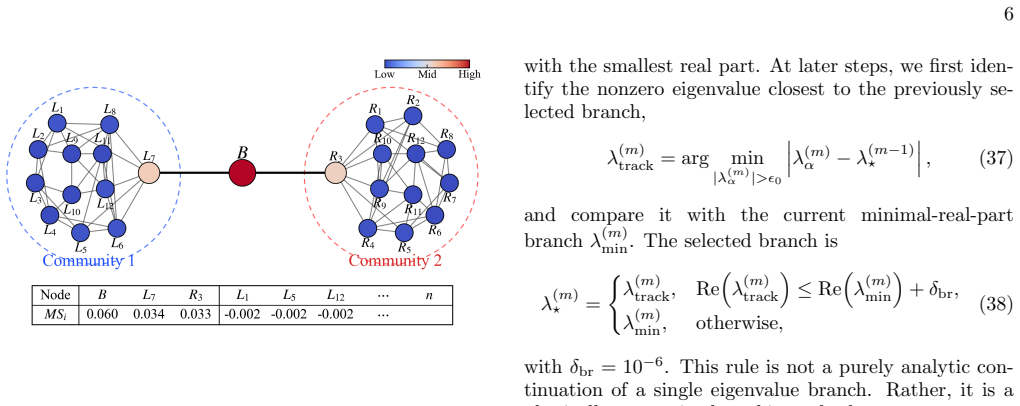
Node deletion is then treated as a dimension-changing compression of the operator, leading to a modal susceptibility (MS) score that estimates the first-order reduction of the branch-tracked relaxation rate from the biorthogonal support of the slow mode.
Load-bearing premise
That a unique slow collective mode can be reliably identified and tracked across node deletions, and that the first-order perturbation via biorthogonal projection accurately captures the change in the real part of the relevant Laplacian eigenvalue without higher-order effects dominating.
Figures


read the original abstract
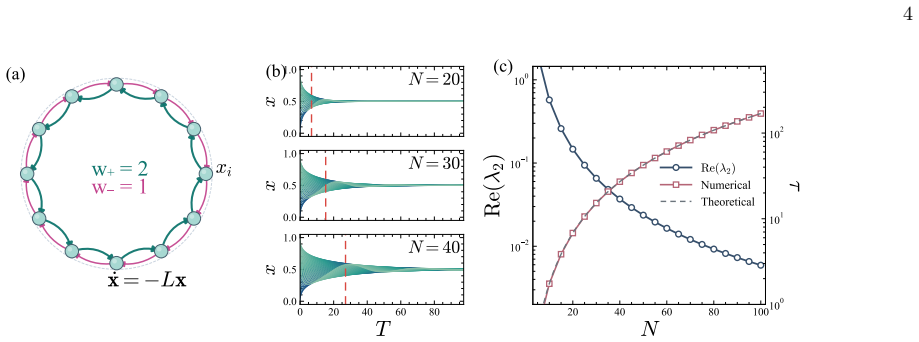
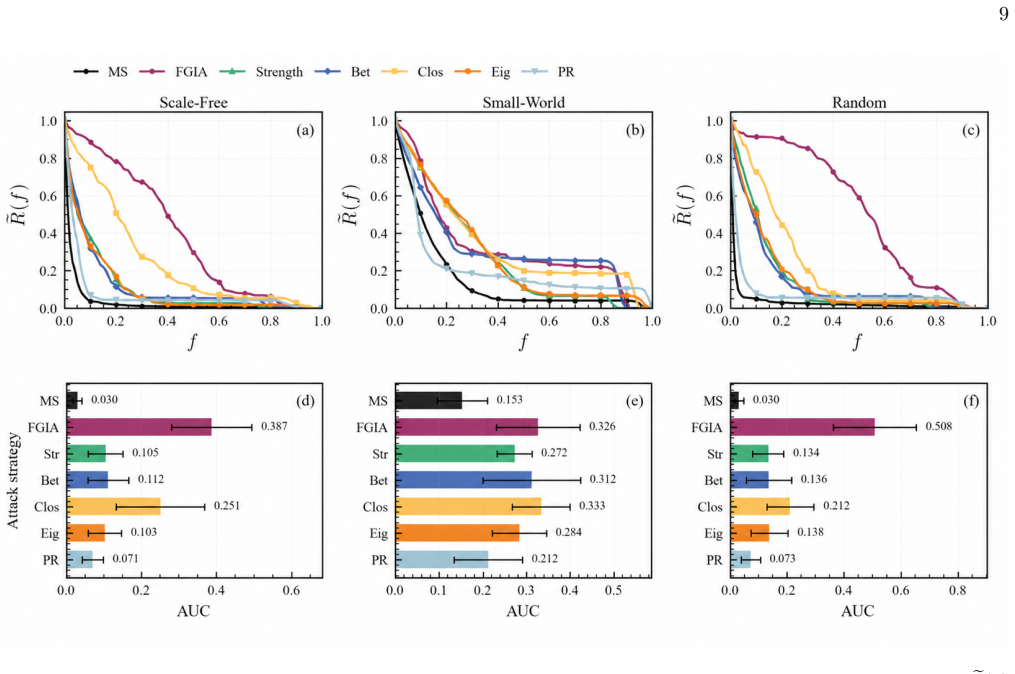
Robustness of relaxation on asymmetric networks is not determined by connectivity alone, because the slow collective mode can be complex and may change its spectral identity under adaptive damage. We introduce a slow-branch susceptibility framework for functional dismantling of network relaxation. Starting from the projected relaxation dynamics, we show that the relevant robustness observable is the real part of the selected nonzero Laplacian branch, which controls the long-time decay of the nonstationary sector. Node deletion is then treated as a dimension-changing compression of the operator, leading to a modal susceptibility (MS) score that estimates the first-order reduction of the branch-tracked relaxation rate from the biorthogonal support of the slow mode. In the reciprocal limit, the same construction reduces to the weighted Fiedler sector, placing directed and weighted-undirected networks within a common spectral-response formulation. Tests on synthetic and real-world networks show that MS identifies vulnerability patterns that differ from standard centrality-based attacks and edge-level spectral proxies. These results resolve a modal-selection ambiguity in non-Hermitian robustness analysis and provide a spectral basis for functional dismantling in asymmetric networks.
Editorial analysis
A structured set of objections, weighed in public.
Axiom & Free-Parameter Ledger
axioms (3)
- domain assumption Relaxation dynamics on the network are governed by the (possibly non-Hermitian) Laplacian operator.
- domain assumption The long-time decay of the nonstationary sector is controlled by the real part of a selected nonzero eigenvalue.
- standard math Biorthogonal left and right eigenvectors exist and can be used to compute first-order perturbations.
invented entities (1)
-
Modal susceptibility (MS) score
no independent evidence
Reference graph
Works this paper leans on
-
[1]
M. E. J. Newman,Networks: An Introduction(Oxford University Press, Oxford, 2010)
2010
-
[2]
Albert and A.-L
R. Albert and A.-L. Barab´ asi, Rev. Mod. Phys.74, 47 (2002)
2002
-
[3]
Arenas, A
A. Arenas, A. D´ ıaz-Guilera, J. Kurths, Y. Moreno, and C. Zhou, Phys. Rep.469, 93 (2008)
2008
-
[4]
J. G. Restrepo, E. Ott, and B. R. Hunt, Phys. Rev. E 71, 036151 (2005)
2005
-
[5]
Chung, Annals of Combinatorics9, 1 (2005)
F. Chung, Annals of Combinatorics9, 1 (2005)
2005
-
[6]
Battiston, E
F. Battiston, E. Amico, A. Barrat, G. Bianconi, G. Fer- raz de Arruda, B. Franceschiello, I. Iacopini, S. K´ efi, V. Latora, Y. Moreno, M. M. Murray, T. P. Peixoto, F. Vaccarino, and G. Petri, Nature Physics17, 1093 (2021)
2021
-
[7]
Gallo, R
L. Gallo, R. Muolo, L. V. Gambuzza, V. Latora, M. Frasca, and T. Carletti, Communications Physics5, 263 (2022)
2022
-
[8]
Zhang, M
Y. Zhang, M. Lucas, and F. Battiston, Nature Commu- nications14, 1605 (2023)
2023
-
[9]
Nazerian, J
A. Nazerian, J. D. Hart, M. Lodi, and F. Sorrentino, Nature Communications15, 9003 (2024)
2024
-
[10]
Forrow, F
A. Forrow, F. G. Woodhouse, and J. Dunkel, Physical Review X8, 041043 (2018)
2018
-
[11]
J. C. Bronski and L. DeVille, SIAM Journal on Applied Mathematics74, 83 (2014)
2014
-
[12]
E. M. Shahrivar, M. Pirani, and S. Sundaram, Automat- ica83, 234 (2017)
2017
-
[13]
Grassia, M
M. Grassia, M. De Domenico, and G. Mangioni, Nature Communications12, 5190 (2021)
2021
-
[14]
Artime and M
O. Artime and M. De Domenico, Nature Communica- tions12, 2478 (2021)
2021
-
[15]
Fiedler, Czechoslovak Mathematical Journal23, 298 (1973)
M. Fiedler, Czechoslovak Mathematical Journal23, 298 (1973)
1973
-
[16]
Merris, Linear Algebra Appl.197–198, 143 (1994)
R. Merris, Linear Algebra Appl.197–198, 143 (1994)
1994
-
[17]
Mohar, Graph Theory, Combinatorics, and Applica- tions2, 871 (1991)
B. Mohar, Graph Theory, Combinatorics, and Applica- tions2, 871 (1991)
1991
-
[18]
Albert, H
R. Albert, H. Jeong, and A.-L. Barab´ asi, Nature406, 378 (2000)
2000
-
[19]
Cohen, K
R. Cohen, K. Erez, D. ben Avraham, and S. Havlin, Phys. Rev. Lett.86, 3682 (2001)
2001
-
[20]
Holme, B
P. Holme, B. J. Kim, C. N. Yoon, and S. K. Han, Phys. Rev. E65, 056109 (2002)
2002
-
[21]
Crucitti, V
P. Crucitti, V. Latora, and M. Marchiori, Phys. Rev. E 69, 045104 (2004)
2004
-
[22]
C. M. Schneider, A. A. Moreira, J. S. Andrade, S. Havlin, and H. J. Herrmann, Proceedings of the National Academy of Sciences108, 3838 (2011)
2011
-
[23]
J. Gao, S. V. Buldyrev, H. E. Stanley, and S. Havlin, Nature Physics8, 40 (2012)
2012
-
[24]
S. V. e. a. Buldyrev, Nature464, 1025 (2010)
2010
-
[25]
Luo, Chaos36, 023137 (2026)
K. Luo, Chaos36, 023137 (2026)
2026
-
[26]
Jiang, J.-a
S. Jiang, J.-a. Lu, J. Zhou, and Q. Dai, Phys. Rev. E 109, 054301 (2024)
2024
-
[27]
J. Zhou, Y. Zhang, J.-a. Lu, and G. Chen, IEEE Trans- actions on Systems, Man, and Cybernetics: Systems54, 2757 (2024)
2024
-
[28]
A. Hu, J. Zhou, S. Jiang, J. Hu, and J.-a. Lu, Inter- national Journal of Bifurcation and Chaos35, 2550076 (2025)
2025
-
[29]
Jiang, J
S. Jiang, J. Zhou, M. Small, J.-a. Lu, and Y. Zhang, Phys. Rev. Lett.130, 187402 (2023)
2023
-
[30]
X. Wen, J. Zhou, S. Jiang, Q. Zhou, and J.-a. Lu, Chaos, Solitons & Fractals201, 117389 (2025)
2025
-
[31]
R. A. Rossi and N. K. Ahmed, inAAAI(2015)
2015
discussion (0)
Sign in with ORCID, Apple, or X to comment. Anyone can read and Pith papers without signing in.