Recognition: unknown
Semantic Segmentation for Histopathology using Learned Regularization based on Global Proportions
Pith reviewed 2026-05-07 17:13 UTC · model grok-4.3
The pith
VSLP produces dense histopathology segmentations from global label proportions using variational optimization.
A machine-rendered reading of the paper's core claim, the machinery that carries it, and where it could break.
Core claim
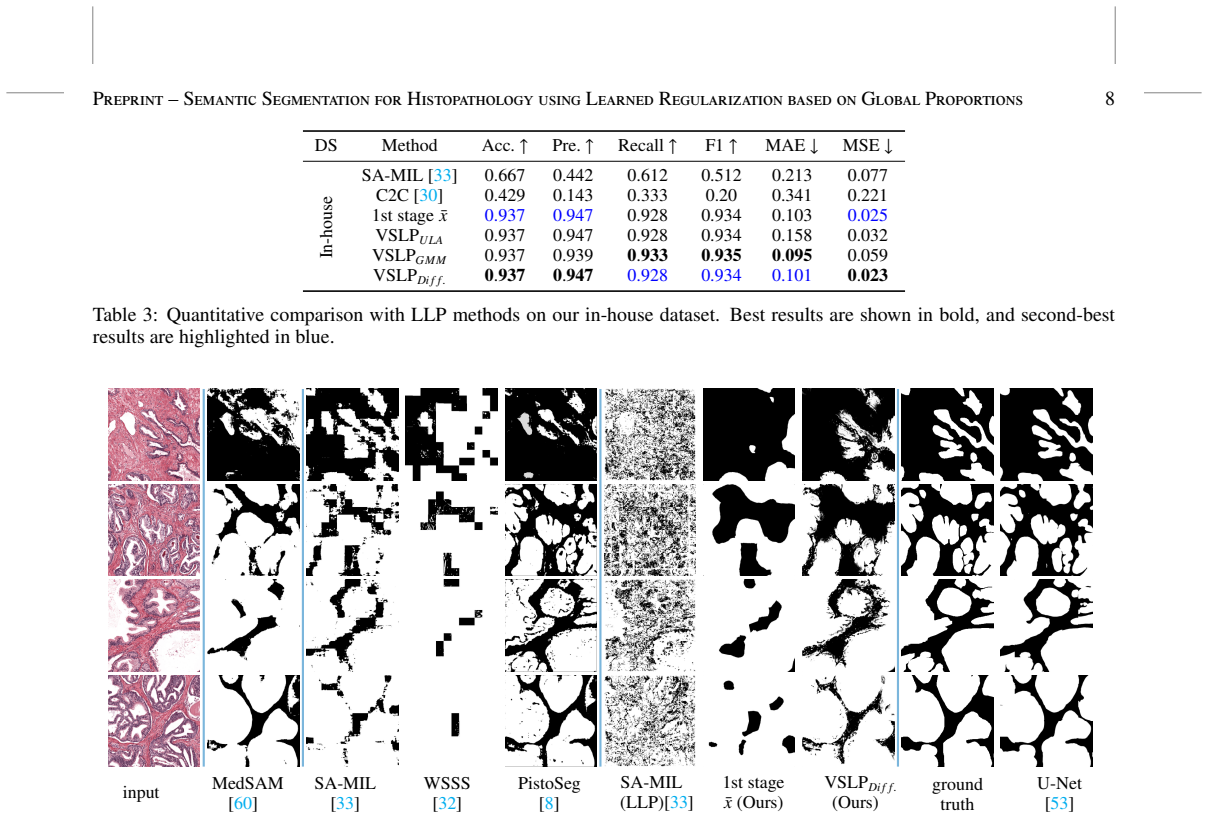
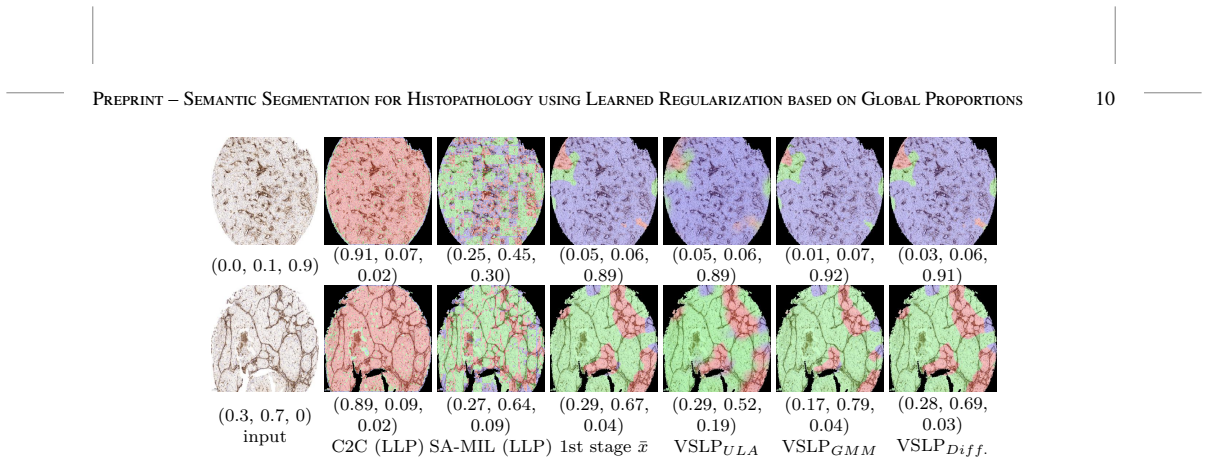
We introduce Variational Segmentation from Label Proportions (VSLP), a two-stage framework that infers dense segmentations from global label proportions without any pixel-level annotations. This framework first leverages a pre-trained transformer model with test-time augmentation to produce a pixel-wise confidence estimate. In the second stage, these estimates are fused by solving a variational optimization problem that incorporates a Wasserstein data fidelity term alongside a learned regularizer. Unlike end-to-end networks, our variational method can visualize the fidelity-regularization energy, resulting in more interpretable segmentation. We validate our approach on two public datasets, a
What carries the argument
The variational optimization stage that fuses initial transformer confidence maps by minimizing a combination of Wasserstein distance to the supplied global proportions and a learned regularizer that encodes spatial priors.
Load-bearing premise
The pre-trained transformer with test-time augmentation produces sufficiently accurate initial pixel-wise confidence estimates so that the learned regularizer can resolve the many possible spatial arrangements consistent with the same global proportions.
What would settle it
On a held-out histopathology dataset that supplies both global proportions and independent pixel-level ground truth, the full VSLP pipeline fails to produce higher Dice scores than the initial transformer confidence map alone or than standard weakly-supervised baselines.
Figures



read the original abstract
In pathology, the spatial distribution and proportions of tissue types are key indicators of disease progression, and are more readily available than fine-grained annotations. However, these assessments are rarely mapped to pixel-wise segmentation. The task is fundamentally underdetermined, as many spatially distinct segmentations can satisfy the same global proportions in the absence of pixel-wise constraints. To address this, we introduce Variational Segmentation from Label Proportions (VSLP), a two-stage framework that infers dense segmentations from global label proportions, without any pixel-level annotations. This framework first leverages a pre-trained transformer model with test-time augmentation to produce a pixel-wise confidence estimate. In the second stage, these estimates are fused by solving a variational optimization problem that incorporates a Wasserstein data fidelity term alongside a learned regularizer. Unlike end-to-end networks, our variational method can visualize the fidelity-regularization energy, resulting in more interpretable segmentation. We validate our approach on two public datasets, achieving superior performance over existing weakly supervised and unsupervised methods. For one of these datasets, proportions have been estimated by an experienced pathologist to provide a realistic benchmark to the community. Furthermore, the method scales to an in-house dataset with noisy pathologist labels, severely outperforming state-of-the-art methods, thereby demonstrating practical applicability. The code and data will be made publicly available upon acceptance at https://github.com/xiaoliangpi/VSLP.
Editorial analysis
A structured set of objections, weighed in public.
Referee Report
Summary. The manuscript introduces Variational Segmentation from Label Proportions (VSLP), a two-stage framework for dense semantic segmentation in histopathology images using only global label proportions and no pixel-level annotations. Stage one employs a pre-trained transformer with test-time augmentation to generate initial pixel-wise confidence maps. Stage two fuses these via variational optimization incorporating a Wasserstein data fidelity term and a learned regularizer. The approach is claimed to achieve superior performance over weakly supervised and unsupervised baselines on two public datasets (one with pathologist-estimated proportions) and one in-house dataset with noisy labels, while offering interpretability through energy visualization; code and data release is promised.
Significance. If the quantitative claims hold after verification, the work would be significant for computational pathology by addressing the annotation bottleneck through global proportions, which are more readily available than dense labels. The variational formulation's interpretability is a clear strength over end-to-end networks, and successful scaling to noisy real-world data supports practical utility in clinical workflows.
major comments (3)
- [Abstract] Abstract: The central claim of 'superior performance' over existing methods on two public datasets is asserted without any quantitative metrics, tables, error bars, or specific numerical comparisons, rendering the claim unverifiable from the provided text and load-bearing for acceptance.
- [Method] Method section (variational stage description): No details are supplied on the learned regularizer's architecture, training objective, dataset (including any separation from test images), or optimization procedure. This is critical because the regularizer must disambiguate spatial layouts consistent with global proportions; without these, the risk of circular fitting or implicit dense supervision cannot be assessed.
- [Experiments] Experiments section: Absence of ablation studies isolating the learned regularizer's contribution versus the initial transformer + TTA estimates, and no description of how global proportions were obtained or validated for the public datasets, undermines evaluation of the two-stage framework's necessity and robustness.
minor comments (1)
- [Abstract] The GitHub link is given but code is not yet available; this is standard for arXiv submissions but should be confirmed in the final version.
Simulated Author's Rebuttal
We thank the referee for the detailed and constructive review. The comments highlight important areas for improving clarity and verifiability. We address each major comment below and will revise the manuscript accordingly.
read point-by-point responses
-
Referee: [Abstract] Abstract: The central claim of 'superior performance' over existing methods on two public datasets is asserted without any quantitative metrics, tables, error bars, or specific numerical comparisons, rendering the claim unverifiable from the provided text and load-bearing for acceptance.
Authors: We agree that the abstract should include quantitative support for the performance claims. In the revised manuscript, we will expand the abstract to report key metrics (e.g., mIoU and Dice scores) with direct numerical comparisons to the weakly supervised and unsupervised baselines, including standard deviations from repeated runs where applicable. revision: yes
-
Referee: [Method] Method section (variational stage description): No details are supplied on the learned regularizer's architecture, training objective, dataset (including any separation from test images), or optimization procedure. This is critical because the regularizer must disambiguate spatial layouts consistent with global proportions; without these, the risk of circular fitting or implicit dense supervision cannot be assessed.
Authors: We will substantially expand the Method section to provide the missing details. The learned regularizer is a lightweight convolutional network whose architecture, training objective (a self-supervised loss encouraging spatial consistency while matching global proportions on synthetic layouts), training dataset (generated synthetically from proportion statistics on a held-out collection of histopathology images with no overlap to any test images), and optimization procedure (gradient-based minimization with explicit hyperparameters) will be described explicitly. This training uses only global proportions and synthetic data, with no access to pixel-level labels on the evaluation images, thereby avoiding circular fitting or implicit dense supervision. revision: yes
-
Referee: [Experiments] Experiments section: Absence of ablation studies isolating the learned regularizer's contribution versus the initial transformer + TTA estimates, and no description of how global proportions were obtained or validated for the public datasets, undermines evaluation of the two-stage framework's necessity and robustness.
Authors: We will add ablation experiments that isolate the contribution of the variational stage (learned regularizer + Wasserstein fidelity) by comparing full VSLP against the initial transformer + TTA confidence maps alone. We will also clarify the provenance of global proportions: for the dataset with pathologist estimates, these are used directly as provided; for the second public dataset, proportions are obtained by summing the available (but unused) pixel annotations into global counts only. We will include a short validation subsection describing how these proportions were cross-checked for consistency. revision: yes
Circularity Check
No significant circularity detected in derivation chain
full rationale
The paper presents VSLP as a two-stage method: a pre-trained transformer with test-time augmentation generates initial pixel-wise confidence maps, followed by variational optimization using a Wasserstein fidelity term and a learned regularizer to produce dense segmentations from global proportions alone. No equations, self-citations, or definitional steps in the abstract or description reduce the output by construction to the inputs. The regularizer is introduced as learned without any indication that its training objective or data directly encodes the target segmentations or global proportions in a self-referential manner. The framework is self-contained against external benchmarks with no load-bearing self-citation chains or fitted predictions renamed as independent results.
Axiom & Free-Parameter Ledger
free parameters (1)
- parameters of the learned regularizer
axioms (2)
- standard math Wasserstein distance serves as an appropriate data fidelity term for proportion matching
- domain assumption Pre-trained transformer with test-time augmentation yields useful pixel-wise confidence estimates
Reference graph
Works this paper leans on
-
[1]
Meixu Chen, Kai Wang, Payal Kapur, James Brugaro- las, Raquibul Hannan, and Jing Wang. A multimodal ensemble approach for clear cell renal cell carcinoma treatment outcome prediction.ArXiv, 2024. doi: 10. 48550/arXiv.2412.07136. URLhttps://arxiv.org/ abs/2412.07136
-
[2]
Histopathology based ai model predicts anti-angiogenic therapy response in renal cancer clinical trial.Na- ture communications, 16(1):2610, 2025
Jay Jasti, Hua Zhong, Vandana Panwar, Vipul Jarmale, Jeffrey Miyata, Deyssy Carrillo, Alana Christie, Dinesh Rakheja, Zora Modrusan, Edward Ernest Kadel III, et al. Histopathology based ai model predicts anti-angiogenic therapy response in renal cancer clinical trial.Na- ture communications, 16(1):2610, 2025. doi: 10.1038/ s41467-025-57717-6
2025
-
[3]
Spatial transcriptomics inferred from pathology whole-slide images links tu- mor heterogeneity to survival in breast and lung can- cer.Scientific reports, 10(1):18802, 2020
Alona Levy-Jurgenson, Xavier Tekpli, Vessela N Kris- tensen, and Zohar Yakhini. Spatial transcriptomics inferred from pathology whole-slide images links tu- mor heterogeneity to survival in breast and lung can- cer.Scientific reports, 10(1):18802, 2020. doi: 10.1038/ s41598-020-75708-z
2020
-
[4]
Co- training for demographic classification using deep learn- ing from label proportions
Ehsan Mohammady Ardehaly and Aron Culotta. Co- training for demographic classification using deep learn- ing from label proportions. InICDMW, pages 1017–1024,
-
[5]
doi: 10.1109/icdmw.2017.144
-
[6]
Proportion estimation by masked learning from label proportion
Takumi Okuo, Kazuya Nishimura, Hiroaki Ito, Kazuhiro Terada, Akihiko Yoshizawa, and Ryoma Bise. Proportion estimation by masked learning from label proportion. In MICCAI, pages 117–126. Springer, 2023. doi: 10.1007/ 978-3-031-58171-7_12
2023
-
[7]
Selvaraju, Michael Cogswell, Ab- hishek Das, Ramakrishna Vedantam, Devi Parikh, and Dhruv Batra
Lyndon Chan, Mahdi S Hosseini, Corwyn Rowsell, Kon- stantinos N Plataniotis, and Savvas Damaskinos. His- tosegnet: Semantic segmentation of histological tissue type in whole slide images. InCVPR, pages 10662– 10671, 2019. doi: 10.1109/ICCV .2019.01076
-
[8]
Online easy example mining for weakly- supervised gland segmentation from histology images
Yi Li, Yiduo Yu, Yiwen Zou, Tianqi Xiang, and Xi- aomeng Li. Online easy example mining for weakly- supervised gland segmentation from histology images. In MICCAI, pages 578–587. Springer, 2022. doi: 10.1007/ 978-3-031-16440-8_55
2022
-
[9]
Zijie Fang, Yang Chen, Yifeng Wang, Zhi Wang, Xi- angyang Ji, and Yongbing Zhang. Weakly-supervised semantic segmentation for histopathology images based on dataset synthesis and feature consistency constraint. InAAAI conference on artificial intelligence, volume 37, pages 606–613, 2023. doi: 10.1609/aaai.v37i1.25136
-
[10]
Scribble-supervised meibomian glands segmentation in infrared images.TOMM, 18(3):1–23, 2022
Xiaoming Liu, Shuo Wang, Ying Zhang, and Quan Yuan. Scribble-supervised meibomian glands segmentation in infrared images.TOMM, 18(3):1–23, 2022. doi: 10.1145/ 3497747
2022
-
[11]
Learning pixel-level se- mantic affinity with image-level supervision for weakly supervised semantic segmentation
Jiwoon Ahn and Suha Kwak. Learning pixel-level se- mantic affinity with image-level supervision for weakly supervised semantic segmentation. InCVPR, pages 4981– 4990, 2018
2018
-
[12]
Yi Li, Yiqun Duan, Zhanghui Kuang, Yimin Chen, Wayne Zhang, and Xiaomeng Li. Uncertainty estimation via response scaling for pseudo-mask noise mitigation in Preprint– SemanticSegmentation forHistopathology usingLearnedRegularization based onGlobalProportions11 weakly-supervised semantic segmentation. InAAAI, vol- ume 36, pages 1447–1455, 2022
2022
-
[13]
Xueliang Zhang, Qi Su, Pengfeng Xiao, Wenye Wang, Zhenshi Li, and Guangjun He. Flipcam: A feature- level flipping augmentation method for weakly supervised building extraction from high-resolution remote sensing imagery.TGRS, 62:1–17, 2024. doi: 10.1109/TGRS. 2024.3360276
-
[14]
Jun Zhang, Zhiyuan Hua, Kezhou Yan, Kuan Tian, Jian- hua Yao, Eryun Liu, Mingxia Liu, and Xiao Han. Joint fully convolutional and graph convolutional networks for weakly-supervised segmentation of pathology images. Medical image analysis, 73:102183, 2021. doi: 10.1016/ j.media.2021.102183
-
[15]
Global-and-local context network for semantic segmentation of street view images
Chih-Yang Lin, Yi-Cheng Chiu, Hui-Fuang Ng, Timo- thy K Shih, and Kuan-Hung Lin. Global-and-local context network for semantic segmentation of street view images. Sensors, 20(10):2907, 2020
2020
-
[16]
ImageNet: A large-scale hierarchical im age database
Jia Deng, Wei Dong, Richard Socher, Li-Jia Li, Kai Li, and Li Fei-Fei. Imagenet: A large-scale hierarchical im- age database. InCVPR, pages 248–255, 2009. doi: 10.1109/CVPR.2009.5206848
-
[17]
https://arxiv.org/abs/2103.14030
Ze Liu, Yutong Lin, Yue Cao, Han Hu, Yixuan Wei, Zheng Zhang, Stephen Lin, and Baining Guo. Swin transformer: Hierarchical vision transformer using shifted windows. InCVPR, pages 10012–10022, 2021. URL https://arxiv.org/abs/2103.14030
-
[18]
Leonid I Rudin, Stanley Osher, and Emad Fatemi. Nonlin- ear total variation based noise removal algorithms.Phys- ica D: nonlinear phenomena, 60(1-4):259–268, 1992. doi: 10.1016/0167-2789(92)90242-F
-
[19]
A unified variational seg- mentation framework with a level-set based sparse com- posite shape prior.Physics in Medicine&Biology, 60(5): 1865, 2015
Wenyang Liu and Dan Ruan. A unified variational seg- mentation framework with a level-set based sparse com- posite shape prior.Physics in Medicine&Biology, 60(5): 1865, 2015
2015
-
[20]
Antonin Chambolle and Thomas Pock. An introduction to continuous optimization for imaging.Acta Numerica, 25:161–319, 2016. doi: 10.1017/S096249291600009X
-
[21]
Erich Kobler, Alexander Effland, Karl Kunisch, and Thomas Pock. Total deep variation: A stable regulariza- tion method for inverse problems.IEEE PAMI, 44(12): 9163–9180, 2021. doi: 10.1109/TPAMI.2021.3124086
-
[22]
Learning weakly convex regularizers for convergent image-reconstruction algorithms.SIAM Journal on Imaging Sciences, 17(1):91–115, 2024
Alexis Goujon, Sebastian Neumayer, and Michael Unser. Learning weakly convex regularizers for convergent image-reconstruction algorithms.SIAM Journal on Imaging Sciences, 17(1):91–115, 2024. doi: 10.1137/ 23M1565243. URLhttps://arxiv.org/abs/2308. 10542
2024
-
[23]
Total deep variation for linear inverse problems
Erich Kobler, Alexander Effland, Karl Kunisch, and Thomas Pock. Total deep variation for linear inverse problems. InCVPR, pages 7549–7558, 2020. doi: 10.48550/arXiv.2001.05005
-
[24]
Blind single image super-resolution via it- erated shared prior learning
Thomas Pinetz, Erich Kobler, Thomas Pock, and Alexan- der Effland. Blind single image super-resolution via it- erated shared prior learning. InGCPR, pages 151–165. Springer, 2022. doi: 10.1007/978-3-031-16788-1_10
-
[25]
Equivariant boot- strapping for uncertainty quantification in imaging inverse problems.ArXiv, 2023
Julian Tachella and Marcelo Pereyra. Equivariant boot- strapping for uncertainty quantification in imaging inverse problems.ArXiv, 2023. doi: 10.48550/arXiv.2310.11838. URLhttps://arxiv.org/abs/2310.11838
-
[26]
Dalalyan
Arnak S. Dalalyan. Theoretical guarantees for approx- imate sampling from smooth and log-concave densities. Journal of the Royal Statistical Society Series B: Statisti- cal Methodology, 79(3):651–676, 04 2016. ISSN 1369-
2016
-
[27]
doi: 10.1111/rssb.12183
-
[28]
Multi- task deep learning for medical image computing and analy- sis: A review
Xiaoming Liu, Qi Liu, Ying Zhang, Man Wang, and Jin- shan Tang. Tssk-net: Weakly supervised biomarker local- ization and segmentation with image-level annotation in retinal oct images.Computers in Biology and Medicine, 153:106467, 2023. doi: 10.1016/j.compbiomed.2022. 106467
-
[29]
Yixiong Liang, Zhihua Yin, Haotian Liu, Hailong Zeng, Jianxin Wang, Jianfeng Liu, and Nanying Che. Weakly supervised deep nuclei segmentation with sparsely an- notated bounding boxes for dna image cytometry. IEEE/ACM transactions on computational biology and bioinformatics, 20(1):785–795, 2021. doi: 10.1109/ TCBB.2021.3138189
-
[30]
Weakly supervised segmenta- tion with point annotations for histopathology images via contrast-based variational model
Hongrun Zhang, Liam Burrows, Yanda Meng, De- clan Sculthorpe, Abhik Mukherjee, Sarah E Coupland, Ke Chen, and Yalin Zheng. Weakly supervised segmenta- tion with point annotations for histopathology images via contrast-based variational model. InICCV, pages 15630– 15640, 2023. URLhttps://arxiv.org/abs/2304. 03572
2023
-
[31]
A comprehensive analysis of weakly- supervised semantic segmentation in different image do- mains.IJCV, 129(2):361–384, 2021
Lyndon Chan, Mahdi S Hosseini, and Konstantinos N Plataniotis. A comprehensive analysis of weakly- supervised semantic segmentation in different image do- mains.IJCV, 129(2):361–384, 2021. doi: 10.1007/ s11263-020-01373-4
2021
-
[32]
Yash Sharma, Aman Shrivastava, Lubaina Ehsan, Christo- pher A Moskaluk, Sana Syed, and Donald Brown. Cluster-to-conquer: A framework for end-to-end multi- instance learning for whole slide image classification. InMIDL, pages 682–698. PMLR, 2021. URLhttps: //arxiv.org/abs/2103.10626
-
[33]
Kausik Das, Sailesh Conjeti, Jyotirmoy Chatterjee, and Debdoot Sheet. Detection of breast cancer from whole slide histopathological images using deep multiple in- stance cnn.IEEE Access, 8:213502–213511, 2020. doi: 10.1109/ACCESS.2020.3040106
-
[34]
Chu Han, Jiatai Lin, Jinhai Mai, Yi Wang, Qingling Zhang, Bingchao Zhao, Xin Chen, Xipeng Pan, Zhenwei Shi, Zeyan Xu, et al. Multi-layer pseudo-supervision for histopathology tissue semantic segmentation using patch- level classification labels.Medical Image Analysis, 80: 102487, 2022. doi: 10.1016/j.media.2022.102487
-
[35]
Kailu Li, Ziniu Qian, Yingnan Han, I Eric, Chao Chang, Bingzheng Wei, Maode Lai, Jing Liao, Yubo Fan, and Yan Xu. Weakly supervised histopathology image segmen- tation with self-attention.Medical Image Analysis, 86: 102791, 2023. doi: https://doi.org/10.1016/j.media.2023. 102791. Preprint– SemanticSegmentation forHistopathology usingLearnedRegularization ...
-
[36]
Svm for learning with label propor- tions
Felix Yu, Dong Liu, Sanjiv Kumar, Jebara Tony, and Shih-Fu Chang. Svm for learning with label propor- tions. InICML, pages 504–512. PMLR, 2013. URL https://arxiv.org/abs/1306.0886
-
[37]
A two- stage training framework with feature-label matching mechanism for learning from label proportions
Haoran Yang, Wanjing Zhang, and Wai Lam. A two- stage training framework with feature-label matching mechanism for learning from label proportions. In Asian Conference on Machine Learning, pages 1461–
-
[38]
URLhttps://proceedings.mlr
PMLR, 2021. URLhttps://proceedings.mlr. press/v157/yang21b.html
2021
-
[39]
Shinnosuke Matsuo, Ryoma Bise, Seiichi Uchida, and Daiki Suehiro. Learning from label proportion with online pseudo-label decision by regret minimization. InICASSP, pages 1–5. IEEE, 2023. doi: 10.1109/ICASSP49357. 2023.10097069
-
[40]
Manning, Stefano Ermon, and Chelsea Finn
Liyao Tang, Zhe Chen, Shanshan Zhao, Chaoyue Wang, and Dacheng Tao. All points matter: entropy-regularized distribution alignment for weakly-supervised 3d segmen- tation.NeuRIPS, 36, 2024. doi: 10.5555/3666122. 3669562
-
[41]
Negative pseudo la- beling using class proportion for semantic segmentation in pathology
Hiroki Tokunaga, Brian Kenji Iwana, Yuki Teramoto, Ak- ihiko Yoshizawa, and Ryoma Bise. Negative pseudo la- beling using class proportion for semantic segmentation in pathology. InECCV, pages 430–446. Springer, 2020. doi: 10.1007/978-3-030-58555-6_26
-
[42]
Learning from partial label proportions for whole slide image segmentation
Shinnosuke Matsuo, Daiki Suehiro, Seiichi Uchida, Hi- roaki Ito, Kazuhiro Terada, Akihiko Yoshizawa, and Ry- oma Bise. Learning from partial label proportions for whole slide image segmentation. InMICCAI, pages 372–
-
[43]
doi: 10.48550/arXiv.2405.09041
Springer, 2024. doi: 10.48550/arXiv.2405.09041
-
[44]
A first-order primal-dual algorithm for convex problems with appli- cations to imaging.J
Antonin Chambolle and Thomas Pock. A first-order primal-dual algorithm for convex problems with appli- cations to imaging.J. Math. Imaging Vis., 40:120–145,
-
[45]
doi: 10.1007/s10851-010-0251-1
-
[46]
Shared prior learning of energy-based mod- els for image reconstruction.SIAM J
Thomas Pinetz, Erich Kobler, Thomas Pock, and Alexan- der Effland. Shared prior learning of energy-based mod- els for image reconstruction.SIAM J. Imaging Sci., 14(4): 1706–1748, 2021. doi: 10.48550/arXiv.2011.06539
-
[47]
Kai Zhang, Luc Van Gool, and Radu Timofte. Deep un- folding network for image super-resolution. InCVPR, pages 3217–3226, 2020. doi: 10.1109/CVPR42600.2020. 00328
-
[48]
Fista-net: Learning a fast iterative shrinkage thresholding network for inverse problems in imaging.TMI, 40(5):1329–1339,
Jinxi Xiang, Yonggui Dong, and Yunjie Yang. Fista-net: Learning a fast iterative shrinkage thresholding network for inverse problems in imaging.TMI, 40(5):1329–1339,
-
[49]
doi: 10.1109/TMI.2021.3054167
-
[50]
Kristian Bredies, Karl Kunisch, and Thomas Pock. Total generalized variation.SIAM Journal on Imaging Sciences, 3(3):492–526, 2010. doi: 10.1137/090769521
-
[51]
Springer International Pub- lishing, Cham, 2023
Sebastian Lunz.Learned Regularizers for Inverse Prob- lems, pages 1133–1153. Springer International Pub- lishing, Cham, 2023. ISBN 978-3-030-98661-2. doi: 10.1007/978-3-030-98661-2_68
-
[52]
Varia- tional methods with application to medical image segmen- tation: A survey.Neurocomputing, page 130260, 2025
Xiu Shu, Zhihui Li, Xiaojun Chang, and Di Yuan. Varia- tional methods with application to medical image segmen- tation: A survey.Neurocomputing, page 130260, 2025
2025
-
[53]
Learning loss for test-time augmentation.NeuRIPS, 33: 4163–4174, 2020
Ildoo Kim, Younghoon Kim, and Sungwoong Kim. Learning loss for test-time augmentation.NeuRIPS, 33: 4163–4174, 2020. doi: 10.48550/arXiv.2010.11422. URL https://arxiv.org/abs/2010.11422
-
[54]
Better aggregation in test-time aug- mentation
Divya Shanmugam, Davis Blalock, Guha Balakrishnan, and John Guttag. Better aggregation in test-time aug- mentation. InCVPR, pages 1214–1223, 2021. URL https://arxiv.org/abs/2011.11156
-
[55]
Springer, Basel, 2005
Luigi Ambrosio, Nicola Gigli, and Giuseppe Savaré.Gra- dient flows: in metric spaces and in the space of proba- bility measures. Springer, Basel, 2005. doi: 10.1007/ 978-3-7643-8722-8
2005
-
[56]
Cédric Villani.Optimal transport: old and new, volume
-
[57]
Springer, Berlin, 2009. URLhttps://doi.org/ 10.1007/978-3-540-71050-9
-
[58]
Sebastian Nowozin, Botond Cseke, and Ryota Tomioka. f-gan: Training generative neural samplers using varia- tional divergence minimization.NeuRIPS, 29, 2016. doi: 10.48550/arXiv.1606.00709. URLhttps://arxiv. org/abs/1606.00709
-
[59]
Martin Arjovsky, Soumith Chintala, and Léon Bottou. Wasserstein generative adversarial networks. InICML, pages 214–223. PMLR, 2017. URLhttps://arxiv. org/abs/1701.07875
work page Pith review arXiv 2017
-
[60]
U-Net: Convolutional Networks for Biomedical Image Segmentation, pp.\ 234–241
Olaf Ronneberger, Philipp Fischer, and Thomas Brox. U- net: Convolutional networks for biomedical image seg- mentation. InMICCAI, pages 234–241. Springer, 2015. doi: 10.1007/978-3-319-24574-4_28
-
[61]
Bayesian learning via stochastic gradient langevin dynamics
Max Welling and Yee W Teh. Bayesian learning via stochastic gradient langevin dynamics. InICML, pages 681–688, Madison, WI, USA, 2011. Omnipress
2011
-
[62]
Improved denois- ing diffusion probabilistic models.arXiv preprint arXiv:2102.09672,
Alexander Quinn Nichol and Prafulla Dhariwal. Improved denoising diffusion probabilistic models. InICML, pages 8162–8171. PMLR, 2021. URLhttps://arxiv.org/ abs/2102.09672
-
[63]
A hybrid deep learning approach for gland segmentation in prostate histopathological images
Massimo Salvi, Martino Bosco, Luca Molinaro, Alessan- dro Gambella, Mauro Papotti, U Rajendra Acharya, and Filippo Molinari. A hybrid deep learning approach for gland segmentation in prostate histopathological images. Artificial Intelligence in Medicine, 115:102076, 2021. doi: 10.1016/j.artmed.2021.102076
-
[64]
Structured crowdsourcing enables convolutional segmentation of histology images
Mohamed Amgad, Habiba Elfandy, Hagar Hussein, Lamees A Atteya, Mai AT Elsebaie, Lamia S Abo El- nasr, Rokia A Sakr, Hazem SE Salem, Ahmed F Is- mail, Anas M Saad, et al. Structured crowdsourcing enables convolutional segmentation of histology images. Bioinformatics, 35(18):3461–3467, 2019. doi: 10.1093/ bioinformatics/btz083
2019
-
[65]
Language Model Cascades: Token-Level Uncertainty and Beyond
Ilya Loshchilov and Frank Hutter. Decoupled weight de- cay regularization. InICLR, 2019. doi: 10.48550/arXiv. 1711.05101
work page internal anchor Pith review doi:10.48550/arxiv 2019
-
[66]
Adam: A Method for Stochastic Optimization
Diederik P. Kingma and Jimmy Ba. Adam: A method for stochastic optimization. InICLR, 2015. doi: 10.48550/ arXiv.1412.6980
work page internal anchor Pith review arXiv 2015
-
[67]
Segment anything in medical images.Na- Preprint– SemanticSegmentation forHistopathology usingLearnedRegularization based onGlobalProportions13 ture Communications, 15(1):654, 2024
Jun Ma, Yuting He, Feifei Li, Lin Han, Chenyu You, and Bo Wang. Segment anything in medical images.Na- Preprint– SemanticSegmentation forHistopathology usingLearnedRegularization based onGlobalProportions13 ture Communications, 15(1):654, 2024. doi: 10.1038/ s41467-024-44824-z
2024
-
[68]
Swin-unet: Unet-like pure transformer for medical image segmenta- tion
Hu Cao, Yueyue Wang, Joy Chen, Dongsheng Jiang, Xi- aopeng Zhang, Qi Tian, and Manning Wang. Swin-unet: Unet-like pure transformer for medical image segmenta- tion. InECCV, pages 205–218. Springer, 2022
2022
-
[69]
Transunet: Transformers make strong encoders for medical image segmentation.arXiv, 2021
Jieneng Chen, Yongyi Lu, Qihang Yu, Xiangde Luo, Ehsan Adeli, Yan Wang, Le Lu, Alan L Yuille, and Yuyin Zhou. Transunet: Transformers make strong encoders for medical image segmentation.arXiv, 2021
2021
-
[70]
Generative adversarial networks for stain normalisation in histopathology
Jack Breen, Kieran Zucker, Katie Allen, Nishant Raviku- mar, and Nicolas M Orsi. Generative adversarial networks for stain normalisation in histopathology. InApplications of Generative AI, pages 227–247. Springer, Cham, 2024
2024
discussion (0)
Sign in with ORCID, Apple, or X to comment. Anyone can read and Pith papers without signing in.