Recognition: unknown
Fates of the sub-stellar objects (FOSSO) II. Evidence for Suppression of Metal Pollution in White Dwarfs by Close Substellar Companions
Pith reviewed 2026-05-08 01:34 UTC · model grok-4.3
The pith
White dwarfs with close substellar companions show metal pollution rates five times lower than isolated white dwarfs.
A machine-rendered reading of the paper's core claim, the machinery that carries it, and where it could break.
Core claim
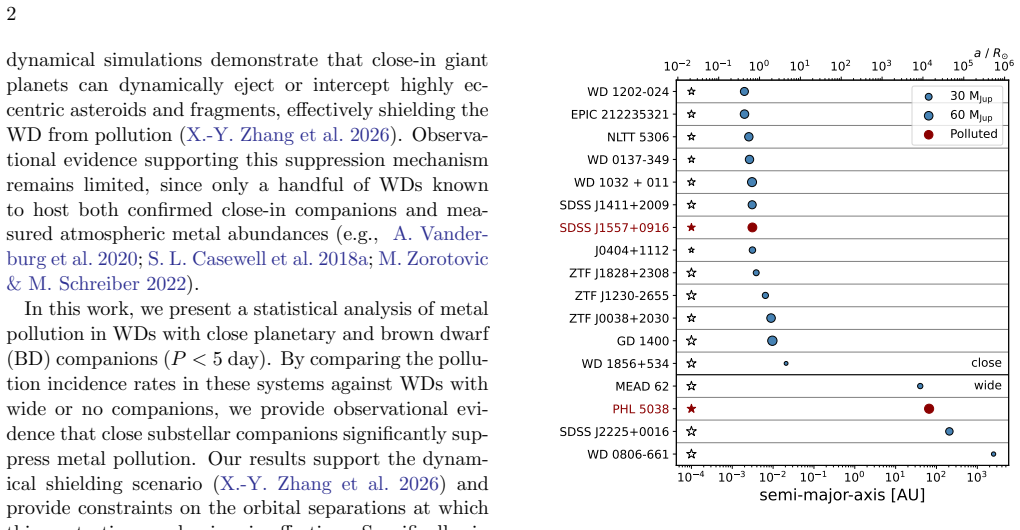
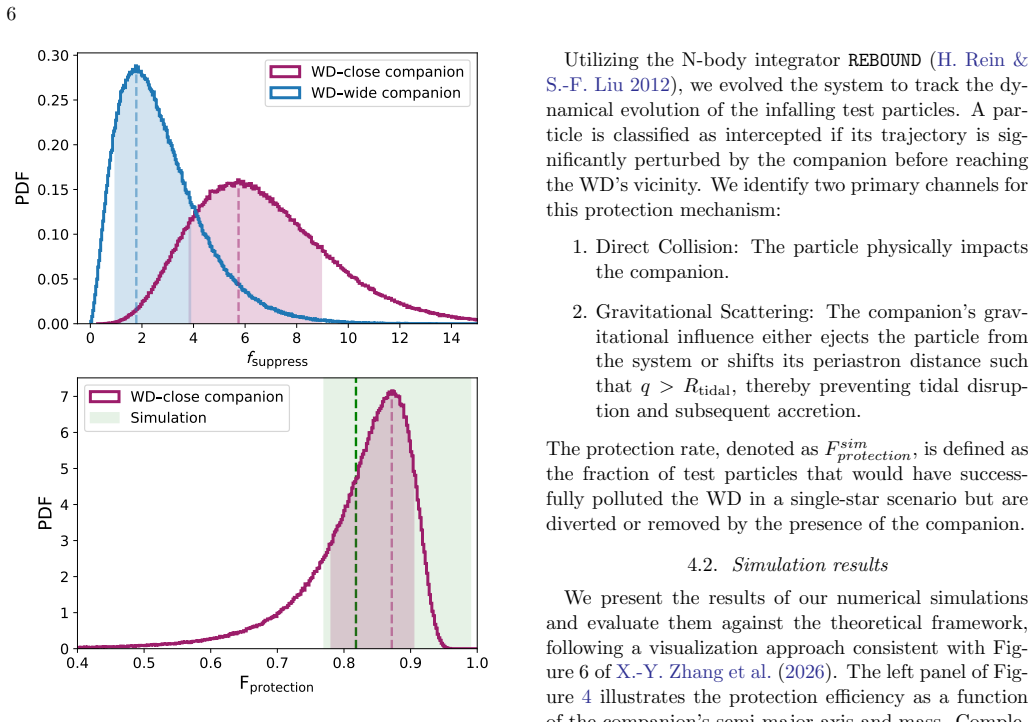
In a sample of 17 white dwarf-substellar companion systems, white dwarfs with close companions (orbital period less than 5 days) display a metal-pollution fraction of 7.7 percent, which is 5.75 times lower than for single white dwarfs. This indicates a protection efficiency of 87 percent. Systems with wider companions exhibit pollution fractions comparable to single white dwarfs at about 25 percent. Numerical simulations of dynamical interactions confirm that massive close companions are able to remove most small-body pollutants from the system.
What carries the argument
Close-in substellar companions that dynamically clear small-body contaminants through gravitational interactions, preventing their accretion onto the white dwarf.
If this is right
- The metal pollution observed in white dwarfs largely originates from systems without close massive companions.
- The long-term stability of remnant planetary systems depends on the presence of surviving close substellar bodies.
- Pollution rates in white dwarf spectra can indicate the likelihood of undetected close companions.
Where Pith is reading between the lines
- This mechanism may help explain the range of pollution levels seen in different white dwarf populations.
- Future observations could use the presence of metal pollution to predict or search for close companions.
- The dynamical protection could extend to understanding debris disks in other post-main sequence systems.
Load-bearing premise
The sample of 17 white dwarf-substellar companion systems is representative of the population and not affected by selection biases in measuring pollution fractions.
What would settle it
Finding a high fraction of metal pollution in a larger sample of white dwarfs with close substellar companions would disprove the suppression effect.
Figures


read the original abstract
Approximately 25--50\% of white dwarfs (WDs) exhibit metal absorption lines in their photospheres, interpreted as evidence of ongoing/recent accretion of planetary debris from remnant systems. Previous theoretical studies have suggested that massive, close-in substellar companion may prevent delivery of larger bodies via dynamical interactions, thereby reducing white-dwarf pollution. However, no conclusive observational evidence has yet been established to confirm such a protective effect. In this work, based on a sample of 17 white dwarf-substellar companion (1--75 $M_{\rm J}$) systems with reliable spectroscopic classifications, we find that white dwarfs hosting close substellar companions (orbital period $P < 5$ d) exhibit a metal-pollution fraction of $7.7^{+11.3}_{-4.0}\%$, which is suppressed by a factor of $5.75^{+3.24}_{-1.94}$ (corresponding to a protection efficiency of $87.2^{+3.4}_{-9.2}\%$) relative to single white dwarfs with a confidence level of 99.96\%. In contrast, white dwarfs with wider companions show a metal-pollution fraction of approximately $25.0^{+24.0}_{-12.8}\%$, comparable to that of single white dwarf systems. To interpret these results, we perform ensembles of N-body integrations and demonstrate that massive close-in substellar companions are capable of clearing 80\%--90\% of small-body contaminants. The good consistency between the observational statistics and dynamical simulations provides strong evidence for suppressed metal pollution in white dwarfs with close companions, and offers insights into the long-term dynamical evolution of WD remanent systems.
Editorial analysis
A structured set of objections, weighed in public.
Referee Report
Summary. The paper presents evidence from a sample of 17 white dwarf-substellar companion systems that close companions with orbital periods P < 5 days suppress metal pollution in the white dwarf photospheres. The close subsample shows a pollution fraction of 7.7^{+11.3}_{-4.0}%, suppressed by a factor of 5.75^{+3.24}_{-1.94} (87.2% protection efficiency) relative to single white dwarfs at 99.96% confidence, while wider companions exhibit rates similar to single WDs (~25%). N-body simulations confirm that such companions can clear 80-90% of small-body contaminants.
Significance. If the central result holds, it constitutes the first observational confirmation of the hypothesized protective role of close substellar companions against white dwarf metal pollution. The consistency between the empirical suppression factor and the dynamical clearing efficiency from N-body integrations adds substantial weight to the interpretation, advancing our understanding of dynamical interactions in evolved planetary systems.
major comments (2)
- [Sample Selection and Classification] The description of how the 17 systems were selected and vetted for reliable spectroscopic classifications is insufficiently detailed. Since the key result hinges on the difference in pollution fractions between close and wide companions, the paper must demonstrate that the sample is free from selection biases that could preferentially affect the close-in systems (e.g., completeness of RV or transit detections around polluted vs. non-polluted WDs).
- [Statistical Analysis and Uncertainties] With a total sample of only 17 systems, the close-companion bin is small, leading to large asymmetric uncertainties. The method used to calculate the 99.96% confidence level for the suppression and the protection efficiency should be fully specified, including any assumptions in the binomial statistics or Monte Carlo approach.
minor comments (2)
- [Abstract] The abstract would benefit from stating the number of systems in the close and wide subsamples to allow immediate assessment of the statistical basis.
- [N-body Integrations] Provide more specifics on the initial conditions, particle numbers, and integration timescales in the N-body simulations to facilitate independent verification.
Simulated Author's Rebuttal
We thank the referee for their constructive comments and positive assessment of the work's significance. We have revised the manuscript to address both major concerns by expanding the sample description and fully documenting the statistical methods.
read point-by-point responses
-
Referee: [Sample Selection and Classification] The description of how the 17 systems were selected and vetted for reliable spectroscopic classifications is insufficiently detailed. Since the key result hinges on the difference in pollution fractions between close and wide companions, the paper must demonstrate that the sample is free from selection biases that could preferentially affect the close-in systems (e.g., completeness of RV or transit detections around polluted vs. non-polluted WDs).
Authors: We agree that the original description was insufficiently detailed. In the revised manuscript we have expanded Section 2 with a complete account of the sample compilation from the FOSSO I catalog and the literature, including explicit vetting criteria for spectroscopic classifications. We have added a dedicated paragraph and supporting references arguing that the sample is free from the suggested biases: companion detections (RV or transit) are drawn from independent photometric and spectroscopic surveys whose completeness does not correlate with the presence of metal lines, which are measured from separate optical spectra. A new table listing all 17 systems, their orbital periods, masses, pollution status, and literature references has been included to allow readers to assess selection effects directly. revision: yes
-
Referee: [Statistical Analysis and Uncertainties] With a total sample of only 17 systems, the close-companion bin is small, leading to large asymmetric uncertainties. The method used to calculate the 99.96% confidence level for the suppression and the protection efficiency should be fully specified, including any assumptions in the binomial statistics or Monte Carlo approach.
Authors: We acknowledge the small-sample limitation and the need for explicit methodology. The 99.96% confidence was obtained via a binomial proportion test comparing the observed pollution rate in the close subsample against the well-established ~25% rate for single white dwarfs, with asymmetric uncertainties derived from the beta distribution (Clopper-Pearson intervals). In the revised text we have inserted a new subsection that fully specifies the procedure: the exact binomial probability formula, the assumption of independent Bernoulli trials with no informative priors, the Monte Carlo validation runs (10^5 realizations) used to confirm the significance, and the propagation of uncertainties into the suppression factor and protection efficiency. We also note the small-sample caveat in the discussion. revision: yes
Circularity Check
No significant circularity; central result is direct observational comparison of measured fractions.
full rationale
The paper's core claim rests on counting metal-pollution incidence in a sample of 17 WD-substellar systems split by orbital period (P<5 d vs. wider), then comparing the resulting binomial fractions (7.7% vs. ~25%) to the known rate for single WDs. The suppression factor and protection efficiency are simple arithmetic ratios of these directly observed rates, with uncertainties propagated from binomial statistics. N-body integrations are performed afterward solely for interpretation and show consistency with the observed suppression; they do not supply the input fractions or define the reported percentages. No self-definitional loops, fitted parameters renamed as predictions, load-bearing self-citations, or ansatzes appear in the derivation. The analysis is therefore self-contained against external benchmarks (literature single-WD pollution rate) and receives the default low-circularity score.
Axiom & Free-Parameter Ledger
free parameters (2)
- Orbital period threshold =
5 days
- Companion mass range =
1-75 M_J
axioms (2)
- domain assumption Metal absorption lines in white-dwarf spectra indicate ongoing or recent accretion of planetary debris
- domain assumption The 17 white-dwarf-substellar systems constitute an unbiased sample for comparing pollution rates
Reference graph
Works this paper leans on
-
[1]
2024, ApJL, 966, L4, doi: 10.3847/2041-8213/ad394c
Akiba, T., McIntyre, S., & Madigan, A.-M. 2024, ApJL, 966, L4, doi: 10.3847/2041-8213/ad394c
-
[2]
Albert, L., Poulsen, S. R., Le Bourdais, ´E., et al. 2025, arXiv e-prints, arXiv:2510.12601, doi: 10.48550/arXiv.2510.12601
-
[3]
Bertolami, M. M., & Romero, A. D. 2009, ApJL, 693, L23, doi: 10.1088/0004-637X/693/1/L23
-
[4]
Hauschildt, P. H. 2003, A&A, 402, 701, doi: 10.1051/0004-6361:20030252
-
[5]
Beuermann, K., Dreizler, S., Hessman, F. V., et al. 2013, A&A, 558, A96, doi: 10.1051/0004-6361/201322241
-
[6]
Bonsor, A., Carter, P. J., Hollands, M., et al. 2020, MNRAS, 492, 2683, doi: 10.1093/mnras/stz3603
-
[7]
Papaloizou, J. C. B. 1999, ApJ, 514, 344, doi: 10.1086/306917
-
[8]
title AGN-controlled cooling in elliptical galaxies
Burleigh, M. R., Hogan, E., Dobbie, P. D., Napiwotzki, R., & Maxted, P. F. L. 2006, MNRAS, 373, L55, doi: 10.1111/j.1745-3933.2006.00242.x
-
[9]
Burleigh, M. R., Steele, P. R., Dobbie, P. D., et al. 2011, in American Institute of Physics Conference Series, Vol. 1331, Planetary Systems Beyond the Main Sequence, ed. S. Schuh, H. Drechsel, & U. Heber, 262–270, doi: 10.1063/1.3556209
-
[10]
Casewell, S. L., Littlefair, S. P., Parsons, S. G., et al. 2018a, MNRAS, 481, 5216, doi: 10.1093/mnras/sty2599
-
[11]
Casewell, S. L., Burleigh, M. R., Wynn, G. A., et al. 2012, ApJL, 759, L34, doi: 10.1088/2041-8205/759/2/L34
-
[12]
Casewell, S. L., Braker, I. P., Parsons, S. G., et al. 2018b, MNRAS, 476, 1405, doi: 10.1093/mnras/sty245
-
[13]
Casewell, S. L., Belardi, C., Parsons, S. G., et al. 2020, MNRAS, 497, 3571, doi: 10.1093/mnras/staa1608
-
[14]
Casewell, S. L., Burleigh, M. R., Napiwotzki, R., et al. 2024, MNRAS, 535, 753, doi: 10.1093/mnras/stae2301
-
[15]
2019, Nature Astronomy, 3, 69, doi: 10.1038/s41550-018-0609-7
Chen, D.-C., Zhou, J.-L., Xie, J.-W., et al. 2019, Nature Astronomy, 3, 69, doi: 10.1038/s41550-018-0609-7
-
[16]
2026, A&A, 707, A312, doi: 10.1051/0004-6361/202557835
Chen, Z., Jin, H., Ge, H., et al. 2026, A&A, 707, A312, doi: 10.1051/0004-6361/202557835
-
[17]
2019, ApJ, 885, 74, doi: 10.3847/1538-4357/ab46b9 de Wit, J., Alonso, R., Rackham, B
Coutu, S., Dufour, P., Bergeron, P., et al. 2019, ApJ, 885, 74, doi: 10.3847/1538-4357/ab46b9 de Wit, J., Alonso, R., Rackham, B. V., et al. 2025, Research Notes of the American Astronomical Society, 9, 270, doi: 10.3847/2515-5172/ae1228
-
[18]
Eisenstein, D. J., Liebert, J., Harris, H. C., et al. 2006, ApJS, 167, 40, doi: 10.1086/507110
-
[19]
2004, AJ, 128, 1868, doi: 10.1086/423919
Farihi, J., & Christopher, M. 2004, AJ, 128, 1868, doi: 10.1086/423919
-
[20]
2009, ApJ, 694, 805, doi: 10.1088/0004-637X/694/2/805 9
Farihi, J., Jura, M., & Zuckerman, B. 2009, ApJ, 694, 805, doi: 10.1088/0004-637X/694/2/805 9
-
[21]
Farihi, J., Parsons, S. G., & G¨ ansicke, B. T. 2017, Nature Astronomy, 1, 0032, doi: 10.1038/s41550-016-0032
-
[22]
French, J. R., Casewell, S. L., Dupuy, T. J., et al. 2023, MNRAS, 519, 5008, doi: 10.1093/mnras/stac3807 Gaia Collaboration, Prusti, T., de Bruijne, J. H. J., et al. 2016, A&A, 595, A1, doi: 10.1051/0004-6361/201629272
-
[23]
2022, arXiv e-prints, arXiv:2206.06693, 10.48550/arXiv.2206.06693
Ge, J., Zhang, H., Zang, W., et al. 2022, arXiv e-prints, arXiv:2206.06693, doi: 10.48550/arXiv.2206.06693
-
[24]
2012, ApJS, 199, 29, doi: 10.1088/0067-0049/199/2/29
Giammichele, N., Bergeron, P., & Dufour, P. 2012, ApJS, 199, 29, doi: 10.1088/0067-0049/199/2/29
-
[25]
2021, A&A, 650, A102, doi: 10.1051/0004-6361/202038757
Irrgang, A., Geier, S., Heber, U., et al. 2021, A&A, 650, A102, doi: 10.1051/0004-6361/202038757
-
[26]
2003, ApJL, 584, L91, doi: 10.1086/374036
Jura, M. 2003, ApJL, 584, L91, doi: 10.1086/374036
-
[27]
Kleinman, S. J., Kepler, S. O., Koester, D., et al. 2013, ApJS, 204, 5, doi: 10.1088/0067-0049/204/1/5
-
[28]
2009, A&A, 498, 517, doi: 10.1051/0004-6361/200811468
Koester, D. 2009, A&A, 498, 517, doi: 10.1051/0004-6361/200811468
-
[29]
Koester, D., G¨ ansicke, B. T., & Farihi, J. 2014, A&A, 566, A34, doi: 10.1051/0004-6361/201423691
-
[30]
2009, A&A, 505, 441, doi: 10.1051/0004-6361/200912531
Koester, D., Voss, B., Napiwotzki, R., et al. 2009, A&A, 505, 441, doi: 10.1051/0004-6361/200912531
-
[31]
2001, A&A, 378, 556, doi: 10.1051/0004-6361:20011235
Koester, D., Napiwotzki, R., Christlieb, N., et al. 2001, A&A, 378, 556, doi: 10.1051/0004-6361:20011235
-
[32]
A., Vanderburg, A., MacDonald, R
Limbach, M. A., Vanderburg, A., MacDonald, R. J., et al. 2025, ApJL, 984, L28, doi: 10.3847/2041-8213/adc9ad
-
[33]
Littlefair, S. P., Casewell, S. L., Parsons, S. G., et al. 2014, MNRAS, 445, 2106, doi: 10.1093/mnras/stu1895
-
[34]
Longstaff, E. S., Casewell, S. L., Wynn, G. A., et al. 2019, MNRAS, 484, 2566, doi: 10.1093/mnras/stz127
-
[35]
Luhman, K. L., Burgasser, A. J., & Bochanski, J. J. 2011, ApJL, 730, L9, doi: 10.1088/2041-8205/730/1/L9
-
[36]
Burleigh, M. R. 2006, Nature, 442, 543, doi: 10.1038/nature04987 M¨ uller, S., Baron, J., Helled, R., Bouchy, F., & Parc, L. 2024, A&A, 686, A296, doi: 10.1051/0004-6361/202348690 O’Brien, M. W., Tremblay, P.-E., Gentile Fusillo, N. P., et al. 2023, MNRAS, 518, 3055, doi: 10.1093/mnras/stac3303 Ould Rouis, L. B., Hermes, J. J., G¨ ansicke, B. T., et al. 2...
-
[37]
Parsons, S. G., Hermes, J. J., Marsh, T. R., et al. 2017, MNRAS, 471, 976, doi: 10.1093/mnras/stx1610
-
[38]
Parsons, S. G., Brown, A. J., Casewell, S. L., et al. 2025, MNRAS, 537, 2112, doi: 10.1093/mnras/staf166
-
[39]
1986, ApJ, 307, 242, doi: 10.1086/164410
Wegner, G. 1986, ApJ, 307, 242, doi: 10.1086/164410
-
[40]
Phillips, M. W., Tremblin, P., Baraffe, I., et al. 2020, A&A, 637, A38, doi: 10.1051/0004-6361/201937381
-
[41]
2017, MNRAS, 471, 948, doi: 10.1093/mnras/stx1611
Rappaport, S., Vanderburg, A., Nelson, L., et al. 2017, MNRAS, 471, 948, doi: 10.1093/mnras/stx1611
-
[42]
Rein, H., & Liu, S.-F. 2012, A&A, 537, A128, doi: 10.1051/0004-6361/201118085
-
[43]
R., Zuckerman, B., Melis, C., & Song, I
Rodriguez, D. R., Zuckerman, B., Melis, C., & Song, I. 2011, ApJL, 732, L29, doi: 10.1088/2041-8205/732/2/L29
-
[44]
2012, MNRAS, 420, 1825, doi: 10.1111/j.1365-2966.2011.19805.x
Steele, P. R., Burleigh, M. R., Dobbie, P. D., et al. 2011, MNRAS, 416, 2768, doi: 10.1111/j.1365-2966.2011.19225.x
-
[45]
Steele, P. R., Burleigh, M. R., Farihi, J., et al. 2009, A&A, 500, 1207, doi: 10.1051/0004-6361/200911694
-
[46]
Steele, P. R., Saglia, R. P., Burleigh, M. R., et al. 2013, MNRAS, 429, 3492, doi: 10.1093/mnras/sts620
-
[47]
Subasavage, J. P., Jao, W.-C., Henry, T. J., et al. 2009, AJ, 137, 4547, doi: 10.1088/0004-6256/137/6/4547 van Roestel, J., Kupfer, T., Bell, K. J., et al. 2021, ApJL, 919, L26, doi: 10.3847/2041-8213/ac22b7
-
[48]
Vanderburg, A., Rappaport, S. A., Xu, S., et al. 2020, Nature, 585, 363, doi: 10.1038/s41586-020-2713-y
-
[49]
2016, Royal Society Open Science, 3, 150571, doi: 10.1098/rsos.150571
Veras, D. 2016, Royal Society Open Science, 3, 150571, doi: 10.1098/rsos.150571
-
[50]
2022, MNRAS, 510, 3379, doi: 10.1093/mnras/stab3490
Veras, D., Birader, Y., & Zaman, U. 2022, MNRAS, 510, 3379, doi: 10.1093/mnras/stab3490
-
[51]
M., Bonsor, A., & G¨ ansicke, B
Veras, D., Leinhardt, Z. M., Bonsor, A., & G¨ ansicke, B. T. 2014, MNRAS, 445, 2244, doi: 10.1093/mnras/stu1871
-
[52]
MIRI-LRS Spectrum of a Cold Exoplanet around a White Dwarf: Water, Ammonia, and Methane Measurements
Voyer, M., Changeat, Q., Lagage, P.-O., et al. 2025, ApJL, 982, L38, doi: 10.3847/2041-8213/adbd46
-
[53]
2026, A&A, 707, A195, doi: 10.1051/0004-6361/202557402
Zhang, X.-Y., Xie, J.-W., Chen, D.-C., & Zhou, J.-L. 2026, A&A, 707, A195, doi: 10.1051/0004-6361/202557402
-
[54]
2022, MNRAS, 513, 3587, doi: 10.1093/mnras/stac1137
Zorotovic, M., & Schreiber, M. 2022, MNRAS, 513, 3587, doi: 10.1093/mnras/stac1137
-
[55]
Zuckerman, B., Koester, D., Reid, I. N., & H¨ unsch, M. 2003, ApJ, 596, 477, doi: 10.1086/377492
-
[56]
2010, ApJ, 722, 725, doi: 10.1088/0004-637X/722/1/725
Zuckerman, B., Melis, C., Klein, B., Koester, D., & Jura, M. 2010, ApJ, 722, 725, doi: 10.1088/0004-637X/722/1/725
discussion (0)
Sign in with ORCID, Apple, or X to comment. Anyone can read and Pith papers without signing in.