Recognition: unknown
TARMM: Scaling Delay-Critical Edge AI Offloading in 5G O-RAN via Temporal Graph Mobility Management
Pith reviewed 2026-05-08 01:22 UTC · model grok-4.3
The pith
A temporal graph model with multi-agent reinforcement learning enables proactive handovers that cut tail latency by up to 44% in 5G edge AI offloading.
A machine-rendered reading of the paper's core claim, the machinery that carries it, and where it could break.
Core claim
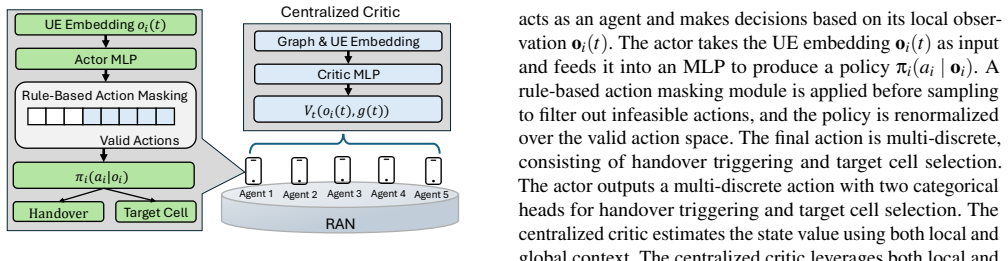
TARMM optimizes user mobility management for delay-critical edge AI offloading in 5G O-RAN by using a temporal graph model that captures the spatiotemporal dynamics of the RAN across users and cells to support near real-time handover decisions, along with a multi-agent reinforcement learning framework that incorporates rule-based action masking and proactive resource preparation for safe and efficient handovers.
What carries the argument
The temporal graph model that captures spatiotemporal dynamics of the RAN across users and cells, enabling the multi-agent reinforcement learning framework with rule-based action masking and proactive resource preparation.
If this is right
- Handover decisions shift from reactive to proactive based on predicted network states.
- Edge AI applications like VR perception and real-time video analytics achieve lower tail latencies and higher reliability.
- Multi-cell 5G O-RAN deployments can support more stable offloading under dynamic user conditions.
- Rule-based masking ensures that learned policies remain safe and do not cause network instability.
Where Pith is reading between the lines
- Similar temporal graph approaches might improve mobility management in other wireless standards if adapted to their specific dynamics.
- Combining TARMM with energy-aware offloading policies could reduce power consumption in addition to latency.
- Validation in outdoor or high-mobility scenarios would test how well the temporal model scales beyond indoor testbeds.
- Integration into standard O-RAN interfaces could allow broader adoption without custom hardware.
Load-bearing premise
The temporal graph accurately represents the real spatiotemporal changes in user-cell connections, and the reinforcement learning framework with masking works consistently in varied real-world conditions.
What would settle it
Running the system in a new test environment with different mobility patterns or cell densities and finding that tail latency and packet loss do not improve over baseline methods would disprove the benefits.
Figures









read the original abstract
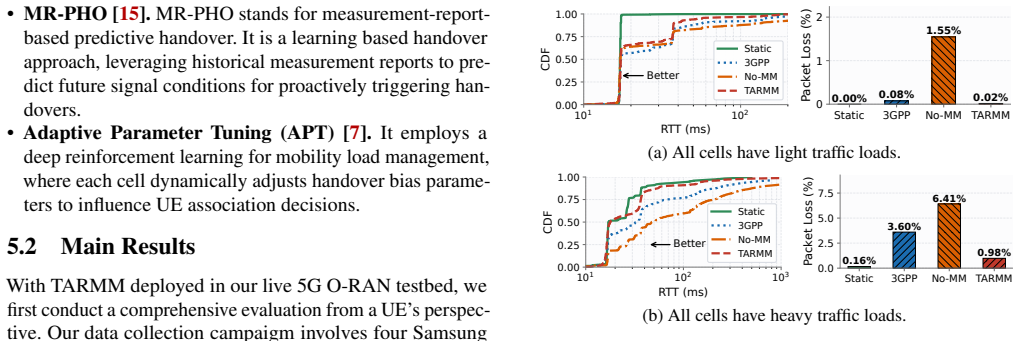
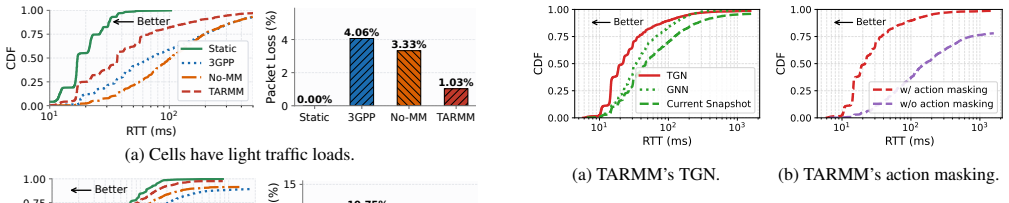
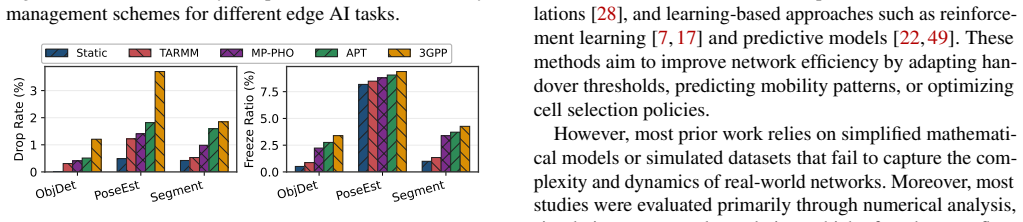
Emerging delay-critical edge AI applications, such as VR perception and real-time video analytics, impose stringent latency and reliability requirements on 5G networks. However, existing mobility management mechanisms are largely reactive and fail to adapt to dynamic network conditions, resulting in suboptimal handover decisions and degraded performance. In this paper, we present TARMM, a 5G Open Radio Access Network (O-RAN) system that optimizes user mobility management for delay-critical edge AI offloading. The core of TARMM is a temporal graph model that captures the spatiotemporal dynamics of the RAN across users and cells, enabling near real-time handover decisions. Building on this representation, we design a multi-agent reinforcement learning (MARL) framework with rule-based action masking and proactive resource preparation to ensure safe, stable, and efficient handovers. We implement TARMM on a multi-cell indoor 5G O-RAN testbed and evaluate it using diverse VR workloads. Extensive experiments show that TARMM reduces tail latency by up to 44% and packet loss by up to 56% compared to state-of-the-art approaches. Source code and demo videos are available at: https://margo-source.github.io/Margo/
Editorial analysis
A structured set of objections, weighed in public.
Referee Report
Summary. The paper presents TARMM, a 5G O-RAN system for optimizing mobility management for delay-critical edge AI offloading. It uses a temporal graph model to capture spatiotemporal RAN dynamics across users and cells, combined with a multi-agent reinforcement learning (MARL) framework incorporating rule-based action masking and proactive resource preparation for safe handovers. The system is implemented and evaluated on a multi-cell indoor 5G O-RAN testbed using diverse VR workloads, with claims of up to 44% reduction in tail latency and 56% reduction in packet loss compared to state-of-the-art approaches. Source code and demo videos are provided.
Significance. If the performance gains hold under broader conditions, TARMM could meaningfully advance proactive, graph-based mobility management in O-RAN deployments for latency-sensitive edge AI applications such as VR. The open-source release supports reproducibility and further validation.
major comments (1)
- [Evaluation / Abstract] The central performance claims (up to 44% tail-latency reduction and 56% packet-loss reduction) rest on experiments in a controlled indoor multi-cell 5G O-RAN testbed with VR workloads. This setting inherently limits the range of mobility patterns, interference levels, cell overlap, and handover dynamics relative to outdoor or dense urban deployments; if the temporal graph representation and rule-masked MARL decisions exploit these constraints, the reported gains may not support the title's claim of scaling delay-critical offloading.
minor comments (1)
- [Abstract] The abstract references comparisons to 'state-of-the-art approaches' without naming the specific baselines, number of experimental runs, or statistical methods used to establish the percentage improvements.
Simulated Author's Rebuttal
We thank the referee for highlighting the evaluation scope and its relation to the broader claims in the title and abstract. We address the point directly below.
read point-by-point responses
-
Referee: [Evaluation / Abstract] The central performance claims (up to 44% tail-latency reduction and 56% packet-loss reduction) rest on experiments in a controlled indoor multi-cell 5G O-RAN testbed with VR workloads. This setting inherently limits the range of mobility patterns, interference levels, cell overlap, and handover dynamics relative to outdoor or dense urban deployments; if the temporal graph representation and rule-masked MARL decisions exploit these constraints, the reported gains may not support the title's claim of scaling delay-critical offloading.
Authors: We agree that the reported gains are measured in a controlled indoor multi-cell testbed and that this environment does not replicate the full spectrum of outdoor mobility patterns, interference, or dense urban cell overlaps. The temporal graph and rule-masked MARL are intended to capture fundamental spatiotemporal RAN dynamics (user-cell interactions over time) that exist across settings, and the indoor testbed does include realistic multi-cell handovers and VR-induced traffic variability. Nevertheless, the specific numerical improvements cannot be claimed to generalize without additional data from other environments. To address the concern, we will revise the abstract to explicitly state the indoor testbed scope and add a limitations paragraph discussing the constraints of the current evaluation and the role of the open-source code in enabling broader validation. We interpret the title's use of 'scaling' as referring to the architectural support for delay-critical offloading within O-RAN rather than a claim of universal empirical performance; we will ensure the revised text aligns with this interpretation. revision: partial
Circularity Check
No circularity; claims rest on empirical testbed evaluation
full rationale
The paper introduces TARMM as a system combining a temporal graph model for RAN dynamics with a MARL framework for handover decisions, then directly implements and measures it on a multi-cell indoor 5G O-RAN testbed using VR workloads. Reported gains (up to 44% tail latency, 56% packet loss reduction) are obtained via side-by-side experimental comparison against baselines, with no equations, fitted parameters, or self-citations presented as derivations that reduce to the inputs by construction. The derivation chain is therefore self-contained through design description plus external falsifiable measurements rather than any of the enumerated circular patterns.
Axiom & Free-Parameter Ledger
axioms (1)
- domain assumption Temporal graph model captures the spatiotemporal dynamics of the RAN across users and cells
Reference graph
Works this paper leans on
-
[1]
Nr; nr and ng-ran overall description; stage-2
3GPP. Nr; nr and ng-ran overall description; stage-2. Technical Report TS 38.300, 3GPP, 2020
2020
-
[2]
Nr; radio resource control (rrc); protocol specifi- cation
3GPP. Nr; radio resource control (rrc); protocol specifi- cation. Technical Report TS 38.331, 3GPP, 2022
2022
-
[3]
Ng-ran; architecture description
3GPP. Ng-ran; architecture description. Technical Re- port TS 38.401, 3GPP, 2024
2024
-
[4]
3GPP TSG- SA Meeting #3 Report (SP-99100)
3rd Generation Partnership Project (3GPP). 3GPP TSG- SA Meeting #3 Report (SP-99100). Technical report, 3GPP, 1999
1999
-
[5]
A sur- vey on mobility of edge computing networks in iot: State-of-the-art, architectures, and challenges.IEEE Communications Surveys & Tutorials, 24(4):2329–2365, 2022
Forough Shirin Abkenar, Parisa Ramezani, Saeid Iran- manesh, Sarumathi Murali, Donpiti Chulerttiyawong, Xinyu Wan, Abbas Jamalipour, and Raad Raad. A sur- vey on mobility of edge computing networks in iot: State-of-the-art, architectures, and challenges.IEEE Communications Surveys & Tutorials, 24(4):2329–2365, 2022
2022
-
[6]
Warping the edge: Enabling instant mobility for stateful applica- tions over 5g and beyond
Mukhtiar Ahmad, Faaiq Bilal, Mutahar Ali, Syed Muhammad Ali Nawazish, Amir Salman, Shazer Ali, Fawad Ahmad, and Zafar Ayyub Qazi. Warping the edge: Enabling instant mobility for stateful applica- tions over 5g and beyond. InProceedings of the Tenth ACM/IEEE Symposium on Edge Computing, pages 1–18, 2025
2025
-
[7]
Mobility load management in cel- lular networks: A deep reinforcement learning approach
Ghada Alsuhli, Karim Banawan, Kareem Attiah, Ayman Elezabi, Karim G Seddik, Ayman Gaber, Mohamed Zaki, and Yasser Gadallah. Mobility load management in cel- lular networks: A deep reinforcement learning approach. IEEE Transactions on Mobile Computing, 22(3):1581– 1598, 2021
2021
-
[8]
The 300ms rule: Why latency makes or breaks voice ai
AssemblyAI. The 300ms rule: Why latency makes or breaks voice ai. https://www.assemblyai. com/blog/low-latency-voice-ai , 2025. Accessed: 2026-03-13
2025
-
[9]
A comprehensive survey on machine learning for networking: evolution, appli- cations and research opportunities.Journal of Internet Services and Applications, 9(1):1–99, 2018
Raouf Boutaba, Mohammad A Salahuddin, Noura Li- mam, Sara Ayoubi, Nashid Shahriar, Felipe Estrada- Solano, and Oscar M Caicedo. A comprehensive survey on machine learning for networking: evolution, appli- cations and research opportunities.Journal of Internet Services and Applications, 9(1):1–99, 2018
2018
-
[10]
Challenges and opportunities for delay- invariant telerobotic interactions
Dries Cardinaels, Tom Veuskens, Raf Ramakers, and Kris Luyten. Challenges and opportunities for delay- invariant telerobotic interactions. InCompanion Pro- ceedings of the 30th International Conference on Intel- ligent User Interfaces, pages 26–30, 2025
2025
-
[11]
Vehicular edge computing networks optimization via drl-based communication resource allocation and load balancing.IEEE Transactions on Mobile Comput- ing, 2025
Quan Chen, Xiaoqin Song, Tiecheng Song, and Yang Yang. Vehicular edge computing networks optimization via drl-based communication resource allocation and load balancing.IEEE Transactions on Mobile Comput- ing, 2025
2025
-
[12]
Latency standards in trad- ing systems
Christopher Downie. Latency standards in trad- ing systems. https://www.luxalgo.com/blog/ latency-standards-in-trading-systems/ , 2025. LuxAlgo Blog, Accessed: 2026-03-13
2025
-
[13]
Elbamby, Cristina Perfecto, Mehdi Ben- nis, and Klaus Doppler
Mohammed S. Elbamby, Cristina Perfecto, Mehdi Ben- nis, and Klaus Doppler. Toward low-latency and ultra- reliable virtual reality.IEEE Network, 32(2):78–84, 2018
2018
-
[14]
Acceptable latency in predictable first-person vr cloud games
Håkon Medhus Fornes, Elias Hoel Birketvedt, Carsten Griwodz, Magnus Skjegstad, Michael Welzl, and Özgü Alay. Acceptable latency in predictable first-person vr cloud games. InProceedings of the 17th International Workshop on IMmersive Mixed and Virtual Environment Systems, pages 58–64, 2025
2025
-
[15]
Vivisecting mo- bility management in 5g cellular networks
Ahmad Hassan, Arvind Narayanan, Anlan Zhang, Wei Ye, Ruiyang Zhu, Shuowei Jin, Jason Carpenter, Z Mor- ley Mao, Feng Qian, and Zhi-Li Zhang. Vivisecting mo- bility management in 5g cellular networks. InProceed- ings of the ACM SIGCOMM 2022 Conference, pages 86–100, 2022
2022
-
[16]
Aruba wi-fi 6 networks deployment guide
Hewlett Packard Enterprise. Aruba wi-fi 6 networks deployment guide. https://higherlogicdownload. s3.amazonaws.com/HPE/UploadedImages/ 2e31f761-75c1-4680-8d55-009a31e45948/ Aruba_WiFi6_Networks_Deployment_Guide.pdf,
-
[17]
A closer look at invalid action masking in policy gradient algorithms
Shengyi Huang and Santiago Ontañón. A closer look at invalid action masking in policy gradient algorithms. arXiv preprint arXiv:2006.14171, 2020
-
[18]
Deep reinforce- ment learning for resource management on network slic- ing: A survey.Sensors, 22(8):3031, 2022
Johanna Andrea Hurtado Sánchez, Katherine Casilimas, and Oscar Mauricio Caicedo Rendon. Deep reinforce- ment learning for resource management on network slic- ing: A survey.Sensors, 22(8):3031, 2022
2022
-
[19]
Robot feedback design for response delay.International Journal of Social Robotics, 16(2):341–361, 2024
Dahyun Kang, Changjoo Nam, and Sonya S Kwak. Robot feedback design for response delay.International Journal of Social Robotics, 16(2):341–361, 2024
2024
-
[20]
Distributed task offloading and re- source allocation for latency minimization in mobile edge computing networks.IEEE Transactions on Mo- bile Computing, 23(12):15149–15166, 2024
Minwoo Kim, Jonggyu Jang, Youngchol Choi, and Hyun Jong Yang. Distributed task offloading and re- source allocation for latency minimization in mobile edge computing networks.IEEE Transactions on Mo- bile Computing, 23(12):15149–15166, 2024. 13
2024
-
[21]
The quic transport protocol: Design and internet-scale deploy- ment
Adam Langley, Alistair Riddoch, Alyssa Wilk, Antonio Vicente, Charles Krasic, Dan Zhang, Fan Yang, Fedor Kouranov, Ian Swett, Janardhan Iyengar, et al. The quic transport protocol: Design and internet-scale deploy- ment. InProceedings of the conference of the ACM special interest group on data communication, pages 183–196, 2017
2017
-
[22]
Beyond 5g: Reliable extreme mobility management
Yuanjie Li, Qianru Li, Zhehui Zhang, Ghufran Baig, Lili Qiu, and Songwu Lu. Beyond 5g: Reliable extreme mobility management. InProceedings of the Annual conference of the ACM Special Interest Group on Data Communication on the applications, technologies, ar- chitectures, and protocols for computer communication, pages 344–358, 2020
2020
-
[23]
Jie Lu, Peihao Yan, and Huacheng Zeng. Eexapp: Gnn- based reinforcement learning for radio unit energy opti- mization in 5g o-ran.arXiv preprint arXiv:2602.09206, 2026
-
[24]
Qos-aware content deliv- ery in 5g-enabled edge computing: Learning-based ap- proaches.IEEE Transactions on Mobile Computing, 23(10):9324–9336, 2024
Erfan Farhangi Maleki, Weibin Ma, Lena Mashayekhy, and Humberto J La Roche. Qos-aware content deliv- ery in 5g-enabled edge computing: Learning-based ap- proaches.IEEE Transactions on Mobile Computing, 23(10):9324–9336, 2024
2024
-
[25]
Neural adaptive video streaming with pensieve
Hongzi Mao, Ravi Netravali, and Mohammad Alizadeh. Neural adaptive video streaming with pensieve. InPro- ceedings of the conference of the ACM special interest group on data communication, pages 197–210, 2017
2017
-
[26]
Learning scheduling algorithms for data processing clus- ters
Hongzi Mao, Malte Schwarzkopf, Shaileshh Bojja Venkatakrishnan, Zili Meng, and Mohammad Alizadeh. Learning scheduling algorithms for data processing clus- ters. InProceedings of the ACM special interest group on data communication, pages 270–288. 2019
2019
-
[27]
Gcn-based throughput-oriented handover management in dense 5g vehicular networks
Nazanin Mehregan and E Robson. Gcn-based throughput-oriented handover management in dense 5g vehicular networks. In2025 21st International Confer- ence on Distributed Computing in Smart Systems and the Internet of Things (DCOSS-IoT), pages 895–902. IEEE, 2025
2025
-
[28]
A survey of machine learning applications to handover management in 5g and beyond.IEEE Access, 9:45770– 45802, 2021
Michael S Mollel, Attai Ibrahim Abubakar, Metin Oz- turk, Shubi Felix Kaijage, Michael Kisangiri, Sajjad Hus- sain, Muhammad Ali Imran, and Qammer H Abbasi. A survey of machine learning applications to handover management in 5g and beyond.IEEE Access, 9:45770– 45802, 2021
2021
-
[29]
Telesurgery: current status and strategies for la- tency reduction.Journal of Robotic Surgery, 19(1):153, 2025
Zainab Yusufali Motiwala, Arusha Desai, Rahul Bisht, Saloni Lathkar, Sidharth Misra, and Danny Darlington Carbin. Telesurgery: current status and strategies for la- tency reduction.Journal of Robotic Surgery, 19(1):153, 2025
2025
-
[30]
Tan Nguyen. Low-latency mixed reality headset.Low- latency VR/AR Headset project from Conix Research Center , Computing On Network Infrastructure for Per- vasive Perception, Cognition and Action, 2:9, 2020
2020
-
[31]
Tackling the network challenges for xr: Under- standing, developing and delivering an e2e xr connec- tivity solution
Nokia. Tackling the network challenges for xr: Under- standing, developing and delivering an e2e xr connec- tivity solution. White paper, Nokia, 2022
2022
-
[32]
O-RAN Soft- ware Community: Near-Real-Time RAN Intelli- gent Controller (Near-RT RIC)
O-RAN Software Community. O-RAN Soft- ware Community: Near-Real-Time RAN Intelli- gent Controller (Near-RT RIC). https://docs. o-ran-sc.org/en/latest/projects.html# near-realtime-ran-intelligent-controller-ric . Accessed: 2026-03-26
2026
-
[33]
Graph-based multicell scheduling in ofdma-based small cell networks.IEEE Access, 2:897–908, 2014
Emmanouil Pateromichelakis, Mehrdad Shariat, Atta Ul Quddus, and Rahim Tafazolli. Graph-based multicell scheduling in ofdma-based small cell networks.IEEE Access, 2:897–908, 2014
2014
-
[34]
{DOTE}: Rethinking (predictive){W AN} traffic engineering
Yarin Perry, Felipe Vieira Frujeri, Chaim Hoch, Srikanth Kandula, Ishai Menache, Michael Schapira, and Aviv Tamar. {DOTE}: Rethinking (predictive){W AN} traffic engineering. In20th USENIX Symposium on Networked Systems Design and Implementation (NSDI 23), pages 1557–1581, 2023
2023
-
[35]
Enabling proportionally-fair mobility management with reinforce- ment learning in 5g networks.IEEE Journal on Selected Areas in Communications, 41(6):1845–1858, 2023
Anna Prado, Franziska Stöckeler, Fidan Mehmeti, Patrick Krämer, and Wolfgang Kellerer. Enabling proportionally-fair mobility management with reinforce- ment learning in 5g networks.IEEE Journal on Selected Areas in Communications, 41(6):1845–1858, 2023
2023
-
[36]
Edge computing for real-time decision-making in indus- trial automation systems-a comprehensive review
R Raffik, VJ Balamurugan, and N Gopinath Pandian. Edge computing for real-time decision-making in indus- trial automation systems-a comprehensive review. In 2025 3rd International Conference on Advancements in Electrical, Electronics, Communication, Computing and Automation (ICAECA), pages 1–6. IEEE, 2025
2025
-
[37]
Empowering near- urllc iot with 5g dect-2020 nr: Current state and the road ahead.IEEE Communications Magazine, 63(4):130– 136, 2025
Andrey Samuylov, Dmitri Moltchanov, Anna Gay- damaka, Eike Lyczkowski, Andreas Frotzscher, Frank von Schoettler, Juho Pirskanen, Jussi Numminen, Juha Salokannel, Endika Llaguno, et al. Empowering near- urllc iot with 5g dect-2020 nr: Current state and the road ahead.IEEE Communications Magazine, 63(4):130– 136, 2025
2020
-
[38]
Yang Shen, Shuqi Chai, Bing Li, Xiaodong Luo, Qingjiang Shi, and Rongqing Zhang. Decentralized han- dover parameter optimization with marl for load balanc- ing in 5g networks.arXiv preprint arXiv:2504.13424, 2025
-
[39]
Law: Towards consistent low latency in 802.11 home networks
Yibin Shen and Zili Meng. Law: Towards consistent low latency in 802.11 home networks. InProc. USENIX NSDI, 2026. 14
2026
-
[40]
Mortise: Auto-tuning congestion control to optimize qoe via network-aware parameter optimiza- tion
Yixin Shen, Ruihua Chen, Bo Wang, Jing Chen, Haochen Zhang, Minhu Wang, Yan Liu, Mingwei Xu, and Zili Meng. Mortise: Auto-tuning congestion control to optimize qoe via network-aware parameter optimiza- tion
-
[41]
srsRAN Project
Software Radio Systems Ltd. srsRAN Project. https: //github.com/srsran/srsRAN_Project. Accessed: 2026-03-26
2026
-
[42]
Automated model-based fuzzing for 5g o-ran
Sixu Tan, Zeyu Li, Zhutian Liu, Harsh Patel, and Zhaowei Tan. Automated model-based fuzzing for 5g o-ran. InProceedings of the 31st Annual Interna- tional Conference on Mobile Computing and Network- ing, pages 201–215, 2025
2025
-
[43]
{Device-Based}{LTE} latency reduction at the application layer
Zhaowei Tan, Jinghao Zhao, Yuanjie Li, Yifei Xu, and Songwu Lu. {Device-Based}{LTE} latency reduction at the application layer. In18th USENIX Symposium on Networked Systems Design and Implementation (NSDI 21), pages 471–486, 2021
2021
-
[44]
A survey on handover management: From lte to nr.IEEE Access, 7:118907–118930, 2019
Muhammad Tayyab, Xavier Gelabert, and Riku Jäntti. A survey on handover management: From lte to nr.IEEE Access, 7:118907–118930, 2019
2019
-
[45]
Signaling overhead and power consumption during handover in lte
Muhammad Tayyab, George P Koudouridis, Xavier Gelabert, and Riku Jäntti. Signaling overhead and power consumption during handover in lte. In2019 IEEE wireless communications and networking conference (WCNC), pages 1–6. IEEE, 2019
2019
-
[46]
Assessing the impact of network quality-of-service on metaverse virtual reality user experience
Rahul Dev Tripathi, Minzhao Lyu, and Vijay Sivaraman. Assessing the impact of network quality-of-service on metaverse virtual reality user experience. In2024 IEEE International Conference on Metaverse Computing, Net- working, and Applications (MetaCom), pages 206–213. IEEE, 2024
2024
-
[47]
Fovrl: Joint foveation and quality control for immersive vr streaming using reinforcement learning
Yuk Hang Tsui, Ze Wu, Ahmad Alhilal, Matti Siekkinen, and Pan Hui. Fovrl: Joint foveation and quality control for immersive vr streaming using reinforcement learning. InProceedings of the ACM Web Conference 2026, pages 5648–5656, 2026
2026
-
[48]
Quality of experience of 360 video– subjective and eye-tracking assessment of encoding and freezing distortions.Multimedia tools and applications, 81(7):9771–9802, 2022
Anouk Van Kasteren, Kjell Brunnström, John Hedlund, and Chris Snijders. Quality of experience of 360 video– subjective and eye-tracking assessment of encoding and freezing distortions.Multimedia tools and applications, 81(7):9771–9802, 2022
2022
-
[49]
Mitigating unnecessary handovers in ultra-dense networks through machine learning-based mobility prediction
Donglin Wang, Anjie Qiu, Sanket Partani, Qiuheng Zhou, and Hans D Schotten. Mitigating unnecessary handovers in ultra-dense networks through machine learning-based mobility prediction. In2023 IEEE 97th V ehicular Technology Conference (VTC2023-Spring), pages 1–7. IEEE, 2023
2023
-
[50]
Low-latency schedul- ing approach for dependent tasks in mec-enabled 5g vehicular networks.IEEE Internet of Things Journal, 11(4):6278–6289, 2023
Zhiying Wang, Gang Sun, Hanyue Su, Hongfang Yu, Bo Lei, and Mohsen Guizani. Low-latency schedul- ing approach for dependent tasks in mec-enabled 5g vehicular networks.IEEE Internet of Things Journal, 11(4):6278–6289, 2023
2023
-
[51]
Rajomon: Decentral- ized and coordinated overload control for {Latency- Sensitive} microservices
Jiali Xing, Akis Giannoukos, Paul Loh, Shuyue Wang, Justin Qiu, Henri Maxime Demoulin, Konstantinos Kallas, and Benjamin C Lee. Rajomon: Decentral- ized and coordinated overload control for {Latency- Sensitive} microservices. In22nd USENIX Sympo- sium on Networked Systems Design and Implementation (NSDI 25), pages 21–36, 2025
2025
-
[52]
Teal: Learning- accelerated optimization of wan traffic engineering
Zhiying Xu, Francis Y Yan, Rachee Singh, Justin T Chiu, Alexander M Rush, and Minlan Yu. Teal: Learning- accelerated optimization of wan traffic engineering. In Proceedings of the ACM SIGCOMM 2023 Conference, pages 378–393, 2023
2023
-
[53]
Near-real-time resource slicing for qos optimization in 5g o-ran using deep reinforcement learning.IEEE Trans- actions on Networking, 34:1596–1611, 2025
Peihao Yan, Jie Lu, Huacheng Zeng, and Y Thomas Hou. Near-real-time resource slicing for qos optimization in 5g o-ran using deep reinforcement learning.IEEE Trans- actions on Networking, 34:1596–1611, 2025
2025
-
[54]
xdiff: Online diffusion model for collaborative inter-cell inter- ference management in 5g o-ran.IEEE Transactions on Networking, 2025
Peihao Yan, Huacheng Zeng, and Y Thomas Hou. xdiff: Online diffusion model for collaborative inter-cell inter- ference management in 5g o-ran.IEEE Transactions on Networking, 2025
2025
-
[55]
Dissecting carrier aggregation in 5g networks: Measurement, qoe implications and prediction
Wei Ye, Xinyue Hu, Steven Sleder, Anlan Zhang, Ud- haya Kumar Dayalan, Ahmad Hassan, Rostand AK Fezeu, Akshay Jajoo, Myungjin Lee, Eman Ramadan, et al. Dissecting carrier aggregation in 5g networks: Measurement, qoe implications and prediction. InPro- ceedings of the ACM SIGCOMM 2024 Conference, pages 340–357, 2024. 15 Appendix A Actor-Critic Loss The act...
2024
discussion (0)
Sign in with ORCID, Apple, or X to comment. Anyone can read and Pith papers without signing in.