Recognition: unknown
Analyses on Wassenius' Report for Total Solar Eclipse in 1733: Quantifications of the Solar Radius and the Earliest Reported Prominences
Pith reviewed 2026-05-08 01:31 UTC · model grok-4.3
The pith
A 1733 eclipse report yields a solar radius of 696250 km and places the earliest reported prominences at high latitudes during solar minimum.
A machine-rendered reading of the paper's core claim, the machinery that carries it, and where it could break.
Core claim
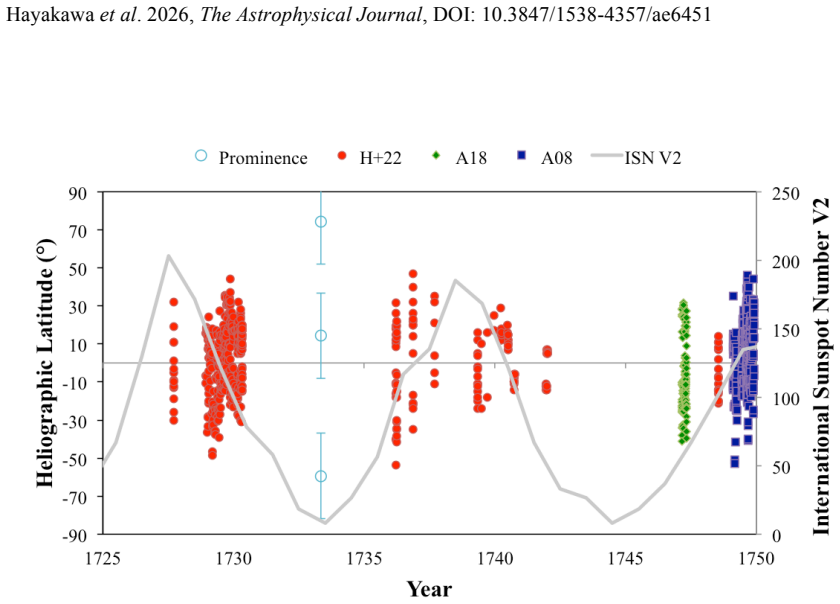
From Wassenius' descriptions of the 1733 total solar eclipse, the solar radius is quantified as 696250 +/- 170 km (absolute) and 959.99 +/- 0.24 arcseconds (apparent), which differs from the modern helioseismic value of 695780 +/- 160 km but agrees with the 1715 record. Three prominences are located at heliographic latitudes of +23.5 +/- 22.5 degrees, +66.5 +/- 22.5 degrees, and -68.5 +/- 22.5 degrees, appearing at latitudes higher than expected from the sunspot butterfly diagram for that period and thereby confirming 1733 as a solar minimum; at least two are classified as quiescent prominences, implying the presence of a polarity inversion line in the polar regions.
What carries the argument
Conversion of the observer's qualitative timing of eclipse contacts and positional descriptions of prominences into precise angular sizes of the solar disk and heliographic latitude coordinates.
If this is right
- The Sun's radius in 1733 was approximately 470 km larger than the current standard value.
- Solar prominences formed at high latitudes during the 1733 solar minimum, unlike the typical sunspot distribution.
- If the high-latitude prominences are polar rush features, the solar minimum date must be shifted to before May 1733.
- At least two of the prominences qualify as quiescent, indicating polarity inversion lines existed in the polar regions in early 1733.
Where Pith is reading between the lines
- Historical eclipse reports may allow tracking of possible slow changes in solar radius over centuries.
- The re-dating of the minimum could adjust reconstructions of solar activity levels in the early 18th century.
- Such analyses demonstrate how single eyewitness accounts can be turned into testable data on solar cycle behavior.
Load-bearing premise
Wassenius' qualitative descriptions of timing, duration, and prominence locations can be converted into precise angular measurements without large systematic errors from his instruments or personal perception.
What would settle it
An independent modern eclipse observation or helioseismic measurement that yields a solar radius near 695780 km, or a reconstruction showing that high-latitude prominences do not occur at solar minimum.
Figures


read the original abstract
Total solar eclipses (TSEs) offer a unique opportunity to observe the solar atmosphere, detect limb phenomena, and accurately measure the solar radius. Following the TSE in 1733, Wassenius first reported the existence of prominences to the scientific community. Wassenius' original manuscript is held in the Royal Academy Archives of Sweden; this study translates his report and documents the associated source materials and local eclipse visibility. The solar radius (R_Sun) during the TSE in 1733 are 696250 +/- 170 km and 959.99 +/- 0.24" in the absolute and apparent scales, respectively. This result contrasts with the modern standard (helioseismic) R_Sun of 695780 +/- 160 km and 959.34 +/- 0.22"; however, it is consistent with the solar radius recorded in 1715. The observed prominences are located at +23.5 +/- 22.5{\deg}, +66.5 +/- 22.5{\deg}, and -68.5 +/- 22.5{\deg} in the heliographic latitude. The appearance of prominences at such high latitudes contrasts with the sunspot butterfly diagram for 1725-1750, confirming 1733 as a solar minimum. These high-latitude prominences can potentially be attributed to the so-called 'polar rush' prominences that appear a few years after a solar minimum. If they are categorised as 'polar rush' prominences, the solar minimum must be re-dated to before 1733 May. Furthermore, the latitudes of at least two of the prominences reported by Wassenius enable their classification as quiescent prominences, suggesting the presence of a polarity inversion line in the polar regions in early 1733.
Editorial analysis
A structured set of objections, weighed in public.
Referee Report
Summary. The manuscript translates Wassenius' 1733 total solar eclipse report from the original Swedish manuscript and derives quantitative values for the solar radius and the heliographic latitudes of three reported prominences. It obtains R_Sun = 696250 ± 170 km (absolute) and 959.99 ± 0.24 arcsec (apparent), slightly larger than the modern helioseismic values, and places the prominences at +23.5 ± 22.5°, +66.5 ± 22.5°, and -68.5 ± 22.5°. These latitudes are interpreted as high-latitude activity confirming a solar minimum in 1733, with possible attribution to polar-rush prominences that would require re-dating the minimum to before May 1733.
Significance. If the conversions from narrative descriptions to angular quantities prove robust, the work supplies one of the earliest quantified prominence observations and a historical eclipse-based solar-radius measurement. Explicit error bars on both radius and latitudes are a clear strength, enabling direct statistical comparison with modern data and with the 1715 eclipse radius. The polar-rush hypothesis offers a testable link to solar-cycle dynamics.
major comments (3)
- [Prominence latitude derivation] Prominence latitude section: the reported ±22.5° uncertainties imply that the +23.5° feature spans +1° to +46°. This range overlaps both mid- and high-latitude regimes and therefore does not unambiguously support the claim that the observations 'contrast with the sunspot butterfly diagram' or confirm 1733 as a solar minimum.
- [Solar radius quantification] Solar radius quantification: the 470 km offset from the modern value (696250 ±170 km vs. 695780 ±160 km) lies near the edge of the combined 1-σ interval (~230 km). The manuscript does not demonstrate that all systematic contributions from timing accuracy, instrument resolution, and eclipse geometry have been folded into the quoted ±170 km; an unrecognized offset in any single timing datum could move the result inside or outside the modern value.
- [Methods] Methods for angular conversion: the translation of Wassenius' qualitative timing and position descriptions into sub-arcminute and 22.5°-precision quantities assumes negligible perceptual and instrumental bias. No sensitivity table or Monte-Carlo propagation of plausible timing errors (e.g., ±1 min) is provided, leaving the central claims dependent on unquantified interpretive steps.
minor comments (2)
- [Abstract] Abstract: 'The solar radius (R_Sun) during the TSE in 1733 are 696250' contains a subject-verb agreement error; 'is' is required.
- [Figures/Tables] Figure or table captions should explicitly list the sources of the quoted uncertainties (timing, geometry, perception) so readers can assess their completeness without returning to the text.
Simulated Author's Rebuttal
We thank the referee for the thoughtful and detailed report. The comments highlight important points regarding the robustness of our quantitative derivations and the strength of our interpretive claims. We have revised the manuscript to address each major comment, adding clarifications, sensitivity analyses, and moderated language where appropriate. Our responses are given point by point below.
read point-by-point responses
-
Referee: [Prominence latitude derivation] Prominence latitude section: the reported ±22.5° uncertainties imply that the +23.5° feature spans +1° to +46°. This range overlaps both mid- and high-latitude regimes and therefore does not unambiguously support the claim that the observations 'contrast with the sunspot butterfly diagram' or confirm 1733 as a solar minimum.
Authors: We agree that the ±22.5° uncertainty on the +23.5° prominence permits values as low as +1°, which overlaps the mid-latitude regime and weakens a strict high-latitude classification for that feature alone. The other two prominences remain unambiguously high-latitude. In the revised manuscript we have updated the relevant section to state that at least two prominences are at high latitudes, which remains consistent with solar-minimum conditions, while noting the ambiguity for the third. The claim of contrast with the butterfly diagram has been softened to 'is consistent with' rather than 'confirms,' and a short paragraph discussing possible interpretations has been added. revision: partial
-
Referee: [Solar radius quantification] Solar radius quantification: the 470 km offset from the modern value (696250 ±170 km vs. 695780 ±160 km) lies near the edge of the combined 1-σ interval (~230 km). The manuscript does not demonstrate that all systematic contributions from timing accuracy, instrument resolution, and eclipse geometry have been folded into the quoted ±170 km; an unrecognized offset in any single timing datum could move the result inside or outside the modern value.
Authors: The ±170 km uncertainty was obtained by propagating the timing and geometric measurement errors reported by Wassenius. We acknowledge that the manuscript did not explicitly demonstrate inclusion of all possible systematics such as instrument resolution or observer bias. In the revision we have added an expanded error-budget subsection that includes a Monte-Carlo exploration of ±1 min timing offsets and plausible variations in eclipse geometry. The results show that the derived radius stays within ~2σ of the modern value and remains consistent with the 1715 eclipse measurement. We have also inserted a caveat paragraph noting that unrecognized systematics could shift the result. revision: yes
-
Referee: [Methods] Methods for angular conversion: the translation of Wassenius' qualitative timing and position descriptions into sub-arcminute and 22.5°-precision quantities assumes negligible perceptual and instrumental bias. No sensitivity table or Monte-Carlo propagation of plausible timing errors (e.g., ±1 min) is provided, leaving the central claims dependent on unquantified interpretive steps.
Authors: We accept that the original methods section lacked a quantitative sensitivity study of the interpretive steps. The revised manuscript now contains a dedicated sensitivity table that varies the adopted timings by ±30 s to ±2 min and recomputes both the solar radius and prominence latitudes. A brief Monte-Carlo summary is also provided, confirming that the central values and quoted uncertainties are stable under these perturbations. These additions are placed in a new subsection of the Methods. revision: yes
Circularity Check
No significant circularity; central derivations are from historical text and eclipse geometry
full rationale
The paper translates Wassenius' 1733 report, applies standard eclipse geometry and timing data to compute R_Sun (absolute and apparent) and heliographic latitudes of prominences. These steps start from the observer's qualitative descriptions and known local circumstances rather than from fitted parameters or prior results by the same authors. Modern helioseismic R_Sun appears only in post-hoc comparison, not as an input or constraint. No self-definitional loops, renamed predictions, or load-bearing self-citations are present in the derivation chain.
Axiom & Free-Parameter Ledger
axioms (1)
- standard math Standard spherical geometry and eclipse projection formulas apply to convert observed timings and positions into heliographic coordinates.
Reference graph
Works this paper leans on
-
[3]
Introduction When viewed from the Earth’s surface, the apparent (angular) lunar radius appears to be extremely close to that of the Sun. This coincidence enables the Moon to completely block the solar photosphere, while showing the solar atmosphere and limb phenomena during total solar eclipses (TSEs) (Pasachoff, 2017). Past TSE records occasionally offer...
2017
-
[4]
For millennia, TSEs have left an imprint on human history (Stephenson, 1997; Hayakawa et al.,
and more accurate ephemeris data (Park et al., 2021). For millennia, TSEs have left an imprint on human history (Stephenson, 1997; Hayakawa et al.,
2021
-
[6]
Wassenius’ reports for the TSE in 1733 offer unique datasets composed of past solar activity
and his prominence drawings (Nordenmark, 1938). Wassenius’ reports for the TSE in 1733 offer unique datasets composed of past solar activity. The scientific community has no data on the latitudinal distribution of prominence in the 18th century. The 1730s are known as fault lines for sunspot number calibrations and solar-cycle reconstructions because suns...
1938
-
[8]
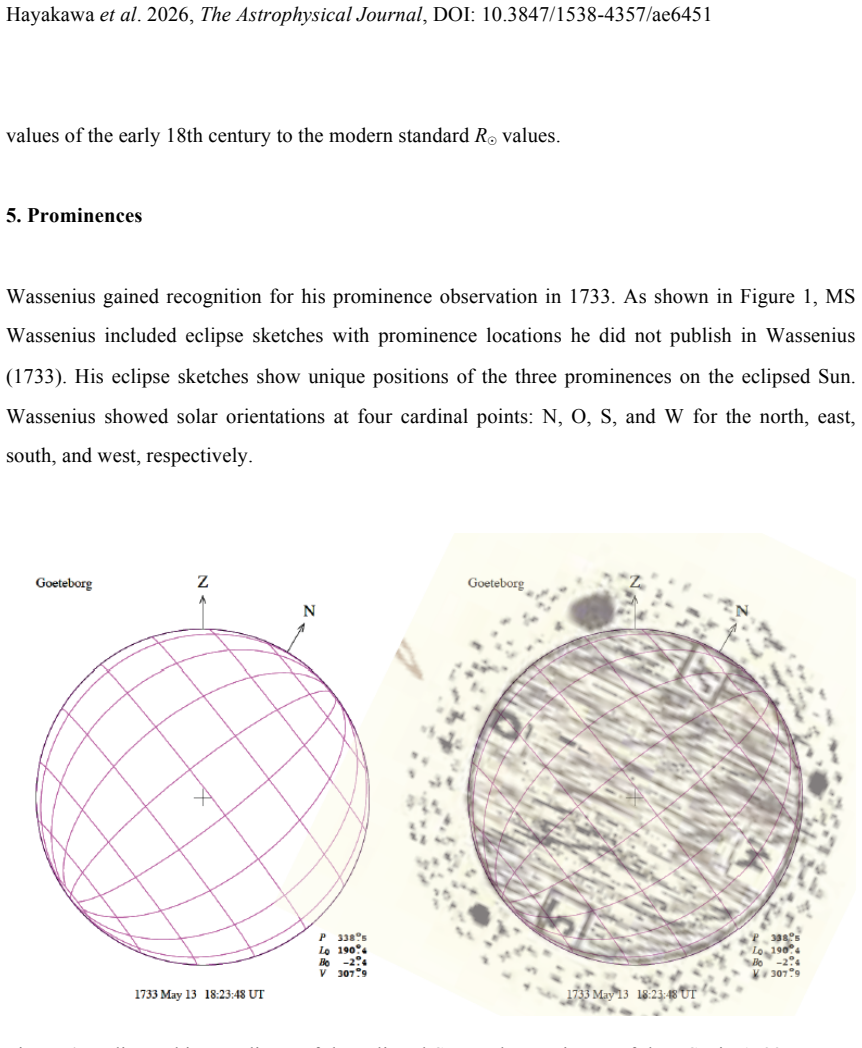
Figure 1: Wassenius’ sketches of the eclipsed Sun and prominences on 1733 May 13, as reproduced from MS Wassenius (f
yet to be analysed in the scientific community (Nordenmark, 1938). Figure 1: Wassenius’ sketches of the eclipsed Sun and prominences on 1733 May 13, as reproduced from MS Wassenius (f. 2b), with a courtesy to the Center for History of Science of the Royal Swedish Academy of Sciences
1938
-
[11]
following the method proposed by Sôma et al. (2012). Any excesses of the solar photosphere above the lunar limb are observed as Bailey beads. We need to set the R☉ margin of 696250 ± 170 km to satisfy the totality duration of 128 ± 1 s. This is slightly larger than the old canonical R☉ of 696000 km (Auwers, 1891; Archinal et al., 2011), modern standard (h...
2012
-
[13]
For a long-term comparison, our R☉ value was translated to 959.99 ± 0.24″ in the apparent R☉, setting the Sun at 1 au from the Earth
and NASA JPL DE 441 (Park et al., 2021). For a long-term comparison, our R☉ value was translated to 959.99 ± 0.24″ in the apparent R☉, setting the Sun at 1 au from the Earth. Subsequently, we calculated the departure from the modern standard R☉ = 959.34″ (Takata and Gough, 2024), which appears consistent with two other ground-based measurements (Rozelot e...
2021
-
[16]
This likelihood is documented in Chatterjee et al
This is because high-latitude prominences are more likely to appear during the later parts of the rising phase of the solar cycle. This likelihood is documented in Chatterjee et al. (2020), who studied the concentrations of the appearances of prominences at high latitudes referred to as the ‘polar rush’ of prominences. Figures 5 and 7 in their paper show ...
2020
-
[19]
and the International Sunspot Number V2 (ISN V2: Clette et al., 2023). We need to be cautious on the reliability of the International Sunspot Number V2 before 1749, as the recent studies suggested substantial revisions in this period (Hayakawa et al., 2022; Carrasco et al., 2024). We also examined Wassenius’ report for the TSE in 1733 and the drawings loc...
2023
-
[22]
DOI: 10.1007/s41116-020-0023-y Auwers, A. 1891, Der Sonnendurchmesser und der Venusdurchmesser nach den Beobachtungen an den Heliometern der deutschen Venus-Expeditionen, Astronomische Nachrichten, 128, 361-376. DOI: 10.1002/asna.18911282002 Bell, T. E. 2025, Observatories, Marine Chronometers, and Terrestrial Applications: From Chronometric Longitude Exp...
-
[23]
DOI: 10.3847/1538-4357/ad3fb9 Celsius, A. 1733, CCCXVI. Observationes de lumine Boreali: ab A. MDCCXVI. ad A. MDCCXXXII. partim a se, partim ab aliis, in Suecia habitas, Norimberga, Endter Charbonneau, P. 2014, Wassenius, Birger, in: Hockey, T., Trimble, V., Williams, T. R., Bracher, K., Jarrell, R. A., Marché II, J. D., Palmeri, J., Green, D. W. E. (eds....
-
[24]
DOI: 10.1007/s41116-020-00025-6 Chatterjee, S., Hegde, M., Banerjee, D., Ravindra, B., McIntosh, S. W. 2020, Time-Latitude Hayakawa et al. 2026, The Astrophysical Journal, DOI: 10.3847/1538-4357/ae6451 15 Distribution of Prominences for 10 Solar Cycles: A Study Using Kodaikanal, Meudon, and Kanzelhohe Data, Earth and Space Science, 7, e00666. DOI: 10.1029...
-
[25]
DOI: 10.1007/s11207-023-02136-3 Dunham, D. W., Sofia, S., Fiala, A. D., Herald, D., Muller, P. M. 1980, Observations of a Probable Change in the Solar Radius between 1715 and 1979, Science, 210, 1243-1245. DOI: 10.1126/science.210.4475.1243 Fiala, A. D., Dunham, D. W., Sofia, S. 1994, Variation of the Solar Diameter from Solar Eclipse Observations, 1715 –...
-
[26]
R., Druckmüller, M., Alzate, N., et al
DOI: 10.1007/s11214-023-00976-w Habbal, S. R., Druckmüller, M., Alzate, N., et al. 2021, Identifying the Coronal Source Regions of Solar Wind Streams from Total Solar Eclipse Observations and in situ Measurements Extending over a Solar Cycle, The Astrophysical Journal Letters, 911, L4. DOI: 10.3847/2041-8213/abe775 Hayakawa, H., Lockwood, M., Owens, M. J....
-
[27]
DOI: 10.1051/swsc/2020035 Hayakawa, H., Hattori, K., Soma, M., Iju, T., Besser, B. P., Kosaka, S. 2022, An Overview of Sunspot Observations in 1727–1748, The Astrophysical Journal, 941,
-
[28]
J., Meng, J., Sôma, M., Lockwood, M
DOI: 10.3847/1538-4357/ac6671 Hayakawa, H., Owens, M. J., Meng, J., Sôma, M., Lockwood, M. 2025, Analyses of the Ancient Chinese Report on the Total Solar Eclipse in 709 BCE: Implications for the Contemporaneous Earth’s Rotation Speed and Solar Cycles, The Astrophysical Journal Letters, 995, L1. DOI: 10.3847/2041-8213/ae0461 Hiremath, K. M., Rozelot, J. P...
-
[29]
DOI: 10.3847/1538-4357/ab6d08 Kilcik, A., Sigismondi, C., Rozelot, J. P., Guhl, K. 2009, Solar Radius Determination from Total Solar Eclipse Observations on 29 March 2006, Solar Physics, 257, 237-250. DOI: 10.1007/s11207-009-9378-x Hayakawa et al. 2026, The Astrophysical Journal, DOI: 10.3847/1538-4357/ae6451 16 Kubo, Y. 1993, Position and Radius of the S...
-
[30]
DOI: 10.3847/1538-3881/abd414 Parkinson, J. H., Morrison, L. V., Stephenson, F. R. 1980, The Constancy of the Solar Diameter over the Past 250 Years, Nature, 288, 548-551. DOI: 10.1038/288548a0 Parenti, S. 2014, Solar Prominences: Observations, Living Reviews in Solar Physics, 11,
-
[31]
DOI: 10.12942/lrsp-2014-1 Pasachoff, J. M. 2017, Heliophysics at Total Solar Eclipses, Nature Astronomy, 1,
-
[32]
F., Chen, J., Dehant, V., Rosat, S., Zhu, P
DOI: 10.1038/s41550-017-0190 Pettit, E. 1943, The Earliest Observations of Prominences, Publications of the Astronomical Society of the Pacific, 55, 184-189. DOI: 10.1086/125540 Petersen, J. 2009, Birger och Torsten Wassenius – Två Bröder från Vänersborg i frihetstidens Sverige, Vänersborgs Söners Gille, 2009, 29-50 Pevtsov, A.A., Nagovitsyn, Yu. A., Tlat...
-
[34]
DOI: 10.3847/1538-4357/ac9af4 Quaglia, L., Irwin, J., Emmanouilidis, K., Pessi, A. 2021, Estimation of the Eclipse Solar Radius by Flash Spectrum Video Analysis, The Astrophysical Journal Supplement Series, 256,
-
[35]
DOI: 10.3847/1538-4365/ac1279 Rozelot, J. P., Lefebvre, S., Desnoux, V. 2003, Observations of the Solar Limb Shape Distortions, Solar Physics, 217, 39-52. DOI: 10.1023/A:1027363803045 Rozelot, J. P., Damiani, C. 2012, Rights and Wrongs of the Temporal Solar Radius Variability, The European Physical Journal H, 37, 709-743. DOI: 10.1140/epjh/e2012-20030-4 R...
-
[36]
DOI: 10.1007/s11214-018-0534-1 Appendix: Translation of Wassenius’ Report to the Royal Academy of Sweden (MS Wassenius) Solar Eclipse dated 2 May 1733 observed in/from Göteborg, at a castle, named Cronan6, approximately 1,000 al:7 from the city itself. The time, according to my clock which shows and clicks minutes and seconds, as well as 4 other smaller o...
-
[38]
o’clock, the end of the total eclipse 7 20' 5
The Sun became completely full, and the eclipse ended with the southeastern ☉ edge; this is as much as one could deduct 55 or 56 degrees from a vertical line drawn through the ☉ disc. The Sun completely covered in Göteborg: 2 minutes 8 seconds. As soon as the Sun here in Göteborg was completely obscured, I saw the true circumference of the Moon through my...
discussion (0)
Sign in with ORCID, Apple, or X to comment. Anyone can read and Pith papers without signing in.