Recognition: unknown
Accurate distances of the Galactic spiral arms from dust-scattered X-ray emission of gamma-ray bursts
Pith reviewed 2026-05-08 01:33 UTC · model grok-4.3
The pith
Dust-scattered X-ray rings from gamma-ray bursts give direct distances to the outer Milky Way spiral arms with percent-level accuracy.
A machine-rendered reading of the paper's core claim, the machinery that carries it, and where it could break.
Core claim
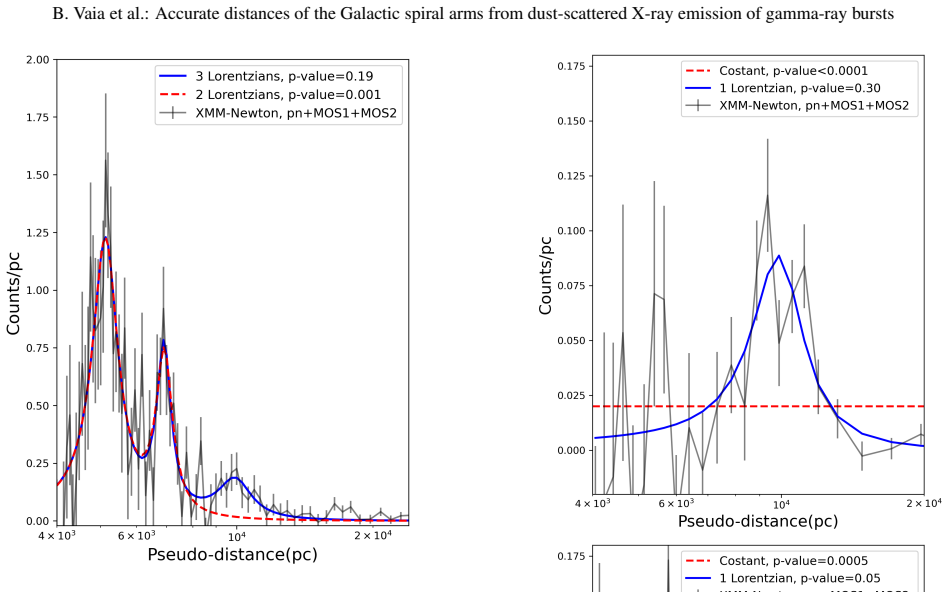
The paper establishes that the X-ray rings detected in the follow-up observations of GRB 031203, GRB 160623A, and GRB 221009A are produced by dust in the Perseus, Outer, and Outer Scutum-Centaurus spiral arms, yielding accurate distances along three lines of sight, including 6.91 ± 0.06 kpc and 9.9 ± 0.6 kpc for one burst, 9.7 ± 0.4 kpc for another, and 19.0 ± 0.2 kpc for the third. These measurements constrain the geometry of the outer Milky Way and reveal significant deviations from current models that rely on spectroscopy-based Galactic rotation curves at large distances.
What carries the argument
X-ray dust scattering rings produced by short extragalactic transients, which encode the distance to the scattering cloud through the light-travel time and observed ring size.
If this is right
- Direct geometric distances to the Perseus, Outer, and Outer Scutum-Centaurus arms become available along multiple sightlines with few-percent precision.
- Current models of the outer Milky Way that depend on spectroscopic rotation curves at large distances must be revised to match the new measurements.
- The method extends reliable cloud-distance mapping out to at least 19 kpc from the Sun.
- Repeated observations of the same burst can confirm and refine the positions of multiple clouds along a single line of sight.
Where Pith is reading between the lines
- The approach could be applied to additional gamma-ray bursts or other bright X-ray transients to assemble a more complete three-dimensional dust map of the Galaxy.
- The observed deviations from existing models may indicate unaccounted dynamical features such as disk warping or flaring in the outer Milky Way.
- Combining these geometric distances with future high-resolution surveys could calibrate or cross-check other indirect distance indicators.
Load-bearing premise
The detected X-ray rings can be unambiguously associated with dust in the named spiral arms rather than unrelated clouds, and the scattering geometry and timing model introduce no unrecognized systematics at the reported precision.
What would settle it
An independent distance measurement to one of the same dust clouds, for example via stellar parallax or maser proper motion, that falls outside the reported uncertainty range for the corresponding ring.
Figures





read the original abstract
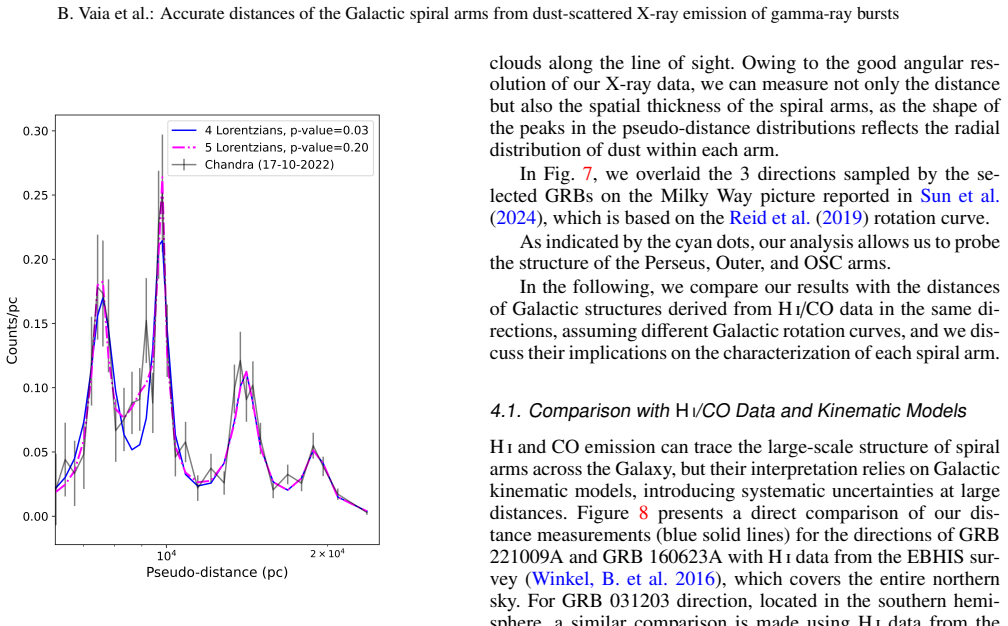
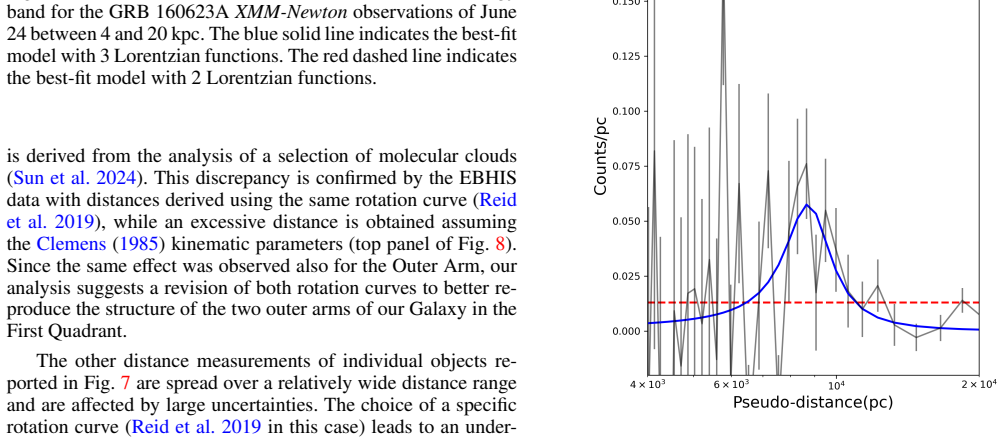
The details of the spiral structure of the Milky Way are still debated due to large uncertainties in the distance estimates obtained through the most common tracers. X-ray dust scattering rings produced by short extragalactic X-ray transients provide instead a direct method to measure the 3D distribution of interstellar clouds up to the edges of our Galaxy with a few percent precision. We report on the analysis of all the available XMM-Newton and Chandra follow-up observations of three low-latitude gamma-ray bursts: GRB 031203 ($l \sim 255{\deg}$, $b \sim -5{\deg}$), GRB 160623A ($l \sim 84{\deg}$, $b \sim -3{\deg}$), and GRB 221009A ($l \sim 53{\deg}$, $b \sim 4{\deg}$). The previous detection of X-ray rings in these observations, produced by dust clouds located beyond 5 kpc, can be associated with dust in the Perseus, Outer, and Outer Scutum-Centaurus arms, thus providing direct distance measurements to these structures along three distinct lines of sight. We have identified two additional rings in the direction of GRB 160623A, produced by dusty clouds at $6.91\, \pm\,0.06$ kpc and $9.9\,\pm\,0.6$ kpc, and confirmed -- through a second XMM-Newton observation -- the presence of one cloud at $9.7\,\pm\,0.4$ kpc toward GRB 031203. We also accurately measured the distance of dusty clouds up to $19.0\,\pm\,0.2$ kpc owing to the analysis of one Chandra and four XMM-Newton observations of GRB 221009A. The small statistical and systematic uncertainties of these measurements place tight constraints on the geometry of the outer Milky Way and reveal significant deviations from current models, which critically depend on spectroscopy-based Galactic rotation curves at large distances.
Editorial analysis
A structured set of objections, weighed in public.
Referee Report
Summary. The paper claims that X-ray dust scattering rings from three gamma-ray bursts (GRB 031203, GRB 160623A, GRB 221009A) observed with XMM-Newton and Chandra yield direct geometric distances to interstellar dust clouds associated with the Perseus, Outer, and Outer Scutum-Centaurus spiral arms. Reported distances include 6.91 ± 0.06 kpc and 9.9 ± 0.6 kpc toward GRB 160623A, 9.7 ± 0.4 kpc toward GRB 031203, and up to 19.0 ± 0.2 kpc toward GRB 221009A, with the small uncertainties said to tightly constrain outer Milky Way geometry and reveal significant deviations from rotation-curve-based models.
Significance. If the associations hold, the geometric light-travel-time method provides a valuable independent tracer of Galactic dust distribution up to large distances, free from spectroscopic rotation-curve assumptions. The few-percent precisions reported represent a clear strength and could falsifiably test outer-arm models. This approach has potential to resolve long-standing uncertainties in Milky Way spiral structure.
major comments (2)
- [Ring identifications for GRB 160623A and GRB 221009A] The assignment of rings (e.g., the 6.91 ± 0.06 kpc cloud to the Perseus arm in the GRB 160623A analysis) rests on proximity to positions from existing Galactic models without described independent identifiers such as kinematics, extinction maps, or multi-tracer cross-checks. This is load-bearing for the central claim of significant model deviations, as alternative assignments within the quoted uncertainties would weaken the interpretation.
- [Abstract and results sections] The abstract states measured distances and uncertainties but the manuscript provides no derivation details, full error-budget breakdown (including scattering geometry and timing systematics), or validation against independent tracers. This leaves the 'accurate' and 'few percent precision' claims only partially supported.
minor comments (2)
- [Abstract] The abstract could specify the exact number and dates of the XMM-Newton and Chandra observations used for each GRB to improve reproducibility.
- [Figures] Figures showing the detected rings would benefit from explicit labels indicating the assigned arm and measured distance for each feature.
Simulated Author's Rebuttal
We thank the referee for their positive evaluation of the potential impact of our work and for the detailed, constructive comments. We address each major point below and will incorporate revisions to strengthen the manuscript.
read point-by-point responses
-
Referee: [Ring identifications for GRB 160623A and GRB 221009A] The assignment of rings (e.g., the 6.91 ± 0.06 kpc cloud to the Perseus arm in the GRB 160623A analysis) rests on proximity to positions from existing Galactic models without described independent identifiers such as kinematics, extinction maps, or multi-tracer cross-checks. This is load-bearing for the central claim of significant model deviations, as alternative assignments within the quoted uncertainties would weaken the interpretation.
Authors: We agree that the primary basis for associating the measured distances with specific spiral arms is their alignment with positions predicted by existing Galactic models. The geometric light-travel-time method itself is independent of rotation-curve assumptions, which is a core advantage. To address the concern, we will revise the manuscript to expand the discussion of each line of sight, incorporating references to available extinction maps, CO surveys, and other multi-tracer data from the literature. We will also add an explicit analysis of how alternative arm assignments within the quoted uncertainties would affect the claimed deviations, demonstrating why the favored associations remain the most consistent with the data. revision: yes
-
Referee: [Abstract and results sections] The abstract states measured distances and uncertainties but the manuscript provides no derivation details, full error-budget breakdown (including scattering geometry and timing systematics), or validation against independent tracers. This leaves the 'accurate' and 'few percent precision' claims only partially supported.
Authors: We acknowledge that the current version would benefit from greater transparency in the methods. In the revised manuscript we will add a dedicated methods subsection (and supporting appendix if needed) that provides the full derivation of the distances from the observed ring expansion, including a complete error budget that quantifies contributions from scattering geometry, timing systematics, instrumental effects, and background subtraction. We will also include direct comparisons to independent distance estimates for the nearer structures (e.g., Perseus arm) drawn from maser parallaxes and other tracers to validate the precision claims. revision: yes
Circularity Check
Distances derived geometrically from ring timing; arm associations interpretive but not load-bearing for the measurements.
full rationale
The paper's core derivation uses the observed expansion of X-ray scattering rings around GRBs to compute cloud distances via light-travel-time geometry. This calculation depends only on the GRB trigger time, the observed ring radii at later epochs, and the scattering angle; it contains no reference to Galactic rotation curves, arm models, or prior distance estimates. The subsequent labeling of specific distance values as belonging to named arms (Perseus, Outer, Outer Scutum-Centaurus) is an interpretive step that occurs after the distances have already been obtained. Because the numerical results themselves are produced by an independent geometric method and are not fitted or redefined to match any model, the derivation chain does not reduce to its inputs by construction. No self-citation, ansatz smuggling, or fitted-input-as-prediction pattern appears in the measurement procedure.
Axiom & Free-Parameter Ledger
axioms (2)
- standard math X-ray photons scatter off dust grains and the resulting ring radius grows linearly with time at the speed of light, allowing distance inference from observed expansion.
- domain assumption Dust clouds responsible for the rings lie within the named Galactic spiral arms (Perseus, Outer, Outer Scutum-Centaurus).
Reference graph
Works this paper leans on
-
[1]
The Wide Field Infrared Survey Telescope: 100 Hubbles for the 2020s
Akeson, R., Armus, L., Bachelet, E., et al. 2019, arXiv e-prints, arXiv:1902.05569 Anderson, L. D., Bania, T. M., Balser, D. S., & Rood, R. T. 2011, ApJS, 194, 32 Barnes, D. G., Staveley-Smith, L., de Blok, W. J. G., et al. 2001, MNRAS, 322, 486 Breen, S. L., Fuller, G. A., Caswell, J. L., et al. 2015, MNRAS, 450, 4109 Chen, B.-Q., Huang, Y ., Yuan, H.-B....
work page Pith review arXiv 2019
-
[2]
The LSR ve- locities are deprojected into distances using two different models for the Galactic rotation curve: Reid et al
for GRB031203. The LSR ve- locities are deprojected into distances using two different models for the Galactic rotation curve: Reid et al. (2019) (red dot-dashed lines) and Clemens (1985) (black dotted lines). Frederiks, D., Golenetskii, S., Aptekar, R., et al. 2016, GRB Coordinates Net- work, 19554, 1 Fruscione, A., McDowell, J. C., Allen, G. E., et al. ...
2019
discussion (0)
Sign in with ORCID, Apple, or X to comment. Anyone can read and Pith papers without signing in.