Recognition: unknown
VEHRON: A Configuration-Driven BEV Simulation Framework for Subsystem-Level Studies
Pith reviewed 2026-05-07 17:15 UTC · model grok-4.3
The pith
VEHRON delivers a YAML-driven Python framework for deterministic longitudinal simulation of battery-electric vehicles with interchangeable subsystem models and full audit trails.
A machine-rendered reading of the paper's core claim, the machinery that carries it, and where it could break.
Core claim
VEHRON organizes its simulation around a compact engine, shared state bus, model registry, and schema-based YAML loading so that a single vehicle definition plus test-case file produces deterministic outputs, copied inputs, summary metadata, and plots inside a portable case package. Users can extend the battery and HVAC blocks by pointing to external Python files while the rest of the workflow stays unchanged. The current implementation covers longitudinal motion at prescribed speeds with simplified representations of battery state, thermal behavior, auxiliary loads, and cabin climate control.
What carries the argument
The schema-validated YAML configuration loader and model registry that together allow interchangeable low-order subsystem blocks to be selected and executed through a shared state bus without altering the simulation engine.
If this is right
- Each simulation run automatically emits a self-contained case package that bundles the original configuration files, the fully resolved settings, and standard plots for later inspection.
- Custom battery and HVAC models can be added by referencing external Python files while the rest of the workflow and output format remain unchanged.
- Drive-cycle resources are packaged with the code so that the same test conditions can be reproduced without external file management.
- The flat time-series output plus metadata summary allows direct comparison across multiple vehicle or test-case variants.
- The command-line interface keeps the entire process scriptable and repeatable for batch studies of subsystem trade-offs.
Where Pith is reading between the lines
- The same registry and state-bus structure could later support coupling to external optimization routines that vary vehicle parameters across many runs.
- Packaging drive cycles inside the framework reduces one common source of inconsistency when different research groups compare results.
- The emphasis on auditable case outputs could serve as a template for other vehicle simulation tools that need to satisfy traceability requirements in regulated development settings.
- Because the models are low-order and interchangeable, the framework could be used as a fast front-end filter before committing to higher-fidelity physics solvers.
Load-bearing premise
Low-order models for the battery, thermal system, auxiliaries, and HVAC are accurate enough for the targeted subsystem studies and that users will keep their YAML files free of hidden inconsistencies when extending or reusing them.
What would settle it
Running an identical prescribed-speed drive cycle once inside VEHRON and once with an equivalent set of manual calculations or another tool, then checking whether the VEHRON case package actually contains every input file, resolved parameter, and output plot that would be needed for independent reproduction.
Figures

read the original abstract
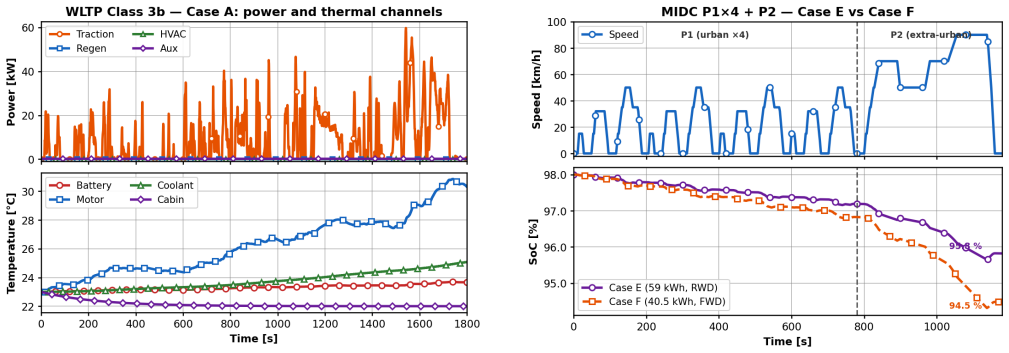
In practical early-stage battery-electric vehicle studies, analysis workflows may become fragmented across spreadsheets, notebooks, and project-specific scripts, making reuse, audit, and extension harder. VEHRON is an open-source Python framework for a deterministic, traceable workflow built around prescribed-speed longitudinal simulation of battery-electric vehicles using validated YAML configuration, packaged drive-cycle resources, interchangeable subsystem models, and auditable case outputs. VEHRON currently runs as a command-line workflow in which a vehicle definition and a testcase definition are combined to execute a simulation, emit a flat time series, and write a case package containing copied inputs, resolved configuration, summary metadata, and standard plots. Architecturally, VEHRON is organized around a small simulation engine, a shared state bus, a registry of model selections, schema-based configuration loading, and extension points for custom battery and HVAC models loaded from external Python files. VEHRON currently focuses on battery-electric longitudinal simulation with low-order battery, thermal, auxiliary-load, and HVAC models. This paper explains how VEHRON is structured, how it is used, which models it implements, and where its present limits lie. Source code is available at https://github.com/vehron-dev/vehron, with archived release metadata recorded under DOI https://doi.org/10.5281/zenodo.19820111.
Editorial analysis
A structured set of objections, weighed in public.
Referee Report
Summary. The manuscript describes VEHRON, an open-source Python framework for deterministic, traceable workflows in early-stage battery-electric vehicle (BEV) studies. It centers on prescribed-speed longitudinal simulation using validated YAML configuration, packaged drive-cycle resources, interchangeable subsystem models (low-order battery, thermal, auxiliary-load, and HVAC), and auditable case outputs containing copied inputs, resolved configuration, metadata, and plots. The architecture is organized around a small simulation engine, shared state bus, model registry, schema-based loading, and extension points for custom models from external Python files. The paper explains structure, command-line usage, implemented models, and present limits, with source code at https://github.com/vehron-dev/vehron and archived release at DOI https://doi.org/10.5281/zenodo.19820111.
Significance. If the described implementation and workflow hold, VEHRON addresses fragmentation in BEV analysis by offering a reusable, configuration-driven alternative to ad-hoc scripts and spreadsheets. The emphasis on determinism, traceability, open-source release, and extension points for subsystem models supports reproducibility and early-stage design studies in computational engineering. The public GitHub repository and Zenodo archive are concrete strengths that facilitate adoption and verification.
minor comments (3)
- [Abstract and Architecture] The abstract and architecture section refer to 'validated YAML configuration' and 'schema-based configuration loading' without specifying the validation library, schema definition file, or error-handling behavior; adding this detail would improve usability for new users.
- [Architecture] The description of the shared state bus and model registry would benefit from a concrete example of data exchange between interchangeable models (e.g., how battery SOC updates propagate to the thermal model) to clarify the claimed interchangeability.
- [Models and Limitations] The paper notes current limits on low-order models but does not discuss quantitative validation against higher-fidelity references or experimental data; a brief table or reference to such checks would strengthen the claim of suitability for subsystem-level studies.
Simulated Author's Rebuttal
We thank the referee for their positive and constructive review of our manuscript on VEHRON. Their recognition of the framework's emphasis on determinism, traceability, and open-source accessibility aligns with our goals for supporting reproducible early-stage BEV studies. We are pleased with the recommendation to accept.
Circularity Check
No significant circularity in software framework description
full rationale
The paper presents a descriptive account of an implemented open-source Python framework for BEV longitudinal simulation. It details architecture (simulation engine, state bus, model registry, YAML configuration), usage workflow, low-order subsystem models, and output packaging without any equations, first-principles derivations, parameter fitting, or predictions. Central claims rest on publicly available GitHub code and Zenodo archive, which are externally verifiable and independent of the paper text. No load-bearing step reduces to self-definition, fitted inputs renamed as predictions, or self-citation chains.
Axiom & Free-Parameter Ledger
axioms (1)
- domain assumption Low-order models for battery, thermal, auxiliary-load, and HVAC subsystems are adequate for the intended early-stage subsystem-level studies
Reference graph
Works this paper leans on
-
[1]
Natarajan.VEHRON
S. Natarajan.VEHRON. Version 0.2.2,
-
[2]
Archived release DOI:https: //doi.org/10.5281/zenodo.19820111
Software available athttps://github.com/ vehron-dev/vehron. Archived release DOI:https: //doi.org/10.5281/zenodo.19820111
-
[3]
T. Markel, A. Brooker, T. Hendricks, V. John- son, K. Kelly, B. Kramer, M. O’Keefe, S. Sprik, and K. Wipke. ADVISOR: a systems analysis tool for advanced vehicle modeling.Journal of Power Sources, 110(2):255–266, 2002. doi:10.1016/S0378- 7753(02)00163-2
-
[4]
2026.https://www.anl.gov/taps/ autonomie-vehicle-system-simulation-tool
Argonne National Laboratory.Au- tonomie Vehicle System Simulation Tool. 2026.https://www.anl.gov/taps/ autonomie-vehicle-system-simulation-tool. Accessed April 27, 2026
2026
-
[5]
A. Brooker, J. Gonder, L. Wang, E. Wood, S. Lopp, and L. Ramroth. FASTSim: A model to estimate ve- hicle efficiency, cost and performance. SAE Techni- cal Paper 2015-01-0973, 2015. doi:10.4271/2015-01-
-
[6]
NREL publication page: FASTSim publication record
-
[7]
P. Fritzson, A. Pop, K. Abdelhak, A. Asghar, B. Bachmann, W. Braun, D. Bouskela, R. Braun, L. Buffoni, and N. Casella et al. The Open- Modelica integrated environment for modeling, sim- ulation, and model-based development.Model- ing, Identification and Control, 41(4):241–295, 2020. doi:10.4173/mic.2020.4.1
-
[8]
T. D. Gillespie.Fundamentals of Vehicle Dynam- ics. SAE International, Warrendale, PA, 1992. doi:10.4271/R-114.https://saemobilus.sae.org/ books/fundamentals-vehicle-dynamics-r-114
work page doi:10.4271/r-114.https://saemobilus.sae.org/ 1992
-
[9]
2013.Linear Mixed-Effects Model
R. Rajamani.Vehicle Dynamics and Control. 2nd edition, Springer, 2012. doi:10.1007/978-1-4614- 1433-9
-
[10]
Liu.Introduction to Hybrid Vehicle System Mod- eling and Control
W. Liu.Introduction to Hybrid Vehicle System Mod- eling and Control. John Wiley & Sons, 2013
2013
-
[11]
2025.https://dmassets.hyundai.com/is/ content/hyundaiautoever/Hyundai_IONIQ-6_ Brochure-EN_20251202_1280x720_40ppdf
Hyundai Motor Europe.IONIQ 6 Brochure. 2025.https://dmassets.hyundai.com/is/ content/hyundaiautoever/Hyundai_IONIQ-6_ Brochure-EN_20251202_1280x720_40ppdf. Ac- cessed April 2026
2025
-
[12]
2024.https://www.tesla.com/en_eu/model3
Tesla, Inc.Model 3 EU Technical Specifications. 2024.https://www.tesla.com/en_eu/model3. Ac- cessed April 2026
2024
-
[13]
2024.https://www.bmw.com/en/models/ ix1/xdrive30.html
BMW Group.BMW iX1 xDrive30 Technical Data. 2024.https://www.bmw.com/en/models/ ix1/xdrive30.html. Accessed April 2026
2024
-
[14]
2024.https: //www.renault.co.uk/electric-vehicles/ r5-e-tech-electric/specifications.html
Renault Group.Renault 5 E-Tech 100% Elec- tric Technical Specifications. 2024.https: //www.renault.co.uk/electric-vehicles/ r5-e-tech-electric/specifications.html. Accessed April 2026
2024
-
[15]
154 - World- wide harmonized Light vehicles Test Proce- dure (WLTP)
United Nations Economic Commission for Europe.UN Regulation No. 154 - World- wide harmonized Light vehicles Test Proce- dure (WLTP). 2021.https://unece.org/ transport/documents/2021/02/standards/ un-regulation-no-154-worldwide-harmonized-light-vehicles-test. Accessed April 24, 2026
2021
-
[16]
Worldwide harmonised Light-duty vehicles Test Procedure (WLTP) and Real Driving Emis- sions (RDE)
Publications Office of the European Union. Worldwide harmonised Light-duty vehicles Test Procedure (WLTP) and Real Driving Emis- sions (RDE). 2024.https://op.europa. eu/en/publication-detail/-/publication/ 12790537-f4f0-11e9-8c1f-01aa75ed71a1/ language-en. Accessed April 24, 2026
2024
-
[17]
X. Hu, S. E. Li, and H. Peng. A comparative study of equivalent circuit models for Li-ion batter- ies.Journal of Power Sources, 198:359–367, 2012. doi:10.1016/j.jpowsour.2011.10.013
-
[18]
J. Su, M. Lin, S. Wang, J. Li, J. Coffie-Ken, and F. Xie. An equivalent circuit model analysis for the lithium-ion battery pack in pure electric vehi- cles.Measurement and Control, 52(3–4):193–201,
-
[19]
doi:10.1177/0020294019827338
-
[20]
D. Marcos, F. J. Pino, C. Bordons, and J. J. Guerra. The development and validation of a thermal model for the cabin of a vehicle.Ap- plied Thermal Engineering, 66(1–2):646–656, 2014. doi:10.1016/j.applthermaleng.2014.02.054
-
[21]
B. Torregrosa-Jaime, F. Bjurling, J. M. Corberan, and F. Di Sciullo. Transient thermal model of a ve- hicle’s cabin validated under variable ambient condi- tions.Applied Thermal Engineering, 75:45–53, 2015. doi:10.1016/j.applthermaleng.2014.05.074
-
[22]
G. J. Marshall, C. P. Mahony, M. J. Rhodes, S. R. Daniewicz, N. Tsolas, and S. M. Thomp- son. Thermal management of vehicle cab- ins, external surfaces, and onboard electronics: 11 An overview.Engineering, 5(5):954–969, 2019. doi:10.1016/j.eng.2019.02.009
-
[23]
L. Zhao, Q. Zhou, and Z. Wang. A systematic re- viewonmodellingthethermalenvironmentofvehicle cabins.Applied Thermal Engineering, 257:124142,
-
[24]
doi:10.1016/j.applthermaleng.2024.124142
-
[25]
Agrawal and A
S. Agrawal and A. Mistry. Review of traction motors for electric vehicle application.Journal of Electrical Systems, 20(3):2737–2747, 2024. https://journal.esrgroups.org/jes/article/ download/4522/3325/8206
2024
-
[26]
B. Shi, A. I. Ramones, Y. Liu, H. Wang, Y. Li, S. Pischinger, and J. Andert. A review of silicon car- bide MOSFETs in electrified vehicles: Application, challenges, andfuturedevelopment.IET Power Elec- tronics, 2023. doi:10.1049/pel2.12524
-
[27]
Surface Vehicle Recommended Practice J2452
SAE International.Stepwise Coastdown Methodol- ogy for Measuring Tire Rolling Resistance. Surface Vehicle Recommended Practice J2452. SAE Interna- tional, 2017
2017
-
[28]
E. M. Szumska. Regenerative braking systems in electric vehicles: A comprehensive review of design, controlstrategies, andefficiencychallenges.Energies, 18(10):2422, 2025. doi:10.3390/en18102422
-
[29]
Hucho.Aerodynamics of Road Vehicles
W.-H. Hucho.Aerodynamics of Road Vehicles. 4th edition. SAE International, 1998. ISBN 978- 0768000290
1998
-
[30]
ARAI,Pune, Febru- ary 2015
Automotive Industry Standards Committee / Au- tomotive Research Association of India.AIS-040 (Rev.1): 2015 — Electric Power Train Vehicles — Method of Measuring the Range. ARAI,Pune, Febru- ary 2015
2015
-
[31]
3 (04/2024) to AIS-040 (Rev.1): 2015 — Elec- tric Power Train Vehicles — Method of Measuring the Range
Automotive Industry Standards Committee / Au- tomotive Research Association of India.Amendment No. 3 (04/2024) to AIS-040 (Rev.1): 2015 — Elec- tric Power Train Vehicles — Method of Measuring the Range. ARAI, Pune, April 2024. Amendment 3 specifiesMIDCforM1/M2asPartI(fourelementary urban cycles of 195s each) plus Part II
2024
-
[32]
MoRTH, 1989 (as amended)
Ministry of Road Transport and Highways, Gov- ernment of India.The Central Motor Vehicles Rules, 1989, Annexure IV-B: Driving Cycles and Cold Start. MoRTH, 1989 (as amended). Part I and Part II MIDC speed tables at pp. 626–627 of the machine-readable mirror: https://ebook.commerciallawpublishers.com/ fa/cmvr/files/basic-html/page626.htmland https://ebook....
1989
-
[33]
Mahindra & Mahindra Ltd.BE 6 Technical Specifications. 2025. Official brochure:https:// www.mahindraelectricsuv.com/on/demandware. static/-/Library-Sites-eSUVSharedLibrary/ default/dwc19a84f6/Be-6e/ 5050-MAH-BE-6-Brochure-v18-AW-150DPI.pdf. Accessed April 2026
2025
-
[34]
2024.https: //ev.tatamotors.com/content/tml/ev/in/ en/nexon/ev/specifications.html
Tata Motors Ltd.Nexon EV Long Range Technical Specifications. 2024.https: //ev.tatamotors.com/content/tml/ev/in/ en/nexon/ev/specifications.html. Accessed April 2026
2024
-
[35]
GT-SUITE vehicle simulation software.https://www.gtisoft.com/ gt-suite/, 2024
Gamma Technologies LLC. GT-SUITE vehicle simulation software.https://www.gtisoft.com/ gt-suite/, 2024. Accessed April 2026
2024
-
[36]
CarMaker vehicle simulation.https://ipg-automotive.com/en/ products-solutions/software/carmaker/, 2024
IPG Automotive GmbH. CarMaker vehicle simulation.https://ipg-automotive.com/en/ products-solutions/software/carmaker/, 2024. Accessed April 2026. 12
2024
discussion (0)
Sign in with ORCID, Apple, or X to comment. Anyone can read and Pith papers without signing in.