Recognition: unknown
Finite Mixture Modeling with Riemannian Gaussian Distributions on Hyperbolic Space
Pith reviewed 2026-05-08 02:11 UTC · model grok-4.3
The pith
Finite mixtures of isotropic Riemannian Gaussians on the hyperboloid model admit tractable EM algorithms via weighted Fréchet means.
A machine-rendered reading of the paper's core claim, the machinery that carries it, and where it could break.
Core claim
The paper establishes that finite mixtures of isotropic Riemannian Gaussians on the hyperboloid model of hyperbolic space can be estimated by weighted maximum likelihood, with the location parameter given by the weighted Fréchet mean and the inverse-scale parameter obtained from a strictly convex one-dimensional profile likelihood; both exact EM and a generalized EM that employs truncated hyperbolic majorization-minimization updates are derived, together with guarantees of existence and uniqueness for the single-component estimator, singularity of the unrestricted mixture likelihood, existence of a constrained mixture estimator, and monotonicity of the algorithms.
What carries the argument
The isotropic Riemannian Gaussian distribution on hyperbolic space under the hyperboloid model, whose density permits an explicit radial normalizing constant and supports formulation of the EM updates through weighted Fréchet means and profile likelihoods.
If this is right
- The weighted Fréchet mean supplies a consistent estimator for component locations in hyperbolic space.
- The generalized EM procedure yields reliable mixture recovery with substantially lower computational cost than exact barycenter solves.
- Standard model-selection criteria remain effective for choosing the number of components in these non-Euclidean mixtures.
- The resulting likelihood-based procedure provides an exploratory clustering method for network data already embedded in hyperbolic space.
Where Pith is reading between the lines
- Clustering can be performed directly in the hyperbolic embedding space rather than after projection to Euclidean coordinates.
- Similar derivations may be feasible on other manifolds once the corresponding normalizing constants become available in closed form.
- The framework supplies a probabilistic alternative to heuristic methods for grouping tree-structured or hierarchical observations.
Load-bearing premise
The data are generated from a finite mixture of isotropic Riemannian Gaussians on the hyperboloid model and the weighted Fréchet mean and one-dimensional profile problems each admit unique solutions.
What would settle it
A simulation study that draws data exactly from a known finite mixture of these distributions on hyperbolic space yet finds that the fitted EM parameters deviate from the true values by more than Monte Carlo sampling error.
Figures



read the original abstract
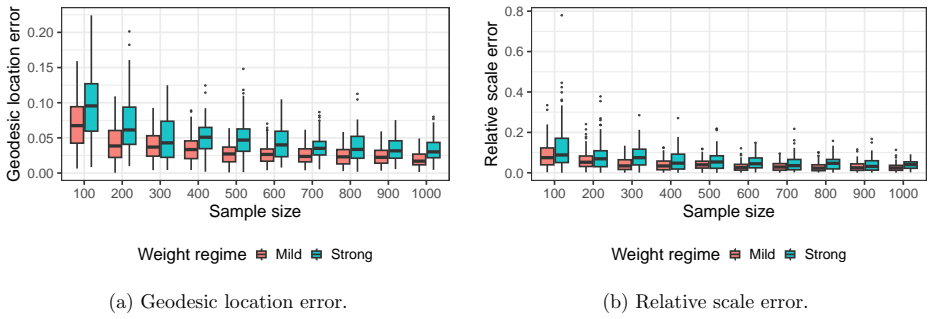
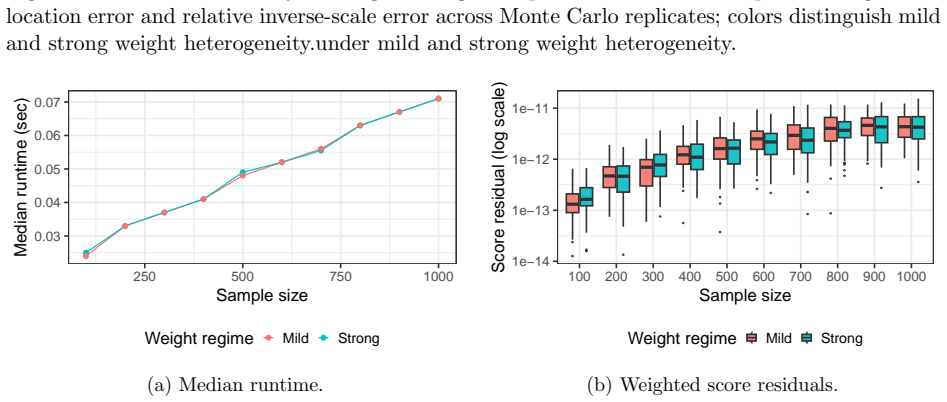
Hyperbolic space is increasingly used for hierarchical, tree-like, and network-structured data, but likelihood-based density modeling on hyperbolic space remains relatively limited. This paper develops finite mixture modeling with isotropic Riemannian Gaussian distributions on hyperbolic space under the hyperboloid model. We derive the density, radial normalizing constant, and a finite-sum representation involving the complementary error function. We then formulate weighted maximum likelihood estimation, which is the fundamental subproblem in mixture fitting: the location estimator is the weighted Fr\'{e}chet mean, while the inverse-scale estimator is obtained from a one-dimensional strictly convex profile problem. For finite mixtures, we derive exact EM and generalized EM algorithms. The generalized version replaces exact barycenter solves with truncated hyperbolic majorization-minimization updates. We establish existence and uniqueness of the weighted single-component estimator, singularity of the unrestricted mixture likelihood, existence of a constrained mixture estimator, and monotonicity properties of the EM-type algorithms. Simulations show accurate weighted estimation, reliable mixture recovery, effective model selection, and substantial computational savings from generalized EM. Real network examples based on hyperbolic embeddings illustrate the method as an exploratory likelihood-based clustering tool for non-Euclidean data.
Editorial analysis
A structured set of objections, weighed in public.
Referee Report
Summary. The manuscript develops finite mixture models based on isotropic Riemannian Gaussian distributions on the hyperboloid model of hyperbolic space. It derives the density, a radial normalizing constant expressed via a finite sum involving the complementary error function, weighted maximum-likelihood estimators (weighted Fréchet mean for location and a one-dimensional strictly convex profile problem for inverse scale), exact EM and generalized EM algorithms (the latter using truncated hyperbolic majorization-minimization), and proves existence/uniqueness of the single-component estimators, singularity of the unrestricted mixture likelihood, existence of a constrained mixture estimator, and monotonicity of the EM-type procedures. Validation is provided through simulations showing accurate estimation and model recovery, plus applications to hyperbolic embeddings of real networks.
Significance. If the derivations and proofs hold, the work supplies a principled likelihood-based framework for clustering and density estimation on hyperbolic space, addressing a gap for hierarchical and network-structured data. Strengths include the explicit normalizing constant, closed-form or efficiently solvable M-steps, and rigorous justification of the EM algorithms via existence, uniqueness, and monotonicity results. The generalized EM variant offers practical computational benefits while preserving theoretical guarantees.
minor comments (3)
- [Abstract] In the abstract and introduction, the phrase 'finite-sum representation involving the complementary error function' for the normalizing constant should be accompanied by a brief statement of whether the sum is exact or truncated, and the number of terms required for a given precision.
- [§2] Notation for the hyperboloid model (e.g., the Minkowski inner product and the radial coordinate) should be introduced with a short table or explicit definitions in §2 to avoid ambiguity when the density and Fréchet mean are later defined.
- [Simulations] The simulation section would benefit from reporting the number of Monte Carlo replicates and standard errors for the reported recovery rates and timing comparisons between exact and generalized EM.
Simulated Author's Rebuttal
We thank the referee for their positive and constructive review of our manuscript. We are pleased that the referee recognizes the contributions of the work in providing a likelihood-based framework for finite mixture modeling on hyperbolic space, including the derivations, algorithms, and theoretical guarantees. The recommendation to accept is appreciated.
Circularity Check
No significant circularity; derivations self-contained from standard geometry and MLE
full rationale
The paper starts from the standard definition of the isotropic Riemannian Gaussian on the hyperboloid model of hyperbolic space, derives the density and radial normalizing constant (including the erfc finite-sum form) directly from the Riemannian metric and volume element, then applies standard weighted maximum-likelihood and EM principles to obtain the Fréchet-mean location estimator and the one-dimensional profile problem for the scale. Existence/uniqueness statements and monotonicity of the EM algorithms are established from convexity and compactness arguments that do not invoke the paper's own fitted quantities. No step reduces by construction to a parameter defined only in terms of the model's outputs, and no load-bearing self-citation chain is present in the derivation.
Axiom & Free-Parameter Ledger
axioms (2)
- standard math Properties of the hyperboloid model of hyperbolic space
- domain assumption Existence and uniqueness of the weighted Frechet mean on hyperbolic space
Forward citations
Cited by 3 Pith papers
-
Intrinsic effective sample size for manifold-valued Markov chain Monte Carlo via kernel discrepancy
An intrinsic effective sample size for manifold MCMC is defined via kernel discrepancy as the number of independent draws yielding equivalent expected squared discrepancy to the target.
-
Profile Likelihood Inference for Anisotropic Hyperbolic Wrapped Normal Models on Hyperbolic Space
The profile maximum likelihood estimator for the location in anisotropic hyperbolic wrapped normal models is strongly consistent, asymptotically normal, and attains the Hájek-Le Cam minimax lower bound under squared g...
-
Scale selection for geometric medians on product manifolds
Joint location-scale minimization for geometric medians on product manifolds degenerates to marginal medians, and three new scale-selection methods restore identifiability with asymptotic guarantees.
Reference graph
Works this paper leans on
-
[1]
Afsari, B. (2011). Riemannian$L p$center of mass: Existence, uniqueness, and convexity,Pro- ceedings of the American Mathematical Society139(02): 655–655. Bhattacharya, A. and Bhattacharya, R. (2012).Nonparametric Inference on Manifolds: With Applications to Shape Spaces, Cambridge University Press, Cambridge. Boumal, N. (2023).An Introduction to Optimiza...
2011
-
[2]
and Krioukov, D
Cunningham, W., Zuev, K. and Krioukov, D. (2017). Navigability of Random Geometric Graphs in the Universe and Other Spacetimes,Scientific Reports7(1):
2017
-
[3]
Numerische Mathematik , author =
Dempster, A. P., Laird, N. M. and Rubin, D. B. (1977). Maximum Likelihood from Incomplete Data Via theEMAlgorithm,Journal of the Royal Statistical Society: Series B (Methodological) 39(1): 1–22. 46 Dijkstra, E. W. (1959). A note on two problems in connexion with graphs,Numerische Mathematik 1(1): 269–271. URL:http://link.springer.com/10.1007/BF01386390 Fr...
discussion (0)
Sign in with ORCID, Apple, or X to comment. Anyone can read and Pith papers without signing in.