Recognition: 2 theorem links
· Lean TheoremScale selection for geometric medians on product manifolds
Pith reviewed 2026-05-11 02:30 UTC · model grok-4.3
The pith
Joint minimization of location and scale for geometric medians on product manifolds degenerates, driving scale to the boundary and reducing to a marginal median.
A machine-rendered reading of the paper's core claim, the machinery that carries it, and where it could break.
Core claim
The central claim is that naive joint minimization over location and scale is degenerate: the scale is driven to the boundary and the problem collapses to a marginal median, effectively discarding one factor. Relative scale is not identifiable from the raw median loss alone. Three alternatives are developed: treating scale as indexing a sensitivity path with uniform consistency, a functional central limit theorem, and a derivative-based sensitivity measure; constructing a robust scale-calibrated median from marginal radial median scales that achieves unit invariance, consistency, a two-step central limit theorem, and bounded influence; and introducing a bounded balance equation for direct, a
What carries the argument
The geometric median objective on the product manifold, defined via the sum of distances to observed points, which couples the scales of the component manifolds and permits boundary collapse under simultaneous optimization.
If this is right
- Scale must be treated separately from location rather than optimized jointly, or the estimator discards one manifold factor.
- The sensitivity-path approach yields a continuous family of medians whose derivative with respect to scale quantifies sensitivity to relative metric choice.
- The marginal-scale calibration produces an estimator that is invariant to unit rescaling of either factor and has bounded influence.
- The balance-equation estimator admits a joint asymptotic normal distribution for location and scale together with uniqueness and monotonicity guarantees.
Where Pith is reading between the lines
- The degeneracy pattern may appear in other summed-distance estimators on product spaces, suggesting separate scale calibration is needed for broader classes of manifold-valued robust statistics.
- The derivative-based sensitivity measure could serve as a practical diagnostic for choosing scales in applied settings where the relative metrics of the factors are unknown a priori.
- Joint asymptotic normality under the balance-equation method opens the door to simultaneous confidence regions for both location and scale parameters on product manifolds.
Load-bearing premise
The median objective couples the factors through the sum of distances in a manner that permits boundary collapse under joint optimization.
What would settle it
Numerical optimization of the joint location-scale objective on data drawn from a product of two spaces with mismatched intrinsic scales, checking whether the estimated scale ratio converges to zero or infinity as sample size grows.
Figures


read the original abstract
Geometric medians on product manifolds are sensitive to the relative scaling of factor metrics because the median objective couples the factors rather than separating them. We study this scale-selection problem and first prove that naive joint minimization over location and scale is degenerate: the scale is driven to the boundary and the problem collapses to a marginal median, effectively discarding one factor. Thus relative scale is not identifiable from the raw median loss alone. We develop three alternatives to mitigate this issue. The first treats scale as indexing a sensitivity path and establishes uniform consistency, a functional central limit theorem, and a derivative-based sensitivity measure. The second constructs a robust scale-calibrated median using marginal radial median scales, yielding unit invariance, consistency, a two-step central limit theorem, and bounded influence. The third introduces a bounded balance equation for direct scale estimation, with monotonicity, uniqueness, joint asymptotic normality, and bounded influence. Simulations illustrate boundary collapse, sensitivity, unit invariance, and balanced estimation in Euclidean and Bures-Wasserstein settings.
Editorial analysis
A structured set of objections, weighed in public.
Referee Report
Summary. The paper studies scale selection for geometric medians on product manifolds. It proves that naive joint minimization over location and relative scale is degenerate: the scale parameter is driven to the boundary (typically zero), collapsing the estimator to a marginal median on one factor and discarding the other. Three alternatives are developed: (i) treating scale as a sensitivity index with uniform consistency, a functional CLT, and a derivative-based sensitivity measure; (ii) a scale-calibrated median constructed from marginal radial median scales, yielding unit invariance, consistency, a two-step CLT, and bounded influence; (iii) direct scale estimation via a bounded balance equation, with monotonicity, uniqueness, joint asymptotic normality, and bounded influence. Theoretical results are illustrated by simulations on Euclidean and Bures-Wasserstein product spaces.
Significance. If the degeneracy result and the accompanying consistency/CLT/influence-function statements hold under the stated assumptions, the work identifies a fundamental identifiability obstruction in product-manifold geometric medians and supplies three theoretically grounded remedies. The degeneracy argument, the uniform consistency and FCLT for the sensitivity path, the two-step CLT and unit invariance for the calibrated median, and the monotonicity/uniqueness for the balance equation are all load-bearing contributions to robust statistics on manifolds. The explicit construction of bounded-influence estimators and the simulation evidence in both Euclidean and Bures-Wasserstein geometries strengthen the practical relevance.
major comments (2)
- [Introduction / degeneracy section] The degeneracy claim (naive joint minimization collapses to a marginal median) is central; the argument appears to rest on the partial derivative of the objective with respect to the scale parameter being strictly positive for scale > 0 whenever the second-factor distances are not identically zero. This should be stated with the precise product distance form used (e.g., sqrt(d1^2 + lambda^2 d2^2)) and the domain of lambda made explicit, because the sign of the derivative may change under other product metrics or when distances can be zero.
- [Section on scale-calibrated median] For the second method, the two-step CLT and bounded-influence claim rely on the marginal radial median scales being consistent and having their own CLT; the joint asymptotic covariance between the calibrated location and the estimated scales should be derived explicitly rather than asserted, because the calibration step introduces dependence that is not automatically negligible.
minor comments (2)
- [Throughout] Notation for the product manifold, the relative scale parameter, and the three estimators should be unified across sections to avoid re-definition of symbols.
- [Simulation section] The simulation section would benefit from a table reporting the empirical scale estimates and their variability under the three methods, rather than only qualitative illustrations of boundary collapse.
Simulated Author's Rebuttal
We thank the referee for the careful reading, the positive assessment of the contributions, and the recommendation for minor revision. The two major comments help clarify the presentation of the degeneracy argument and the asymptotic covariance in the scale-calibrated estimator. We address each point below.
read point-by-point responses
-
Referee: [Introduction / degeneracy section] The degeneracy claim (naive joint minimization collapses to a marginal median) is central; the argument appears to rest on the partial derivative of the objective with respect to the scale parameter being strictly positive for scale > 0 whenever the second-factor distances are not identically zero. This should be stated with the precise product distance form used (e.g., sqrt(d1^2 + lambda^2 d2^2)) and the domain of lambda made explicit, because the sign of the derivative may change under other product metrics or when distances can be zero.
Authors: We agree that explicitness improves clarity. The degeneracy proof in the manuscript is derived for the standard weighted product distance d((x,y),(x',y')) = sqrt(d_M(x,x')^2 + lambda^2 d_N(y,y')^2) with lambda in (0, infty). Under this metric the partial derivative of the objective with respect to lambda is strictly positive for lambda > 0 whenever the second-factor distances are not all zero (which is the generic case under continuous distributions). We will revise the introduction and the degeneracy section to state this distance form and domain explicitly, and to note that the result is tied to this natural relative-scaling metric rather than to arbitrary product metrics. revision: yes
-
Referee: [Section on scale-calibrated median] For the second method, the two-step CLT and bounded-influence claim rely on the marginal radial median scales being consistent and having their own CLT; the joint asymptotic covariance between the calibrated location and the estimated scales should be derived explicitly rather than asserted, because the calibration step introduces dependence that is not automatically negligible.
Authors: The two-step central limit theorem is obtained by first establishing marginal consistency and CLTs for the radial-median scales and then applying a continuous-mapping argument to the calibration map. The dependence between the location estimator and the estimated scales is accounted for in the proof, but the explicit joint asymptotic covariance matrix is only sketched. We will expand the relevant theorem statement and proof to display the full covariance expression, which incorporates the cross terms arising from the calibration step. This addition will make the bounded-influence property fully transparent without changing any of the stated results. revision: yes
Circularity Check
No significant circularity detected
full rationale
The paper's derivation begins with a direct proof that joint minimization over location and scale on the product manifold is degenerate, driven by the strictly positive partial derivative of the median objective with respect to the scale parameter whenever the second-factor distances are non-zero; this follows immediately from the product distance form without any fitted inputs or self-referential definitions. The three alternatives are then constructed explicitly as new estimators (sensitivity path, marginal radial calibration, and bounded balance equation) whose consistency, CLTs, uniqueness, and influence bounds are derived from standard asymptotic arguments on the manifold rather than being equivalent to the input data or prior self-citations by construction. No equations reduce predictions to fitted parameters, no uniqueness theorems are imported from overlapping authors, and no ansatzes are smuggled via citation; the central claims remain independent of the target results.
Axiom & Free-Parameter Ledger
axioms (2)
- domain assumption Geometric median on a product manifold is defined by joint minimization of summed distances under the product metric.
- standard math Standard regularity conditions for uniform consistency and functional central limit theorems hold on the manifold.
Lean theorems connected to this paper
-
IndisputableMonolith/Cost/FunctionalEquation.leanwashburn_uniqueness_aczel unclear?
unclearRelation between the paper passage and the cited Recognition theorem.
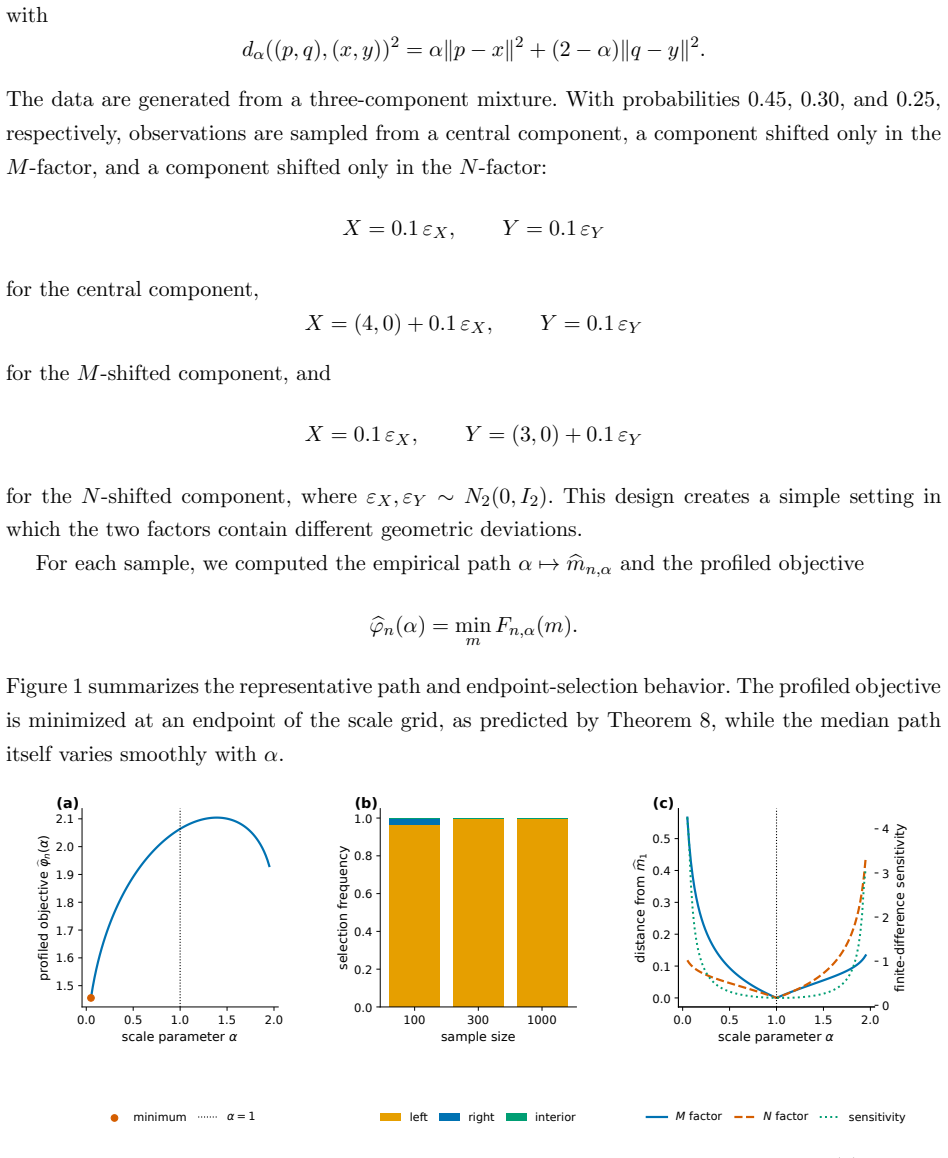
For every fixed location m, the map α↦Fn,α(m) is concave. Hence an interior critical point in α is generically a maximum, not a minimum. Minimization over α is likely to drive the solution to the boundary.
-
IndisputableMonolith/Foundation/BranchSelection.leanRCLCombiner_isCoupling_iff unclear?
unclearRelation between the paper passage and the cited Recognition theorem.
The balance equation compares the two scaled squared factor distances through a bounded relative contrast... α↦hα(Z;m) is nondecreasing, and it is strictly increasing whenever A>0 and B>0.
What do these tags mean?
- matches
- The paper's claim is directly supported by a theorem in the formal canon.
- supports
- The theorem supports part of the paper's argument, but the paper may add assumptions or extra steps.
- extends
- The paper goes beyond the formal theorem; the theorem is a base layer rather than the whole result.
- uses
- The paper appears to rely on the theorem as machinery.
- contradicts
- The paper's claim conflicts with a theorem or certificate in the canon.
- unclear
- Pith found a possible connection, but the passage is too broad, indirect, or ambiguous to say the theorem truly supports the claim.
Reference graph
Works this paper leans on
-
[1]
Geodesic. Brain Connectivity , author =. 2021 , pages =. doi:10.1089/brain.2020.0881 , language =
-
[2]
SIAM Journal on Matrix Analysis and Applications , author =
Schubert. SIAM Journal on Matrix Analysis and Applications , author =. 2016 , pages =. doi:10.1137/15M1054201 , language =
- [3]
-
[4]
Lee, Jongmin and Jung, Sungkyu , month = jul, year =. Huber means on. doi:10.48550/arXiv.2407.15764 , abstract =
- [5]
-
[6]
Huber, Marco F. and Hanebeck, Uwe D. , year =. Progressive. doi:10.5445/IR/1000034859 , abstract =
-
[7]
Journal of Mathematical Imaging and Vision40(1), 120–145 (2010)
A. Journal of Mathematical Imaging and Vision , author =. 2011 , pages =. doi:10.1007/s10851-010-0251-1 , language =
-
[8]
Proceedings of the National Academy of Sciences , author =
The multivariate. Proceedings of the National Academy of Sciences , author =. 2000 , pages =. doi:10.1073/pnas.97.4.1423 , language =
-
[9]
van der Vaart, A. W. and Wellner, Jon A. , year =. Weak convergence and empirical processes , isbn =
-
[10]
van der Vaart, A. W. , year =. Asymptotic
-
[11]
Journal of Machine Learning Research , author =
Visualizing data using t-. Journal of Machine Learning Research , author =. 2008 , pages =
work page 2008
-
[12]
Serfling, Robert J. , month = nov, year =. Approximation. doi:10.1002/9780470316481 , language =
-
[13]
A. The Annals of Mathematical Statistics , author =. 1966 , pages =. doi:10.1214/aoms/1177699450 , language =
- [14]
-
[15]
Hampel, Frank R. and Ronchetti, Elvezio M. and Rousseeuw, Peter J. and Stahel, Werner A. , month = mar, year =. Robust. doi:10.1002/9781118186435 , language =
-
[16]
You, Kisung , year =. Constant. doi:10.48550/ARXIV.2601.10992 , abstract =
-
[17]
Fréchet means and. Bernoulli , author =. doi:10.3150/17-BEJ1009 , number =
-
[18]
Panaretos, Victor M. and Zemel, Yoav , year =. An. doi:10.1007/978-3-030-38438-8 , language =
-
[19]
Huang, Minhui and Ma, Shiqian and Lai, Lifeng , editor =. Projection. Proceedings of the 38th international conference on machine learning , publisher =. 2021 , pages =
work page 2021
-
[20]
The Annals of Mathematical Statistics , author =
Robust. The Annals of Mathematical Statistics , author =. 1964 , pages =. doi:10.1214/aoms/1177703732 , language =
-
[21]
The Annals of Applied Probability , author =
Statistical inference for. The Annals of Applied Probability , author =. doi:10.1214/20-AAP1618 , number =
-
[22]
Journal of the European Mathematical Society , author =
Fast convergence of empirical barycenters in. Journal of the European Mathematical Society , author =. 2022 , pages =. doi:10.4171/JEMS/1234 , language =
-
[23]
Probability Theory and Related Fields , author =
Existence and consistency of. Probability Theory and Related Fields , author =. 2017 , pages =. doi:10.1007/s00440-016-0727-z , language =
-
[24]
Journal of Mathematical Analysis and Applications , author =
A fixed-point approach to barycenters in. Journal of Mathematical Analysis and Applications , author =. 2016 , pages =. doi:10.1016/j.jmaa.2016.04.045 , language =
-
[25]
Cheng, Zixiong and Liu, Hang , year =. Robust. doi:10.48550/ARXIV.2603.07563 , abstract =
-
[26]
Journal of the Royal Statistical Society Series B: Statistical Methodology , author =
Huber means on. Journal of the Royal Statistical Society Series B: Statistical Methodology , author =. 2026 , pages =. doi:10.1093/jrsssb/qkaf054 , abstract =
-
[27]
Journal of Multivariate Analysis , author =
Geometric medians on product manifolds , volume =. Journal of Multivariate Analysis , author =. 2026 , pages =. doi:10.1016/j.jmva.2026.105653 , language =
-
[28]
Foundations and Trends® in Machine Learning , author =
Kernel. Foundations and Trends® in Machine Learning , author =. 2017 , pages =. doi:10.1561/2200000060 , language =
-
[29]
Learning from distributions via support measure machines , volume =
Muandet, Krikamol and Fukumizu, Kenji and Dinuzzo, Francesco and Schölkopf, Bernhard , editor =. Learning from distributions via support measure machines , volume =. Advances in neural information processing systems , publisher =
-
[30]
and Salzmann, Mathieu and Jayasumana, Sadeep and Hartley, Richard and Li, Hongdong , editor =
Harandi, Mehrtash T. and Salzmann, Mathieu and Jayasumana, Sadeep and Hartley, Richard and Li, Hongdong , editor =. Expanding the. Computer. 2014 , pages =. doi:10.1007/978-3-319-10584-0_27 , language =
-
[31]
Hamm, Jihun and Lee, Daniel D. , year =. Grassmann. Proceedings of the 25th international conference on. doi:10.1145/1390156.1390204 , language =
-
[32]
Wolf, Lior and Shashua, Amnon , month = dec, year =. Learning over. Journal of Machine Learning Research , publisher =
-
[33]
Rank-. Bayesian Analysis , author =. doi:10.1214/20-BA1221 , number =
-
[34]
Inference from. Statistical Science , author =. doi:10.1214/ss/1177011136 , number =
-
[35]
Probability Surveys , author =
Basic. Probability Surveys , author =. doi:10.1214/154957805100000104 , number =
-
[36]
Journal of Machine Learning Research , author =
Kernel. Journal of Machine Learning Research , author =. 2022 , pages =
work page 2022
-
[37]
The Annals of Statistics , author =
Batch means and spectral variance estimators in. The Annals of Statistics , author =. doi:10.1214/09-AOS735 , number =
-
[38]
Journal of the American Statistical Association , author =
Fixed-. Journal of the American Statistical Association , author =. 2006 , pages =. doi:10.1198/016214506000000492 , language =
-
[39]
Feragen, Aasa and Lauze, Francois and Hauberg, Soren , month = jun, year =. Geodesic exponential kernels:. 2015. doi:10.1109/CVPR.2015.7298922 , urldate =
-
[40]
SIAM Journal on Matrix Analysis and Applications , author =
Geometric. SIAM Journal on Matrix Analysis and Applications , author =. 2007 , pages =. doi:10.1137/050637996 , number =
-
[41]
and Salzmann, Mathieu and Hartley, Richard , editor =
Harandi, Mehrtash T. and Salzmann, Mathieu and Hartley, Richard , editor =. From. Computer. 2014 , pages =. doi:10.1007/978-3-319-10605-2_2 , language =
-
[42]
SIAM Journal on Matrix Analysis and Applications , author =
Theoretically and. SIAM Journal on Matrix Analysis and Applications , author =. 2022 , pages =. doi:10.1137/22M1471729 , language =
-
[43]
Thanwerdas, Yann and Pennec, Xavier , editor =. Geodesics and. Geometric. 2021 , pages =. doi:10.1007/978-3-030-80209-7_11 , language =
-
[44]
Journal of Machine Learning Research , author =
Universality,. Journal of Machine Learning Research , author =. 2011 , pages =
work page 2011
-
[45]
Strictly and non-strictly positive definite functions on spheres , volume =. Bernoulli , author =. doi:10.3150/12-BEJSP06 , number =
-
[46]
Duke Mathematical Journal , author =
Positive definite functions on spheres , volume =. Duke Mathematical Journal , author =. doi:10.1215/S0012-7094-42-00908-6 , number =
-
[47]
Equivalence of distance-based and RKHS -based statistics in hypothesis testing
Equivalence of distance-based and. The Annals of Statistics , author =. doi:10.1214/13-AOS1140 , number =
-
[48]
Gretton, Arthur and Borgwardt, Karsten M. and Rasch, Malte J. and Schölkopf, Bernhard and Smola, Alexander , month = mar, year =. A. Journal of Machine Learning Research , publisher =
-
[49]
Bhatia, Rajendra , month = dec, year =. Positive. doi:10.1515/9781400827787 , urldate =
-
[50]
Arnaudon, Marc and Barbaresco, Frédéric and Yang, Le , editor =. Medians and. Matrix. 2013 , note =. doi:10.1007/978-3-642-30232-9_8 , language =
-
[51]
Econometrics and Statistics , author =
Modeling. Econometrics and Statistics , author =. 2022 , pages =. doi:10.1016/j.ecosta.2021.04.004 , language =
-
[52]
Petersen, Peter , year =. Riemannian. doi:10.1007/978-0-387-29403-2 , publisher =
-
[53]
You, Kisung , year =. Finite. doi:10.48550/ARXIV.2604.24895 , abstract =
work page internal anchor Pith review Pith/arXiv arXiv doi:10.48550/arxiv.2604.24895
-
[54]
The Annals of Statistics , author =
Fréchet regression for random objects with. The Annals of Statistics , author =. doi:10.1214/17-AOS1624 , number =
-
[55]
The. NeuroImage , author =. 2012 , pages =. doi:10.1016/j.neuroimage.2012.02.018 , language =
- [56]
-
[57]
Prediction of. Science , author =. 2010 , pages =. doi:10.1126/science.1194144 , language =
-
[58]
A wrapped normal distribution on hyperbolic space for gradient-based learning , volume =
Nagano, Yoshihiro and Yamaguchi, Shoichiro and Fujita, Yasuhiro and Koyama, Masanori , editor =. A wrapped normal distribution on hyperbolic space for gradient-based learning , volume =. Proceedings of the 36th international conference on machine learning , publisher =. 2019 , pages =
work page 2019
- [59]
-
[60]
Le Cam, Lucien and Lo Yang, Grace , year =. Asymptotics in. doi:10.1007/978-1-4612-1166-2 , publisher =
-
[61]
A General Qualitative Definition of Robustness
Asymptotic. The Annals of Mathematical Statistics , author =. 1971 , pages =. doi:10.1214/aoms/1177693066 , language =
-
[62]
Note on the. The Annals of Mathematical Statistics , author =. 1949 , pages =. doi:10.1214/aoms/1177729952 , language =
-
[63]
Local asymptotic minimax and admissibility in estimation , language =
Hajek, Jaroslav , year =. Local asymptotic minimax and admissibility in estimation , language =. Proceedings of the
-
[64]
Cox, D.R. , year =. Analysis of. doi:10.1201/9781315137391 , urldate =
-
[65]
Journal of the Royal Statistical Society Series B: Statistical Methodology , author =
An. Journal of the Royal Statistical Society Series B: Statistical Methodology , author =. 1964 , pages =. doi:10.1111/j.2517-6161.1964.tb00553.x , abstract =
-
[66]
Computational Statistics & Data Analysis , author =
Parameter estimation and model-based clustering with spherical normal distribution on the unit hypersphere , volume =. Computational Statistics & Data Analysis , author =. 2022 , pages =. doi:10.1016/j.csda.2022.107457 , urldate =
-
[67]
Li, Songzi and Rizzo, Maria L. , month = nov, year =. K-groups:. doi:10.48550/arXiv.1711.04359 , abstract =
-
[68]
Hauberg, Soren , month = jul, year =. Directional. 2018 21st. doi:10.23919/ICIF.2018.8455242 , urldate =
-
[69]
R., Falorsi, L., De Cao, N., Kipf, T., and Tomczak, J
Davidson, Tim R. and Falorsi, Luca and Cao, Nicola De and Kipf, Thomas and Tomczak, Jakub M. , month = sep, year =. Hyperspherical. doi:10.48550/arXiv.1804.00891 , abstract =
-
[70]
Directional. 2022 , note =. doi:10.1007/978-981-19-1044-9 , language =
-
[71]
You, Kisung and Shung, Dennis , year =. On the spherical. doi:10.48550/ARXIV.2208.11929 , abstract =
-
[72]
Fuzzy communities and the concept of bridgeness in complex networks , volume =. Physical Review E , author =. 2008 , pages =. doi:10.1103/PhysRevE.77.016107 , number =
-
[73]
Journal of Anthropological Research , author =
An. Journal of Anthropological Research , author =. 1977 , pages =. doi:10.1086/jar.33.4.3629752 , number =
-
[74]
Journal of Complex Networks , author =
Hydra: a method for strain-minimizing hyperbolic embedding of network- and distance-based data , volume =. Journal of Complex Networks , author =. 2020 , pages =. doi:10.1093/comnet/cnaa002 , number =
-
[75]
Numerische Mathematik , author =
A note on two problems in connexion with graphs , volume =. Numerische Mathematik , author =. 1959 , pages =. doi:10.1007/BF01386390 , number =
-
[76]
Foundations of Data Science , author =
Tverberg's theorem and multi-class support vector machines , volume =. Foundations of Data Science , author =. 2025 , pages =. doi:10.3934/fods.2024039 , number =
-
[77]
Multivariate output analysis for. Biometrika , author =. 2019 , pages =. doi:10.1093/biomet/asz002 , language =
-
[78]
Fréchet analysis of variance for random objects , volume =. Biometrika , author =. 2019 , pages =. doi:10.1093/biomet/asz052 , abstract =
-
[79]
Proceedings of the American Mathematical Society , author =
Omnibus. Proceedings of the American Mathematical Society , author =. 2016 , pages =. doi:10.1090/proc/13216 , number =
- [80]
discussion (0)
Sign in with ORCID, Apple, or X to comment. Anyone can read and Pith papers without signing in.