Recognition: unknown
SUDP: Secret-Use Delegation Protocol for Agentic Systems
Pith reviewed 2026-05-08 02:36 UTC · model grok-4.3
The pith
SUDP lets untrusted agents trigger secret-backed operations with single-use grants that never expose reusable authority.
A machine-rendered reading of the paper's core claim, the machinery that carries it, and where it could break.
Core claim
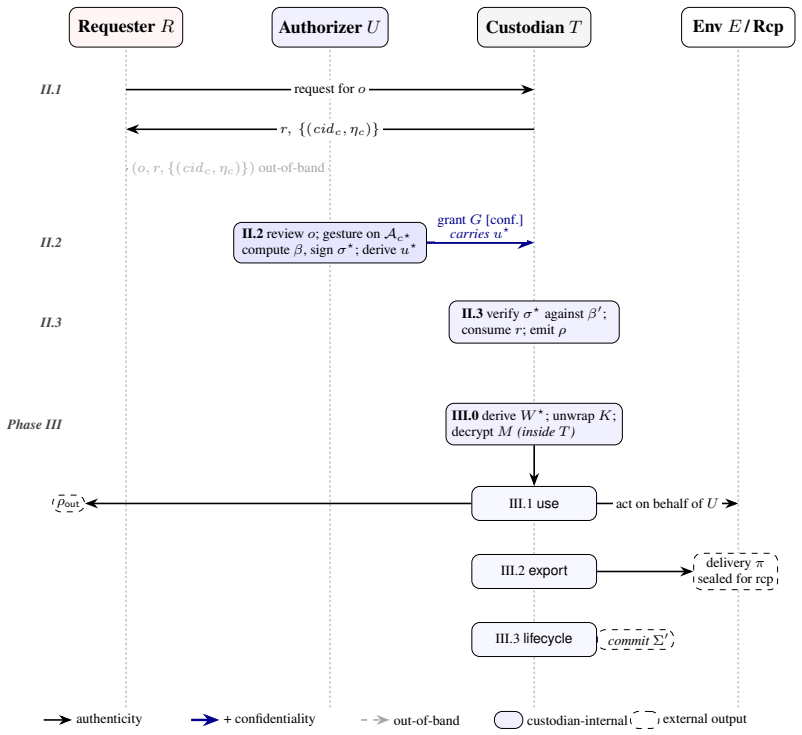
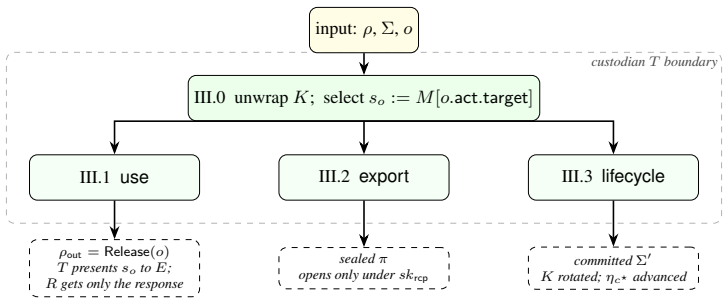
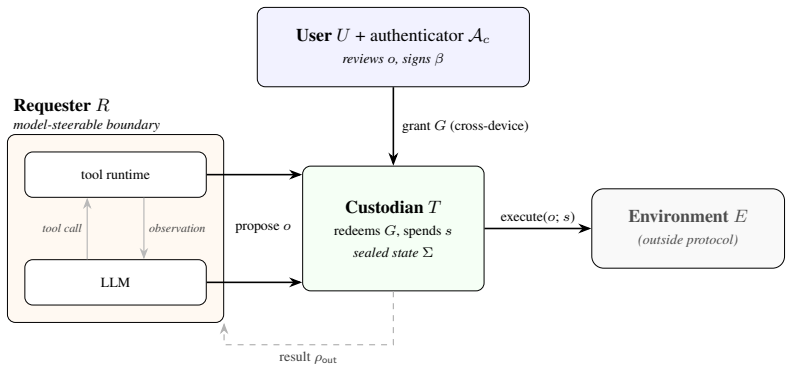
SUDP is a three-role protocol realizing Agent Secret Use: a requester proposes a canonical operation, the user authorizes it with a fresh authenticator-backed grant, and a custodian redeems the grant once to perform the bounded use so that reusable authority never crosses the requester boundary. Under explicit assumptions the protocol satisfies verifiable, operation-bound, and single-use authorization; it additionally provides storage confidentiality and wrapping-epoch key isolation when sealing and erasure are enforced, with plaintext forward secrecy requiring environment-driven rotation and revocation of the secret.
What carries the argument
The Secret-Use Delegation Protocol (SUDP), a three-role mechanism in which an operation proposal is paired with a single-use, operation-bound grant that the custodian redeems exactly once.
If this is right
- Agents can propose and cause secret-backed operations without ever retrieving or storing the secret itself.
- A transient compromise of the requester cannot produce durable account access because grants are single-use and bound to specific operations.
- Authorization decisions remain auditable because each grant carries an explicit, verifiable description of the permitted action.
- Confidentiality of stored secrets holds as long as the custodian enforces the stated sealing and erasure steps between epochs.
Where Pith is reading between the lines
- SUDP could be composed with existing scoped-token systems to add single-use enforcement on top of current delegation primitives.
- The separation of roles suggests a natural place to insert human confirmation steps before grant issuance without changing the protocol flow.
- Platform-level adoption would require custodians that can enforce erasure guarantees across heterogeneous agent runtimes.
Load-bearing premise
The custodian correctly seals and erases wrapping keys after each epoch, and the environment rotates and revokes the underlying secret to maintain forward secrecy.
What would settle it
A concrete attack in which a compromised requester successfully re-uses a prior grant to execute an operation outside the originally authorized scope.
Figures


read the original abstract
Agentic systems increasingly act with user secrets for APIs, messaging platforms, and cloud services. Today's bearer-secret interfaces implement authorization by exposure: enabling action often means placing a reusable secret, or a reusable artifact derived from it, within a model-steerable boundary, so a transient prompt-injection or tool-side compromise becomes durable account compromise. Existing defenses cover adjacent pieces such as secret storage, scoped delegation, sender-constrained tokens, and runtime monitoring, but leave the combined agentic obligation without a common specification: an untrusted autonomous requester should be able to cause a user-authorized secret-backed operation without exposing reusable authority to the requester. We formalize this problem as Agent Secret Use (ASU). From ASU we derive a security-property taxonomy that separates the problem's structural obligations from the realization-level robustness conditions any concrete construction must establish, enabling principled comparison of existing agentic-secret defenses against a problem-grounded specification. We propose the Secret-Use Delegation Protocol (SUDP), a three-role protocol realizing ASU: a requester proposes a canonical operation; the user authorizes it with a fresh authenticator-backed grant; and a custodian redeems the grant once to perform the bounded use, so reusable authority never crosses the requester boundary. We specialize SUDP for agentic deployments: agents propose operations; they do not retrieve secrets. Under explicit assumptions, we show that SUDP satisfies the ASU requirements: authorization is verifiable, operation-bound, and single-use. SUDP also provides storage confidentiality and wrapping-epoch key isolation under stated sealing and erasure assumptions; plaintext-level forward secrecy of the underlying secret additionally requires the environment to rotate and revoke it.
Editorial analysis
A structured set of objections, weighed in public.
Referee Report
Summary. The paper formalizes the Agent Secret Use (ASU) problem for agentic systems acting with user secrets, derives a security-property taxonomy separating structural obligations from realization conditions, and proposes the Secret-Use Delegation Protocol (SUDP). SUDP is a three-role construction (requester proposes canonical operation; user issues fresh authenticator-backed grant; custodian redeems once) specialized so agents never retrieve secrets. The central claim is that, under explicit assumptions on sealing/erasure and environment-driven rotation/revocation, SUDP satisfies verifiable, operation-bound, single-use authorization plus storage confidentiality, wrapping-epoch key isolation, and plaintext forward secrecy.
Significance. If the claims hold, the work supplies a problem-grounded specification and protocol for preventing reusable-authority exposure in autonomous agents, a timely contribution given prompt-injection and tool-compromise risks in API-using agents. The explicit scoping to assumptions and the separation of ASU formalization from the concrete construction are strengths that could enable principled comparison of existing defenses.
major comments (2)
- [Abstract] Abstract: the assertion that 'Under explicit assumptions, we show that SUDP satisfies the ASU requirements' is not supported by any derivation, proof sketch, formal argument, or reference to a later section containing the reasoning. This is load-bearing for the central claim, as the satisfaction statements cannot be assessed without seeing how the three-role structure and single-use grants entail the listed properties.
- [Full manuscript] The manuscript supplies no explicit definitions of the protocol steps, message formats, authenticator construction, or the precise mapping from the three-role design to the ASU properties, preventing verification that the construction actually realizes the claimed guarantees even under the stated assumptions.
Simulated Author's Rebuttal
We thank the referee for the constructive and detailed review. We appreciate the recognition of the problem formalization and the potential for principled comparison of defenses. We address each major comment below, indicating the revisions we will undertake.
read point-by-point responses
-
Referee: [Abstract] Abstract: the assertion that 'Under explicit assumptions, we show that SUDP satisfies the ASU requirements' is not supported by any derivation, proof sketch, formal argument, or reference to a later section containing the reasoning. This is load-bearing for the central claim, as the satisfaction statements cannot be assessed without seeing how the three-role structure and single-use grants entail the listed properties.
Authors: We agree that the abstract claim requires an explicit pointer to the supporting reasoning for verifiability. In the revised manuscript we will update the abstract to reference the new section (or appendix) that contains a structured argument deriving the ASU properties—verifiable authorization, operation-boundedness, single-use semantics, storage confidentiality, wrapping-epoch isolation, and plaintext forward secrecy—from the three-role construction and single-use grant mechanism under the stated sealing, erasure, rotation, and revocation assumptions. This will make the entailment traceable without expanding the abstract length. revision: yes
-
Referee: [Full manuscript] The manuscript supplies no explicit definitions of the protocol steps, message formats, authenticator construction, or the precise mapping from the three-role design to the ASU properties, preventing verification that the construction actually realizes the claimed guarantees even under the stated assumptions.
Authors: We acknowledge the absence of these concrete artifacts in the current version. The manuscript intentionally presents SUDP at the level of structural obligations to separate the problem specification from any particular realization. To enable direct verification, the revision will add a dedicated section (or appendix) that supplies: (i) numbered protocol steps with participant roles, (ii) canonical message formats and fields, (iii) the authenticator construction (including freshness and binding mechanisms), and (iv) a property-mapping table or short proof sketch that shows, assumption by assumption, how each ASU requirement is satisfied by the three-role flow and single-use redemption. These additions will be self-contained and will not alter the high-level taxonomy or core claims. revision: yes
Circularity Check
No significant circularity
full rationale
The paper defines the ASU problem and its security taxonomy independently of the SUDP construction, then presents SUDP as a three-role protocol (requester proposes operation, user issues grant, custodian redeems once) whose properties are shown to hold under explicitly stated assumptions on sealing, erasure, and environment-driven rotation. No equations or claims reduce by construction to fitted parameters, self-referential definitions, or load-bearing self-citations; the satisfaction statements follow directly from the structural separation of roles and the listed assumptions rather than from any renaming or smuggling of prior results. The central argument remains self-contained against external benchmarks.
Axiom & Free-Parameter Ledger
axioms (2)
- domain assumption Sealing and erasure assumptions hold for storage confidentiality and wrapping-epoch key isolation
- domain assumption The environment rotates and revokes the underlying secret
Reference graph
Works this paper leans on
-
[1]
URLhttps://arxiv.org/abs/2603.24414. Yi Liu, Gelei Deng, Yuekang Li, Kailong Wang, Tianwei Zhang, Yepang Liu, Haoyu Wang, Yan Zheng, and Yang Liu. Prompt injection attacks and defenses in LLM-integrated applications. In ACM Computing Surveys, 2024. Torsten Lodderstedt, Justin Richer, and Brian Campbell. OAuth 2.0 rich authorization requests. https://www.r...
-
[2]
URLhttps://arxiv.org/abs/2509.25974. OWASP Foundation. OWASP Top 10 for large language model applications.OWASP Project,
-
[3]
Agent tools orchestration leaks more: Dataset, benchmark, and mitigation,
URL https://owasp.org/www-project-top-10-for-large-language-model- applications/. Yuxuan Qiao, Dongqin Liu, Hongchang Yang, Wei Zhou, and Songlin Hu. Agent tools orchestration leaks more: Dataset, benchmark, and mitigation.arXiv preprint arXiv:2512.16310, 2025. doi: 10.48550/arXiv.2512.16310. URLhttps://arxiv.org/abs/2512.16310. Eric Rescorla. The transpo...
-
[4]
Agent Security Bench (ASB): Formalizing and Benchmarking Attacks and Defenses in LLM-based Agents
URLhttps://arxiv.org/abs/2410.02644. Zhexin Zhang, Shiyao Cui, Yida Lu, Jingzhuo Zhou, Junxiao Yang, Hongning Wang, and Minlie Huang. Agent-safetybench: Evaluating the safety of LLM agents.arXiv preprint arXiv:2412.14470,
work page internal anchor Pith review arXiv
-
[5]
Agent-SafetyBench: Evaluating the Safety of LLM Agents
doi: 10.48550/arXiv.2412.14470. URLhttps://arxiv.org/abs/2412.14470. Xuhui Zhou, Hyunwoo Kim, Faeze Brahman, Liwei Jiang, Hao Zhu, Ximing Lu, Frank F. Xu, Bill Yuchen Lin, Yejin Choi, Niloofar Mireshghallah, Ronan Le Bras, and Maarten Sap. Haicosys- tem: An ecosystem for sandboxing safety risks in interactive AI agents. InConference on Language Modeling (...
work page internal anchor Pith review doi:10.48550/arxiv.2412.14470 2025
discussion (0)
Sign in with ORCID, Apple, or X to comment. Anyone can read and Pith papers without signing in.