Recognition: 2 theorem links
· Lean TheoremMoving-Mesh Simulations of Mini-Common Envelope Ejection in Classical Novae
Pith reviewed 2026-05-13 06:48 UTC · model grok-4.3
The pith
Simulations show that material crossing the L1 point in cataclysmic variables ejects isotropically with boosted specific angular momentum.
A machine-rendered reading of the paper's core claim, the machinery that carries it, and where it could break.
Core claim
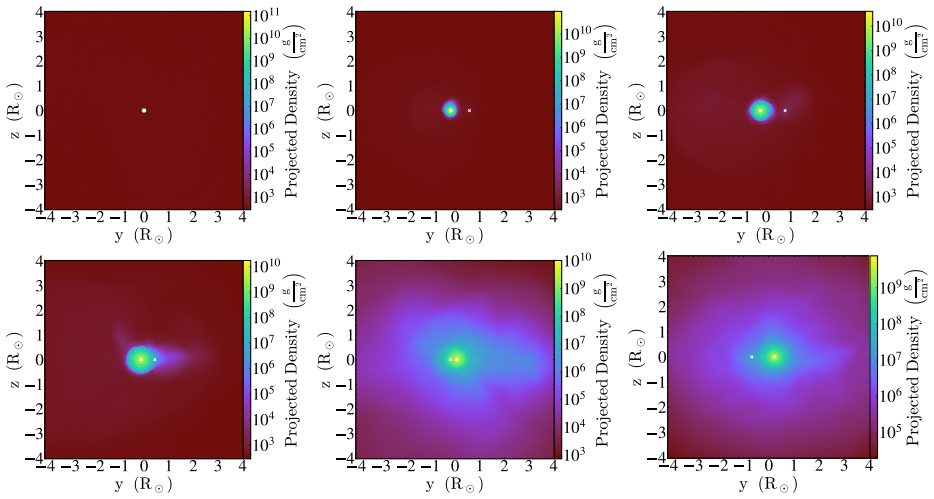
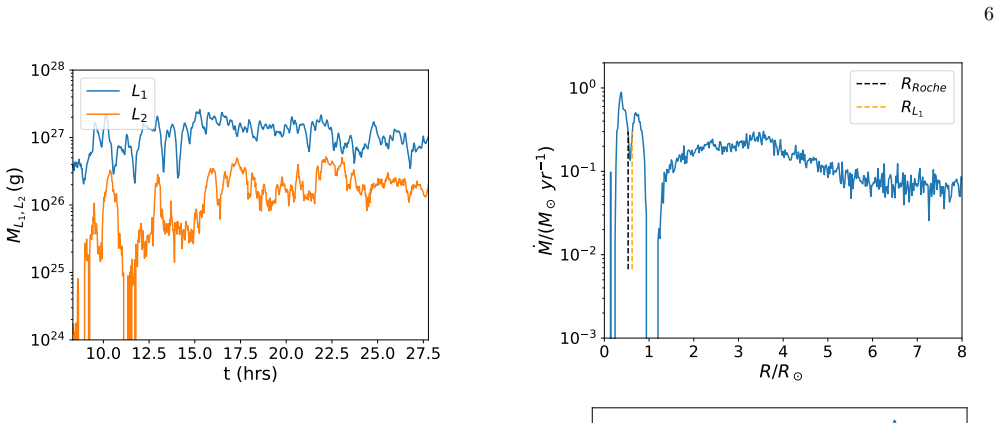
Three-dimensional moving-mesh hydrodynamic simulations of a cataclysmic variable system show that once the flow crosses the L1 Lagrange point, the material is ejected roughly isotropically, producing a spherical distribution of ejecta at large radii. The L2 Lagrange point plays no important role in mass ejection. The specific angular momentum of the ejected material exceeds its initial value, implying effects on the long-term binary evolution.
What carries the argument
Three-dimensional moving-mesh hydrodynamic simulation of mass flow through the L1 Lagrange point in a binary system during the mini-common-envelope phase.
If this is right
- Mass ejection in classical novae occurs isotropically after crossing L1, forming roughly spherical shells at large distances.
- Models of nova mass loss can safely neglect the L2 Lagrange point for ejection calculations.
- Enhanced angular momentum carried away by the ejecta will drive faster orbital shrinkage than models assuming conserved initial angular momentum.
- Binary interaction during the common-envelope phase shapes both the geometry and the angular-momentum budget of the ejected material.
Where Pith is reading between the lines
- The isotropic ejection may account for the spherical appearance of many observed nova shells without invoking later shaping by the white dwarf wind.
- Accounting for the extra angular momentum loss could revise predictions for the time until the next nova cycle or until the binary reaches contact.
- The same moving-mesh approach could be applied to other Roche-lobe-overflow binaries to test whether the angular-momentum boost is generic.
- One-dimensional or analytic models that rely on L2 overflow for mass loss would need revision to match these three-dimensional results.
Load-bearing premise
The chosen initial binary parameters, mass-transfer rate, and numerical resolution capture the real hydrodynamics of the mini-common-envelope phase without artifacts from mesh motion or artificial viscosity.
What would settle it
High-resolution imaging or polarimetry of a recent nova that reveals strongly non-spherical ejecta geometry at large radii, or orbital-period measurements in a post-nova binary showing angular-momentum loss rates matching the initial rather than enhanced value.
Figures





read the original abstract
Although well studied, our understanding of the mass ejection mechanisms of cataclysmic variables remains incomplete. Recent work suggests that binary interaction plays an important role in driving and shaping this mass ejection and may affect the long-term evolution of the system. In this paper, we perform a three-dimensional moving-mesh hydrodynamic simulation of a cataclysmic variable system to study the effect of binary interaction on mass ejection. We find that once the flow crosses the ${\rm L}_1$ Lagrange point, the material is ejected roughly isotropically. This can be seen in a roughly spherical distribution of the ejecta at large radii. We also show that the ${\rm L}_2$ Lagrange point is not important in the ejection of mass, contrary to the assumption in some previous work in this area. Finally, we find that the specific angular momentum of the ejected material is larger than its initial specific angular momentum. This enhanced angular momentum ejection likely affects the long-term evolution of the binary system.
Editorial analysis
A structured set of objections, weighed in public.
Referee Report
Summary. The manuscript presents three-dimensional moving-mesh hydrodynamic simulations of mass ejection in a cataclysmic variable system during the mini-common-envelope phase of a classical nova. The central claims are that material crossing the L1 Lagrange point is ejected roughly isotropically (producing a spherical ejecta distribution at large radii), that the L2 point contributes negligibly to mass loss (contrary to some prior assumptions), and that the specific angular momentum of the ejected material exceeds its initial value, with potential consequences for the long-term binary evolution.
Significance. If the hydrodynamic results are shown to be numerically robust, the work would provide valuable direct evidence on the geometry and angular-momentum budget of nova ejecta, challenging L2-dominated ejection scenarios and offering a concrete mechanism for angular-momentum loss that could be incorporated into binary population synthesis. The moving-mesh technique is appropriate for following the flow across the Lagrange points and into the outer domain.
major comments (3)
- [§3 (Numerical Setup)] §3 (Numerical Setup): The manuscript provides no resolution study, convergence tests, or quantification of artificial viscosity and mesh-regularization effects. Because the reported isotropy, negligible L2 mass flux, and specific-angular-momentum excess are all extracted from the simulated flow near the Lagrange points and at large radii, the absence of such tests leaves open the possibility that the headline results are sensitive to numerical choices.
- [§4.2 (Ejecta Morphology)] §4.2 (Ejecta Morphology): The claim of roughly isotropic ejection after L1 crossing rests on visual inspection of density slices and a qualitative description of sphericity at large radii. No quantitative metric (e.g., angular mass-flux distribution, multipole decomposition, or ratio of radial to tangential kinetic energy) is supplied to substantiate how isotropic the outflow actually is or to allow direct comparison with earlier analytic or 2-D models.
- [§4.3 (Angular Momentum Budget)] §4.3 (Angular Momentum Budget): The statement that ejected material carries higher specific angular momentum than its initial value is central to the evolutionary implication, yet the text does not detail the reference frame, the unbound criterion used to tag ejecta, or the surface through which angular momentum is measured. Without these definitions it is impossible to judge whether the reported excess survives changes in numerical dissipation or domain size.
minor comments (3)
- [Abstract] The abstract introduces 'mini-common envelope' without a one-sentence definition; adding a brief parenthetical explanation would improve accessibility.
- [Figures] Figure captions lack information on viewing angles, color-bar units, and contour levels, which hinders interpretation of the density and velocity fields.
- [§2 (Initial Conditions)] The initial binary parameters and mass-transfer rate are stated but not varied; a short sensitivity test or reference to prior work justifying the chosen values would strengthen the setup.
Simulated Author's Rebuttal
We thank the referee for their careful reading and constructive comments on our manuscript. We have addressed each major point below and will incorporate revisions to strengthen the presentation of our numerical results and their robustness.
read point-by-point responses
-
Referee: §3 (Numerical Setup): The manuscript provides no resolution study, convergence tests, or quantification of artificial viscosity and mesh-regularization effects. Because the reported isotropy, negligible L2 mass flux, and specific-angular-momentum excess are all extracted from the simulated flow near the Lagrange points and at large radii, the absence of such tests leaves open the possibility that the headline results are sensitive to numerical choices.
Authors: We agree that explicit convergence tests would strengthen confidence in the results. In the revised manuscript we will add a dedicated subsection in §3 that reports additional simulations performed at two higher and one lower resolutions (factor of 2 in linear resolution). We will show that the isotropy of the L1 outflow, the negligible L2 mass flux, and the specific-angular-momentum excess remain quantitatively consistent (within ~10 %) across these runs. We will also quantify the sensitivity to artificial viscosity by presenting a short parameter study varying the viscosity coefficient and will discuss the mesh-regularization scheme employed by the moving-mesh code. These additions directly address the concern about numerical sensitivity. revision: yes
-
Referee: §4.2 (Ejecta Morphology): The claim of roughly isotropic ejection after L1 crossing rests on visual inspection of density slices and a qualitative description of sphericity at large radii. No quantitative metric (e.g., angular mass-flux distribution, multipole decomposition, or ratio of radial to tangential kinetic energy) is supplied to substantiate how isotropic the outflow actually is or to allow direct comparison with earlier analytic or 2-D models.
Authors: We accept that a quantitative metric is needed. In the revised §4.2 we will include (i) the angular mass-flux distribution integrated over a spherical shell at 10^12 cm, (ii) the l=0 to l=4 multipole moments of the density field at the same radius, and (iii) the ratio of radial to tangential kinetic energy of the unbound material. These diagnostics will be presented both for the fiducial run and for the resolution variants, allowing direct comparison with prior analytic and 2-D models. revision: yes
-
Referee: §4.3 (Angular Momentum Budget): The statement that ejected material carries higher specific angular momentum than its initial value is central to the evolutionary implication, yet the text does not detail the reference frame, the unbound criterion used to tag ejecta, or the surface through which angular momentum is measured. Without these definitions it is impossible to judge whether the reported excess survives changes in numerical dissipation or domain size.
Authors: We thank the referee for highlighting the missing definitions. In the revised §4.3 we will explicitly state that (a) all quantities are computed in the center-of-mass frame of the binary, (b) unbound material is identified by positive specific energy (E > 0) evaluated in that frame, and (c) specific angular momentum is measured through a spherical surface at r = 5 × 10^11 cm (well outside the binary orbit and inside the outer domain boundary). We will also show that the reported excess is insensitive to modest changes in the surface radius and to the resolution variations already discussed in the new §3 subsection. revision: yes
Circularity Check
No significant circularity; results from direct hydrodynamic integration
full rationale
The paper performs a forward 3D moving-mesh hydrodynamic simulation of a cataclysmic variable with chosen initial binary parameters and mass-transfer rate. The three headline results—isotropic ejecta distribution after L1 crossing, negligible L2 mass loss, and net gain in specific angular momentum—are extracted directly from the evolved flow fields at large radii. No parameters are fitted to these target quantities, no self-referential definitions equate inputs to outputs, and no uniqueness theorems or prior self-citations are invoked to force the reported isotropy or angular-momentum excess. The simulation is self-contained against external benchmarks (re-running the code with different resolution or mesh strategy can falsify the claims), satisfying the criteria for a non-circular numerical study.
Axiom & Free-Parameter Ledger
Lean theorems connected to this paper
-
IndisputableMonolith/Cost/FunctionalEquationwashburn_uniqueness_aczel unclear?
unclearRelation between the paper passage and the cited Recognition theorem.
We find that once the flow crosses the L1 Lagrange point, the material is ejected roughly isotropically... the L2 Lagrange point is not important... specific angular momentum of the ejected material is larger than its initial specific angular momentum.
-
IndisputableMonolith/Foundation/RealityFromDistinctionreality_from_one_distinction unclear?
unclearRelation between the paper passage and the cited Recognition theorem.
three-dimensional moving-mesh hydrodynamic simulation... constant specific heating rate of ϵ=10^12 ergs g^-1 s^-1
What do these tags mean?
- matches
- The paper's claim is directly supported by a theorem in the formal canon.
- supports
- The theorem supports part of the paper's argument, but the paper may add assumptions or extra steps.
- extends
- The paper goes beyond the formal theorem; the theorem is a base layer rather than the whole result.
- uses
- The paper appears to rely on the theorem as machinery.
- contradicts
- The paper's claim conflicts with a theorem or certificate in the canon.
- unclear
- Pith found a possible connection, but the passage is too broad, indirect, or ambiguous to say the theorem truly supports the claim.
Reference graph
Works this paper leans on
-
[1]
J. S. Gallagher and S. Starrfield, ARAA 16, 171 (1978)
work page 1978
-
[2]
L. Chomiuk, B. D. Metzger, and K. J. Shen, ARAA 59, 391 (2021), arXiv:2011.08751 [astro-ph.HE]
- [3]
-
[4]
T. Liimets, R. L. M. Corradi, M. Santander-Garc´ ıa, E. Villaver, P. Rodr´ ıguez-Gil, K. Verro, and I. Kolka, As- trophys. J. 761, 34 (2012), arXiv:1210.5884 [astro-ph.SR]
-
[5]
S. Starrfield, J. W. Truran, and W. M. Sparks, Astro- phys. J. 226, 186 (1978)
work page 1978
-
[6]
E. Quataert, R. Fern´ andez, D. Kasen, H. Klion, and B. Paxton, MNRAS 458, 1214 (2016), arXiv:1509.06370 [astro-ph.SR]
-
[7]
G. T. Bath and G. Shaviv, MNRAS 175, 305 (1976)
work page 1976
- [8]
- [9]
- [10]
-
[11]
J. MacDonald, M. Y. Fujimoto, and J. W. Truran, As- trophys. J. 294, 263 (1985)
work page 1985
- [12]
- [13]
-
[14]
W.-S. Tang, X.-D. Li, and Z. Cui, Astrophys. J. 977, 34 (2024), arXiv:2410.15254 [astro-ph.HE]
-
[15]
The Evolution of Cataclysmic Variables as Revealed by their Donor Stars
C. Knigge, I. Baraffe, and J. Patterson, ApJS 194, 28 (2011), arXiv:1102.2440 [astro-ph.SR]
work page Pith review arXiv 2011
- [16]
- [17]
- [18]
-
[19]
Springel, MNRAS 401, 791 (2010), arXiv:0901.4107
V. Springel, MNRAS 401, 791 (2010), arXiv:0901.4107
- [20]
- [21]
-
[22]
S. Starrfield, C. Iliadis, and W. R. Hix, PASP 128, 051001 (2016), arXiv:1605.04294 [astro-ph.SR]
- [23]
-
[24]
R. Williams, R. Ryan, and R. Rudy, Astrophys. J. 975, 191 (2024), arXiv:2409.09565 [astro-ph.SR]
-
[25]
J.-H. Zheng, H.-M. Zhang, R.-Y. Liu, M. Zha, and X.- Y. Wang, Journal of High Energy Astrophysics 43, 171 (2024), arXiv:2405.01257 [astro-ph.HE]
- [26]
- [27]
-
[28]
D. Belloni and M. R. Schreiber, inHandbook of X-ray and Gamma-ray Astrophysics(2023) p. 129
work page 2023
discussion (0)
Sign in with ORCID, Apple, or X to comment. Anyone can read and Pith papers without signing in.