Recognition: unknown
Lagrangian Rotating Contracting Structures
Pith reviewed 2026-05-07 16:55 UTC · model grok-4.3
The pith
Lagrangian rotating contracting structures are identified in unsteady flows by combining LAVD with material contraction tests, even when LAVD level-set geometry is unreliable.
A machine-rendered reading of the paper's core claim, the machinery that carries it, and where it could break.
Core claim
LRCS are materially defined regions combining finite-time contraction with high accumulated intrinsic rotation; they are located by pairing LAVD maxima with contraction criteria rather than by LAVD level-set geometry, which breaks down in strongly deforming flows.
What carries the argument
Lagrangian-averaged vorticity deviation (LAVD) paired with direct material contraction tests, which together isolate regions of inward spiraling motion and contraction.
If this is right
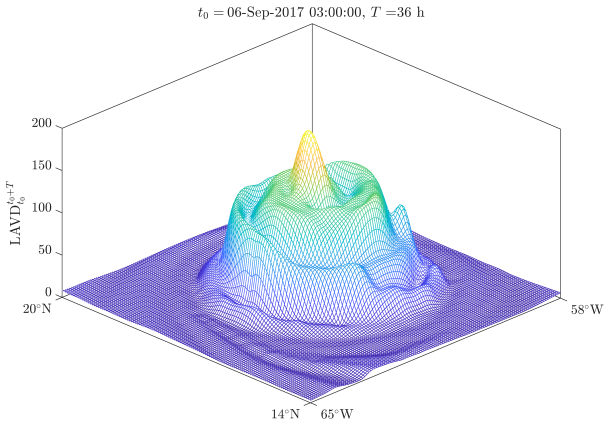
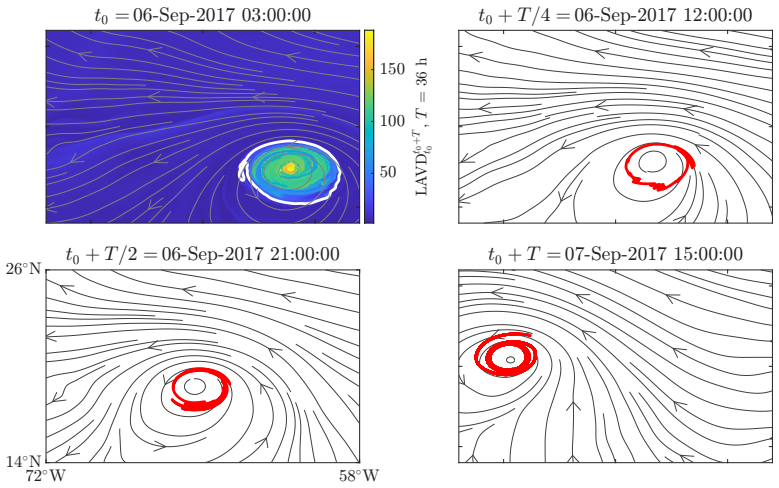
- In atmospheric and oceanic flows, the method extracts LRCS from twisted LAVD fields at submesoscales.
- At mesoscales the same pairing is strengthened by inertial effects and finite-time contraction supplies the needed dynamical constraint.
- The combination provides an objective way to locate materially organized regions with elevated intrinsic rotation even when geometry-based LAVD detection fails.
Where Pith is reading between the lines
- The approach may clarify how coherent rotation and contraction together control material transport in turbulent geophysical flows.
- It could be tested in other classes of unsteady flows to check whether the same pairing continues to separate organized regions from background deformation.
- If the contraction test is replaced by an equivalent strain-based criterion, the method might extend to three-dimensional flows where LAVD geometry is similarly unreliable.
Load-bearing premise
Pairing LAVD maxima with contraction tests will isolate regions of elevated intrinsic rotation and contraction without producing false positives or missing structures in deforming flows.
What would settle it
An unsteady flow example in which an LAVD maximum satisfying the contraction test fails to show inward spiraling particle motion, or a known spiraling contracting region is missed by both diagnostics.
Figures


read the original abstract
We identify materially defined regions in unsteady two-dimensional flows that combine finite-time contraction with elevated accumulated intrinsic rotation along trajectories, which we term \emph{Lagrangian rotating contracting structures} (LRCS). These regions are detected using existing objective diagnostics -- the Lagrangian-averaged vorticity deviation (LAVD) together with direct tests of material contraction -- without relying on the geometry of LAVD level sets. In strongly deforming flows, LAVD maxima need not correspond to vortical regions or be enclosed by regular level sets, rendering geometry-based identification unreliable. Nevertheless, regions exhibiting inward spiraling motion and contraction can be extracted by combining LAVD with a contraction criterion. Applications to atmospheric and oceanic flows show that such behavior arises both in twisted LAVD fields generated at submesoscales and in mesoscale flows where it is enhanced by inertial effects, with finite-time contraction providing the dynamical constraint that isolates materially organized regions with elevated intrinsic rotation.
Editorial analysis
A structured set of objections, weighed in public.
Referee Report
Summary. The manuscript proposes Lagrangian rotating contracting structures (LRCS) as materially defined regions in unsteady two-dimensional flows that exhibit both finite-time contraction and elevated accumulated intrinsic rotation. These are identified objectively by combining Lagrangian-averaged vorticity deviation (LAVD) maxima with direct material contraction tests, without dependence on the geometry or regularity of LAVD level sets. The approach is motivated by the observation that strong deformation can render LAVD maxima unreliable for vortical identification, and it is illustrated through applications to atmospheric and oceanic flows at submesoscale and mesoscale regimes.
Significance. If the central claim holds, the work offers a practical, parameter-free extension of established objective diagnostics (LAVD and deformation-gradient-based contraction) for isolating regions of inward spiraling motion in highly deforming flows. This could improve detection of materially organized structures in geophysical contexts where traditional geometric methods fail, with potential relevance for understanding rotation-contraction interplay at multiple scales.
major comments (2)
- [applications section] The central claim that LAVD maxima filtered by contraction tests reliably isolate regions of elevated intrinsic rotation without false positives rests on the assumption that the contraction criterion supplies a sufficient dynamical constraint. However, no quantitative validation, error analysis, or comparison against known vortical structures is supplied to test this in strongly deforming regimes (see applications section).
- [introduction and method description] The manuscript states that LAVD maxima 'need not correspond to vortical regions' in strongly deforming flows, yet provides no explicit counter-example or diagnostic threshold demonstrating when the combined criterion succeeds where pure LAVD geometry fails.
minor comments (2)
- [method] Notation for the contraction test (e.g., via the deformation gradient) should be defined explicitly with reference to prior literature to ensure reproducibility.
- [abstract] The abstract and applications would benefit from at least one concrete numerical example or figure caption quantifying the contraction rate and LAVD value for an identified LRCS.
Simulated Author's Rebuttal
We thank the referee for the constructive comments, which highlight opportunities to strengthen the validation and clarity of our approach. We address each major comment below and will revise the manuscript to incorporate the suggested additions.
read point-by-point responses
-
Referee: [applications section] The central claim that LAVD maxima filtered by contraction tests reliably isolate regions of elevated intrinsic rotation without false positives rests on the assumption that the contraction criterion supplies a sufficient dynamical constraint. However, no quantitative validation, error analysis, or comparison against known vortical structures is supplied to test this in strongly deforming regimes (see applications section).
Authors: We acknowledge that the applications rely on illustrative examples from real atmospheric and oceanic flows rather than quantitative benchmarks. This reflects the difficulty of obtaining ground truth in observational data. The contraction test is based on the deformation gradient and provides an objective filter. To address the concern, we will add a synthetic unsteady flow example with prescribed vortical structures, including quantitative error analysis and direct comparisons, to demonstrate performance in strongly deforming regimes. revision: yes
-
Referee: [introduction and method description] The manuscript states that LAVD maxima 'need not correspond to vortical regions' in strongly deforming flows, yet provides no explicit counter-example or diagnostic threshold demonstrating when the combined criterion succeeds where pure LAVD geometry fails.
Authors: The statement follows from the established limitations of LAVD under strong deformation, as noted in the introduction. While the applications section shows cases with twisted LAVD fields, we agree an explicit counter-example would improve clarity. We will add a simple analytical example of a strongly deforming flow where LAVD maxima do not correspond to vortical regions, along with a specific contraction threshold (e.g., based on the finite-time contraction rate) to show where the combined criterion succeeds. revision: yes
Circularity Check
No significant circularity; derivation applies established external diagnostics
full rationale
The paper identifies LRCS by combining the pre-existing LAVD diagnostic (for accumulated intrinsic rotation) with direct material contraction tests, explicitly without relying on LAVD level-set geometry. No equations, parameters, or predictions are fitted or redefined in terms of the target structures; the central statements about LAVD behavior in deforming flows serve as motivation and are tested via application rather than derived from the method itself. All load-bearing components trace to independent prior literature on objective Lagrangian diagnostics, rendering the chain self-contained against external benchmarks with no self-definitional, fitted-input, or self-citation reductions.
Axiom & Free-Parameter Ledger
axioms (2)
- domain assumption LAVD is an objective measure of accumulated intrinsic rotation
- domain assumption Direct objective tests for finite-time material contraction exist and can be applied in unsteady flows
Reference graph
Works this paper leans on
-
[1]
Anticyclonic eddies increase accumulation of microplastic in the North Atlantic subtropical gyre
Laurent Brach, Patrick Deixonne, Marie-France Bernard, Edm\'ee Durand, Marie-Christine Desjean, Emile Perez, Erik van Sebille, and Alexandra ter Halle. Anticyclonic eddies increase accumulation of microplastic in the North Atlantic subtropical gyre . Marine Pollution Bulletin , 126:191--196, 2018
2018
-
[2]
F. J. Beron-Vera. Nonlinear dynamics of inertial particles in the ocean: From drifters and floats to marine debris and Sargassum . Nonlinear Dyn. , 103:1--26, 2021
2021
-
[3]
F. J. Beron-Vera, A. Hadjighasem, Q. Xia, M. J. Olascoaga, and G. Haller. Coherent Lagrangian swirls among submesoscale motions . Proc. Natl. Acad. Sci. U.S.A. , 116:18251--18256, 2019
2019
-
[4]
Beron-Vera and J
Francisco J. Beron-Vera and J. H. LaCasce. Statistics of simulated and observed pair separations in the gulf of mexico. J. Phys. Oceanorg , 46(7):2183--2199, 2016
2016
-
[5]
F. J. Beron-Vera, M. J. Olascoaga, G. Haller, M. Farazmand, J. Tri\ nanes , and Y. Wang. Dissipative inertial transport patterns near coherent Lagrangian eddies in the ocean . Chaos , 25:087412, 2015
2015
-
[6]
F. J. Beron-Vera, M. J. Olascoaga, and P. Miron. Building a Maxey--Riley framework for surface ocean inertial particle dynamics . Phys. Fluids , 31:096602, 2019
2019
-
[7]
F. J. Beron-Vera, Y. Wang, M. J. Olascoaga, G. J. Goni, and G. Haller. Objective detection of oceanic eddies and the Agulhas leakage . J. Phys. Oceanogr. , 43:1426--1438, 2013
2013
-
[8]
Cangialosi, Andrew S
John P. Cangialosi, Andrew S. Latto, and Robbie Berg. National hurricane center tropical cyclone report: Hurricane irma (al112017) 30 august--12 september 2017. Nhc technical report, National Hurricane Center, NOAA, 2018
2017
-
[9]
Dellnitz, G
M. Dellnitz, G. Froyland, C. Horenkam, K. Padberg-Gehle, and A. Sen Gupta . Seasonal variability of the subpolar gyres in the southern ocean: a numerical investigation based on transfer operators. Nonlinear Process. Geophys. , 16:655--663, 2009
2009
-
[10]
D Asaro, Andrey Y
Eric A. D Asaro, Andrey Y. Shcherbina, Jody M. Klymak, Jeroen Molemaker, Guillaume Novelli, C \'e dric M. Guigand, Angelique C. Haza, Brian K. Haus, Edward H. Ryan, Gregg A. Jacobs, Helga S. Huntley, Nathan J. M. Laxague, Shuyi Chen, Falko Judt, James C. McWilliams, Roy Barkan, A. D. Kirwan, Andrew C. Poje, and Tamay M. \"O zg \"o kmen. Ocean convergence ...
2018
-
[11]
A Tutorial on the Dynamic Laplacian , page 93–114
Gary Froyland. A Tutorial on the Dynamic Laplacian , page 93–114. Springer Nature Singapore, 2026
2026
-
[12]
Froyland, C
G. Froyland, C. P. Rock, and K. Sakellariou. Sparse eigenbasis approximation: Multiple feature extraction across spatiotemporal scales with application to coherent set identification . Commun Nonlinear Sci Numer Simulat , 77:81--107, 2019
2019
-
[13]
G. Haller. Lagrangian coherent structures. Ann. Rev. Fluid Mech. , 47:137--162, 2015
2015
-
[14]
Transport Barriers and Coherent Structures in Flow Data
George Haller. Transport Barriers and Coherent Structures in Flow Data . Cambridge University Press, Cambridge, United Kindom, 2023
2023
-
[15]
Hans Hersbach, Bill Bell, Paul Berrisford, Shoji Hirahara, András Horányi, Joaquín Muñoz‐Sabater, Julien Nicolas, Carole Peubey, Raluca Radu, Dinand Schepers, Adrian Simmons, Cornel Soci, Saleh Abdalla, Xavier Abellan, Gianpaolo Balsamo, Peter Bechtold, Gionata Biavati, Jean Bidlot, Massimo Bonavita, Giovanna Chiara, Per Dahlgren, Dick Dee, Michail Diaman...
1999
-
[16]
Beron-Vera
George Haller and Francisco J. Beron-Vera. Geodesic theory of transport barriers in two-dimensional flows. Physica D , 241:1680--1702, 2012
2012
-
[17]
Beron-Vera
George Haller and Francisco J. Beron-Vera. Coherent Lagrangian vortices: The black holes of turbulence . J. Fluid Mech. , 731:R4, 2013
2013
-
[18]
Beron-Vera
George Haller and Francisco J. Beron-Vera. Addendum to `Coherent Lagrangian vortices: The black holes of turbulence' . J. Fluid Mech. , 755:R3, 2014
2014
-
[19]
Haller, A
G. Haller, A. Hadjighasem, M. Farazmand, and F. Huhn. Defining coherent vortices objectively from the vorticity. J. Fluid Mech. , 795:136--173, 2016
2016
-
[20]
Jacobs, Brent P
Gregg A. Jacobs, Brent P. Bartels, Darek J. Bogucki, Francisco J. Beron-Vera, Shuyi S. Chen, Emanuel F. Coelho, Milan Curcic, Annalisa Griffa, Matthew Gough, Brian K. Haus, Angelique C. Haza, Robert W. Helber, Patrick J. Hogan, Helga S. Huntley, Mohamed Iskandarani, Falko Judt, A.D. Kirwan Jr., Nathan Laxague, Arnoldo Valle-Levinson, Bruce L. Lipphardt Jr...
2014
-
[21]
Y Le Traon , F
P. Y Le Traon , F. Nadal, and N. Ducet. An improved mapping method of multisatellite altimeter data. J. Atmos. Oceanic Technol. , 15:522--534, 1998
1998
-
[22]
W. Munk, L. Armi, K. Fischer, and F. Zachariasen. Spirals on the sea. Proc. R. Soc. Lond. A , 456:1,217--1,280, 2000
2000
-
[23]
M. R. Maxey and J. J. Riley. Equation of motion for a small rigid sphere in a nonuniform flow. Phys. Fluids , 26:883, 1983
1983
-
[24]
Olascoaga, F
M J. Olascoaga, F. J. Beron-Vera, P. Miron, J. Tri\ nanes , N. F. Putman, R. Lumpkin, and G. J. Goni. Observation and quantification of inertial effects on the drift of floating objects at the ocean surface. Phys. Fluids , 32:026601, 2020
2020
-
[25]
Serra and G
M. Serra and G. Haller. Objective Eulerian coherent structures . Chaos , 26:053110, 2016
2016
discussion (0)
Sign in with ORCID, Apple, or X to comment. Anyone can read and Pith papers without signing in.