Recognition: 2 theorem links
· Lean TheoremSymmetric kiloparsec-scale radio knots in NGC 7213: evidence for a confined weak jet and recurrent nuclear activity
Pith reviewed 2026-05-12 02:47 UTC · model grok-4.3
The pith
Symmetric kiloparsec-scale radio knots in NGC 7213 are termination shocks of a confined weak jet.
A machine-rendered reading of the paper's core claim, the machinery that carries it, and where it could break.
Core claim
The symmetry, spectra, and physical properties of the kiloparsec-scale knots support their interpretation as compact termination shocks of a weak or intermittent jet launched by NGC7213 and confined by the dense, disturbed interstellar medium. The unresolved, variable parsec-scale core indicates that the high-frequency radio variability originates in the innermost jet region, likely linked to a recent increase in nuclear activity. NGC7213 is therefore a nearby example of how weak jets in low-accretion AGN can produce both compact nuclear variability and symmetric kiloparsec-scale structures in complex environments.
What carries the argument
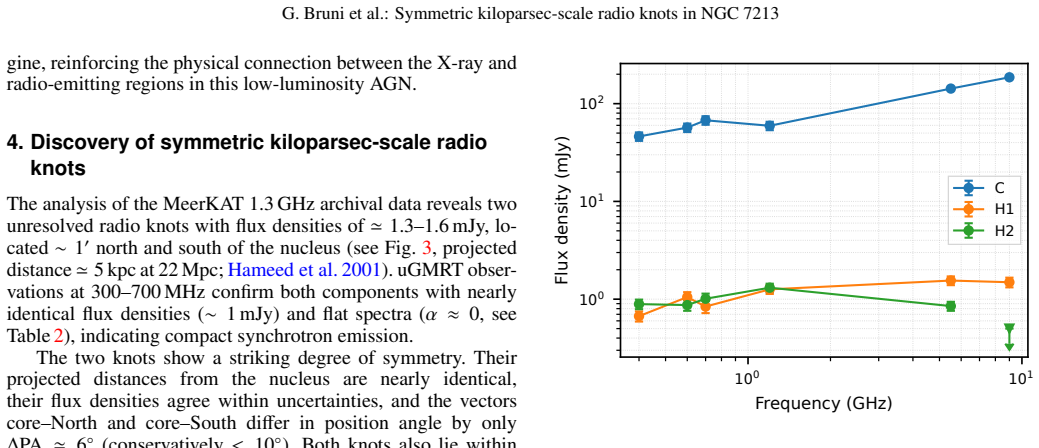
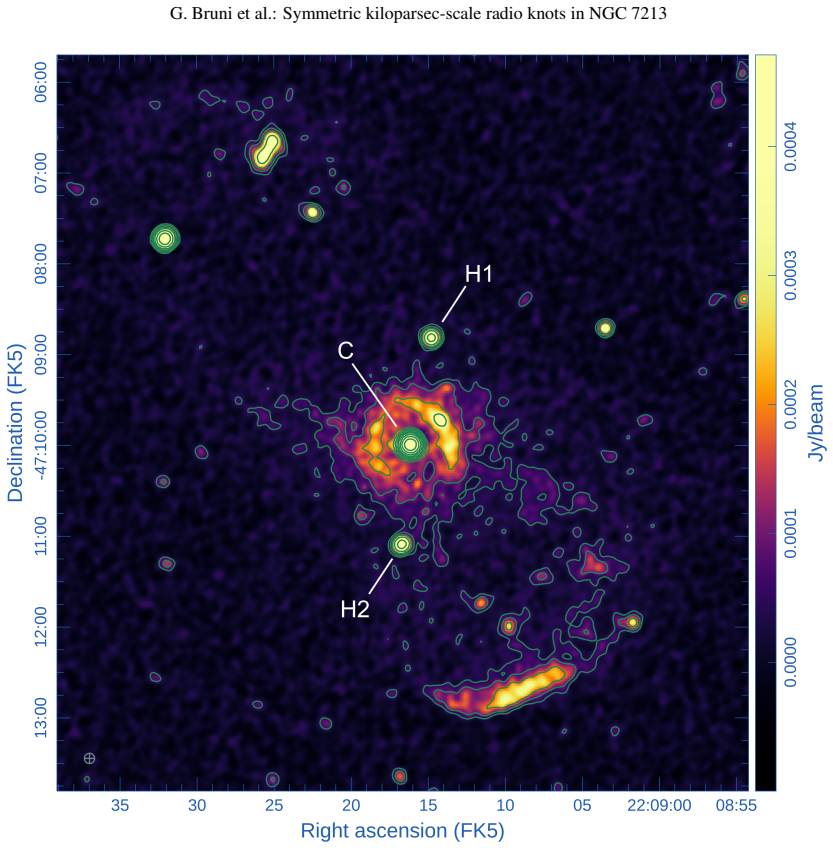
The pair of symmetric kiloparsec-scale radio knots with identical flux densities and flat spectra from 300 MHz to 5.5 GHz, interpreted as compact termination shocks of a confined weak jet.
If this is right
- The weak jet does not propagate freely but is stopped within the galactic disk by the surrounding gas.
- The month-scale nuclear flux increase of about 40 mJy originates on sub-parsec scales inside the core.
- Recurrent episodes of nuclear activity can produce repeated symmetric structures even in low-luminosity systems.
- The dense interstellar medium plays the decisive role in shaping the jet into compact, observable shocks.
Where Pith is reading between the lines
- Comparable symmetric knots may appear in other nearby low-luminosity AGNs once observed at low frequencies with high sensitivity.
- The low jet power implied by confinement suggests these outflows contribute to feedback mainly through repeated, localized heating rather than large-scale expulsion.
- Continued monitoring of the unresolved core could reveal new ejection events that later form additional knots.
- The same confinement physics may operate in other galaxies with disturbed gas, linking nuclear variability to kiloparsec-scale morphology.
Load-bearing premise
That the observed symmetry, identical flux densities, and flat spectra uniquely indicate jet termination shocks rather than star-forming regions, supernova remnants, or background sources, assuming the interstellar medium is dense and disturbed enough to confine any outflow.
What would settle it
High-resolution imaging or spectra above 5.5 GHz showing steep spectral indices, clear optical or infrared star-formation signatures at the knot positions, or marked asymmetry between the north and south knots would undermine the termination-shock interpretation.
Figures


read the original abstract
Low-luminosity active galactic nuclei (LLAGNs) often host weak radio jets whose propagation is shaped by the surrounding interstellar medium. We investigate the nearby LLAGN NGC7213 to assess its ability to launch collimated outflows beyond the nucleus and to characterise the origin and variability of newly identified radio components from parsec to kiloparsec scales. We present new MeerKAT, uGMRT, ATCA, and Australian Long Baseline Array (LBA) observations from 300 MHz to 9 GHz. We analyse the morphology and spectra of the kiloparsec-scale emission and use LBA monitoring to probe the parsec-scale core. We discover a pair of compact radio knots located symmetrically at a projected distance of ~5 kpc north and south of the nucleus. The knots have nearly identical flux densities and flat radio spectra from 300 MHz to at least 5.5 GHz, with no significant spectral or geometric asymmetry. The LBA monitoring shows that the nuclear source remains unresolved at all epochs, constraining the 8 GHz emission to sub-parsec scales, and reveals significant variability on decade-long and month-long timescales, including a flux-density increase of ~40 mJy over six months. The symmetry, spectra, and physical properties of the kiloparsec-scale knots support their interpretation as compact termination shocks of a weak or intermittent jet launched by NGC7213 and confined by the dense, disturbed interstellar medium. The unresolved, variable parsec-scale core indicates that the high-frequency radio variability originates in the innermost jet region, likely linked to a recent increase in nuclear activity. NGC7213 is therefore a nearby example of how weak jets in low-accretion AGN can produce both compact nuclear variability and symmetric kiloparsec-scale structures in complex environments.
Editorial analysis
A structured set of objections, weighed in public.
Referee Report
Summary. The paper reports new multi-frequency radio observations (300 MHz to 9 GHz) of the LLAGN NGC 7213 using MeerKAT, uGMRT, ATCA, and LBA arrays. It identifies a pair of compact, symmetric radio knots at projected ~5 kpc north and south of the nucleus with nearly identical flux densities and flat spectra, interprets these as compact termination shocks of a weak or intermittent jet confined by dense disturbed ISM, and uses LBA monitoring to show the nuclear core is unresolved with significant variability on month-to-decade timescales, linking this to recurrent nuclear activity.
Significance. If the central interpretation holds, the work supplies a nearby laboratory for weak-jet propagation and confinement in complex ISM environments around low-accretion AGN, together with direct evidence connecting parsec-scale nuclear variability to larger-scale symmetric structures. The combination of new high-sensitivity imaging, spectral indices, and time-domain monitoring strengthens the observational basis for recurrent activity in LLAGNs.
major comments (2)
- [Abstract] Abstract and discussion of kiloparsec-scale knots: the claim that the observed symmetry, equal flux densities, and flat spectrum (300 MHz–5.5 GHz) with no measurable asymmetry uniquely support compact termination shocks of a confined weak jet is not secured. The same observables remain consistent with symmetric HII regions, young supernova remnants, or chance-aligned background sources; the manuscript provides neither quantitative ISM density/pressure estimates to demonstrate confinement nor polarization, turnover-frequency, or IR/optical counterpart data that would discriminate synchrotron shock emission from thermal or stellar processes.
- [LBA monitoring results] LBA monitoring and nuclear variability section: while the unresolved core and flux-density increase of ~40 mJy over six months are clearly reported, the link to 'recurrent nuclear activity' and 'recent increase' rests on interpretive assumptions without a quantitative comparison to historical light curves or modeling of the variability timescale against jet-launching scenarios.
minor comments (2)
- [Abstract] The frequency range over which the spectrum is stated to be flat should be stated explicitly in the abstract rather than 'at least 5.5 GHz'.
- [Results] Notation for flux densities and spectral indices should be standardized across figures and text to avoid minor ambiguity in the results section.
Simulated Author's Rebuttal
We thank the referee for the constructive feedback on our manuscript. Below we provide point-by-point responses to the major comments, indicating where revisions will be made to address the concerns.
read point-by-point responses
-
Referee: [Abstract] Abstract and discussion of kiloparsec-scale knots: the claim that the observed symmetry, equal flux densities, and flat spectrum (300 MHz–5.5 GHz) with no measurable asymmetry uniquely support compact termination shocks of a confined weak jet is not secured. The same observables remain consistent with symmetric HII regions, young supernova remnants, or chance-aligned background sources; the manuscript provides neither quantitative ISM density/pressure estimates to demonstrate confinement nor polarization, turnover-frequency, or IR/optical counterpart data that would discriminate synchrotron shock emission from thermal or stellar processes.
Authors: We note that the manuscript does not claim the observables 'uniquely support' the interpretation but rather that they support it as compact termination shocks in the context of the source. We will revise the abstract and discussion to more clearly state that while other origins cannot be entirely ruled out, the precise symmetry, identical properties, flat spectra inconsistent with thermal emission, and alignment with the nuclear activity make the confined jet scenario the preferred interpretation. We will add a dedicated paragraph discussing alternative explanations. For quantitative estimates, we will include simple calculations of the required confining pressure based on the knot luminosity and size. We acknowledge the lack of polarization and turnover data in this work as a limitation and will note this for future studies. Publicly available optical and IR images show no counterparts at the knot positions, which we will explicitly state to help discriminate against stellar processes. revision: partial
-
Referee: [LBA monitoring results] LBA monitoring and nuclear variability section: while the unresolved core and flux-density increase of ~40 mJy over six months are clearly reported, the link to 'recurrent nuclear activity' and 'recent increase' rests on interpretive assumptions without a quantitative comparison to historical light curves or modeling of the variability timescale against jet-launching scenarios.
Authors: We will strengthen this section by adding a quantitative comparison of the new LBA flux densities to historical measurements from the literature, demonstrating that the observed increase is part of recurrent variability rather than a steady state. Additionally, we will discuss the variability timescales in terms of light-travel time across the unresolved core and compare to typical jet-launching episodes in LLAGNs, providing a more robust link to recurrent nuclear activity. revision: yes
Circularity Check
No significant circularity; interpretation rests on new data and standard frameworks
full rationale
The paper reports new multi-frequency radio observations (MeerKAT, uGMRT, ATCA, LBA) of NGC 7213 and interprets the symmetric kiloparsec-scale knots via their observed morphology, identical fluxes, and flat spectra (300 MHz–5.5 GHz). No equations, fitted parameters, or self-citations are used to derive the termination-shock conclusion; the claim is presented as a qualitative inference from the data properties under standard radio-astronomy reasoning about jets and ISM confinement. The parsec-scale variability is likewise a direct observational result. No load-bearing step reduces to a self-definition, prior self-citation chain, or renaming of a known result. The derivation chain is therefore self-contained against external benchmarks.
Axiom & Free-Parameter Ledger
axioms (1)
- domain assumption Compact radio sources with flat spectra indicate regions of recent particle acceleration such as shocks or cores
Lean theorems connected to this paper
-
IndisputableMonolith/Cost/FunctionalEquation.leanwashburn_uniqueness_aczel unclear?
unclearRelation between the paper passage and the cited Recognition theorem.
The symmetry, spectra, and physical properties of the kiloparsec-scale knots support their interpretation as compact termination shocks of a weak or intermittent jet... confined by the dense, disturbed interstellar medium.
-
IndisputableMonolith/Foundation/RealityFromDistinction.leanreality_from_one_distinction unclear?
unclearRelation between the paper passage and the cited Recognition theorem.
We estimate the magnetic field strength... using the revised equipartition... Beck & Krause (2005)
What do these tags mean?
- matches
- The paper's claim is directly supported by a theorem in the formal canon.
- supports
- The theorem supports part of the paper's argument, but the paper may add assumptions or extra steps.
- extends
- The paper goes beyond the formal theorem; the theorem is a base layer rather than the whole result.
- uses
- The paper appears to rely on the theorem as machinery.
- contradicts
- The paper's claim conflicts with a theorem or certificate in the canon.
- unclear
- Pith found a possible connection, but the passage is too broad, indirect, or ambiguous to say the theorem truly supports the claim.
Reference graph
Works this paper leans on
- [1]
- [2]
-
[3]
Assef, R. J., Stern, D., & Kochanek, C. S. e. a. 2013, ApJ, 772, 26
work page 2013
- [4]
-
[5]
E., Tzioumis, T., Uttley, P., et al
Bell, M. E., Tzioumis, T., Uttley, P., et al. 2011, MNRAS, 411, 402
work page 2011
-
[6]
Best, P. N. & Heckman, T. M. 2012, MNRAS, 421, 1569
work page 2012
-
[7]
Bianchi, S., Balestra, I., Matt, G., Guainazzi, M., & Perola, G. C. 2003, A&A, 407, L21
work page 2003
-
[8]
Bicknell, G. V . 1994, ApJ, 422, 542
work page 1994
-
[9]
Bicknell, G. V . 1996, ApJ, 458, 510
work page 1996
- [10]
-
[11]
Clarke, D. A. & Burns, J. O. 1991, ApJ, 369, 308
work page 1991
-
[12]
Croston, J. H., Hardcastle, M. J., Birkinshaw, M., Worrall, D. M., & Laing, R. A. 2008, MNRAS, 386, 1709
work page 2008
- [13]
-
[14]
Emmanoulopoulos, D., McHardy, I. M., & Uttley, P. 2012, MNRAS, 424, 1327
work page 2012
- [15]
-
[16]
Evans, P. A., Beardmore, A. P., Page, K. L., et al. 2009, MNRAS, 397, 1177
work page 2009
-
[17]
Filippenko, A. V . & Halpern, J. P. 1984, ApJ, 285, 458 Gaia Collaboration, Vallenari, A., & Brown, A. G. A. e. a. 2023, A&A, 674, A1
work page 1984
- [18]
-
[19]
Gallimore, J. F., Axon, D. J., O’Dea, C. P., Baum, S. A., & Pedlar, A. 2006, AJ, 132, 546
work page 2006
-
[20]
Godfrey, L. E. H. & Shabala, S. S. 2013, ApJ, 767, 12
work page 2013
-
[21]
Greisen, E. W. 2003, Information Handling in Astronomy – Historical Vistas, 285, 109
work page 2003
-
[22]
Hale, C. L., Whittam, I. H., Jarvis, M. J., et al. 2023, MNRAS, 520, 2668
work page 2023
-
[23]
Hameed, S., Blank, D. L., Young, L. M., & Devereux, N. 2001, ApJL, 546, L97
work page 2001
-
[24]
J., Birkinshaw, M., & Worrall, D
Hardcastle, M. J., Birkinshaw, M., & Worrall, D. M. 1998, MNRAS, 294, 615
work page 1998
-
[25]
J., Birkinshaw, M., & Worrall, D
Hardcastle, M. J., Birkinshaw, M., & Worrall, D. M. 2002, MNRAS, 334, 182
work page 2002
-
[26]
Hardcastle, M. J. & Krause, M. G. H. 2013, MNRAS, 430, 174
work page 2013
-
[27]
2020, MNRAS, 492, 316 HI4PI Collaboration, Ben Bekhti, N., Flöer, L., et al
Heywood, I. 2020, MNRAS, 492, 316 HI4PI Collaboration, Ben Bekhti, N., Flöer, L., et al. 2016, A&A, 594, A116
work page 2020
-
[28]
Hilbert, S., Hartlap, J., White, S. D. M., & Schneider, P. 2007, MNRAS, 382, 1215
work page 2007
-
[29]
T., Jagannathan, P., Mooley, K
Intema, H. T., Jagannathan, P., Mooley, K. P., & Frail, D. A. 2017, A&A, 598, A78
work page 2017
-
[30]
Kaastra, J. S. & Bleeker, J. A. M. 2016, A&A, 587, A151
work page 2016
-
[31]
S., Dovˇciak, M., Matt, G., et al
Kammoun, E. S., Dovˇciak, M., Matt, G., et al. 2025, ApJL, 994, L13
work page 2025
- [32]
-
[33]
Laing, R. A. & Bridle, A. H. 2002, MNRAS, 336, 1161
work page 2002
-
[34]
Lauberts, A. & Valentijn, E. A. 1989, The surface photometry catalogue of the ESO-Uppsala galaxies
work page 1989
- [35]
-
[36]
Matthews, A. M., Condon, J. J., Cotton, W. D., & Mauch, T. 2021, ApJ, 909, 193
work page 2021
-
[37]
Meenakshi, M., Mukherjee, D., Bodo, G., & Rossi, P. 2023, MNRAS, 526, 5418
work page 2023
- [38]
- [39]
-
[40]
Mukherjee, D., Bicknell, G. V ., Sutherland, R. S., & Wagner, A. Y . 2016, MN- RAS, 461, 967
work page 2016
-
[41]
Mukherjee, D., Bicknell, G. V ., Wagner, A. Y ., Sutherland, R. S., & Silk, J. 2018, MNRAS, 479, 5544
work page 2018
-
[42]
Mukherjee, D., Bodo, G., Mignone, A., Rossi, P., & Vaidya, B. 2020, MNRAS, 499, 681
work page 2020
-
[43]
Mukherjee, D., Wagner, A. Y ., Bicknell, G. V ., Sutherland, R. S., & Silk, J. 2018, MNRAS, 476, 80 O’Dea, C. P. 2002, NewAR, 46, 41
work page 2018
-
[44]
R., McKinley, B., & Hurley-Walker, N
Offringa, A. R., McKinley, B., & Hurley-Walker, N. e. a. 2014, MNRAS, 444, 606
work page 2014
-
[45]
Offringa, A. R. & Smirnov, O. 2017, MNRAS, 471, 301
work page 2017
- [46]
-
[47]
Pacholczyk, A. G. 1970, Radio Astrophysics: Nonthermal Processes in Galactic and Extragalactic Sources (San Francisco: W. H. Freeman)
work page 1970
-
[48]
Panessa, F., Barcons, X., Bassani, L., et al. 2007, A&A, 467, 519
work page 2007
- [49]
-
[50]
Phillips, M. M. 1979, ApJ, 227, L121
work page 1979
-
[51]
Richards, E. A. 2000, ApJ, 533, 611
work page 2000
-
[52]
Sault, R. J., Teuben, P. J., & Wright, M. C. H. 1995, ASP Conf. Ser., 77, 433
work page 1995
-
[53]
S., Storchi-Bergmann, T., Nemmen, R., et al
Schimoia, J. S., Storchi-Bergmann, T., Nemmen, R., et al. 2017, MNRAS, 472, 2170 Schnorr-Müller, A., Storchi-Bergmann, T., Nagar, N. M., et al. 2014, MNRAS, 437, 1708
work page 2017
-
[54]
Shepherd, M. C. 1997, ASP Conf. Ser., 125, 77 Smolˇci´c, V ., Novak, M., Bondi, M., et al. 2017, A&A, 602, A1
work page 1997
- [55]
- [56]
-
[57]
Strateva, I. V ., Strauss, M. A., Hao, L., et al. 2003, AJ, 126, 1720
work page 2003
- [58]
-
[59]
Tully, R. B. 1988, Nearby Galaxies Catalog (Cambridge: Cambridge University Press)
work page 1988
-
[60]
Urry, C. M. & Padovani, P. 1995, Publications of the Astronomical Society of the Pacific, 107, 803
work page 1995
-
[61]
Ursini, F., Marinucci, A., Matt, G., et al. 2015, MNRAS, 452, 3266
work page 2015
-
[62]
Vaughan, S., Edelson, R., Warwick, R. S., & Uttley, P. 2003, MNRAS, 345, 1271
work page 2003
- [63]
- [64]
-
[65]
Wright, E. L., Eisenhardt, P. R. M., & Mainzer, A. K. e. a. 2010, AJ, 140, 1868 Article number, page 11 A&A proofs:manuscript no. NGC7213 Fig. A.1: uGMRT images in Band-3 (0.4 GHz, left) and Band-4 (0.6 GHz, right). The compact AGN core (C), and the northern (H1) and southern (H2) radio hotspot are indicated. The synthesized beam is shown in the lower-lef...
work page 2010
discussion (0)
Sign in with ORCID, Apple, or X to comment. Anyone can read and Pith papers without signing in.