Recognition: unknown
Can LLP detectors probe the reheating temperature? A case study of vector dark matter
Pith reviewed 2026-05-07 16:23 UTC · model grok-4.3
The pith
Long-lived particle searches at colliders can set new bounds on the universe's reheating temperature in vector dark matter models.
A machine-rendered reading of the paper's core claim, the machinery that carries it, and where it could break.
Core claim
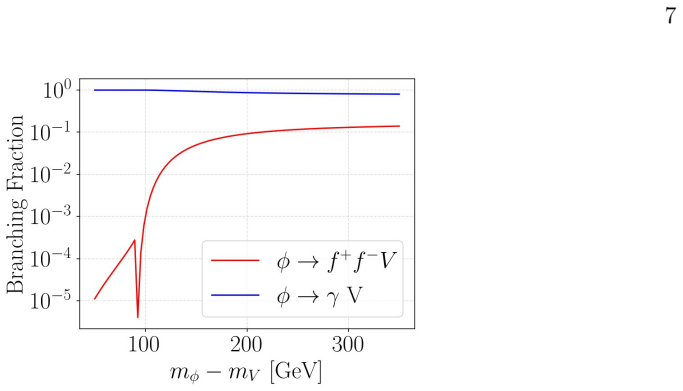
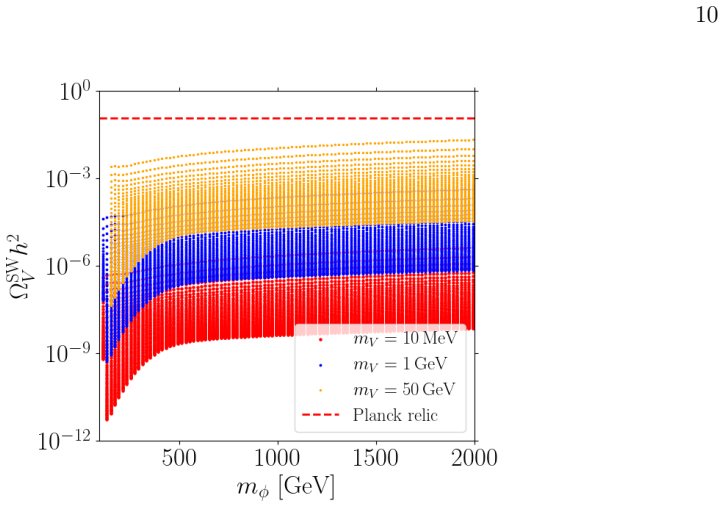
In this model, the vector dark matter is produced via freeze-in at both low and high reheating temperatures, leading to cosmological constraints. The long-lived scalar decays via higher-dimensional operators to produce a Z boson and the vector particle, yielding distinctive LLP signatures at colliders. Far detectors at the LHC and FCC-hh can probe otherwise inaccessible parameter space and place novel bounds on the reheating temperature through the combination of these cosmological and collider constraints.
What carries the argument
The long-lived scalar phi that decays to a Z boson plus the vector dark matter V_mu, connecting the collider-observable LLP signals to the freeze-in production rate which depends on the reheating temperature.
If this is right
- Far detectors enable exploration of parameter space inaccessible to standard searches.
- Novel upper bounds on the reheating temperature become possible.
- The approach combines cosmological freeze-in constraints with LLP detection.
- Future colliders like FCC-hh would significantly extend the sensitivity.
- Interplay shows complementarity between early universe cosmology and particle physics experiments.
Where Pith is reading between the lines
- If such bounds are established, they would restrict models of inflation and post-inflationary dynamics.
- This method could be adapted to other dark matter production scenarios involving long-lived mediators.
- Absence of signals would tighten constraints on the coupling strengths in the model.
- Similar LLP signatures might appear in related portal models with different dark matter candidates.
Load-bearing premise
The scalar particle decays exclusively through unspecified higher-dimensional operators and the dark matter is produced only via freeze-in with no other production or decay channels contributing significantly.
What would settle it
An observation of the long-lived particle decaying in a way inconsistent with the predicted phi to Z plus V mode, or evidence of dark matter production not matching the freeze-in yield at the probed reheating temperature.
Figures




read the original abstract
We study an extension of the singlet-scalar Higgs portal featuring a dark vector $V_\mu$ and a real scalar $\phi$. The vector is a dark matter (DM) candidate, while $\phi$ is long-lived and decays via higher-dimensional operators. We explore the DM production via freeze-in at low and high reheating temperatures. At colliders, the decay $\phi\to Z+V$ yields distinctive long-lived particle (LLP) signatures. We explore the interplay between cosmological constraints and LLP searches at the LHC and FCC-hh, showing that far detectors can probe otherwise inaccessible parameter space and place novel bounds on the reheating temperature.
Editorial analysis
A structured set of objections, weighed in public.
Referee Report
Summary. The paper studies an extension of the singlet-scalar Higgs portal featuring a dark vector V_μ as DM candidate and a real scalar φ that is long-lived and decays via unspecified higher-dimensional operators. DM production is analyzed via freeze-in at both low and high reheating temperatures T_R. The decay φ → Z + V is proposed to yield LLP signatures at far detectors of the LHC and FCC-hh. The central claim is that these searches can probe otherwise inaccessible parameter space and place novel bounds on T_R by combining cosmological and collider constraints.
Significance. If the central claim holds after addressing the operator ambiguities, the work would be significant for providing a concrete case study linking reheating temperature to observable LLP signatures at future colliders. The explicit consideration of both low- and high-T_R regimes for freeze-in production is a strength, as is the emphasis on far detectors for regions beyond standard searches. This could open a new avenue for probing early-universe cosmology at colliders if the parameter space is shown to be robust.
major comments (2)
- [§2] §2 (model definition and decays): The higher-dimensional operators for φ decays are left unspecified, leaving both the lifetime cτ and BR(φ → Z + V) as free parameters tunable by the cutoff scale and coefficients. The abstract claim that far detectors can probe T_R requires demonstrating a non-empty region where, for portal couplings yielding the observed relic density via pure freeze-in at low and high T_R, φ has cτ in the far-detector window, BR(φ → Z + V) is large enough for observability, and no other production/decay channels dominate. At high T_R the required smaller couplings may push the operator scale into regimes where competing modes (e.g., φ → SM or invisible) become unsuppressed; this must be shown explicitly rather than assumed.
- [§3] §3 (DM production): The assumption of purely freeze-in production with no other channels (including possible contributions from φ decays) dominating at both low and high T_R is load-bearing for the T_R bounds. Explicit checks or scans confirming this across the relevant coupling range, especially when varying the unspecified operators, are needed to support the interplay with LLP searches.
minor comments (2)
- Notation for the dark vector field V_μ should be clarified in equations to avoid confusion with SM gauge bosons.
- Figure captions and legends would benefit from explicit listing of benchmark parameter values and operator assumptions used in the scans.
Simulated Author's Rebuttal
We thank the referee for the careful reading of our manuscript and the constructive comments. We address each major point below. Where the comments identify areas requiring explicit demonstration, we agree and have revised the manuscript to include additional scans and checks. We believe these revisions strengthen the central claims without altering the overall conclusions.
read point-by-point responses
-
Referee: [§2] §2 (model definition and decays): The higher-dimensional operators for φ decays are left unspecified, leaving both the lifetime cτ and BR(φ → Z + V) as free parameters tunable by the cutoff scale and coefficients. The abstract claim that far detectors can probe T_R requires demonstrating a non-empty region where, for portal couplings yielding the observed relic density via pure freeze-in at low and high T_R, φ has cτ in the far-detector window, BR(φ → Z + V) is large enough for observability, and no other production/decay channels dominate. At high T_R the required smaller couplings may push the operator scale into regimes where competing modes (e.g., φ → SM or invisible) become unsuppressed; this must be shown explicitly rather than assumed.
Authors: We agree that the higher-dimensional operators are left general in §2, which parameterizes the lifetime and branching ratio. The manuscript already scans over portal couplings λ that yield the observed relic density via freeze-in for both low and high T_R, identifying viable regions where cτ lies in the far-detector range (O(10 m to km)) and BR(φ → Z + V) can be O(1) for appropriate operator choices. To address the referee's concern explicitly, particularly at high T_R where smaller λ implies larger effective scales, we have added new calculations and figures in the revised §2. These show that for cutoff scales Λ ≳ 5 TeV with O(1) coefficients, competing modes (e.g., φ → γγ or invisible decays) remain suppressed by additional powers of 1/Λ, preserving a non-empty parameter space consistent with the LLP signatures and T_R bounds. revision: yes
-
Referee: [§3] §3 (DM production): The assumption of purely freeze-in production with no other channels (including possible contributions from φ decays) dominating at both low and high T_R is load-bearing for the T_R bounds. Explicit checks or scans confirming this across the relevant coupling range, especially when varying the unspecified operators, are needed to support the interplay with LLP searches.
Authors: We acknowledge that the pure freeze-in assumption is central to the T_R constraints. In the original analysis, φ is produced via the Higgs portal but remains out of equilibrium, and its potential decays to DM are subdominant due to the small φ abundance. We have now performed explicit scans over the portal coupling and operator coefficients (varying the effective scale and branching ratios) across the low- and high-T_R regimes. These confirm that φ-decay contributions to the DM yield remain below 10% of the total for the parameter space yielding the observed relic density. The revised §3 includes these scans and updated figures, demonstrating that the assumption holds and that the LLP searches at far detectors can still set novel T_R bounds. revision: yes
Circularity Check
No significant circularity; reheating temperature treated as external input parameter
full rationale
The paper's central chain treats the reheating temperature T_R as an independent input that sets the freeze-in yield for vector DM, then computes the resulting LLP reach at far detectors via standard production and decay kinematics. No parameter is fitted to collider data and relabeled as a prediction; the higher-dimensional operators for phi are left unspecified (an assumption about existence of a lifetime window) rather than defined in terms of the target T_R bounds. No self-citation is invoked as a uniqueness theorem or load-bearing premise, and the derivation does not reduce any claimed bound to a tautology or renamed input. The setup is therefore self-contained against external benchmarks such as standard freeze-in formulas and detector geometry.
Axiom & Free-Parameter Ledger
free parameters (2)
- reheating temperature
- scalar mass and couplings
axioms (2)
- domain assumption Dark matter is produced solely via freeze-in with no other mechanisms contributing significantly.
- domain assumption The scalar phi decays only via higher-dimensional operators to Z+V.
invented entities (2)
-
dark vector V_mu
no independent evidence
-
real scalar phi
no independent evidence
Reference graph
Works this paper leans on
-
[1]
Decay temperature 23
-
[2]
Momentum redshift 23
-
[3]
displaced vertex (DV)+MET
Dark photon population fromϕdecays and BBN constraints 24 References 26 I. INTRODUCTION The nature of dark matter (DM) remains one of the most compelling open problems in modern particle physics. Minimal extensions of the Standard Model (SM), in which the observed relic abundance is explained by the addition of a single new field, are increasingly 3 const...
-
[4]
Decay temperature Recall that we considerm ϕ > m Z ≫m V , such that the total decay width ofϕin equation (4) reduces to Γϕ = Γ(ϕ→γV) + Γ(ϕ→ZV)≃ m3 ϕ 8πΛ2 .(A1) The characteristic decay temperatureT D can be estimated by equating the decay rate to the Hubble expansion rate Γ ϕ ≃H(T D). Solving the latter equation for a radiation dominated universe, and rep...
-
[5]
Momentum redshift Onceϕ, being out-of-equilibrium, decays intoγ, ZplusV, the dark photon has its three- momentum magnitude given by pV (TD)≈ mϕ 2 .(A3) 24 Assuming adiabatic expansion, the three-momentum redshifts as pV (T) =p V (TD) T TD = mϕ 2 T TD .(A4) The energy of the vector particle is therefore EV (T) = q pV (T) 2 +m 2 V = s mϕ 2 T TD 2 +m 2 V .(A...
-
[6]
The amount of dark radiation is crucial to assess its impact on BBN
Dark photon population fromϕdecays and BBN constraints From figure 15 (left) we observe that for high Λ values relativistic dark photons can be present during BBN. The amount of dark radiation is crucial to assess its impact on BBN. 25 FIG. 15: Dark photon energy fromϕdecays as a function of temperature form V = 10 MeV (the left panel) and 1 GeV (the righ...
-
[7]
Freeze-In Production of FIMP Dark Matter
L. J. Hall, K. Jedamzik, J. March-Russell, and S. M. West, “Freeze-In Production of FIMP Dark Matter,”JHEP03(2010) 080,arXiv:0911.1120 [hep-ph]
work page Pith review arXiv 2010
-
[8]
Dark matter freeze-in with a heavy mediator: beyond the EFT approach,
E. Frangipane, S. Gori, and B. Shakya, “Dark matter freeze-in with a heavy mediator: beyond the EFT approach,”JHEP09(2022) 083,arXiv:2110.10711 [hep-ph]
-
[9]
Freeze-in at stronger coupling,
C. Cosme, F. Costa, and O. Lebedev, “Freeze-in at stronger coupling,”Phys. Rev. D109 no. 7, (2024) 075038,arXiv:2306.13061 [hep-ph]
-
[10]
From WIMPs to FIMPs with low reheating temperatures,
J. Silva-Malpartida, N. Bernal, J. Jones-P´ erez, and R. A. Lineros, “From WIMPs to FIMPs with low reheating temperatures,”JCAP09(2023) 015,arXiv:2306.14943 [hep-ph]
-
[11]
LHC-friendly minimal freeze-in models,
G. B´ elangeret al., “LHC-friendly minimal freeze-in models,”JHEP02(2019) 186, arXiv:1811.05478 [hep-ph]
-
[12]
J. Alimenaet al., “Searching for long-lived particles beyond the Standard Model at the Large Hadron Collider,”J. Phys. G47no. 9, (2020) 090501,arXiv:1903.04497 [hep-ex]
-
[13]
Collider Searches for Long-Lived Particles Beyond the Standard Model,
L. Lee, C. Ohm, A. Soffer, and T.-T. Yu, “Collider Searches for Long-Lived Particles Beyond the Standard Model,”Prog. Part. Nucl. Phys.106(2019) 210–255,arXiv:1810.12602 [hep-ph]. [Erratum: Prog.Part.Nucl.Phys. 122, 103912 (2022)]. 27
-
[14]
K. Kaneta, H.-S. Lee, and S. Yun, “Portal Connecting Dark Photons and Axions,”Phys. Rev. Lett.118no. 10, (2017) 101802,arXiv:1611.01466 [hep-ph]
-
[15]
P. deNiverville, H.-S. Lee, and M.-S. Seo, “Implications of the dark axion portal for the muon g−2 , B factories, fixed target neutrino experiments, and beam dumps,”Phys. Rev. D 98no. 11, (2018) 115011,arXiv:1806.00757 [hep-ph]
-
[16]
New searches at reactor experiments based on the dark axion portal,
P. Deniverville, H.-S. Lee, and Y.-M. Lee, “New searches at reactor experiments based on the dark axion portal,”Phys. Rev. D103no. 7, (2021) 075006,arXiv:2011.03276 [hep-ph]
-
[17]
Jodłowski, Probing some photon portals to new physics at intensity frontier experiments, Phys
K. Jod lowski, “Probing some photon portals to new physics at intensity frontier experiments,”Phys. Rev. D108no. 11, (2023) 115017,arXiv:2305.05710 [hep-ph]
-
[18]
Dark axion portal at Z boson factories,
K. Jod lowski, “Dark axion portal at Z boson factories,”JHEP08(2025) 022, arXiv:2411.19196 [hep-ph]
-
[19]
Volumetric grasping network: Real-time 6 dof grasp detection in clutter,
A. Hook, G. Marques-Tavares, and C. Ristow, “Supernova constraints on an axion-photon-dark photon interaction,”JHEP06(2021) 167,arXiv:2105.06476 [hep-ph]
-
[20]
A cosmic window on the dark axion portal,
H. Hong, U. Min, M. Son, and T. You, “A cosmic window on the dark axion portal,”JHEP 03(2024) 155,arXiv:2310.19544 [hep-ph]
-
[21]
Dark photon relic dark matter production through the dark axion portal,
K. Kaneta, H.-S. Lee, and S. Yun, “Dark photon relic dark matter production through the dark axion portal,”Phys. Rev. D95no. 11, (2017) 115032,arXiv:1704.07542 [hep-ph]
-
[22]
Hidden Photon Dark Matter Interacting via Axion-like Particles,
P. Arias, A. Arza, J. Jaeckel, and D. Vargas-Arancibia, “Hidden Photon Dark Matter Interacting via Axion-like Particles,”JCAP05(2021) 070,arXiv:2007.12585 [hep-ph]
-
[23]
Cosmology and direct detection of the Dark Axion Portal,
J. C. Guti´ errez, B. J. Kavanagh, N. Castell´ o-Mor, F. J. Casas, J. M. Diego, E. Mart´ ınez-Gonz´ alez, and R. V. Cortabitarte, “Cosmology and direct detection of the Dark Axion Portal,”arXiv:2112.11387 [hep-ph]
-
[24]
Adiabatic conversion of ALPs into dark photon dark matter,
E. Broadberry, S. Das, A. Hook, and G. Marques Tavares, “Adiabatic conversion of ALPs into dark photon dark matter,”JHEP03(2025) 215,arXiv:2408.03370 [hep-ph]
-
[25]
Thermal dark photon dark matter, coscattering, and long-lived ALPs,
B. D´ ıaz S´ aez, “Thermal dark photon dark matter, coscattering, and long-lived ALPs,”Phys. Dark Univ.48(2025) 101852,arXiv:2405.06113 [hep-ph]
-
[26]
Freezing-in the pure dark axion portal,
P. Arias, B. Diaz Saez, and J. Jaeckel, “Freezing-in the pure dark axion portal,”JCAP06 (2025) 060,arXiv:2501.17234 [hep-ph]
-
[27]
Probing displaced (dark)photons from low reheating freeze-in at the LHC,
P. Arias, B. D´ ıaz S´ aez, L. Duarte, J. Jones-P´ erez, W. Rodriguez, and D. Z. Herrera, “Probing displaced (dark)photons from low reheating freeze-in at the LHC,”JHEP01 (2026) 135,arXiv:2507.15930 [hep-ph]. 28
-
[28]
New Detectors to Explore the Lifetime Frontier,
J. P. Chou, D. Curtin, and H. J. Lubatti, “New Detectors to Explore the Lifetime Frontier,” Phys. Lett. B767(2017) 29–36,arXiv:1606.06298 [hep-ph]
-
[29]
D. Curtinet al., “Long-Lived Particles at the Energy Frontier: The MATHUSLA Physics Case,”Rept. Prog. Phys.82no. 11, (2019) 116201,arXiv:1806.07396 [hep-ph]. [24]MA THUSLACollaboration, C. Alpigianiet al., “A Letter of Intent for MATHUSLA: A Dedicated Displaced Vertex Detector above ATLAS or CMS.,”arXiv:1811.00927 [physics.ins-det]. [25]MA THUSLACollabora...
-
[30]
FASER: ForwArd Search ExpeRiment at the LHC
J. L. Feng, I. Galon, F. Kling, and S. Trojanowski, “ForwArd Search ExpeRiment at the LHC,”Phys. Rev. D97no. 3, (2018) 035001,arXiv:1708.09389 [hep-ph]. [28]F ASERCollaboration, A. Arigaet al., “FASER’s physics reach for long-lived particles,” Phys. Rev. D99no. 9, (2019) 095011,arXiv:1811.12522 [hep-ph]. [29]F ASERCollaboration, H. Abreuet al., “The FASER...
work page Pith review arXiv 2018
-
[31]
Searching for Long-lived Particles: A Compact Detector for Exotics at LHCb,
V. V. Gligorov, S. Knapen, M. Papucci, and D. J. Robinson, “Searching for Long-lived Particles: A Compact Detector for Exotics at LHCb,”Phys. Rev. D97no. 1, (2018) 015023, arXiv:1708.09395 [hep-ph]
-
[32]
Expression of interest for the CODEX-b detector,
G. Aielliet al., “Expression of interest for the CODEX-b detector,”Eur. Phys. J. C80 no. 12, (2020) 1177,arXiv:1911.00481 [hep-ex]
-
[33]
ANUBIS: Proposal to search for long-lived neutral particles in CERN service shafts,
M. Bauer, O. Brandt, L. Lee, and C. Ohm, “ANUBIS: Proposal to search for long-lived neutral particles in CERN service shafts,”arXiv:1909.13022 [physics.ins-det]. [33]ANUBISCollaboration, O. Brandtet al., “The ANUBIS detector and its sensitivity to neutral long-lived particles,”arXiv:2510.26932 [hep-ex]. [34]FCCCollaboration, A. Abadaet al., “FCC-hh: The H...
-
[34]
Future Circular Hadron Collider FCC-hh: Overview and Status,
M. Benediktet al., “Future Circular Hadron Collider FCC-hh: Overview and Status,” 29 arXiv:2203.07804 [physics.acc-ph]
-
[35]
B. Bhattacherjee, S. Matsumoto, and R. Sengupta, “Long-lived light mediators from Higgs boson decay at HL-LHC and FCC-hh, and a proposal of dedicated long-lived particle detectors for FCC-hh,”Phys. Rev. D106no. 9, (2022) 095018,arXiv:2111.02437 [hep-ph]
-
[36]
B. Bhattacherjee, H. K. Dreiner, N. Ghosh, S. Matsumoto, R. Sengupta, and P. Solanki, “Light long-lived particles at the FCC-hh with the proposal for a dedicated forward detector FOREHUNT and a transverse detector DELIGHT,”Phys. Rev. D110no. 1, (2024) 015036, arXiv:2306.11803 [hep-ph]
-
[37]
D. O’Connell, M. J. Ramsey-Musolf, and M. B. Wise, “Minimal Extension of the Standard Model Scalar Sector,”Phys. Rev. D75(2007) 037701,arXiv:hep-ph/0611014
-
[38]
How to Find a Hidden World at the Large Hadron Collider,
J. D. Wells, “How to Find a Hidden World at the Large Hadron Collider,”arXiv:0803.1243 [hep-ph]
-
[39]
Search for dark matter in b —>s transitions with missing energy,
C. Bird, P. Jackson, R. V. Kowalewski, and M. Pospelov, “Search for dark matter in b —>s transitions with missing energy,”Phys. Rev. Lett.93(2004) 201803, arXiv:hep-ph/0401195
-
[40]
M. Pospelov, A. Ritz, and M. B. Voloshin, “Secluded WIMP Dark Matter,”Phys. Lett. B 662(2008) 53–61,arXiv:0711.4866 [hep-ph]
work page Pith review arXiv 2008
-
[41]
G. Krnjaic, “Probing Light Thermal Dark-Matter With a Higgs Portal Mediator,”Phys. Rev. D94no. 7, (2016) 073009,arXiv:1512.04119 [hep-ph]
-
[42]
I. Boiarska, K. Bondarenko, A. Boyarsky, V. Gorkavenko, M. Ovchynnikov, and A. Sokolenko, “Phenomenology of GeV-scale scalar portal,”JHEP11(2019) 162, arXiv:1904.10447 [hep-ph]
-
[43]
J. Alwall, M. Herquet, F. Maltoni, O. Mattelaer, and T. Stelzer, “MadGraph 5 : Going Beyond,”JHEP06(2011) 128,arXiv:1106.0522 [hep-ph]
work page Pith review arXiv 2011
-
[44]
J. Alwall, R. Frederix, S. Frixione, V. Hirschi, F. Maltoni, O. Mattelaer, H. S. Shao, T. Stelzer, P. Torrielli, and M. Zaro, “The automated computation of tree-level and next-to-leading order differential cross sections, and their matching to parton shower simulations,”JHEP07(2014) 079,arXiv:1405.0301 [hep-ph]
work page internal anchor Pith review arXiv 2014
-
[45]
G. B´ elanger, F. Boudjema, A. Goudelis, A. Pukhov, and B. Zaldivar, “micrOMEGAs5.0 : Freeze-in,”Comput. Phys. Commun.231(2018) 173–186,arXiv:1801.03509 [hep-ph]. 30
work page Pith review arXiv 2018
-
[46]
Superweakly interacting massive particles,
J. L. Feng, A. Rajaraman, and F. Takayama, “Superweakly interacting massive particles,” Phys. Rev. Lett.91(2003) 011302,arXiv:hep-ph/0302215. [48]PlanckCollaboration, N. Aghanimet al., “Planck 2018 results. VI. Cosmological parameters,”Astron. Astrophys.641(2020) A6,arXiv:1807.06209 [astro-ph.CO]. [Erratum: Astron.Astrophys. 652, C4 (2021)]
-
[47]
Interplay of super-WIMP and freeze-in production of dark matter,
M. Garny and J. Heisig, “Interplay of super-WIMP and freeze-in production of dark matter,”Phys. Rev. D98no. 9, (2018) 095031,arXiv:1809.10135 [hep-ph]. [50]A TLASCollaboration, M. Aaboudet al., “Search for long-lived, massive particles in events with displaced vertices and missing transverse momentum in √s= 13 TeVppcollisions with the ATLAS detector,”Phys...
-
[48]
Les Houches 2017: Physics at TeV Colliders New Physics Working Group Report,
G. Brooijmanset al., “Les Houches 2017: Physics at TeV Colliders New Physics Working Group Report,” in10th Les Houches Workshop on Physics at TeV Colliders. 3, 2018. arXiv:1803.10379 [hep-ph]. [52]CheckMA TECollaboration, N. Desai, F. Domingo, J. S. Kim, R. R. d. A. Bazan, K. Rolbiecki, M. Sonawane, and Z. S. Wang, “Constraining electroweak and strongly c...
-
[49]
M. Drees, H. Dreiner, D. Schmeier, J. Tattersall, and J. S. Kim, “CheckMATE: Confronting your Favourite New Physics Model with LHC Data,”Comput. Phys. Commun.187(2015) 227–265,arXiv:1312.2591 [hep-ph]
-
[50]
CheckMATE 2: From the model to the limit,
D. Dercks, N. Desai, J. S. Kim, K. Rolbiecki, J. Tattersall, and T. Weber, “CheckMATE 2: From the model to the limit,”Comput. Phys. Commun.221(2017) 383–418, arXiv:1611.09856 [hep-ph]
-
[51]
Long-lived particle phenomenology in one-loop neutrino mass models with dark matter,
C. Arbel´ aez, G. Cottin, J. C. Helo, M. Hirsch, and T. B. de Melo, “Long-lived particle phenomenology in one-loop neutrino mass models with dark matter,”JHEP02(2025) 049, arXiv:2408.03364 [hep-ph]
-
[52]
Enhancing Long-Lived Particles Searches at the LHC with Precision Timing Information,
J. Liu, Z. Liu, and L.-T. Wang, “Enhancing Long-Lived Particles Searches at the LHC with Precision Timing Information,”Phys. Rev. Lett.122no. 13, (2019) 131801, arXiv:1805.05957 [hep-ph]
-
[53]
T. Sj¨ ostrand, S. Ask, J. R. Christiansen, R. Corke, N. Desai, P. Ilten, S. Mrenna, S. Prestel, C. O. Rasmussen, and P. Z. Skands, “An introduction to PYTHIA 8.2”Comput. Phys. 31 Commun.191(2015) 159–177,arXiv:1410.3012 [hep-ph]
work page internal anchor Pith review arXiv 2015
-
[54]
D. Acostaet al., “Review of opportunities for new long-lived particle triggers in Run 3 of the Large Hadron Collider,”arXiv:2110.14675 [hep-ex]
-
[55]
Long-lived heavy neutral leptons with a displaced shower signature at CMS,
G. Cottin, J. C. Helo, M. Hirsch, C. Pe˜ na, C. Wang, and S. Xie, “Long-lived heavy neutral leptons with a displaced shower signature at CMS,”JHEP02(2023) 011, arXiv:2210.17446 [hep-ph]
-
[56]
F. Domingo, J. G¨ unther, J. S. Kim, and Z. S. Wang, “A C++ program for estimating detector sensitivities to long-lived particles: displaced decay counter,”Eur. Phys. J. C84 no. 6, (2024) 642,arXiv:2308.07371 [hep-ph]. [61]MA THUSLACollaboration, B. Aitkenet al., “MATHUSLA: An External Long-Lived Particle Detector to Maximize the Discovery Potential of th...
-
[57]
Updated sensitivities to heavy neutral leptons at the LHC far detectors and SHiP,
Z. S. Wang and Y. Zhang, “Updated sensitivities to heavy neutral leptons at the LHC far detectors and SHiP,”Phys. Rev. D113no. 7, (2026) 075024,arXiv:2512.13011 [hep-ph]
-
[58]
Testing frozen-in pNGB dark matter with a long-lived dark Higgs,
N. Bernal, G. Cottin, B. D´ ıaz S´ aez, and M. L´ opez, “Testing frozen-in pNGB dark matter with a long-lived dark Higgs,”JHEP01(2026) 081,arXiv:2507.07089 [hep-ph]
- [59]
-
[60]
Big-Bang Nucleosynthesis after Planck,
B. D. Fields, K. A. Olive, T.-H. Yeh, and C. Young, “Big-Bang Nucleosynthesis after Planck,”JCAP03(2020) 010,arXiv:1912.01132 [astro-ph.CO]. [Erratum: JCAP 11, E02 (2020)]
discussion (0)
Sign in with ORCID, Apple, or X to comment. Anyone can read and Pith papers without signing in.