Recognition: unknown
Relaxation Kernel and Global Convergence of the Blahut-Arimoto Dynamics
Pith reviewed 2026-05-07 15:20 UTC · model grok-4.3
The pith
The continuous-time Blahut-Arimoto dynamics converge globally to nondegenerate equilibria by combining an exact dissipation identity with a relaxation kernel.
A machine-rendered reading of the paper's core claim, the machinery that carries it, and where it could break.
Core claim
The paper shows that the nonlinear dissipative flow generated by the Gibbs-type self-consistent evolution admits an exact dissipation identity in which the free energy decreases according to a weighted chi-squared-type fluctuation. Linearization around a nondegenerate stationary state reveals that the fluctuation is governed by a symmetric positive-semidefinite relaxation kernel constructed from equilibrium conditional covariances; this kernel determines both the linearized flow and the quadratic expansion of the free energy, and it coincides with the Fisher-Rao Hessian at equilibrium so that its spectral gap characterizes the local relaxation rate. The combination of the exact dissipation (
What carries the argument
the relaxation kernel built from equilibrium conditional covariances that controls both the linearized dynamics and the quadratic free-energy expansion
If this is right
- The free energy decreases monotonically at a rate given exactly by the weighted chi-squared fluctuation.
- The flow converges to equilibrium inside the connected component of any nondegenerate stationary state.
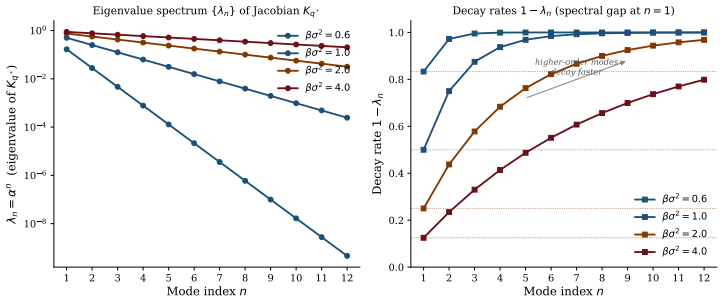
- In the Gaussian quadratic case the dynamics reduce to finite dimensions where the relaxation kernel, spectral gap, and asymptotic law are all available in closed form.
- The local relaxation rate equals the spectral gap of the kernel.
- The kernel supplies both the linearized vector field and the second-order expansion of the free energy around equilibrium.
Where Pith is reading between the lines
- The same dissipation-plus-spectral-gap argument could be used to bound convergence rates for the usual discrete Blahut-Arimoto iteration by viewing it as an Euler discretization.
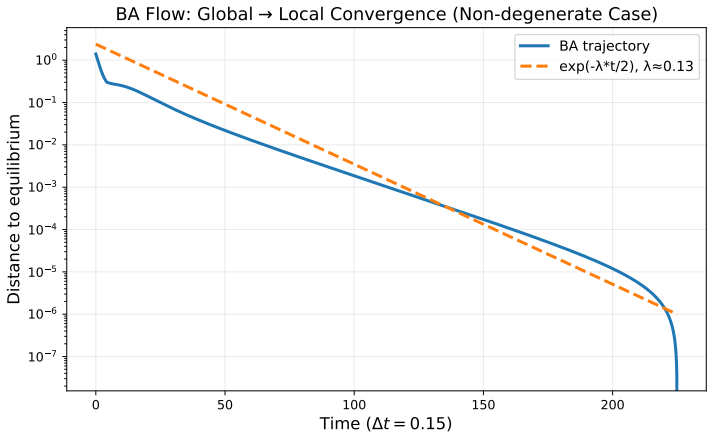
- The explicit Gaussian reduction offers a simple test-bed in which one can numerically verify the predicted relaxation time against direct integration of the flow.
- The identification of the kernel with the Fisher-Rao Hessian suggests that the dynamics is a gradient flow of the free energy in that metric, which may connect it to other information-geometric flows.
- Analogous kernels might appear in other self-consistent Gibbs-type updates arising in statistical mechanics or variational inference.
Load-bearing premise
The stationary state must be nondegenerate so that the linearized operator possesses a positive spectral gap and the trajectory remains inside the connected component of that state.
What would settle it
A concrete counter-example consisting of a nondegenerate stationary point together with an explicit trajectory that leaves its connected component or fails to converge at the predicted spectral rate.
Figures





read the original abstract
Motivated by a continuous-time formulation of the Blahut-Arimoto scheme, we study a nonlinear dissipative flow on the probability simplex generated by a Gibbs-type self-consistent evolution. We establish an exact dissipation identity showing that the free energy decreases according to a weighted $\chi^2$-type fluctuation, yielding an explicit entropy-production formula for the nonlinear dynamics. Linearization around a nondegenerate stationary state reveals that the same fluctuation is governed by a symmetric positive semidefinite relaxation kernel built from equilibrium conditional covariances. This kernel determines both the local linearized flow and the quadratic expansion of the free energy. We further show that it coincides with the Fisher-Rao Hessian of the free energy at equilibrium,so that its spectral gap characterizes the local relaxation rate. Combining the exact dissipation identity with local spectral contraction, we obtain convergence of the flow toward equilibrium within the connected component of a nondegenerate stationary state. In the Gaussian quadratic case, the dynamics admits an explicit finite-dimensional reduction for which the relaxation kernel, spectral gap, and asymptotic relaxation law can be computed in closed form. These results identify a common structure linking entropy dissipation, local equilibrium geometry, and spectral relaxation in a class of nonlinear Gibbs-type probability flows.
Editorial analysis
A structured set of objections, weighed in public.
Referee Report
Summary. The paper develops a continuous-time Blahut-Arimoto dynamics as a nonlinear dissipative flow on the probability simplex. It establishes an exact dissipation identity where the free energy decreases by a weighted χ²-type fluctuation defined via a relaxation kernel. At nondegenerate stationary states, this kernel is shown to coincide with the Fisher-Rao Hessian of the free energy, providing a positive spectral gap for the linearized dynamics. The central result combines these to conclude global convergence of the flow to the equilibrium within the connected component of the nondegenerate state. A special case for Gaussian quadratic models admits an explicit finite-dimensional reduction with closed-form expressions for the kernel, gap, and relaxation law.
Significance. If the convergence claim is rigorously established, this work provides a valuable framework linking entropy dissipation, local geometric structure via the relaxation kernel, and spectral properties in Gibbs-type flows. The identification of the kernel with the Hessian and the explicit Gaussian analysis are notable strengths that could inform analysis of related algorithms in information theory and optimization. The dissipation identity offers an explicit entropy-production formula that may have broader applicability.
major comments (1)
- [Abstract] Abstract: The assertion that 'Combining the exact dissipation identity with local spectral contraction, we obtain convergence of the flow toward equilibrium within the connected component of a nondegenerate stationary state' is load-bearing. The dissipation identity ensures trajectories approach the zero-dissipation set, but does not automatically exclude other equilibria, periodic orbits, or escape from the component. The manuscript must supply an explicit forward-invariance proof for the connected component together with a LaSalle-type argument (or equivalent global Lyapunov analysis) showing that the ω-limit set reduces to the single nondegenerate equilibrium; the abstract outline does not indicate that this step is present.
minor comments (1)
- [Abstract] Abstract: The relaxation kernel is referenced before its construction from equilibrium conditional covariances is described; a short inline definition or forward reference would aid readability.
Simulated Author's Rebuttal
We thank the referee for the careful reading and constructive critique of the convergence claim. We address the single major comment below and will revise the manuscript accordingly to make the global argument fully explicit.
read point-by-point responses
-
Referee: [Abstract] Abstract: The assertion that 'Combining the exact dissipation identity with local spectral contraction, we obtain convergence of the flow toward equilibrium within the connected component of a nondegenerate stationary state' is load-bearing. The dissipation identity ensures trajectories approach the zero-dissipation set, but does not automatically exclude other equilibria, periodic orbits, or escape from the component. The manuscript must supply an explicit forward-invariance proof for the connected component together with a LaSalle-type argument (or equivalent global Lyapunov analysis) showing that the ω-limit set reduces to the single nondegenerate equilibrium; the abstract outline does not indicate that this step is present.
Authors: We agree that the global convergence statement requires an explicit supporting argument that goes beyond the local spectral analysis and the dissipation identity. The manuscript establishes that the free-energy dissipation vanishes precisely on the zero set of the relaxation kernel and that this kernel is positive definite at nondegenerate equilibria, but the referee correctly notes that forward invariance of the connected component and an invariance-principle argument for the ω-limit set are not spelled out in the abstract and should be detailed in the text. In the revision we will add a dedicated subsection that (i) proves forward invariance of the connected component of any nondegenerate stationary state (using the fact that the vector field is tangent to the probability simplex and that the component is a connected open set in the relative interior), and (ii) applies LaSalle’s invariance principle to the free energy, showing that every trajectory’s ω-limit set lies inside the largest invariant set on which the dissipation vanishes. Nondegeneracy then forces this set to consist solely of the equilibrium. We will also revise the abstract to indicate that the global result follows from the dissipation identity together with these two additional steps. revision: yes
Circularity Check
No circularity: derivation builds dissipation identity, kernel construction, and local spectral properties independently before claiming convergence.
full rationale
The paper first derives an exact dissipation identity for the free energy along the nonlinear flow, then constructs the relaxation kernel explicitly from equilibrium conditional covariances, proves its coincidence with the Fisher-Rao Hessian, and obtains a local spectral gap from the linearized operator. The final step combines these to assert convergence inside the connected component. None of these reductions are self-definitional, fitted-input renamings, or load-bearing self-citations; each step introduces new structure (the kernel, the Hessian equivalence, the gap) rather than presupposing the target convergence result. The global-convergence claim may require an explicit invariance or LaSalle argument to be fully rigorous, but that is a completeness issue, not a circular reduction by construction.
Axiom & Free-Parameter Ledger
axioms (2)
- domain assumption The nonlinear flow generated by the Gibbs-type self-consistent evolution is well-defined and differentiable on the interior of the probability simplex.
- domain assumption Nondegenerate stationary states possess a positive spectral gap in the linearized operator.
invented entities (1)
-
Relaxation kernel
no independent evidence
Forward citations
Cited by 1 Pith paper
-
Expectation-Maximization as a Spectrally Governed Relaxation Flow
EM's monotonicity and local rate are unified by the spectral operator G = I - DT that equals the missing-information ratio and observed-likelihood Hessian, enabling accelerated local updates.
Reference graph
Works this paper leans on
-
[1]
S. Amari. Natural gradient works efficiently in learning.Neural Com- putation, 10(2):251–276, 1998
1998
-
[2]
Amari.Information Geometry and Its Applications, volume 194 of Applied Mathematical Sciences
S. Amari.Information Geometry and Its Applications, volume 194 of Applied Mathematical Sciences. Springer, Tokyo, 2016
2016
-
[3]
S. Arimoto. An algorithm for computing the capacity of arbitrary dis- crete memoryless channels.IEEE Transactions on Information Theory, 18(1):14–20, 1972
1972
-
[4]
Arnold, P
A. Arnold, P. Markowich, G. Toscani, and A. Unterreiter. On con- vex Sobolev inequalities and the rate of convergence to equilibrium for Fokker–Planck type equations.Comm. Partial Differential Equations, 26(1-2):43–100, 2001
2001
-
[5]
Springer, Cham, 2014
Dominique Bakry, Ivan Gentil, and Michel Ledoux.Analysis and Ge- ometry of Markov Diffusion Operators, volume 348 ofGrundlehren der Mathematischen Wissenschaften. Springer, Cham, 2014
2014
-
[6]
Beck and M
A. Beck and M. Teboulle. Mirror descent and nonlinear projected sub- gradient methods for convex optimization.Operations Research Letters, 31(3):167–175, 2003. 39
2003
-
[7]
Beretta and M
G. Beretta and M. Pelillo. Vector flows that compute the capacity of discrete memoryless channels.Entropy, 27(4):362, 2025
2025
-
[8]
R. E. Blahut. Computation of channel capacity and rate-distortion functions.IEEE Transactions on Information Theory, 18(4):460–473, 1972
1972
-
[9]
J. F. Bonnans and A. Shapiro.Perturbation Analysis of Optimization Problems. Springer, New York, 2000
2000
-
[10]
Csisz´ ar
I. Csisz´ ar. Information geometry and alternating minimization proce- dures.Statistics & Decisions, pages 205–237, 1984. Supplement Issue No. 1
1984
-
[11]
Dupuis and W
F. Dupuis and W. Yu. A Blahut-Arimoto type algorithm for computing the capacity of MIMO channels. InProc. IEEE International Sympo- sium on Information Theory (ISIT), page 477, Chicago, IL, 2004
2004
-
[12]
Dupuis and W
F. Dupuis and W. Yu. A Blahut-Arimoto type algorithm for computing the rate-distortion function of a Wyner-Ziv source. InProc. IEEE International Symposium on Information Theory (ISIT), pages 91–95, Austin, TX, 2010
2010
-
[13]
A. L. Gibbs and F. E. Su. On choosing and bounding probability metrics.International Statistical Review, 70(3):419–435, 2002
2002
-
[14]
M. Hayashi. Bregman divergence based EM algorithm and its applica- tion to classical and quantum rate distortion theory.IEEE Transactions on Information Theory, 68(6):3469–3491, 2022
2022
-
[15]
K. He, J. Saunderson, and H. Fawzi. A Bregman proximal perspective on classical and quantum Blahut–Arimoto algorithms.IEEE Transac- tions on Information Theory, 70(8):5710–5730, 2024
2024
-
[16]
M. W. Hirsch, S. Smale, and R. L. Devaney.Differential Equations, Dynamical Systems, and an Introduction to Chaos. Academic Press, New York, 3rd edition, 2013
2013
-
[17]
Milgrom and I
P. Milgrom and I. Segal. Envelope theorems for arbitrary choice sets. Econometrica, 70(2):583–601, 2002
2002
-
[18]
Nakagawa and S
K. Nakagawa and S. Watanabe. On a proof of the convergence speed of quadratic recurrence formulas in the Arimoto-Blahut algorithm.IEEE Transactions on Information Theory, 67(10):6810–6831, 2021
2021
-
[19]
C. R. Rao. Information and the accuracy attainable in the estimation of statistical parameters.Bull. Calcutta Math. Soc., 37:81–91, 1945. 40
1945
-
[20]
Reed and B
M. Reed and B. Simon.Methods of Modern Mathematical Physics. IV: Analysis of Operators. Academic Press, New York, 1978
1978
-
[21]
Emre Telatar
I. Emre Telatar. Capacity of multi-antenna Gaussian channels.Euro- pean Transactions on Telecommunications, 10(6):585–595, 1999
1999
-
[22]
confusable
A. D. Wyner and J. Ziv. The rate-distortion function for source coding with side information at the decoder.IEEE Transactions on Informa- tion Theory, 22(1):1–10, 1976. 41 Table 1: Vocabulary guide: dynamical concepts and their information- theoretic meanings. Dynamical concept Information-theoretic meaning BA flow ˙q=T(q)−qContinuous-time limit of the al...
1976
discussion (0)
Sign in with ORCID, Apple, or X to comment. Anyone can read and Pith papers without signing in.