Recognition: unknown
Tail allocation for conformal prediction intervals
Pith reviewed 2026-05-07 15:39 UTC · model grok-4.3
The pith
TA-CQR estimates the optimal lower-tail allocation to produce the shortest single-interval conformal predictor while retaining exact finite-sample marginal coverage.
A machine-rendered reading of the paper's core claim, the machinery that carries it, and where it could break.
Core claim
We parameterize the single-interval oracle by a lower-tail allocation that determines the split of nominal miscoverage α between the endpoints, propose tail-allocation conformalized quantile regression (TA-CQR) that estimates this allocation by searching quantile-defined cores and applies nonnegative additive split-conformal calibration, characterize the oracle geometry including its highest-density interpretation under unimodality and the positive connectedness cost of disconnected sets, prove local recovery of the selected allocation and core, establish that calibration radii are asymptotically negligible under endpoint-density conditions, and give a finite-sample calibrated length oracle
What carries the argument
The lower-tail allocation parameter, which splits the nominal miscoverage α between the lower and upper tails to define the shortest interval containing conditional mass at least 1-α.
If this is right
- Exact finite-sample marginal coverage is guaranteed under exchangeability regardless of how the allocation is estimated.
- Under positive endpoint densities the extra length contributed by calibration vanishes asymptotically relative to the oracle length.
- The selected allocation and core converge locally to their oracle counterparts.
- A finite-sample oracle inequality bounds the excess length of the calibrated interval by explicit additive terms involving grid size, endpoint-quantile estimation error, and calibration-sample size.
Where Pith is reading between the lines
- The highest-density and connectedness-cost characterization suggests that TA-CQR will be most advantageous when the conditional distribution is unimodal and the shortest interval is connected.
- Replacing the fixed grid search with a data-driven adaptive choice of quantile cores could tighten the explicit grid term appearing in the length oracle inequality.
- The method could be applied to settings with approximate exchangeability, such as weakly dependent time series, where the coverage guarantee would degrade gracefully rather than fail abruptly.
Load-bearing premise
The observations are exchangeable, which underpins the exact finite-sample marginal coverage guarantee of the split-conformal calibration step.
What would settle it
A simulation with known conditional densities where the recovered allocation deviates from the oracle shortest-interval allocation by an amount larger than the rate stated in the local-recovery theorem.
Figures
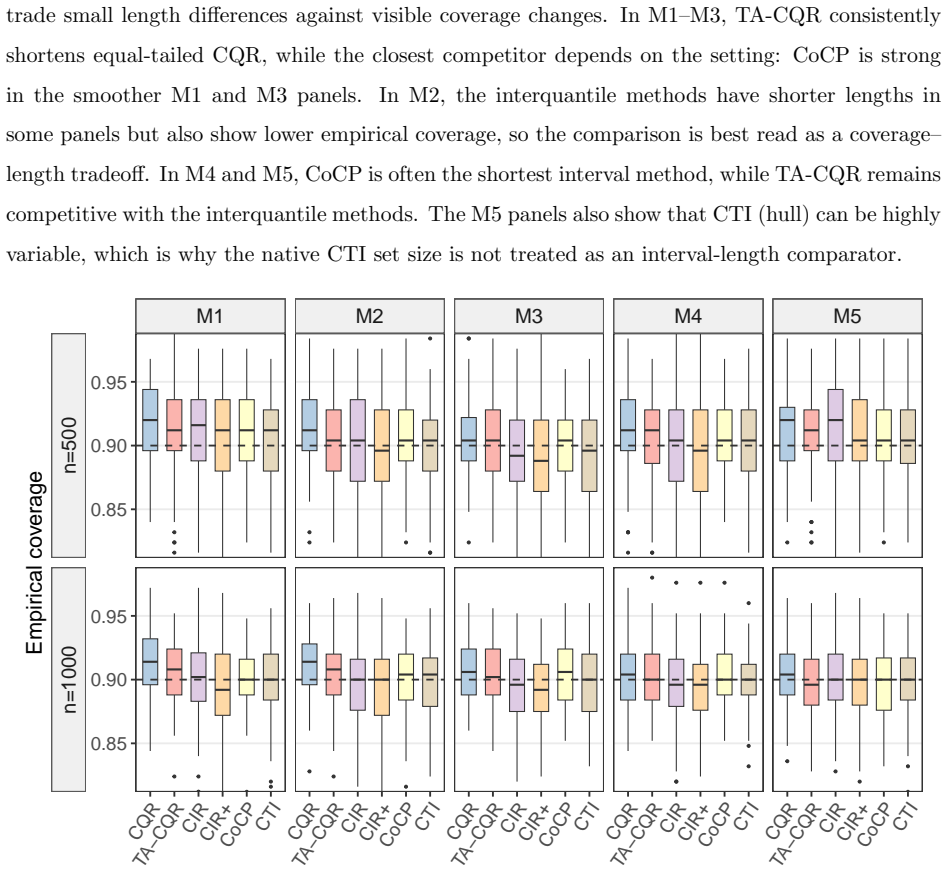
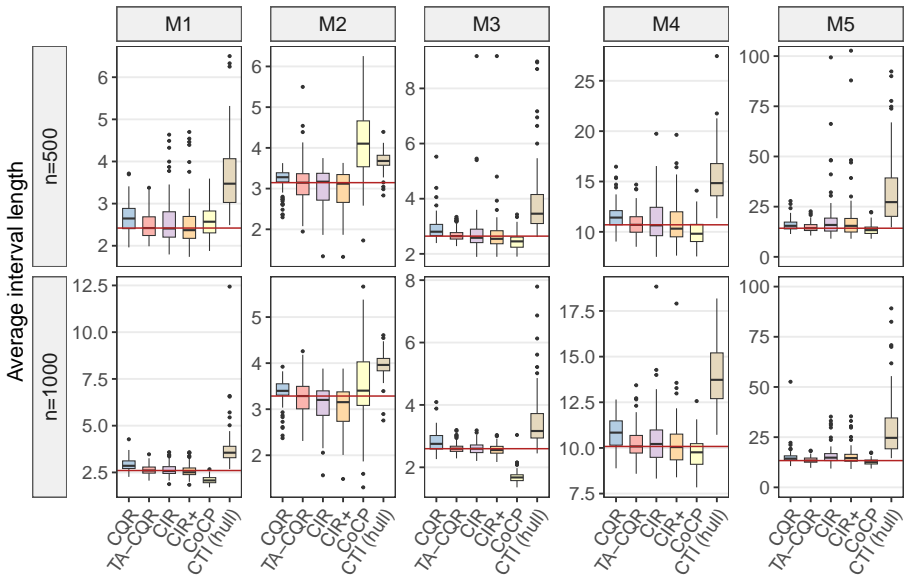

read the original abstract
We study split-conformal prediction for regression when the reported prediction set must be a single interval, at target marginal coverage $1-\alpha$, where $\alpha$ is the nominal miscoverage level. Under this reporting constraint, the natural conditional target is the shortest interval with conditional mass at least $1-\alpha$, rather than an equal-tailed interval or a possibly disconnected high-probability set. We parameterize this single-interval oracle by a lower-tail allocation, which determines how the nominal miscoverage $\alpha$ is split between the two endpoints, and propose tail-allocation conformalized quantile regression (TA-CQR). TA-CQR estimates this allocation by searching over quantile-defined cores and then applies nonnegative additive split-conformal calibration, retaining exact finite-sample marginal coverage under exchangeability. The main contribution is theoretical. We characterize the oracle geometry, including its highest-density interpretation under unimodality and the positive connectedness cost induced by disconnected highest-density sets. We prove local recovery of the selected allocation and core, establish that calibration radii are asymptotically negligible under endpoint-density conditions, and give a finite-sample calibrated length oracle inequality with explicit grid, endpoint-quantile estimation, and calibration-sampling terms. Simulations and real-data examples report coverage and length jointly.
Editorial analysis
A structured set of objections, weighed in public.
Referee Report
Summary. The paper claims to develop tail-allocation conformalized quantile regression (TA-CQR) for producing single-interval prediction sets in regression problems using split conformal prediction at level 1-α. By parameterizing the target oracle interval via a lower-tail allocation parameter and estimating it via a search over quantile cores, followed by split-conformal calibration, the method achieves exact finite-sample marginal coverage under exchangeability. Key theoretical contributions include a characterization of the oracle geometry (including highest-density interpretation under unimodality and connectedness costs), proofs of local recovery of the allocation and core, asymptotic negligibility of calibration radii under endpoint-density conditions, and a finite-sample oracle inequality for the length that explicitly accounts for grid resolution, endpoint-quantile estimation error, and calibration sampling variability. The paper also includes simulation studies and real-data examples evaluating coverage and interval lengths.
Significance. If the theoretical claims hold, the work is significant for advancing conformal prediction methods towards more optimal single-interval predictors that minimize length while maintaining coverage guarantees. The explicit finite-sample oracle inequality with decomposed terms is a strong point, as it allows practitioners to understand the trade-offs involved in the estimation procedure. The local recovery result and the handling of the single-interval constraint address a practical need in applications where disconnected sets are undesirable. The reliance on standard exchangeability for coverage is appropriate and does not introduce new risks. Overall, this could influence how conformal intervals are constructed in regression settings requiring connected sets.
minor comments (2)
- Abstract: the phrase 'endpoint-density conditions' is used without a brief qualifier on their nature (e.g., positivity or continuity at the relevant quantiles); adding one sentence would improve accessibility while preserving the summary character of the abstract.
- The free parameter 'grid resolution for tail allocation search' is noted in the construction; a short discussion of its effect on the explicit terms in the oracle inequality (or a default choice justified by the local recovery result) would clarify the practical implementation.
Simulated Author's Rebuttal
We thank the referee for their careful reading, accurate summary of the paper, and positive assessment of its significance. We appreciate the recommendation for minor revision.
Circularity Check
No significant circularity detected in derivation chain
full rationale
The paper's core procedure applies standard split-conformal calibration (relying on exchangeability for exact finite-sample marginal coverage) after estimating the tail allocation via quantile cores; this calibration step is independent of the allocation search and does not reduce to it by construction. The theoretical contributions—local recovery of allocation/core, asymptotic negligibility of calibration radii under endpoint-density conditions, and the finite-sample length oracle inequality—are stated with explicit additive terms for grid, endpoint-quantile estimation, and calibration-sampling errors, making the bounds self-contained rather than tautological. No self-definitional steps, fitted inputs renamed as predictions, or load-bearing self-citations appear in the described claims or abstract.
Axiom & Free-Parameter Ledger
free parameters (1)
- grid resolution for tail allocation search
axioms (1)
- domain assumption Exchangeability of the data points
Reference graph
Works this paper leans on
-
[1]
doi: 10.1561/2200000101. Rina Foygel Barber, Emmanuel J Cand` es, Aaditya Ramdas, and Ryan J Tibshirani. Conformal prediction beyond exchangeability.The Annals of Statistics, 51(2):816–845,
-
[2]
doi: 10.1073/pnas. 2107794118. Leying Guan. Localized conformal prediction: a generalized inference framework for confor- mal prediction.Biometrika, 110(1):33–50,
-
[3]
URLhttps: //academic.oup.com/biomet/article/110/1/33/6647831
doi: 10.1093/biomet/asac040. URLhttps: //academic.oup.com/biomet/article/110/1/33/6647831. Naixin Guo, Rui Luo, and Zhixin Zhou. Fast conformal prediction using conditional interquan- tile intervals.Proceedings of the AAAI Conference on Artificial Intelligence, 40(26):21468– 21476,
-
[4]
URLhttps://ojs.aaai.org/index.php/AAAI/ article/view/39294
doi: 10.1609/aaai.v40i26.39294. URLhttps://ojs.aaai.org/index.php/AAAI/ article/view/39294. Rohan Hore and Rina Foygel Barber. Conformal prediction with local weights: randomization en- ables robust guarantees.Journal of the Royal Statistical Society Series B: Statistical Methodology, 87(2):549–578,
-
[5]
Rafael Izbicki, Gilson Shimizu, and Rafael B
doi: 10.1093/jrsssb/qkae103. Rafael Izbicki, Gilson Shimizu, and Rafael B. Stern. Flexible distribution-free conditional predictive bands using density estimators. InProceedings of the Twenty Third International Conference on Artificial Intelligence and Statistics, volume 108 ofProceedings of Machine Learning Research, pages 3068–3077,
-
[6]
Jing Lei, Max G’Sell, Alessandro Rinaldo, Ryan J Tibshirani, and Larry Wasserman
doi: 10.1111/rssb.12021. Jing Lei, Max G’Sell, Alessandro Rinaldo, Ryan J Tibshirani, and Larry Wasserman. Distribution- free predictive inference for regression.Journal of the American Statistical Association, 113(523): 1094–1111,
-
[7]
doi: 10.1080/01621459.2017.1307116. Rui Luo and Zhixin Zhou. Conformal thresholded intervals for efficient regression.Proceedings of the AAAI Conference on Artificial Intelligence, 39(18):19216–19223,
-
[8]
Longllada: Unlocking long context capabilities in diffusion llms
doi: 10.1609/aaai. v39i18.34115. URLhttps://ojs.aaai.org/index.php/AAAI/article/view/34115. Nicolai Meinshausen. Quantile regression forests.Journal of Machine Learning Research, 7:983–999,
-
[9]
URLhttps://onlinelibrary.wiley
doi: 10.1002/sta4.261. URLhttps://onlinelibrary.wiley. com/doi/10.1002/sta4.261. Matteo Sesia and Yaniv Romano. Conformal prediction using conditional histograms. InAdvances in Neural Information Processing Systems, volume 34, pages 6304–6315,
-
[10]
Ryan J Tibshirani, Rina Foygel Barber, Emmanuel Cand` es, and Aaditya Ramdas
arXiv preprint arXiv:2603.01719. Ryan J Tibshirani, Rina Foygel Barber, Emmanuel Cand` es, and Aaditya Ramdas. Conformal prediction under covariate shift.Advances in neural information processing systems, 32,
-
[11]
doi: 10.1007/b106715. 27
discussion (0)
Sign in with ORCID, Apple, or X to comment. Anyone can read and Pith papers without signing in.