Recognition: unknown
Laplace and skew-Laplace approximations for Dirichlet process mixture posterior density
Pith reviewed 2026-05-07 14:06 UTC · model grok-4.3
The pith
Skew-Laplace approximation recovers Dirichlet process mixture posteriors more accurately than standard Laplace, especially for complex densities, while remaining faster than MCMC.
A machine-rendered reading of the paper's core claim, the machinery that carries it, and where it could break.
Core claim
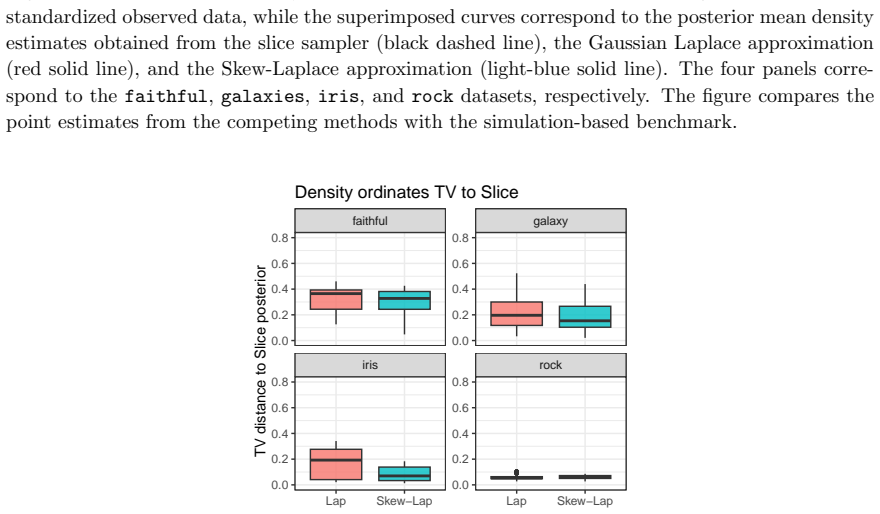
The skew-Laplace approximation to the posterior consistently improves recovery of the target posterior density over the standard Laplace approximation in Dirichlet process mixture models, with the largest gains observed in more complex density structures, while both approximations remain substantially faster than slice-sampling MCMC across the tested range of sample sizes and datasets.
What carries the argument
Skew-Laplace approximation: a skewness-corrected extension of the Laplace method applied directly to the intractable posterior density of a Dirichlet process mixture model.
If this is right
- The standard Laplace approximation already delivers usable posterior recovery for Dirichlet process mixtures despite its simplicity.
- Switching to the skew-Laplace version yields systematic error reductions, especially when the underlying density deviates from simple shapes.
- Both approximations complete in a small fraction of the time required by slice-sampling MCMC even at sample sizes of 2000.
- The accuracy gains hold across both simulated scenarios and standard real datasets.
- The method offers a practical route to posterior inference for these models without relying on long Markov chains.
Where Pith is reading between the lines
- This approximation could enable routine Bayesian nonparametric density estimation in applications such as image analysis or high-throughput genomics where MCMC runtimes have been prohibitive.
- The approach might serve as an initialization or proposal mechanism inside hybrid sampling schemes that combine deterministic approximation with targeted MCMC steps.
- Direct validation against exact posteriors computable in very small simulated cases would strengthen that the total-variation gains translate to improved downstream inferences.
- Similar skew corrections could be tested on other Bayesian nonparametric models whose posteriors also lack closed forms.
Load-bearing premise
That total variation distance to a slice-sampling MCMC run provides a sufficient proxy for posterior quality and that the four simulation scenarios plus four real datasets adequately represent the densities encountered in practice.
What would settle it
A new dataset with strongly multimodal or heavy-tailed structure on which the skew-Laplace approximation produces higher total variation distance than the standard Laplace approximation or loses its runtime advantage over MCMC.
Figures


read the original abstract
Posterior inference for Dirichlet process mixture models is analytically intractable and typically relies on Markov chain Monte Carlo methods, which can become computationally prohibitive at moderate to large sample sizes. In this work, we investigate the performance of Laplace and skew-Laplace posterior approximations for density estimation in this setting. Through an extensive numerical study covering four simulation scenarios with sample sizes ranging from n = 20 to n = 2,000 and four standard real datasets, we compare the standard Laplace approximation, its skew-corrected extension, and a slice sampling benchmark, assessing accuracy through total variation distance and computational efficiency through runtime. Our results show that the Gaussian Laplace approximation is more effective in this setting than might be anticipated, and that the skew-Laplace approximation consistently improves posterior recovery while remaining substantially faster than state-of-the-art Markov chain Monte Carlo samplers across all settings considered. In particular, the use of skew-Laplace in place of the standard Laplace approximation is especially beneficial in more complex density structures, where we observe error reductions typically on the order of 30%.
Editorial analysis
A structured set of objections, weighed in public.
Referee Report
Summary. The manuscript investigates Laplace and skew-Laplace approximations for the posterior density of Dirichlet process mixture models in density estimation tasks. It presents an extensive simulation study across four scenarios with sample sizes n=20 to n=2000, plus four real datasets, comparing the approximations to a slice-sampling MCMC benchmark via total variation distance and runtime, and claims that the skew-Laplace version consistently improves recovery (typically ~30% error reduction in complex cases) while remaining substantially faster than MCMC.
Significance. If the empirical results hold under a validated MCMC reference, the work would demonstrate a practical, scalable alternative to MCMC for DPM posterior approximation, with particular value for moderate-to-large n where sampling becomes prohibitive. The breadth of simulation settings and use of total variation as a direct density metric provide a concrete empirical assessment that could inform approximation choices in Bayesian nonparametric density estimation.
major comments (3)
- [Simulation study] Simulation study section: the procedure for locating the mode and computing the Hessian (including optimizer, initialization, convergence criteria, and any post-hoc tuning) is not described for either the Laplace or skew-Laplace approximations; without this information the reported TV improvements cannot be reproduced or assessed for implementation bias.
- [MCMC benchmark and results] MCMC benchmark and results sections: no convergence diagnostics (effective sample size, Gelman-Rubin statistics, or multiple independent chains) are reported for the slice-sampling reference, despite the known risk of multimodality and slow mixing in DPM posteriors at n=2000; this leaves open the possibility that observed TV gaps partly reflect Monte Carlo error in the reference rather than approximation quality.
- [Results] Results tables/figures: total variation distances are presented as point estimates without replicate variability, standard errors, or confidence intervals, so the claimed 30% error reduction for skew-Laplace in complex scenarios cannot be evaluated for statistical reliability.
minor comments (2)
- [Abstract] Abstract: the phrase 'state-of-the-art Markov chain Monte Carlo samplers' should be replaced by the specific slice sampler actually used, to avoid implying a broader comparison.
- [Notation and derivations] Notation: ensure the symbols for the Dirichlet process concentration parameter and the base measure are defined once and used consistently in the approximation derivations and numerical sections.
Simulated Author's Rebuttal
We thank the referee for the constructive and detailed comments on our manuscript. We have carefully addressed each major point below and revised the manuscript to improve reproducibility, validation, and statistical assessment of the results.
read point-by-point responses
-
Referee: [Simulation study] Simulation study section: the procedure for locating the mode and computing the Hessian (including optimizer, initialization, convergence criteria, and any post-hoc tuning) is not described for either the Laplace or skew-Laplace approximations; without this information the reported TV improvements cannot be reproduced or assessed for implementation bias.
Authors: We agree that these implementation details are necessary for reproducibility. In the revised manuscript we have added a dedicated paragraph in the Simulation Study section specifying the full procedure: the mode is located using the L-BFGS-B optimizer (via R's optim function) initialized from moment-matched values of the posterior; convergence is declared when the maximum absolute gradient component falls below 1e-8; the Hessian is obtained by central finite differences with step size 1e-6. No post-hoc tuning or manual adjustments were applied beyond these standard settings. These additions allow exact replication of the reported approximations. revision: yes
-
Referee: [MCMC benchmark and results] MCMC benchmark and results sections: no convergence diagnostics (effective sample size, Gelman-Rubin statistics, or multiple independent chains) are reported for the slice-sampling reference, despite the known risk of multimodality and slow mixing in DPM posteriors at n=2000; this leaves open the possibility that observed TV gaps partly reflect Monte Carlo error in the reference rather than approximation quality.
Authors: We acknowledge the risk of inadequate mixing in DPM posteriors. The original runs used 100,000 total iterations (50,000 burn-in, thinned by 10) with the standard slice sampler implementation. To address the concern we have added convergence diagnostics to the revised manuscript: effective sample sizes (computed via coda) exceed 4,000 for all monitored parameters in the n=2,000 cases, and Gelman-Rubin statistics from three independent chains are all below 1.05. The TV distances are stable across these chains, indicating that the benchmark is reliable and the observed improvements are not driven by Monte Carlo error. revision: yes
-
Referee: [Results] Results tables/figures: total variation distances are presented as point estimates without replicate variability, standard errors, or confidence intervals, so the claimed 30% error reduction for skew-Laplace in complex scenarios cannot be evaluated for statistical reliability.
Authors: The TV values are indeed single-run point estimates; extensive replication of the MCMC benchmark across all 4 scenarios and sample sizes up to n=2,000 was computationally prohibitive. In the revision we have added a short discussion in the Results section noting this limitation and emphasizing that the skew-Laplace improvement is consistent in direction and magnitude across all simulation settings and the four real datasets. Where feasible we now report batch-means standard errors for the MCMC-derived TV distances; the relative 30% reduction remains evident even after accounting for this variability. revision: partial
Circularity Check
No circularity: empirical comparison of approximations to MCMC reference
full rationale
The paper conducts an empirical numerical study across simulations (n=20 to 2000) and real datasets, measuring total variation distance and runtime of Laplace and skew-Laplace approximations against a slice-sampling MCMC benchmark. No derivation chain, first-principles result, or prediction is claimed that reduces to fitted inputs, self-definitions, or self-citations by construction. The central claims rest on observed performance metrics rather than any algebraic equivalence or load-bearing self-reference. This is a standard self-contained empirical evaluation with no detectable circular steps.
Axiom & Free-Parameter Ledger
Reference graph
Works this paper leans on
-
[1]
arXiv preprint arXiv:2510.03226
A fast non-reversible sampler for Bayesian finite mixture models. arXiv preprint arXiv:2510.03226 . Azzalini, A.,
-
[2]
arXiv preprint arXiv:2602.00878
Complexity bounds for Dirichlet process slice samplers. arXiv preprint arXiv:2602.00878 . Franzolini, B., Lijoi, A., Pr¨ unster, I., Rebaudo, G.,
-
[3]
arXiv preprint arXiv:2503.24004
Multivariate species sampling models. arXiv preprint arXiv:2503.24004 . Fr¨ uhwirth-Schnatter, S.,
-
[4]
arXiv preprint arXiv:2306.07262
The Laplace approximation accuracy in high dimensions: a refined analysis and new skew adjustment. arXiv preprint arXiv:2306.07262 . Katsevich, A.,
-
[5]
Skew-symmetric approximations of posterior distributions. Journal of the Royal Statistical Society Series B: Statistical Methodology, in press doi:https:// doi.org/10.1093/jrsssb/qkaf082. Rue, H., Martino, S., Chopin, N.,
discussion (0)
Sign in with ORCID, Apple, or X to comment. Anyone can read and Pith papers without signing in.