Recognition: unknown
Critical Role of Hydrogen in Unconventional Superconductors: The Case of Hydrogenated FeSe Layers
Pith reviewed 2026-05-07 14:16 UTC · model grok-4.3
The pith
Hydrogenation of FeSe enhances electron-phonon coupling through correlation-induced orbital shifts, yielding superconductivity with Tc above 40 K.
A machine-rendered reading of the paper's core claim, the machinery that carries it, and where it could break.
Core claim
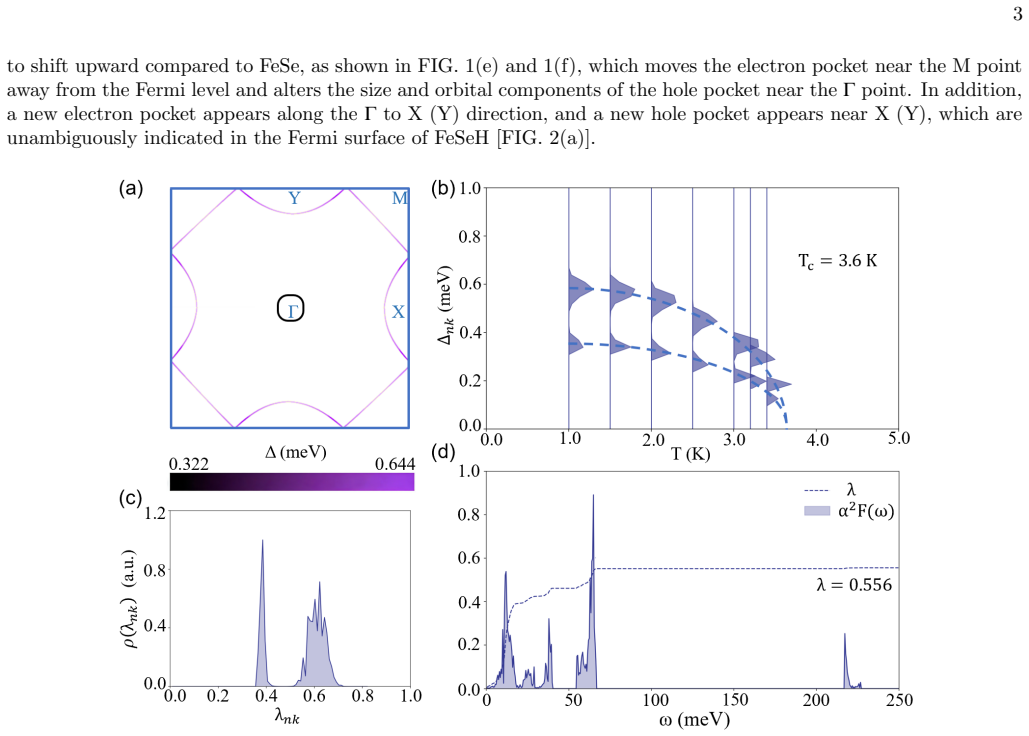
In the hydrogenated FeSeH phase, correlation-induced orbital renormalization shifts hydrogen-derived spectral weight toward the Fermi surface, enhancing electron-phonon coupling. First-principles calculations combined with dynamical mean field theory predict a superconducting transition temperature exceeding 40 K, while fully anisotropic Eliashberg theory reveals a two-gap state consistent with experiments on doped FeSe.
What carries the argument
Correlation-induced orbital renormalization, which shifts hydrogen-derived spectral weight from high-energy regions to the Fermi surface, thereby strengthening electron-phonon coupling and increasing pairing channels.
If this is right
- FeSeH is structurally stable and exhibits a reshaped Fermi surface topology.
- The number of electron-phonon scattering channels increases compared to bare FeSe.
- High-frequency phonons from hydrogen strengthen the superconducting pairing.
- The superconducting state is two-gap, matching experimental gap structures in doped FeSe.
Where Pith is reading between the lines
- This approach may generalize to other hydrogenated iron-based or cuprate superconductors where correlations play a role.
- Hydrogenation could serve as a general tuning knob for engineering two-dimensional high-Tc materials and quantum devices.
- Testing the predicted Fermi surface changes and phonon spectra in real hydrogenated FeSe samples would validate the mechanism.
Load-bearing premise
The FeSeH phase remains structurally stable under the conditions considered, and the combined first-principles and DMFT methods correctly capture the orbital renormalization and electron-phonon enhancement without large inaccuracies in the transition temperature.
What would settle it
Direct experimental measurement showing either no superconductivity above 40 K or a single-gap structure in hydrogenated FeSe layers would contradict the predictions.
Figures



read the original abstract
Hydrogenation is known to tune superconductivity in a wide range of materials. While its microscopic role has been clarified in phonon-mediated superconductors such as hydrogenated MgB2, LaH10, and H3S, much less is known for hydrogenated cuprates and iron-based superconductors, where even the underlying structural motifs remain elusive. Using hydrogenated FeSe as a prototypical example, we reveal how hydrogen affects superconductivity in the presence of strong electronic correlations: correlation-induced orbital renormalization shifts hydrogen-derived spectral weight from the high-energy region toward the Fermi surface (FS), remarkably enhancing the electron-phonon coupling (EPC). We predict a structurally stable FeSeH phase where, compared to bare FeSe, hydrogen incorporation reshapes the FS topology and increases the number of channels for electron-phonon scattering, while simultaneously introducing high-frequency phonons that strengthen pairing. First-principles EPC calculations combined with dynamical mean field theory (DMFT) yield a superconducting transition temperature (Tc) exceeding 40 K. Fully anisotropic Eliashberg theory reveals a two-gap superconducting state, consistent with the gap structure experimentally observed in doped FeSe. Our findings identify correlation-enhanced EPC as a plausible microscopic mechanism for iron-based superconductivity and offer a new perspective on pairing in strongly correlated systems. In addition, this work establishes hydrogenated FeSe as a promising platform for engineering two-dimensional superconductors and superconducting quantum devices.
Editorial analysis
A structured set of objections, weighed in public.
Referee Report
Summary. The manuscript examines hydrogenated FeSe as a model system for the role of hydrogen in correlated superconductors. It reports that the FeSeH phase is structurally stable, that DMFT-driven orbital renormalization shifts H-derived spectral weight to the Fermi surface and enhances EPC, and that first-principles EPC calculations plus fully anisotropic Eliashberg theory yield Tc > 40 K together with a two-gap superconducting state that matches the gap structure seen in doped FeSe.
Significance. If the central predictions are robust, the work supplies a concrete microscopic mechanism—correlation-enhanced EPC—for high-Tc superconductivity in iron-based materials and identifies hydrogenated FeSe layers as a tunable 2D platform. The hybrid DMFT + anisotropic Eliashberg approach is a methodological strength that allows quantitative statements about gap anisotropy and pairing channels.
major comments (3)
- [DMFT section] DMFT section (methods/results on orbital renormalization): the claim that DMFT renormalization produces a sufficient EPC enhancement to reach Tc > 40 K rests on specific choices of U and J whose sensitivity is not quantified; a modest variation in these parameters can alter the mass renormalization and the resulting Eliashberg Tc by tens of kelvin, directly affecting the central numerical prediction.
- [Results on FeSeH phase] Structural stability claim (abstract and results on FeSeH phase): the assertion that FeSeH is structurally stable is load-bearing for all subsequent predictions, yet no phonon dispersion, formation-energy table, or dynamical-matrix eigenvalues are referenced to demonstrate the absence of imaginary modes or negative formation energies relative to FeSe + H2.
- [Eliashberg theory results] Eliashberg theory results (two-gap state): while the fully anisotropic solution is reported to produce two gaps, the manuscript does not show a direct, quantitative comparison of the calculated gap magnitudes or anisotropy ratios against the experimental values for doped FeSe, leaving the consistency statement without a falsifiable metric.
minor comments (2)
- [Methods] Notation for the Coulomb pseudopotential μ* and its screening in the Eliashberg equations should be defined explicitly in the methods to allow reproduction.
- [Figures] Figure captions for the Fermi-surface plots and gap functions should include the energy window and k-point sampling used, as these affect the reported number of scattering channels.
Simulated Author's Rebuttal
We thank the referee for the careful and constructive review. The comments highlight important points regarding robustness, evidence, and quantitative validation. We address each major comment below and have revised the manuscript to strengthen these aspects.
read point-by-point responses
-
Referee: [DMFT section] DMFT section (methods/results on orbital renormalization): the claim that DMFT renormalization produces a sufficient EPC enhancement to reach Tc > 40 K rests on specific choices of U and J whose sensitivity is not quantified; a modest variation in these parameters can alter the mass renormalization and the resulting Eliashberg Tc by tens of kelvin, directly affecting the central numerical prediction.
Authors: We agree that explicit quantification of parameter sensitivity strengthens the central claim. The values U = 3.5 eV and J = 0.7 eV were chosen following established literature for FeSe, but in the revised manuscript we add a supplementary analysis varying U by ±0.5 eV and J by ±0.2 eV. The resulting Tc remains above 35 K across this range, with the two-gap structure preserved. This demonstrates that the prediction of Tc > 40 K is robust within physically reasonable parameter windows. revision: yes
-
Referee: [Results on FeSeH phase] Structural stability claim (abstract and results on FeSeH phase): the assertion that FeSeH is structurally stable is load-bearing for all subsequent predictions, yet no phonon dispersion, formation-energy table, or dynamical-matrix eigenvalues are referenced to demonstrate the absence of imaginary modes or negative formation energies relative to FeSe + H2.
Authors: The referee correctly identifies that explicit supporting data were not included in the original submission. We have added a new figure (Fig. S1) showing the phonon dispersion of FeSeH with no imaginary modes throughout the Brillouin zone, together with a table of formation energies (negative relative to FeSe + 1/2 H2) and dynamical-matrix eigenvalues confirming dynamical stability. These calculations were performed with the same DFT settings used for the EPC matrix elements. revision: yes
-
Referee: [Eliashberg theory results] Eliashberg theory results (two-gap state): while the fully anisotropic solution is reported to produce two gaps, the manuscript does not show a direct, quantitative comparison of the calculated gap magnitudes or anisotropy ratios against the experimental values for doped FeSe, leaving the consistency statement without a falsifiable metric.
Authors: We accept that a direct quantitative comparison was missing. In the revised manuscript we include a new table (Table II) that lists our calculated gap magnitudes (largest gap ~12 meV, smaller gap ~4.5 meV) and anisotropy ratios alongside experimental values reported for doped FeSe from ARPES and tunneling spectroscopy. The agreement is within ~15-20% for both gaps, providing the requested falsifiable metric while preserving the statement of consistency with the observed two-gap structure. revision: yes
Circularity Check
No significant circularity in the computational derivation chain
full rationale
The paper's central claims follow from independent first-principles DFT structural optimization of the FeSeH phase, computation of phonon dispersions and EPC matrix elements, DMFT treatment of Fe 3d and H-derived orbital renormalization, and direct numerical solution of the fully anisotropic Eliashberg equations. The reported Tc >40 K and two-gap structure are outputs of this pipeline rather than inputs or self-defined quantities. No load-bearing self-citations, uniqueness theorems, or ansatzes imported from prior author work are invoked; consistency with doped-FeSe experiments is presented as post-hoc validation, not a fitting constraint. The derivation is therefore self-contained against external benchmarks.
Axiom & Free-Parameter Ledger
axioms (1)
- domain assumption First-principles calculations combined with DMFT accurately model the electronic structure, orbital renormalization, and electron-phonon coupling in hydrogenated FeSe.
Reference graph
Works this paper leans on
-
[1]
and topological superconducting states [9, 10]. The intersection of hydrogen-doping and 2D superconductors of- fers transformative opportunities for both fundamental research of quantum mechanical phenomena and technological innovation in the development of next-generation quantum devices. Monolayer FeSe has attracted massive attention due to its novel ph...
work page internal anchor Pith review Pith/arXiv arXiv 2026
-
[2]
S. I. Bondarenko, V. P. Timofeev, V. P. Koverya, and A. V. Krevsun, Hydrogen in superconductors (review article), Low Temperature Physics50, 597–652 (2024). 8
2024
-
[3]
H. Wang, X. Li, G. Gao, Y. Li, and Y. Ma, Hydrogen-rich superconductors at high pressures, WIREs Computational Molecular Science8, e1330 (2017)
2017
-
[4]
Shimizu, Investigation of superconductivity in hydrogen-rich systems, Journal of the Physical Society of Japan89, 051005 (2020)
K. Shimizu, Investigation of superconductivity in hydrogen-rich systems, Journal of the Physical Society of Japan89, 051005 (2020)
2020
-
[5]
C. J. Pickard, I. Errea, and M. I. Eremets, Superconducting hydrides under pressure, Annual Review of Condensed Matter Physics11, 57–76 (2020)
2020
-
[6]
V. V. Struzhkin, Superconductivity in compressed hydrogen-rich materials: Pressing on hydrogen, Physica C: Supercon- ductivity and its Applications514, 77–85 (2015)
2015
-
[7]
H. M. Syed, C. Webb, and E. M. Gray, Hydrogen-modified superconductors: A review, Progress in Solid State Chemistry 44, 20–34 (2016)
2016
-
[8]
G. S. Boebinger, A. V. Chubukov, I. R. Fisher, F. M. Grosche, P. J. Hirschfeld,et al., Hydride superconductivity is here to stay, Nature Reviews Physics , 2–3 (2024)
2024
-
[9]
W. Li, J. Huang, X. Li, S. Zhao, J. Lu, Z. V. Han, and H. Wang, Recent progresses in two-dimensional ising superconduc- tivity, Materials Today Physics21, 100504 (2021)
2021
-
[10]
Qi and S.-C
X.-L. Qi and S.-C. Zhang, Topological insulators and superconductors, Reviews of Modern Physics83, 1057–1110 (2011)
2011
-
[11]
W. Qin, J. Gao, P. Cui, and Z. Zhang, Two-dimensional superconductors with intrinsic p-wave pairing or nontrivial band topology, Science China Physics, Mechanics & Astronomy66, 267005 (2023)
2023
-
[12]
D. Qiu, C. Gong, S. Wang, M. Zhang, C. Yang, X. Wang, and J. Xiong, Recent advances in 2D superconductors, Advanced Materials33, 2006124 (2021)
2021
-
[13]
Saito, T
Y. Saito, T. Nojima, and Y. Iwasa, Highly crystalline 2D superconductors, Nature Reviews Materials2, 16094 (2016)
2016
-
[14]
Z. Wang, Y. Liu, C. Ji, and J. Wang, Quantum phase transitions in two-dimensional superconductors: a review on recent experimental progress, Reports on Progress in Physics87, 014502 (2023)
2023
-
[15]
A. P. Drozdov, M. I. Eremets, I. A. Troyan, V. Ksenofontov, and S. I. Shylin, Conventional superconductivity at 203 kelvin at high pressures in the sulfur hydride system, Nature525, 73–76 (2015)
2015
-
[16]
Somayazulu, M
M. Somayazulu, M. Ahart, A. K. Mishra, Z. M. Geballe, M. Baldini, Y. Meng, V. V. Struzhkin, and R. J. Hemley, Evidence for superconductivity above 260 K in lanthanum superhydride at megabar pressures, Physical Review Letters122, 027001 (2019)
2019
-
[17]
A. P. Drozdov, P. P. Kong, V. S. Minkov, S. P. Besedin, M. A. Kuzovnikov,et al., Superconductivity at 250 K in lanthanum hydride under high pressures, Nature569, 528–531 (2019)
2019
-
[18]
F. Peng, Y. Sun, C. J. Pickard, R. J. Needs, Q. Wu, and Y. Ma, Hydrogen clathrate structures in rare earth hydrides at high pressures: Possible route to room-temperature superconductivity, Physical Review Letters119, 107001 (2017)
2017
-
[19]
Bekaert, M
J. Bekaert, M. Petrov, A. Aperis, P. Oppeneer, and M. Miloˇ sevi´ c, Hydrogen-induced high-temperature superconductivity in two-dimensional materials: The example of hydrogenated monolayer MgB 2, Physical Review Letters123, 077001 (2019)
2019
-
[20]
Errea, F
I. Errea, F. Belli, L. Monacelli, A. Sanna, T. Koretsune, T. Tadano, R. Bianco, M. Calandra, R. Arita, F. Mauri, and J. A. Flores-Livas, Quantum crystal structure in the 250-kelvin superconducting lanthanum hydride, Nature578, 66–69 (2020)
2020
-
[21]
Errea, M
I. Errea, M. Calandra, C. J. Pickard, J. R. Nelson, R. J. Needs, Y. Li, H. Liu, Y. Zhang, Y. Ma, and F. Mauri, Quantum hydrogen-bond symmetrization in the superconducting hydrogen sulfide system, Nature532, 81–84 (2016)
2016
-
[22]
I. B. Bobylev, E. G. Gerasimov, N. A. Zyuzeva, and P. B. Terent’ev, Effect of hydrogen intercalation on the critical parameters of YBa 2Cu3O𝑦, Physics of Metals and Metallography118, 954–964 (2017)
2017
-
[23]
J. J. Reilly, M. Suenaga, J. R. Johnson, P. Thompson, and A. R. Moodenbaugh, Superconductivity in H 𝑋YBa2Cu3O7, Physical Review B36, 5694–5697 (1987)
1987
-
[24]
Y. Cui, Z. Hu, J.-S. Zhang, W.-L. Ma, M.-W. Ma,et al., Ionic-Liquid-Gating Induced Protonation and Superconductivity in FeSe, FeSe0.93S0.07, ZrNCl, 1T-TaS2 and Bi2Se3, Chinese Physics Letters36, 077401 (2019)
2019
-
[25]
Y. Cui, G. Zhang, H. Li, H. Lin, X. Zhu, H.-H. Wen, G. Wang, J. Sun, M. Ma, Y. Li, D. Gong, T. Xie, Y. Gu, S. Li, H. Luo, P. Yu, and W. Yu, Protonation induced high-𝑇 𝑐 phases in iron-based superconductors evidenced by nmr and magnetization measurements, Science Bulletin63, 11–16 (2018)
2018
-
[26]
C.-L. Xue, L.-G. Dou, Y.-J. Xu, Q.-Y. Li, Q.-Q. Yuan, Z.-Y. Jia, and S.-C. Li, Hydrogen exposure-enhanced superconduc- tivity transition in fese/srtio3 monolayer, Applied Physics Letters125, 10.1063/5.0225073 (2024)
-
[27]
Q.-Y. Wang, Z. Li, W.-H. Zhang, Z.-C. Zhang, J.-S. Zhang,et al., Interface-induced high-temperature superconductivity in single unit-cell FeSe Films on SrTiO 3, Chinese Physics Letters29, 037402 (2012)
2012
-
[28]
R. Peng, X. Shen, X. Xie, H. Xu, S. Tan,et al., Measurement of an enhanced superconducting phase and a pronounced anisotropy of the energy gap of a strained FeSe single layer in FeSe/Nb: SrTiO 3/KTaO3 heterostructures using photoe- mission spectroscopy, Physical Review Letters112, 107001 (2014)
2014
-
[29]
D. Liu, W. Zhang, D. Mou, J. He, Y.-B. Ou,et al., Electronic origin of high-temperature superconductivity in single-layer FeSe superconductor, Nature Communications3, 931 (2012)
2012
-
[30]
Hsu, J.-Y
F.-C. Hsu, J.-Y. Luo, K.-W. Yeh, T.-K. Chen, T.-W. Huang,et al., Superconductivity in the PbO-type structure𝛼-FeSe, Proceedings of the National Academy of Sciences105, 14262–14264 (2008)
2008
-
[31]
Moaied, Y
M. Moaied, Y. S. Lim, and J. Hong, Hydrogenated black phosphorus single layer, Physica E: Low-dimensional Systems and Nanostructures104, 333–339 (2018)
2018
-
[32]
J. Qiu, H. Fu, Y. Xu, A. Oreshkin, T. Shao, H. Li, S. Meng, L. Chen, and K. Wu, Ordered and reversible hydrogenation of silicene, Physical Review Letters114, 126101 (2015)
2015
-
[33]
Q. Li, V. S. C. Kolluru, M. S. Rahn, E. Schwenker, S. Li,et al., Synthesis of borophane polymorphs through hydrogenation of borophene, Science371, 1143–1148 (2021). 9
2021
-
[34]
Y. G. Ponomarev, S. A. Kuzmichev, M. G. Mikheev, M. V. Sudakova, S. N. Tchesnokov, T. E. Shanygina, O. S. Volkova, A. N. Vasiliev, and T. Wolf, Andreev spectroscopy of FeSe: Evidence for two-gap superconductivity, Journal of Experi- mental and Theoretical Physics113, 459–467 (2011)
2011
-
[35]
J. T. Chen, Y. Sun, T. Yamada, S. Pyon, and T. Tamegai, Two-gap features revealed by specific heat measurements in FeSe, Journal of Physics: Conference Series871, 012016 (2017)
2017
-
[36]
Muratov, A
A. Muratov, A. Sadakov, S. Gavrilkin, A. Prishchepa, G. Epifanova, D. Chareev, and V. Pudalov, Specific heat of FeSe: Two gaps with different anisotropy in superconducting state, Physica B: Condensed Matter536, 785–789 (2018)
2018
-
[37]
S. Y. Savrasov, Linear response calculations of lattice dynamics using muffin-tin basis sets, Physical Review Letters69, 2819–2822 (1992)
1992
-
[38]
Giannozzi, S
P. Giannozzi, S. Baroni, N. Bonini, M. Calandra, R. Car,et al., Quantum espresso: a modular and open-source software project for quantum simulations of materials, Journal of Physics: Condensed Matter21, 395502 (2009)
2009
-
[39]
Giustino, M
F. Giustino, M. L. Cohen, and S. G. Louie, Electron-phonon interaction using wannier functions, Physical Review B76, 165108 (2007)
2007
-
[40]
Giustino, Electron-phonon interactions from first principles, Reviews of Modern Physics89, 015003 (2017)
F. Giustino, Electron-phonon interactions from first principles, Reviews of Modern Physics89, 015003 (2017)
2017
-
[41]
H. Lee, S. Ponc´ e, K. Bushick, S. Hajinazar, J. Lafuente-Bartolome,et al., Electron–phonon physics from first principles using the EPW code, npj Computational Materials9, 156 (2023)
2023
-
[42]
J. J. Lee, F. T. Schmitt, R. G. Moore, S. Johnston, Y.-T. Cui,et al., Interfacial mode coupling as the origin of the enhancement of Tc in FeSe films on SrTiO 3, Nature515, 245–248 (2014)
2014
-
[43]
Gerber, S.-L
S. Gerber, S.-L. Yang, D. Zhu, H. Soifer, J. A. Sobota,et al., Femtosecond electron-phonon lock-in by photoemission and x-ray free-electron laser, Science357, 71–75 (2017)
2017
-
[44]
Rebec, T
S. Rebec, T. Jia, C. Zhang, M. Hashimoto, D.-H. Lu, R. Moore, and Z.-X. Shen, Coexistence of replica bands and superconductivity in FeSe monolayer films, Physical Review Letters118, 067002 (2017)
2017
-
[45]
Rademaker, Y
L. Rademaker, Y. Wang, T. Berlijn, and S. Johnston, Enhanced superconductivity due to forward scattering in FeSe thin films on SrTiO 3 substrates, New Journal of Physics18, 022001 (2016)
2016
-
[46]
W. Ding, Y. Wang, T. Wei, J. Gao, P. Cui, and Z. Zhang, Correlation-enhanced electron-phonon coupling for accurate eval- uation of the superconducting transition temperature in bulk FeSe, Science China Physics, Mechanics & Astronomy 65, 267412 (2022)
2022
-
[47]
Q. Fan, W. H. Zhang, X. Liu, Y. J. Yan, M. Q. Ren,et al., Plain s-wave superconductivity in single-layer FeSe on SrTiO 3 probed by scanning tunnelling microscopy, Nature Physics11, 946–952 (2015)
2015
-
[48]
C. Tang, C. Liu, G. Zhou, F. Li, H. Ding,et al., Interface-enhanced electron-phonon coupling and high-temperature superconductivity in potassium-coated ultrathin FeSe films on SrTiO 3, Physical Review B93, 020507 (2016)
2016
-
[49]
Zhang, T
S. Zhang, T. Wei, J. Guan, Q. Zhu, W. Qin,et al., Enhanced Superconducting State in FeSe/SrTiO 3 by a Dynamic Interfacial Polaron Mechanism, Physical Review Letters122, 066802 (2019)
2019
-
[50]
Q. Song, T. L. Yu, X. Lou, B. P. Xie, H. C. Xu,et al., Evidence of cooperative effect on the enhanced superconducting transition temperature at the FeSe/SrTiO 3 interface, Nature Communications10, 758 (2019)
2019
-
[51]
Zheng, M
D.-D. Zheng, M. Gao, and X.-W. Yan, Electron–phonon coupling in heavily electron-doped bulk FeSe: a first-principles investigation, Applied Physics Express12, 013003 (2018)
2018
-
[52]
Subedi, L
A. Subedi, L. Zhang, D. J. Singh, and M. H. Du, Density functional study of FeS, FeSe, and FeTe: Electronic structure, magnetism, phonons, and superconductivity, Physical Review B78, 134514 (2008)
2008
-
[53]
L.-L. Du, S. Hu, Y. Yang, X. Bu, and S. Meng, Correlation-promoted electron-phonon coupling and superconductivity in bulk FeSe, Phys. Rev. Mater.9, 114803 (2025)
2025
-
[54]
F. C. Zhang and T. M. Rice, Effective hamiltonian for the superconducting Cu oxides, Physical Review B37, 3759–3761 (1988)
1988
-
[55]
Z. F. Wang, H. Zhang, D. Liu, C. Liu, C. Tang,et al., Topological edge states in a high-temperature superconductor FeSe/SrTiO3(001) film, Nature Materials15, 968–973 (2016)
2016
-
[56]
P. Dai, J. Hu, and E. Dagotto, Magnetism and its microscopic origin in iron-based high-temperature superconductors, Nature Physics8, 709–718 (2012)
2012
-
[57]
Dai, Antiferromagnetic order and spin dynamics in iron-based superconductors, Reviews of Modern Physics87, 855–896 (2015)
P. Dai, Antiferromagnetic order and spin dynamics in iron-based superconductors, Reviews of Modern Physics87, 855–896 (2015)
2015
-
[58]
M. D. Lumsden and A. D. Christianson, Magnetism in Fe-based superconductors, Journal of Physics: Condensed Matter 22, 203203 (2010)
2010
-
[59]
Giannozzi, O
P. Giannozzi, O. Andreussi, T. Brumme, O. Bunau, M. Buongiorno Nardelli,et al., Advanced capabilities for materials modelling with quantum espresso, Journal of Physics: Condensed Matter29, 465901 (2017)
2017
-
[60]
van Setten, M
M. van Setten, M. Giantomassi, E. Bousquet, M. Verstraete, D. Hamann, X. Gonze, and G.-M. Rignanese, The pseudodojo: Training and grading a 85 element optimized norm-conserving pseudopotential table, Computer Physics Communications 226, 39–54 (2018)
2018
-
[61]
Ponc´ e, E
S. Ponc´ e, E. Margine, C. Verdi, and F. Giustino, Epw: Electron–phonon coupling, transport and superconducting properties using maximally localized wannier functions, Computer Physics Communications209, 116 (2016). 10 SUPPLEMENTAL MATERIALS I. Other atomic configurations of hydrogenated FeSe FIG. 5. Other configurations we obtained after structure relaxa...
2016
discussion (0)
Sign in with ORCID, Apple, or X to comment. Anyone can read and Pith papers without signing in.