Recognition: unknown
Jarvis-HEP: A lightweight Python framework for workflow composition and parameter scans in high-energy physics
Pith reviewed 2026-05-07 15:59 UTC · model grok-4.3
The pith
Jarvis-HEP is a lightweight Python framework that composes workflows and runs parameter scans in high-energy physics using YAML specifications.
A machine-rendered reading of the paper's core claim, the machinery that carries it, and where it could break.
Core claim
The paper claims that a single lightweight Python package can unify workflow specification, dependency tracking, modular calculator integration, and asynchronous scheduling, while adding several sampling methods, so that external HEP tools and custom components run together in reproducible multi-step calculations.
What carries the argument
YAML-based workflow specification with dependency-aware execution that orchestrates modular calculators and sampling backends.
If this is right
- Users define multi-tool studies declaratively in configuration files instead of writing custom glue code for each connection.
- Built-in sampling backends enable immediate parameter-space exploration without separate scan scripts.
- External software packages and internal components coexist in one dependency-managed workflow.
- Asynchronous scheduling runs independent tasks in parallel, reducing wall-clock time for scans.
Where Pith is reading between the lines
- Standardized YAML workflow files could allow research groups to share complete analysis pipelines more easily than before.
- Enforced dependency tracking may reduce common errors when linking different physics calculators.
- The framework's value would be clearest in large scans where manual orchestration becomes error-prone.
Load-bearing premise
The described YAML specification, dependency handling, and sampling features will connect cleanly to real external high-energy physics packages and run with acceptable performance in practice.
What would settle it
A test workflow that links Jarvis-HEP to standard tools such as MadGraph or Pythia and encounters unresolved dependencies or slow execution would show the integration claim does not hold.
Figures


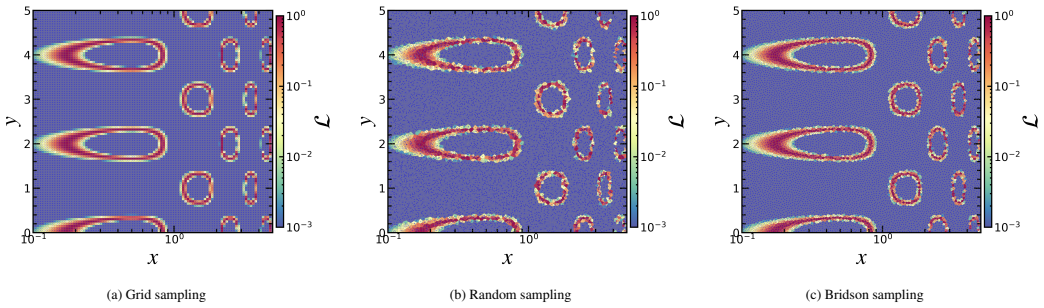
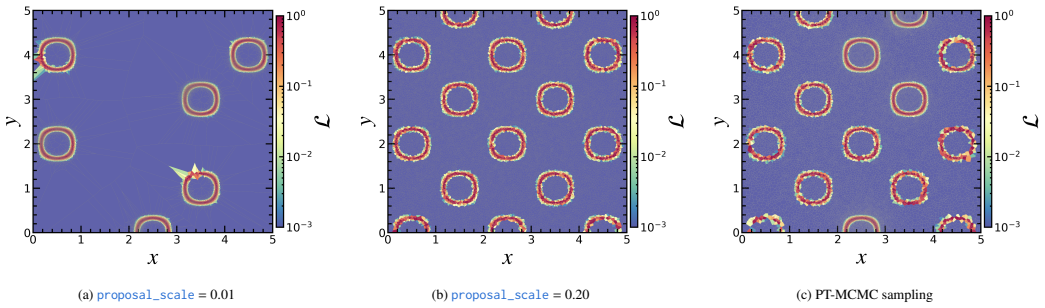


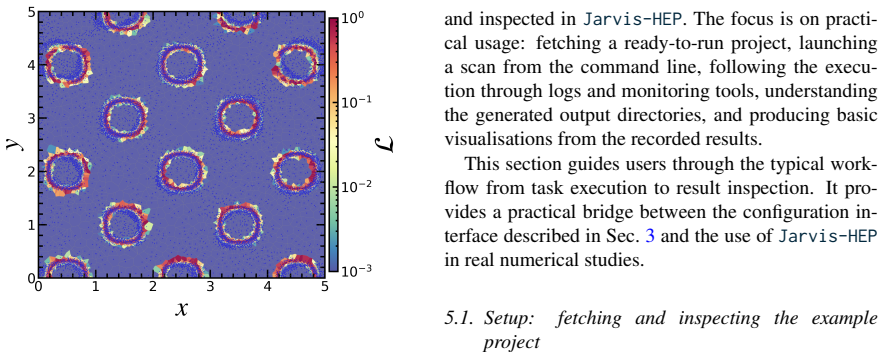

read the original abstract
High-energy physics phenomenology often requires linking multiple computational tools to evaluate observables, likelihoods, and experimental constraints across nontrivial parameter spaces. In this work, we introduce Jarvis-HEP, a lightweight Python framework for workflow composition and parameter scans in high-energy physics. The framework provides YAML-based workflow specification, dependency-aware execution, modular calculator integration, and asynchronous task scheduling for multi-step computational studies. It supports both external software packages and internally implemented components within a unified workflow, and the current implementation includes several built-in sampling backends for exploratory scans. This paper describes the design and user interface of Jarvis-HEP and illustrates its use with representative synthetic and phenomenological examples.
Editorial analysis
A structured set of objections, weighed in public.
Referee Report
Summary. The paper introduces Jarvis-HEP, a lightweight Python framework for workflow composition and parameter scans in high-energy physics. It provides YAML-based workflow specification, dependency-aware execution, modular calculator integration, and asynchronous task scheduling. The framework supports both external software packages and internal components, includes built-in sampling backends, and is illustrated with synthetic and phenomenological examples.
Significance. If the architecture delivers the claimed integration and performance without hidden friction, Jarvis-HEP could serve as a practical, specialized tool for HEP phenomenologists managing multi-tool workflows and parameter explorations, reducing reliance on ad-hoc scripting. The unified handling of external and internal components is a notable design choice that, if validated, would distinguish it from general workflow managers.
major comments (2)
- [Examples section] The examples section: all provided illustrations use only synthetic or internal components; no concrete demonstration of integration with real external HEP packages (e.g., MadGraph, Pythia, or likelihood tools) is shown, leaving the central claim that the framework 'supports both external software packages and internally implemented components within a unified workflow' unverified.
- [Implementation / Features] No section on benchmarks or validation: the manuscript contains no timing data, failure-rate measurements, scalability tests, or side-by-side comparisons against manual scripting or existing tools, which is load-bearing for the assertions of 'usable performance' and 'lightweight' operation for multi-step studies.
minor comments (2)
- [Abstract] The abstract states that 'several built-in sampling backends' are included but does not name or briefly describe them; this information should appear in the main text or a dedicated table for immediate clarity.
- [Introduction / Conclusions] A public code repository link or installation instructions are not mentioned in the provided text; for a software framework paper this is standard and should be added.
Simulated Author's Rebuttal
We thank the referee for the detailed review and constructive suggestions. We appreciate the opportunity to clarify and strengthen the manuscript. Below we respond to the major comments and indicate the planned revisions.
read point-by-point responses
-
Referee: [Examples section] The examples section: all provided illustrations use only synthetic or internal components; no concrete demonstration of integration with real external HEP packages (e.g., MadGraph, Pythia, or likelihood tools) is shown, leaving the central claim that the framework 'supports both external software packages and internally implemented components within a unified workflow' unverified.
Authors: We agree that demonstrating integration with actual external HEP packages would better substantiate the framework's capabilities. The current examples were chosen for self-containment and to focus on the workflow mechanics. The design includes support for external tools via subprocess calls and Python interfaces, as described in the implementation section. In the revised version, we will incorporate an additional example that integrates with a real external package, such as a wrapper for a simple MadGraph simulation or a likelihood tool, to explicitly verify the unified handling of external and internal components. revision: yes
-
Referee: [Implementation / Features] No section on benchmarks or validation: the manuscript contains no timing data, failure-rate measurements, scalability tests, or side-by-side comparisons against manual scripting or existing tools, which is load-bearing for the assertions of 'usable performance' and 'lightweight' operation for multi-step studies.
Authors: We acknowledge the value of empirical validation for the performance claims. The manuscript emphasizes the architectural design and user interface, supported by illustrative examples. To address this, we will add a dedicated section on validation and benchmarks in the revision. This will include timing measurements for workflow execution, error handling statistics from test cases, scalability tests with increasing task complexity, and comparisons to equivalent manual Python scripts for parameter scans. These additions will provide concrete evidence for the 'lightweight' and 'usable performance' aspects. revision: yes
Circularity Check
No circularity: software framework description with no derivations or fitted predictions
full rationale
The paper is a pure software description introducing Jarvis-HEP. It specifies YAML workflows, dependency handling, modular integration, and async scheduling, then illustrates usage with synthetic and phenomenological examples. No equations, parameter fits, predictions, or uniqueness theorems appear. All load-bearing claims are architectural statements supported by design description rather than any reduction to self-citation chains or input data. The absence of mathematical content makes every enumerated circularity pattern inapplicable by definition.
Axiom & Free-Parameter Ledger
Reference graph
Works this paper leans on
- [1]
- [3]
-
[4]
Staub, SARAH 4 : A tool for (not only SUSY) model builders, Comput
F. Staub, SARAH 4 : A tool for (not only SUSY) model builders, Comput. Phys. Com- mun. 185 (2014) 1773–1790.arXiv:1309. 7223,doi:10.1016/j.cpc.2014.02.018
-
[5]
Staub, SARAH 3.2: Dirac Gauginos, UFO output, and more, Comput
F. Staub, SARAH 3.2: Dirac Gauginos, UFO output, and more, Comput. Phys. Commun. 184 (2013) 1792–1809.arXiv:1207.0906,doi: 10.1016/j.cpc.2013.02.019
-
[6]
F. Staub, Automatic Calculation of supersym- metric Renormalization Group Equations and Self Energies, Comput. Phys. Commun. 182 (2011) 808–833.arXiv:1002.0840,doi:10. 1016/j.cpc.2010.11.030
-
[7]
Semenov, LanHEP: A Package for the au- tomatic generation of Feynman rules in field theory
A. Semenov, LanHEP: A Package for the au- tomatic generation of Feynman rules in field theory. Version 3.0, Comput. Phys. Commun. 180 (2009) 431–454.arXiv:0805.0555,doi: 10.1016/j.cpc.2008.10.012
-
[8]
Semenov, LanHEP — A package for au- tomatic generation of Feynman rules from the Lagrangian
A. Semenov, LanHEP — A package for au- tomatic generation of Feynman rules from the Lagrangian. Version 3.2, Comput. Phys. Com- mun. 201 (2016) 167–170.arXiv:1412.5016, doi:10.1016/j.cpc.2016.01.003
-
[10]
F. Mahmoudi, SuperIso v2.3: A Program for calculating flavor physics observables in Super- symmetry, Comput. Phys. Commun. 180 (2009) 1579–1613.arXiv:0808.3144,doi:10.1016/ j.cpc.2009.02.017
-
[11]
B. C. Allanach, SOFTSUSY: a program for calculating supersymmetric spectra, Comput. Phys. Commun. 143 (2002) 305–331.arXiv:hep-ph/0104145, doi:10.1016/S0010-4655(01)00460-X
-
[12]
A. Djouadi, J.-L. Kneur, G. Moultaka, SuSpect: A Fortran code for the supersymmetric and Higgs particle spectrum in the MSSM, Comput. Phys. Commun. 176 (2007) 426–455.arXiv: hep-ph/0211331,doi:10.1016/j.cpc.2006. 11.009
-
[13]
S. Heinemeyer, W. Hollik, G. Weiglein, Feyn- Higgs: A Program for the calculation of the masses of the neutral CP even Higgs bosons in the MSSM, Comput. Phys. Commun. 124 (2000) 76–89.arXiv:hep-ph/9812320,doi: 10.1016/S0010-4655(99)00364-1
-
[14]
W. Porod, SPheno, a program for calculating supersymmetric spectra, SUSY particle decays and SUSY particle production at e+e- collid- ers, Comput. Phys. Commun. 153 (2003) 275– 315.arXiv:hep-ph/0301101,doi:10.1016/ S0010-4655(03)00222-4
-
[15]
W. Porod, F. Staub, SPheno 3.1: Extensions including flavour, CP-phases and models be- yond the MSSM, Comput. Phys. Commun. 183 (2012) 2458–2469.arXiv:1104.1573,doi: 10.1016/j.cpc.2012.05.021
-
[16]
P. Athron, J.-h. Park, D. Stöckinger, A. V oigt, FlexibleSUSY—A spectrum generator genera- tor for supersymmetric models, Comput. Phys. Commun. 190 (2015) 139–172.arXiv:1406. 2319,doi:10.1016/j.cpc.2014.12.020
-
[17]
P. Athron, M. Bach, D. Harries, T. Kwasnitza, J.-h. Park, D. Stöckinger, A. V oigt, J. Ziebell, FlexibleSUSY 2.0: Extensions to investigate the phenomenology of SUSY and non-SUSY models, Comput. Phys. Commun. 230 (2018) 145–217.arXiv:1710.03760,doi:10.1016/ j.cpc.2018.04.016
-
[18]
2HDMC - Two-Higgs-Doublet Model Calculator
D. Eriksson, J. Rathsman, O. Stal, 2HDMC: Two-Higgs-Doublet Model Calculator Physics and Manual, Comput. Phys. Commun. 181 (2010) 189–205.arXiv:0902.0851,doi:10. 1016/j.cpc.2009.09.011
work page Pith review arXiv 2010
-
[19]
ScannerS: constraining the phase diagram of a complex scalar singlet at the LHC
R. Coimbra, M. O. P. Sampaio, R. Santos, Scan- nerS: Constraining the phase diagram of a com- plex scalar singlet at the LHC, Eur. Phys. J. C 73 (2013) 2428.arXiv:1301.2599,doi: 10.1140/epjc/s10052-013-2428-4
-
[20]
A. Djouadi, J. Kalinowski, M. Spira, HDE- CAY: A Program for Higgs boson decays in the standard model and its supersymmetric exten- sion, Comput. Phys. Commun. 108 (1998) 56– 74.arXiv:hep-ph/9704448,doi:10.1016/ S0010-4655(97)00123-9. 27
-
[21]
M. Muhlleitner, A. Djouadi, Y . Mambrini, SDE- CAY: A Fortran code for the decays of the su- persymmetric particles in the MSSM, Comput. Phys. Commun. 168 (2005) 46–70.arXiv: hep-ph/0311167,doi:10.1016/j.cpc.2005. 01.012
-
[22]
U. Ellwanger, J. F. Gunion, C. Hugonie, NMHDECAY: A Fortran code for the Higgs masses, couplings and decay widths in the NMSSM, JHEP 02 (2005) 066.arXiv: hep-ph/0406215,doi:10.1088/1126-6708/ 2005/02/066
-
[23]
U. Ellwanger, C. Hugonie, NMHDECAY 2.0: An Updated program for sparticle masses, Higgs masses, couplings and decay widths in the NMSSM, Comput. Phys. Commun. 175 (2006) 290–303.arXiv:hep-ph/0508022, doi:10.1016/j.cpc.2006.04.004
- [24]
-
[26]
A. Denner, J.-N. Lang, S. Uccirati, NLO electroweak corrections in extended Higgs Sectors with RECOLA2, JHEP 07 (2017) 087.arXiv:1705.06053,doi:10.1007/ JHEP07(2017)087
-
[27]
A. Denner, J.-N. Lang, S. Uccirati, Recola2: REcursive Computation of One-Loop Ampli- tudes 2, Comput. Phys. Commun. 224 (2018) 346–361.arXiv:1711.07388,doi:10.1016/ j.cpc.2017.11.013
-
[28]
D. Das, U. Ellwanger, A. M. Teixeira, NMSDE- CAY: A Fortran Code for Supersymmetric Par- ticle Decays in the Next-to-Minimal Supersym- metric Standard Model, Comput. Phys. Com- mun. 183 (2012) 774–779.arXiv:1106.5633, doi:10.1016/j.cpc.2011.11.021
-
[29]
W. Beenakker, R. Hopker, M. Spira, PROSPINO: A Program for the production of supersymmetric particles in next-to-leading or- der QCD (11 1996).arXiv:hep-ph/9611232
-
[31]
M. Bonvini, S. Marzani, J. Rojo, L. Rot- toli, M. Ubiali, R. D. Ball, V . Bertone, S. Carrazza, N. P. Hartland, Parton distribu- tions with threshold resummation, JHEP 09 (2015) 191.arXiv:1507.01006,doi:10. 1007/JHEP09(2015)191
-
[32]
A. Belyaev, N. D. Christensen, A. Pukhov, CalcHEP 3.4 for collider physics within and be- yond the Standard Model, Comput. Phys. Com- mun. 184 (2013) 1729–1769.arXiv:1207. 6082,doi:10.1016/j.cpc.2013.01.014
-
[33]
Kublbeck, M
J. Kublbeck, M. Bohm, A. Denner, Feyn Arts: Computer Algebraic Generation of Feynman Graphs and Amplitudes, Comput. Phys. Com- mun. 60 (1990) 165–180.doi:10.1016/ 0010-4655(90)90001-H
1990
-
[34]
Generating Feynman diagrams and amplitudes with FeynArts 3,
T. Hahn, Generating Feynman dia- grams and amplitudes with FeynArts 3, Comput. Phys. Commun. 140 (2001) 418–431.arXiv:hep-ph/0012260, doi:10.1016/S0010-4655(01)00290-9
-
[36]
A. Denner, S. Dittmaier, S. Kallweit, A. Mück, HAWK 2.0: A Monte Carlo program for Higgs production in vector-boson fusion and Higgs strahlung at hadron colliders, Comput. Phys. Commun. 195 (2015) 161–171.arXiv:1412. 5390,doi:10.1016/j.cpc.2015.04.021
- [37]
-
[38]
J. Gao, CIJET: A program for computation of jet cross sections induced by quark contact interac- tions at hadron colliders, Comput. Phys. Com- mun. 184 (2013) 2362–2366.arXiv:1301. 7263,doi:10.1016/j.cpc.2013.05.019
-
[39]
Camarda, et al., DYTurbo: Fast predictions for Drell-Yan processes, Eur
S. Camarda, et al., DYTurbo: Fast predictions for Drell-Yan processes, Eur. Phys. J. C 80 (3) (2020) 251, [Erratum: Eur.Phys.J.C 80, 440 (2020)].arXiv:1910.07049,doi:10.1140/ epjc/s10052-020-7757-5. 28
-
[42]
P. Athron, C. Balazs, A. Cherchiglia, D. H. J. Jacob, D. Stöckinger, H. Stöckinger-Kim, A. V oigt, Two-loop prediction of the anomalous magnetic moment of the muon in the Two-Higgs Doublet Model with GM2Calc 2, Eur. Phys. J. C 82 (3) (2022) 229.arXiv:2110.13238, doi:10.1140/epjc/s10052-022-10148-9
-
[43]
P. Athron, C. Balazs, A. Cherchiglia, D. H. J. Jacob, D. Stoeckinger, H. Stoeckinger-Kim, A. V oigt, GM2Calc - 2 for the 2HDM, PoS CompTools2021 (2022) 009.arXiv:2207. 09039,doi:10.22323/1.409.0009
-
[44]
M. Backovi ´c, A. Martini, O. Mattelaer, K. Kong, G. Mohlabeng, Direct Detection of Dark Matter with MadDM v.2.0, Phys. Dark Univ. 9-10 (2015) 37–50.arXiv:1505.04190, doi:10.1016/j.dark.2015.09.001
-
[45]
G. Alguero, G. Belanger, F. Boudjema, S. Chakraborti, A. Goudelis, S. Kraml, A. Mjal- lal, A. Pukhov, micrOMEGAs 6.0: N- component dark matter, Comput. Phys. Com- mun. 299 (2024) 109133.arXiv:2312.14894, doi:10.1016/j.cpc.2024.109133
-
[46]
Co-scattering in micrOMEGAs: a case study for the singlet-triplet dark matter model,
G. Alguero, G. Belanger, S. Kraml, A. Pukhov, Co-scattering in micrOMEGAs: A case study for the singlet-triplet dark matter model, SciPost Phys. 13 (2022) 124.arXiv:2207.10536,doi: 10.21468/SciPostPhys.13.6.124
-
[48]
T. Bringmann, J. Edsjö, P. Gondolo, P. Ul- lio, L. Bergström, DarkSUSY 6 : An Ad- vanced Tool to Compute Dark Matter Proper- ties Numerically, JCAP 07 (2018) 033.arXiv: 1802.03399,doi:10.1088/1475-7516/2018/ 07/033
-
[49]
P. Gondolo, J. Edsjo, P. Ullio, L. Bergstrom, M. Schelke, E. A. Baltz, DarkSUSY: Computing supersymmetric dark mat- ter properties numerically, JCAP 07 (2004) 008.arXiv:astro-ph/0406204, doi:10.1088/1475-7516/2004/07/008
- [50]
-
[51]
P. Bechtle, O. Brein, S. Heinemeyer, G. Wei- glein, K. E. Williams, HiggsBounds: Con- fronting Arbitrary Higgs Sectors with Exclu- sion Bounds from LEP and the Tevatron, Comput. Phys. Commun. 181 (2010) 138– 167.arXiv:0811.4169,doi:10.1016/j.cpc. 2009.09.003
-
[52]
P. Bechtle, O. Brein, S. Heinemeyer, G. Wei- glein, K. E. Williams, HiggsBounds 2.0.0: Con- fronting Neutral and Charged Higgs Sector Pre- dictions with Exclusion Bounds from LEP and the Tevatron, Comput. Phys. Commun. 182 (2011) 2605–2631.arXiv:1102.1898,doi: 10.1016/j.cpc.2011.07.015
-
[53]
P. Bechtle, O. Brein, S. Heinemeyer, O. Stal, T. Stefaniak, G. Weiglein, K. Williams, Recent Developments in HiggsBounds and a Preview of HiggsSignals, PoS CHARGED2012 (2012) 024.arXiv:1301.2345,doi:10.22323/1. 156.0024
work page doi:10.22323/1 2012
-
[54]
P. Bechtle, O. Brein, S. Heinemeyer, O. Stål, T. Stefaniak, G. Weiglein, K. E. Williams, HiggsBounds−4: Improved Tests of Extended Higgs Sectors against Exclusion Bounds from LEP, the Tevatron and the LHC, Eur. Phys. J. C 74 (3) (2014) 2693.arXiv:1311.0055,doi: 10.1140/epjc/s10052-013-2693-2
-
[56]
O. Stål, T. Stefaniak, Constraining extended Higgs sectors with HiggsSignals, PoS EPS- HEP2013 (2013) 314.arXiv:1310.4039,doi: 10.22323/1.180.0314
-
[57]
P. Bechtle, S. Heinemeyer, O. Stål, T. Stefaniak, G. Weiglein, Probing the Standard Model with Higgs signal rates from the Tevatron, the LHC and a future ILC, JHEP 11 (2014) 039.arXiv: 1403.1582,doi:10.1007/JHEP11(2014)039. 29
-
[60]
M. Wallraff, C. Wiebusch, Calculation of os- cillation probabilities of atmospheric neutrinos using nuCraft, Comput. Phys. Commun. 197 (2015) 185–189.arXiv:1409.1387,doi:10. 1016/j.cpc.2015.07.010
-
[61]
P. Stowell, et al., NUISANCE: a neu- trino cross-section generator tuning and com- parison framework, JINST 12 (01) (2017) P01016.arXiv:1612.07393,doi:10.1088/ 1748-0221/12/01/P01016
-
[64]
P. Basler, M. Mühlleitner, J. Müller, BSMPT v2 a tool for the electroweak phase transition and the baryon asymmetry of the universe in extended Higgs Sectors, Comput. Phys. Com- mun. 269 (2021) 108124.arXiv:2007.01725, doi:10.1016/j.cpc.2021.108124
- [65]
-
[66]
P. Athron, C. Balázs, A. Fowlie, Y . Zhang, PhaseTracer: tracing cosmological phases and calculating transition properties, Eur. Phys. J. C 80 (6) (2020) 567.arXiv:2003.02859,doi: 10.1140/epjc/s10052-020-8035-2
- [67]
-
[69]
J. E. Camargo-Molina, B. O’Leary, W. Porod, F. Staub,V evacious: A Tool For Finding The Global Minima Of One-Loop Effective Po- tentials With Many Scalars, Eur. Phys. J. C 73 (10) (2013) 2588.arXiv:1307.1477,doi: 10.1140/epjc/s10052-013-2588-2
-
[70]
J. Alwall, R. Frederix, S. Frixione, V . Hirschi, F. Maltoni, O. Mattelaer, H. S. Shao, T. Stelzer, P. Torrielli, M. Zaro, The automated com- putation of tree-level and next-to-leading or- der differential cross sections, and their match- ing to parton shower simulations, JHEP 07 (2014) 079.arXiv:1405.0301,doi:10.1007/ JHEP07(2014)079
work page internal anchor Pith review arXiv 2014
-
[71]
R. Frederix, S. Frixione, V . Hirschi, D. Pa- gani, H. S. Shao, M. Zaro, The automation of next-to-leading order electroweak calculations, JHEP 07 (2018) 185, [Erratum: JHEP 11, 085 (2021)].arXiv:1804.10017,doi:10.1007/ JHEP11(2021)085
-
[72]
T. Sjostrand, S. Mrenna, P. Z. Skands, PYTHIA 6.4 Physics and Manual, JHEP 05 (2006) 026.arXiv:hep-ph/0603175,doi:10.1088/ 1126-6708/2006/05/026
work page Pith review arXiv 2006
-
[73]
S. Frixione, F. Stoeckli, P. Torrielli, B. R. Web- ber, NLO QCD corrections in Herwig++with MC@NLO, JHEP 01 (2011) 053.arXiv:1010. 0568,doi:10.1007/JHEP01(2011)053
-
[74]
R. Frederix, S. Frixione, S. Prestel, P. Tor- rielli, On the reduction of negative weights in MC@NLO-type matching procedures, JHEP 07 (2020) 238.arXiv:2002.12716,doi:10. 1007/JHEP07(2020)238
- [75]
-
[76]
DELPHES 3, A modular framework for fast simulation of a generic collider experiment
J. de Favereau, C. Delaere, P. Demin, A. Gi- ammanco, V . Lemaître, A. Mertens, M. Sel- vaggi, DELPHES 3, A modular framework for fast simulation of a generic collider experiment, JHEP 02 (2014) 057.arXiv:1307.6346,doi: 10.1007/JHEP02(2014)057
work page internal anchor Pith review doi:10.1007/jhep02(2014)057 2014
- [77]
-
[78]
Collier: A fortran-based complex one-loop library in extended regularizations
A. Denner, S. Dittmaier, L. Hofer, Collier: a fortran-based Complex One-Loop LIbrary in Extended Regularizations, Comput. Phys. Com- mun. 212 (2017) 220–238.arXiv:1604.06792, doi:10.1016/j.cpc.2016.10.013
-
[79]
T. Sjöstrand, S. Ask, J. R. Christiansen, R. Corke, N. Desai, P. Ilten, S. Mrenna, S. Pres- tel, C. O. Rasmussen, P. Z. Skands, An intro- duction to PYTHIA 8.2, Comput. Phys. Com- mun. 191 (2015) 159–177.arXiv:1410.3012, doi:10.1016/j.cpc.2015.01.024
-
[80]
M. Dobbs, J. B. Hansen, The HepMC C++ Monte Carlo event record for High En- ergy Physics, Comput. Phys. Commun. 134 (2001) 41–46.doi:10.1016/S0010-4655(00) 00189-2
-
[82]
C. Bierlich, et al., Robust Independent Vali- dation of Experiment and Theory: Rivet ver- sion 3, SciPost Phys. 8 (2020) 026.arXiv: 1912.05451,doi:10.21468/SciPostPhys.8. 2.026
-
[83]
A. Buckley, J. Butterworth, D. Grellscheid, H. Hoeth, L. Lonnblad, J. Monk, H. Schulz, F. Siegert, Rivet user man- ual, Comput. Phys. Commun. 184 (2013) 2803–2819.arXiv:1003.0694, doi:10.1016/j.cpc.2013.05.021
-
[84]
Li, Q.-S
Q. Li, Q.-S. Yan, Initial State Radiation Simu- lation with MadGraph (3 2018).arXiv:1804. 00125
2018
-
[86]
M. Drees, H. Dreiner, D. Schmeier, J. Tat- tersall, J. S. Kim, CheckMATE: Confronting your Favourite New Physics Model with LHC Data, Comput. Phys. Commun. 187 (2015) 227–265.arXiv:1312.2591,doi:10.1016/j. cpc.2014.10.018
work page doi:10.1016/j 2015
-
[87]
D. Dercks, N. Desai, J. S. Kim, K. Rolbiecki, J. Tattersall, T. Weber, CheckMATE 2: From the model to the limit, Comput. Phys. Com- mun. 221 (2017) 383–418.arXiv:1611.09856, doi:10.1016/j.cpc.2017.08.021
-
[88]
E. Maguire, L. Heinrich, G. Watt, HEPData: a repository for high energy physics data, J. Phys. Conf. Ser. 898 (10) (2017) 102006.arXiv: 1704.05473,doi:10.1088/1742-6596/898/ 10/102006
-
[90]
T. Gleisberg, S. Hoeche, F. Krauss, M. Schon- herr, S. Schumann, F. Siegert, J. Winter, Event generation with SHERPA 1.1, JHEP 02 (2009) 007.arXiv:0811.4622,doi:10.1088/ 1126-6708/2009/02/007
-
[91]
W. Kilian, T. Ohl, J. Reuter, WHIZARD: Simulating Multi-Particle Processes at LHC and ILC, Eur. Phys. J. C 71 (2011) 1742.arXiv:0708.4233, doi:10.1140/epjc/s10052-011-1742-y
-
[92]
A. Buckley, et al., Testing new physics mod- els with global comparisons to collider mea- surements: the Contur toolkit, SciPost Phys. Core 4 (2021) 013.arXiv:2102.04377,doi: 10.21468/SciPostPhysCore.4.2.013
-
[93]
M. Papucci, K. Sakurai, A. Weiler, L. Zeune, Fastlim: a fast LHC limit calculator, Eur. Phys. J. C 74 (11) (2014) 3163.arXiv:1402.0492, doi:10.1140/epjc/s10052-014-3163-1
-
[94]
Y .-C. Guo, F. Feng, A. Di, S.-Q. Lu, J.-C. Yang, MLAnalysis: An open-source program for high energy physics analyses, Comput. Phys. Com- mun. 294 (2024) 108957.arXiv:2305.00964, doi:10.1016/j.cpc.2023.108957
-
[95]
F. Ambrogi, S. Kraml, S. Kulkarni, U. Laa, A. Lessa, V . Magerl, J. Sonneveld, M. Traub, W. Waltenberger, SModelS v1.1 user manual: Improving simplified model constraints with ef- ficiency maps, Comput. Phys. Commun. 227 (2018) 72–98.arXiv:1701.06586,doi:10. 1016/j.cpc.2018.02.007
-
[96]
S. Caron, J. S. Kim, K. Rolbiecki, R. Ruiz de Austri, B. Stienen, The BSM-AI project: SUSY- AI–generalizing LHC limits on supersymme- try with machine learning, Eur. Phys. J. C 77 (4) (2017) 257.arXiv:1605.02797,doi: 10.1140/epjc/s10052-017-4814-9
-
[97]
J. Ren, L. Wu, J. M. Yang, J. Zhao, Exploring supersymmetry with ma- chine learning, Nucl. Phys. B 943 (2019) 114613.arXiv:1708.06615, doi:10.1016/j.nuclphysb.2019.114613. 31
discussion (0)
Sign in with ORCID, Apple, or X to comment. Anyone can read and Pith papers without signing in.