Recognition: unknown
Thermodynamic and Radiative Properties of Euler-Heisenberg AdS Black Holes Surrounded by Quintessence and Dark Matter with a Cloud of Strings
Pith reviewed 2026-05-07 15:01 UTC · model grok-4.3
The pith
Euler-Heisenberg coupling and surrounding matter fields modify the temperature profile, stability structure, and critical point location of AdS black holes.
A machine-rendered reading of the paper's core claim, the machinery that carries it, and where it could break.
Core claim
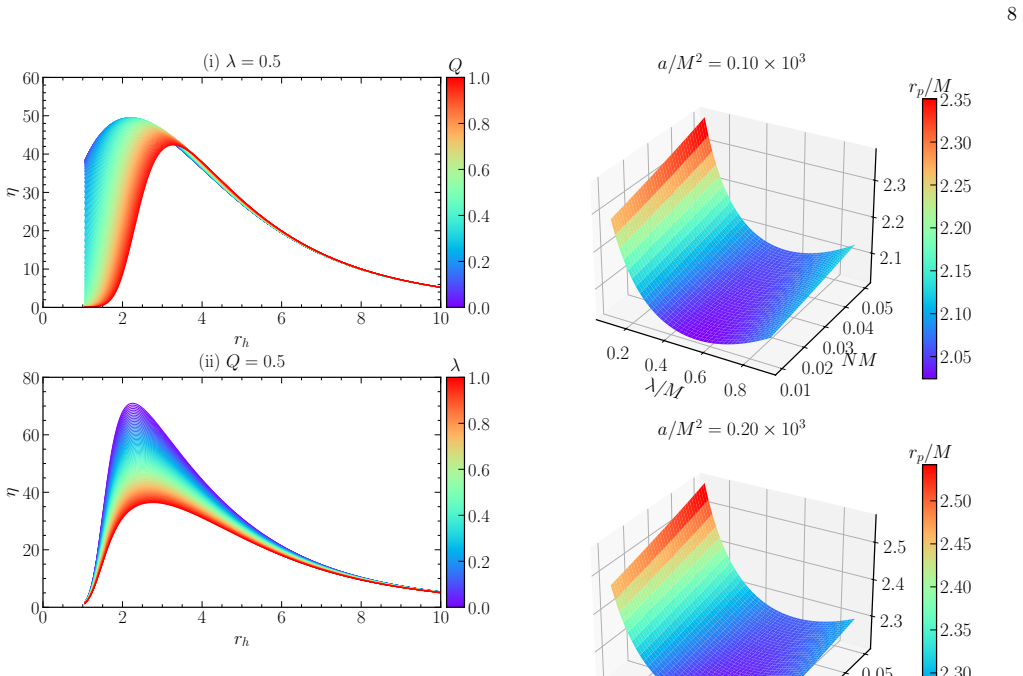
Within the extended phase-space formalism, the thermodynamic quantities are derived for the Euler-Heisenberg AdS black hole with quintessence, perfect fluid dark matter, and cloud of strings. The modified first law and Smarr relation are verified. The equation of state and critical behavior are analyzed, revealing that the Euler-Heisenberg coupling and surrounding matter fields substantially modify the temperature profile, stability structure, and location of the critical point. Radiative properties including sparsity of Hawking radiation, photon sphere, black hole shadow, and geometric-optics emission rate are also examined.
What carries the argument
The modified metric ansatz that incorporates the Euler-Heisenberg nonlinear electromagnetic term together with the stress-energy tensors of quintessence, perfect fluid dark matter, and a cloud of strings.
Load-bearing premise
The assumed metric ansatz with the Euler-Heisenberg nonlinear electromagnetic term plus the stress-energy tensors of quintessence, perfect fluid dark matter, and cloud of strings is a valid solution to the Einstein field equations.
What would settle it
A direct computation of the surface gravity that yields a Hawking temperature inconsistent with the one obtained from the first law would falsify the thermodynamic analysis.
Figures



read the original abstract
We investigate the thermodynamics, criticality, and selected radiative and optical properties of an Euler-Heisenberg AdS black hole surrounded by quintessence, perfect fluid dark matter, and a cloud of strings. Within the extended phase-space formalism, we derive the thermodynamic quantities, verify the modified first law and Smarr relation, and analyze the corresponding equation of state and critical behavior. We show that the Euler--Heisenberg coupling and the surrounding matter fields substantially modify the temperature profile, the stability structure, and the location of the critical point. We also examine the sparsity of Hawking radiation, together with the photon sphere, black hole shadow, and the associated geometric-optics emission rate.
Editorial analysis
A structured set of objections, weighed in public.
Referee Report
Summary. The manuscript investigates the thermodynamics, criticality, and selected radiative/optical properties of Euler-Heisenberg AdS black holes surrounded by quintessence, perfect fluid dark matter, and a cloud of strings. In the extended phase-space formalism, it derives thermodynamic quantities, verifies the modified first law and Smarr relation, analyzes the equation of state and critical behavior, and examines Hawking radiation sparsity, photon sphere, black hole shadow, and geometric-optics emission rate. The central claim is that the Euler-Heisenberg coupling and surrounding matter fields substantially modify the temperature profile, stability structure, and location of the critical point.
Significance. If the metric ansatz is confirmed to be an exact solution, the work would extend studies of AdS black hole thermodynamics by combining nonlinear electrodynamics with multiple matter fields, offering potential insights into modified critical phenomena and observational signatures such as shadows. The explicit verification of the first law and Smarr relation, together with the analysis of radiative properties, would add to the literature on extended phase space thermodynamics.
major comments (1)
- [Metric ansatz (likely §2)] The metric ansatz (presented in the setup of the spacetime, likely §2): the assumed form ds² = -f(r)dt² + dr²/f(r) + r² dΩ² with f(r) incorporating the Euler-Heisenberg nonlinear EM correction plus additive contributions from the quintessence, perfect-fluid dark matter, and cloud-of-strings stress-energy tensors is not shown to satisfy G_μν = 8π T_μν^total exactly. Because the Euler-Heisenberg stress-energy is nonlinear, linear superposition with the other tensors may fail, rendering the derived temperature, heat capacity, equation of state, first law, Smarr relation, and critical-point analysis invalid for the stated physical system.
minor comments (2)
- [Abstract] The abstract asserts that the matter fields 'substantially modify' the temperature profile and critical point, but no quantitative comparison to the pure Euler-Heisenberg AdS case or to limiting values of the free parameters is provided, leaving the magnitude of the effect unclear.
- [Critical behavior analysis] The critical behavior depends on the four free parameters (Euler-Heisenberg coupling, quintessence parameter, dark matter parameter, cloud-of-strings parameter); explicit discussion of their physically allowed ranges or observational constraints would strengthen the analysis of stability and critical points.
Simulated Author's Rebuttal
We thank the referee for the careful reading of our manuscript and the constructive comment on the metric ansatz. We address this concern directly below and will incorporate the necessary clarification and verification in the revised version.
read point-by-point responses
-
Referee: [Metric ansatz (likely §2)] The metric ansatz (presented in the setup of the spacetime, likely §2): the assumed form ds² = -f(r)dt² + dr²/f(r) + r² dΩ² with f(r) incorporating the Euler-Heisenberg nonlinear EM correction plus additive contributions from the quintessence, perfect-fluid dark matter, and cloud-of-strings stress-energy tensors is not shown to satisfy G_μν = 8π T_μν^total exactly. Because the Euler-Heisenberg stress-energy is nonlinear, linear superposition with the other tensors may fail, rendering the derived temperature, heat capacity, equation of state, first law, Smarr relation, and critical-point analysis invalid for the stated physical system.
Authors: We appreciate the referee highlighting the need to explicitly confirm that the metric satisfies the Einstein equations with the total stress-energy tensor. In the construction, the individual stress-energy tensors are taken to be minimally coupled with no direct interactions, so T_μν^total = T_μν^EH + T_μν^quint + T_μν^DM + T_μν^strings. For a static spherically symmetric metric, the Einstein equations reduce to first-order differential equations for f(r) that depend only on the sum of the energy densities ρ_total. The nonlinear character of the Euler-Heisenberg sector is fully incorporated when computing its own T_μν^EH from the nonlinear Lagrangian and the Maxwell field strength; once obtained, this contribution adds linearly to the densities of the other fields. Consequently, the integrated f(r) contains additive terms by construction. In the revised manuscript we will add an explicit verification step: we compute the Einstein tensor components G_t^t and G_r^r from the given metric and show that they equal 8π times the summed T_μν^total, thereby confirming that the first law, Smarr relation, equation of state, and critical-point analysis remain valid for the composite system. revision: yes
Circularity Check
No significant circularity; derivation follows from assumed metric without self-referential reductions
full rationale
The paper assumes a static spherically symmetric metric ansatz incorporating the Euler-Heisenberg nonlinear electrodynamics term plus additive stress-energy contributions from quintessence, perfect-fluid dark matter, and cloud-of-strings. From this ansatz it computes the Hawking temperature via surface gravity, derives the first law and Smarr relation in extended phase space, obtains the equation of state, and locates critical points by standard extremization of the pressure-volume relation. These steps are direct consequences of the input metric and the standard thermodynamic definitions; they do not rename fitted parameters as predictions, invoke self-citations for uniqueness theorems, or smuggle ansatzes via prior work. The reported modifications to temperature profiles and critical locations are explicit functions of the free parameters and therefore constitute model exploration rather than tautological re-derivation. No load-bearing step reduces to its own output by construction.
Axiom & Free-Parameter Ledger
free parameters (4)
- Euler-Heisenberg coupling parameter
- Quintessence parameter
- Dark matter parameter
- Cloud-of-strings parameter
axioms (3)
- standard math Einstein gravity with negative cosmological constant (AdS) governs the spacetime.
- domain assumption The matter fields are described by the standard phenomenological energy-momentum tensors for quintessence, perfect fluid dark matter, and cloud of strings.
- domain assumption Extended phase-space thermodynamics applies, with cosmological constant as pressure.
invented entities (4)
-
Euler-Heisenberg nonlinear electromagnetic field
no independent evidence
-
Quintessence fluid
no independent evidence
-
Perfect fluid dark matter
no independent evidence
-
Cloud of strings
no independent evidence
Reference graph
Works this paper leans on
-
[1]
J. D. Bekenstein, Phys. Rev. D7, 2333 (1973)
1973
-
[2]
J. M. Bardeen, B. Carter, and S. W. Hawking, Commun. Math. Phys.31, 161 (1973)
1973
-
[3]
S. W. Hawking, Commun. Math. Phys.43, 199 (1975)
1975
-
[4]
S. W. Hawking and D. N. Page, Commun. Math. Phys. 87, 577 (1983)
1983
-
[5]
Kastor, S
D. Kastor, S. Ray, and J. Traschen, Class. Quantum Grav.26, 195011 (2009)
2009
-
[6]
Kubizˇ n´ ak and R
D. Kubizˇ n´ ak and R. B. Mann, JHEP2012(7), 033
-
[7]
Gunasekaran, D
S. Gunasekaran, D. Kubizˇ n´ ak, and R. B. Mann, JHEP 2012(11), 110
2012
-
[8]
Kubizˇ n´ ak and R
D. Kubizˇ n´ ak and R. B. Mann, Can. J. Phys.93, 999 (2015)
2015
-
[9]
Kubizˇ n´ ak, R
D. Kubizˇ n´ ak, R. B. Mann, and M. Teo, Class. Quantum Grav.34, 063001 (2017)
2017
-
[10]
Heisenberg and H
W. Heisenberg and H. Euler, Zeitschrift f¨ ur Physik98, 714 (1936)
1936
-
[11]
G. G. L. Nashed and S. Nojiri, Phys. Rev. D104, 044043 (2021)
2021
-
[12]
Guerrero and D
M. Guerrero and D. Rubiera-Garcia, Phys. Rev. D102, 024005 (2020)
2020
-
[13]
Hamil and B
B. Hamil and B. C. L¨ utf¨ uo˘ glu, Fortsc. Phys.73, 2400105 (2024)
2024
-
[14]
Al-Badawi and F
A. Al-Badawi and F. Ahmed, Chin. J. Phys.94, 185 (2025)
2025
-
[15]
Ahmed, A
F. Ahmed, A. Al-Badawi, and ˙I. Sakallı, Eur. Phys. J C 85, 554 (2025)
2025
-
[16]
Ahmed, A
F. Ahmed, A. Al-Badawi, and ˙I. Sakallı, Phys. Dark Univ.49, 101988 (2025)
2025
-
[17]
Ahmed, A
F. Ahmed, A. Al-Badawi, ˙I. Sakallı, and A. Bouzenada, Nucl. Phys. B1011, 116806 (2025)
2025
-
[18]
Breton and L
N. Breton and L. A. L´ opez, Phys. Rev. D104, 024064 (2021)
2021
-
[19]
Magos and N
D. Magos and N. Breton, Phys. Rev. D102, 084011 (2020)
2020
-
[20]
Salazar I., A
H. Salazar I., A. Garc´ ıa D., and J. F. Pleba´ nski, J Math. Phys28, 2171 (1987)
1987
-
[21]
V. V. Kiselev, Class. Quantum Grav.20, 1187 (2003)
2003
-
[22]
Li and K.-C
M.-H. Li and K.-C. Yang, Phys. Rev. D86, 123015 (2012)
2012
-
[23]
P. S. Letelier, Phys. Rev. D20, 1294 (1979)
1979
-
[24]
V. B. Bezerra, I. P. Lobo, J. P. Morais Gra¸ ca, and L. C. N. Santos, Eur. Phys. J C79, 949 (2019)
2019
-
[25]
Abbas and R
G. Abbas and R. H. Ali, Eur. Phys. J C83, 407 (2023)
2023
-
[26]
A. Sood, M. S. Ali, J. K. Singh, and S. G. Ghosh, Chin. Phys. C48, 065109 (2024)
2024
-
[27]
Heydari-Fard, S
M. Heydari-Fard, S. Ghassemi Honarvar, and M. Heydari-Fard, MNRAS521, 708 (2023)
2023
-
[28]
X. Hou, Z. Xu, and J. Wang, JCAP2018(12), 040
-
[29]
Haroon, M
S. Haroon, M. Jamil, K. Jusufi, K. Lin, and R. B. Mann, Phys. Rev. D99, 044015 (2019)
2019
-
[30]
M. R. Shahzad, G. Abbas, T. Zhu,et al., Eur. Phys. J. C85, 164 (2025)
2025
-
[31]
Rehman, G
H. Rehman, G. Abbas, T. Zhu, and B. S. Alkahtani, Phys. Dark Univ.48, 101944 (2025)
2025
-
[32]
Rehman, G
H. Rehman, G. Abbas, T. Zhu,et al., Eur. Phys. J C83, 856 (2023)
2023
-
[33]
Abbas and H
G. Abbas and H. Rehman, Fortsc. Phys.71, 2200205 (2023)
2023
-
[34]
G. D. Acan Yildiz, A. Ditta, A. Ashraf, E. G¨ udekli, Y. M. Alanazi, and A. Reyimberganov, Phys. Dark Univ.46, 101583 (2024)
2024
-
[35]
Chaudhary, M
S. Chaudhary, M. D. Sultan, A. Malik, Y. M. Alanazi, A. Bin Jumah, A. Ashraf, and A. M. Mubaraki, Int. J Geom. Meth. Mod. Phys.22, 2550129 (2025)
2025
-
[36]
Sucu and I
E. Sucu and I. Sakalli, Physics of the Dark Universe52, 102295 (2026)
2026
-
[37]
J Lett.875, L1 (2019)
Event Horizon Telescope Collaboration, Astrophys. J Lett.875, L1 (2019)
2019
-
[38]
J Lett.875, L4 (2019)
Event Horizon Telescope Collaboration, Astrophys. J Lett.875, L4 (2019)
2019
-
[39]
J Lett.930, L12 (2022)
Event Horizon Telescope Collaboration, Astrophys. J Lett.930, L12 (2022)
2022
-
[40]
Perlick and O
V. Perlick and O. Y. Tsupko, Phys. Rep.947, 1 (2022)
2022
-
[41]
Got¯ o, Prog
T. Got¯ o, Prog. Theor. Phys.46, 1560 (1971)
1971
-
[42]
Ruffini, Y.-B
R. Ruffini, Y.-B. Wu, and S.-S. Xue, Phys. Rev. D88, 085004 (2013)
2013
-
[43]
Visser, F
M. Visser, F. Gray, S. Schuster, and A. Van-Brunt, in The Fourteenth Marcel Grossmann Meeting(2017) pp. 1724–1729
2017
-
[44]
Ahmed, A
F. Ahmed, A. Al-Badawi, and E. O. Silva, Phys. Lett. B 876, 140448 (2026). 12
2026
-
[45]
Shadow, Sparsity of Radiation and Energy Emission Rate in Skyrmion Black Holes
F. Ahmed, A. Al-Badawi, and I. Sakalli, (2026), arXiv:2604.06259 [gr-qc]
work page internal anchor Pith review Pith/arXiv arXiv 2026
-
[46]
Charged Black Holes in KR-gravity Surrounded by Perfect Fluid Dark Matter
F. Ahmed, M. Fathi, and E. O. Silva, (2026), arXiv:2604.11357 [gr-qc]
work page internal anchor Pith review Pith/arXiv arXiv 2026
- [47]
- [48]
-
[49]
F. Gray, S. Schuster, A. Van-Brunt, and M. Visser, Class. Quantum Grav.33, 115003 (2016)
2016
-
[50]
D. N. Page, Phys. Rev. D13, 198 (1976)
1976
-
[51]
Ahmed, A
F. Ahmed, A. Al-Badawi, and ˙I. Sakallı, Eur. Phys. J C 85, 984 (2025)
2025
-
[52]
Wei and Y.-X
S.-W. Wei and Y.-X. Liu, JCAP2013(11), 063
-
[53]
D´ ecanini, G
Y. D´ ecanini, G. Esposito-Far` ese, and A. Folacci, Phys. Rev. D83, 044032 (2011)
2011
-
[54]
Mashhoon, Phys
B. Mashhoon, Phys. Rev. D7, 2807 (1973)
1973
-
[55]
Sanchez, Phys
N. Sanchez, Phys. Rev. D18, 1030 (1978)
1978
discussion (0)
Sign in with ORCID, Apple, or X to comment. Anyone can read and Pith papers without signing in.