Recognition: 2 theorem links
· Lean TheoremShadow, Sparsity of Radiation and Energy Emission Rate in Skyrmion Black Holes
Pith reviewed 2026-05-10 18:37 UTC · model grok-4.3
The pith
The Skyrme term fixes the photon sphere location in Skyrmion black holes and thereby sets the size of the shadow while changing the sparsity of Hawking radiation.
A machine-rendered reading of the paper's core claim, the machinery that carries it, and where it could break.
Core claim
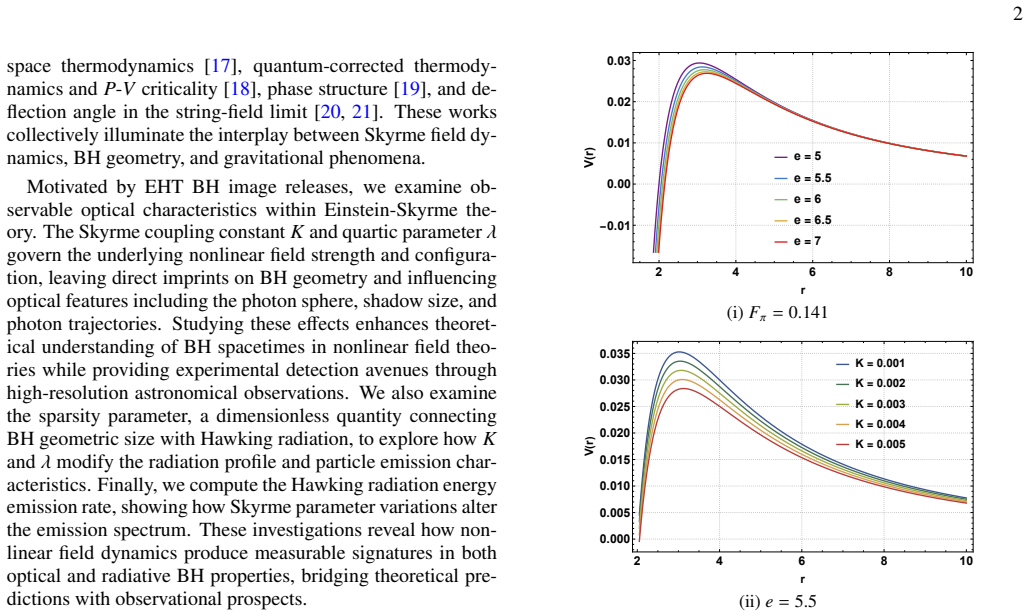
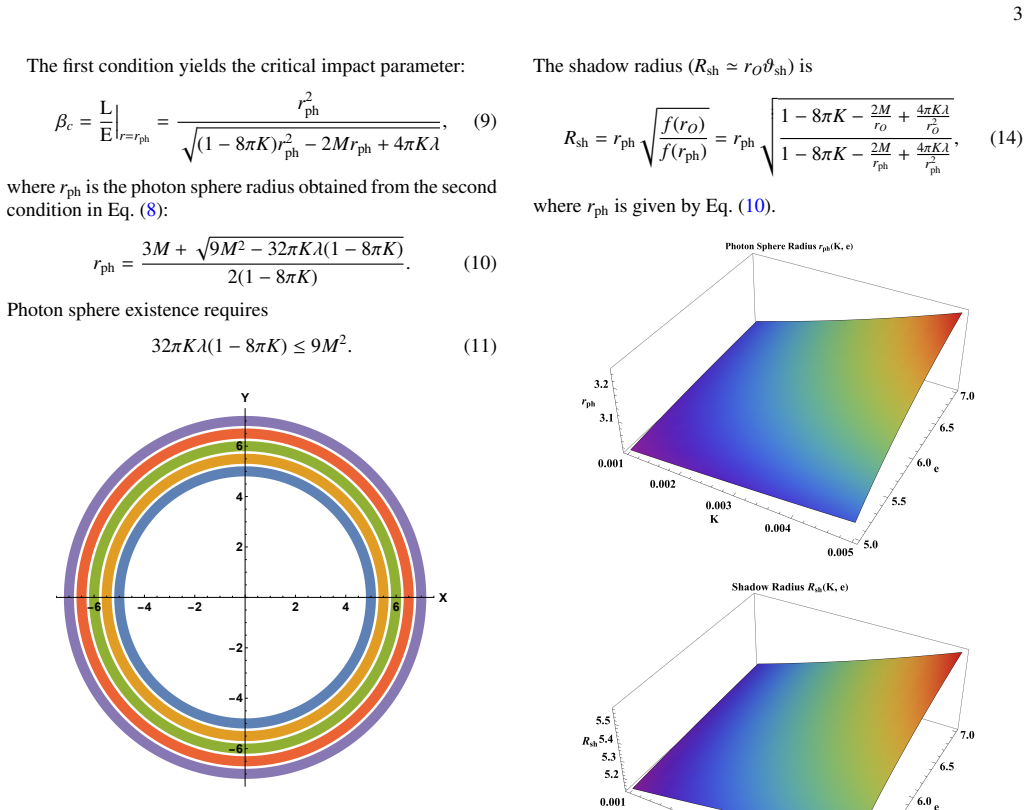
In the Skyrmion black hole spacetime the effective potential for null geodesics receives an extra term from the Skyrme field; solving for the maximum of that potential locates the photon sphere at a radius that depends explicitly on the Skyrme coupling. This radius determines the critical impact parameter and hence the angular size of the shadow. The same coupling enters the surface gravity, which alters the Hawking temperature, the sparsity parameter of the radiation, and the peak and width of the energy emission spectrum.
What carries the argument
The Skyrmion black hole metric whose effective photon potential includes the Skyrme term that shifts the unstable circular orbit and the Hawking temperature.
If this is right
- The shadow radius becomes a monotonic function of the Skyrme coupling for fixed mass and charge.
- Photon trajectories near the horizon deviate from Schwarzschild geodesics by an amount set by the same coupling.
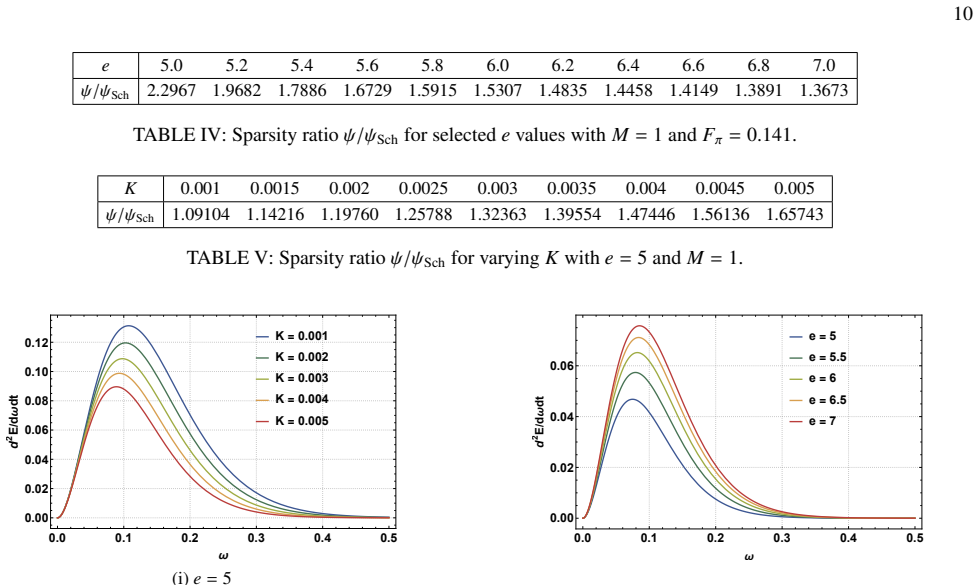
- The sparsity of Hawking radiation increases with larger Skyrme coupling, reducing the effective luminosity at given temperature.
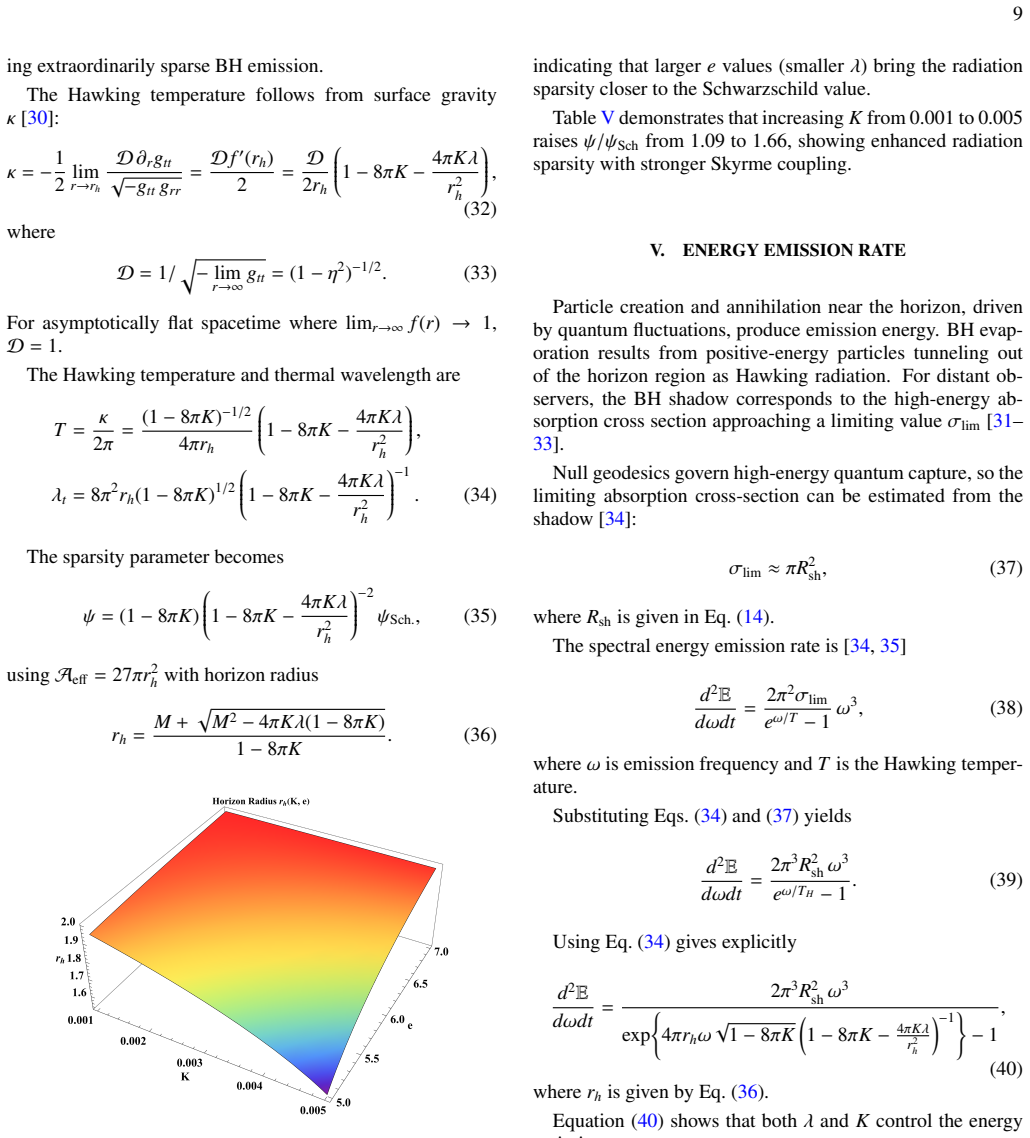
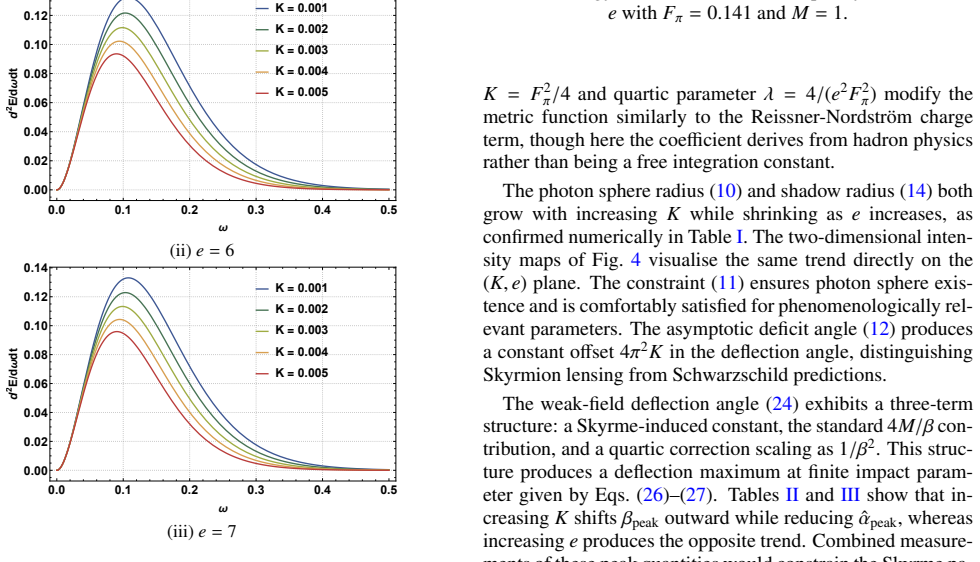
- The peak frequency and total power in the emission spectrum shift systematically with the nonlinear parameter.
Where Pith is reading between the lines
- The same geodesic and thermodynamic machinery could be applied to other nonlinear matter models to generate comparable shadow and radiation predictions.
- If future observations constrain the shadow size tightly, the allowed range for the Skyrme coupling would translate directly into a bound on nonlinear field strength near the horizon.
- The altered sparsity might affect the expected time variability of the radiation, offering a secondary observable beyond the time-averaged spectrum.
Load-bearing premise
The Skyrmion black hole metric is assumed to be a stable, physically allowed solution in which the Skyrme coupling can be changed independently without destroying the spacetime or violating energy conditions.
What would settle it
High-resolution radio images that measure the shadow diameter of Sgr A* or M87* to better than 10 percent precision; if the measured size lies outside the range allowed by any combination of the Skyrme coupling and geometric parameters, the model is ruled out for those sources.
Figures


read the original abstract
We examine several observable optical properties of a Skyrmion black hole (BH), focusing on the photon sphere, BH shadow, and photon trajectories. The Skyrme term, along with other geometric parameters of the spacetime, determines the photon sphere location and shapes the resulting BH shadow. Parameter variations produce observable departures from standard BH geometries, offering potential signatures of nonlinear field effects. We also analyze the sparsity of Hawking radiation and the associated energy emission spectra, showing how these quantities respond to the Skyrme coupling and background parameters. Our findings illuminate the connection between nonlinear field contributions and BH optics, with implications for observational and theoretical studies of modified gravity scenarios.
Editorial analysis
A structured set of objections, weighed in public.
Referee Report
Summary. The manuscript examines several observable optical properties of Skyrmion black holes, including the photon sphere, black hole shadow, and photon trajectories. It claims that the Skyrme term together with other geometric parameters determines the photon sphere location and shapes the resulting shadow, with parameter variations producing observable departures from standard black hole geometries. The paper further analyzes the sparsity of Hawking radiation and the associated energy emission spectra, showing their dependence on the Skyrme coupling and background parameters.
Significance. If the metric is a valid stable solution and the optical/radiation calculations are accurate, the work would link nonlinear Skyrme field contributions to concrete black hole observables, potentially providing signatures for modified gravity in astrophysical data. The inclusion of radiation sparsity adds a quantum aspect to the analysis.
major comments (2)
- [Abstract and §2] Abstract and §2 (metric section): the central claim that the Skyrme term determines the photon sphere and produces observable departures rests on the assumption that the Skyrmion black hole metric is a valid, stable, asymptotically flat solution whose parameters (including Skyrme coupling) can be varied independently. No stability analysis, asymptotic flatness verification, or explicit field equations are shown, which is load-bearing for all subsequent photon sphere, shadow, and radiation calculations.
- [§3] §3 (optical properties): the assertion that parameter variations produce observable departures lacks explicit formulas for the photon sphere radius, shadow radius, or error estimates; without these, it is impossible to quantify the size of the effect or compare to observational precision.
minor comments (1)
- [throughout] Notation for the Skyrme coupling constant and other parameters should be defined at first use and kept consistent throughout.
Simulated Author's Rebuttal
We thank the referee for the detailed and constructive report. We address each major comment below and indicate the revisions we will make to the manuscript.
read point-by-point responses
-
Referee: [Abstract and §2] Abstract and §2 (metric section): the central claim that the Skyrme term determines the photon sphere and produces observable departures rests on the assumption that the Skyrmion black hole metric is a valid, stable, asymptotically flat solution whose parameters (including Skyrme coupling) can be varied independently. No stability analysis, asymptotic flatness verification, or explicit field equations are shown, which is load-bearing for all subsequent photon sphere, shadow, and radiation calculations.
Authors: The Skyrmion black hole metric used in this work is taken from established solutions in the literature on Einstein-Skyrme theory (we will add explicit citations in the revised manuscript). These solutions are known to be asymptotically flat. However, we agree that a stability analysis is not provided here, as the paper focuses on the phenomenological implications for observables rather than the derivation or stability of the background. We will add a note in §2 clarifying the origin of the metric and referencing prior works on its properties. Explicit field equations can be included in an appendix for completeness. This addresses the concern partially, as a full stability analysis would require additional research beyond the scope of the current study. revision: partial
-
Referee: [§3] §3 (optical properties): the assertion that parameter variations produce observable departures lacks explicit formulas for the photon sphere radius, shadow radius, or error estimates; without these, it is impossible to quantify the size of the effect or compare to observational precision.
Authors: We do provide the expressions for the photon sphere radius by extremizing the effective potential for null geodesics in the given metric, and the shadow radius is calculated accordingly. However, to make this clearer, we will highlight the explicit formulas in the revised §3 and include a table or plot with quantitative values for the deviations as a function of the Skyrme coupling parameter. Regarding error estimates, we can add a discussion comparing the shadow size variations to the precision of current observations such as those from the Event Horizon Telescope. This will allow readers to assess the observability of the effects. revision: yes
Circularity Check
No significant circularity detected
full rationale
The abstract and available context describe examination of optical properties and radiation for a Skyrmion black hole metric, with the Skyrme term influencing photon sphere and shadow. No equations, fitting procedures, or derivations are presented that reduce by construction to inputs, self-definitions, or self-citations. The central claims rest on standard computation of observables from a given spacetime metric, which is self-contained and independent of the target results. No load-bearing steps match the enumerated circularity patterns.
Axiom & Free-Parameter Ledger
Lean theorems connected to this paper
-
IndisputableMonolith/Foundation/RealityFromDistinction.leanreality_from_one_distinction unclear?
unclearRelation between the paper passage and the cited Recognition theorem.
f(r)=1−8πK−2M/r+4πKλ/r² … K=F²_π/4 … λ=4/(e²F²_π) … phenomenological values 5≤e≤7
-
IndisputableMonolith/Cost/FunctionalEquation.leanwashburn_uniqueness_aczel unclear?
unclearRelation between the paper passage and the cited Recognition theorem.
r_ph = [3M + sqrt(9M²−32πKλ(1−8πK))] / [2(1−8πK)] … R_sh = r_ph sqrt(f(r_O)/f(r_ph))
What do these tags mean?
- matches
- The paper's claim is directly supported by a theorem in the formal canon.
- supports
- The theorem supports part of the paper's argument, but the paper may add assumptions or extra steps.
- extends
- The paper goes beyond the formal theorem; the theorem is a base layer rather than the whole result.
- uses
- The paper appears to rely on the theorem as machinery.
- contradicts
- The paper's claim conflicts with a theorem or certificate in the canon.
- unclear
- Pith found a possible connection, but the passage is too broad, indirect, or ambiguous to say the theorem truly supports the claim.
Forward citations
Cited by 1 Pith paper
-
Thermodynamic and Radiative Properties of Euler-Heisenberg AdS Black Holes Surrounded by Quintessence and Dark Matter with a Cloud of Strings
Euler-Heisenberg coupling and surrounding matter fields modify the temperature profile, stability structure, and critical point location of AdS black holes, while changing Hawking radiation sparsity, photon sphere, an...
Reference graph
Works this paper leans on
-
[1]
B. P. Abbottet al.(LIGO Scientific and Virgo Collaborations), Phys. Rev. Lett.116, 061102 (2016)
2016
-
[2]
B. P. Abbott, ,et al.(LIGO Scientific and Virgo), Phys. Rev. Lett.118, 221101 (2017), erratum: Phys. Rev. Lett. 121, 129901 (2018)
2017
-
[3]
Akiyamaet al.(Event Horizon Telescope Collaboration), Astrophys
K. Akiyamaet al.(Event Horizon Telescope Collaboration), Astrophys. J. Lett.875, L1 (2019)
2019
-
[4]
Akiyamaet al.(Event Horizon Telescope Collaboration), Astrophys
K. Akiyamaet al.(Event Horizon Telescope Collaboration), Astrophys. J. Lett.930, L12 (2022)
2022
-
[5]
Perlick and O
V . Perlick and O. Y . Tsupko, Phys. Rep.947, 1 (2022)
2022
-
[6]
J. L. Synge, Mon. Not. R. Astron. Soc.131, 463 (1966)
1966
-
[7]
J. M. Bardeen, inLes Astres Occlus(1973) pp. 215–240, proceedings of the Ecole d’Ete de Physique Theorique, Les Houches, France, August 1972
1973
-
[8]
J. P. Luminet, Astron. Astrophys.75, 228 (1979)
1979
-
[9]
Manton and P
N. Manton and P. Sutcliffe,Topological Solitons(Cambridge University Press, Cambridge, 2007)
2007
-
[10]
T. H. R. Skyrme, Proc. R. Soc. London A260, 127 (1961)
1961
-
[11]
T. H. R. Skyrme, Proceedings of the Royal Society of London A262, 237 (1961)
1961
-
[12]
T. H. R. Skyrme, Nucl. Phys.31, 556 (1962)
1962
-
[13]
Canfora and H
F. Canfora and H. Maeda, Phys. Rev. D87, 084049 (2013)
2013
-
[14]
Canfora, F
F. Canfora, F. Correa, and J. Zanelli, Phys. Rev. D90, 085002 (2014)
2014
-
[15]
G. S. Adkins, C. R. Nappi, and E. Witten, Nucl. Phys. B228, 552 (1983)
1983
-
[16]
Barriola and A
M. Barriola and A. Vilenkin, Phys. Rev. Lett.63, 341 (1989)
1989
-
[17]
Flores-Alfonso and H
D. Flores-Alfonso and H. Quevedo, Class. Quantum Grav.36, 154001 (2019)
2019
-
[18]
Y . H. Khan, P. A. Ganai, and S. Upadhyay, Prog. Theor. Exp. Phys.2020, 103B06 (2020)
2020
-
[19]
Senjaya and A
D. Senjaya and A. Klaypong, Eur. Phys. J. C86, 309 (2026)
2026
-
[20]
Canfora, E
F. Canfora, E. F. Eiroa, and C. M. Sendra, Eur. Phys. J. C78, 9 (2018)
2018
-
[21]
E. Sucu and I. Sakallı, Int. J. Geom. Methods Mod. Phys. 10.1142/S0219887826500404 (2026)
-
[22]
Schneider, J
P. Schneider, J. Ehlers, and E. E. Falco,Gravitational Lenses (Springer-Verlag, Berlin, 1992)
1992
-
[23]
K. S. Virbhadra and G. F. R. Ellis, Phys. Rev. D62, 084003 (2000)
2000
-
[24]
Ahmed, ˙I
F. Ahmed, ˙I. Sakallı, and A. Al-Badawi, Phys. Lett. B864, 139448 (2025)
2025
-
[25]
D. N. Page, Phys. Rev. D13, 198 (1976)
1976
-
[26]
D. N. Page, Phys. Rev. D14, 3260 (1976)
1976
-
[27]
D. N. Page,Accretion into and Emission from Black Holes, Phd thesis, California Institute of Technology (1976)
1976
-
[28]
D. N. Page, Phys. Rev. D16, 2402 (1977)
1977
-
[29]
F. Gray, S. Schuster, A. Van-Brunt, and M. Visser, Class. Quan- tum Grav.33, 115003 (2016)
2016
-
[30]
Yu, Nucl
H.-W. Yu, Nucl. Phys. B430, 427 (1994)
1994
-
[31]
C. W. Misner, K. S. Thorne, and J. A. Wheeler,Gravitation(W. H. Freeman, San Francisco, 1973)
1973
-
[32]
Mashhoon, Phys
B. Mashhoon, Phys. Rev. D7, 2807 (1973)
1973
-
[33]
Sanchez, Phys
N. Sanchez, Phys. Rev. D18, 1030 (1978)
1978
-
[34]
Wei and Y .-X
S.-W. Wei and Y .-X. Liu, JCAP2013(11), 063
-
[35]
S. H. Hendi, K. Jafarzade, and B. E. Panah, JCAP2023(2), 022
discussion (0)
Sign in with ORCID, Apple, or X to comment. Anyone can read and Pith papers without signing in.