Recognition: unknown
ClayScape: A GenAI-Supported Workflow for Designing Chinese Style Ceramics with Clay 3D Printing
Pith reviewed 2026-05-07 15:30 UTC · model grok-4.3
The pith
A hybrid GenAI and clay 3D printing workflow makes designing Chinese-style ceramics more accessible to creators.
A machine-rendered reading of the paper's core claim, the machinery that carries it, and where it could break.
Core claim
The central claim is that integrating generative AI with clay 3D printing in a hybrid workflow supports accessible ceramic creation for Chinese styles, expands creative exploration, and presents challenges in balancing agency and control, as demonstrated through evaluation with four ceramic creators using the ClayScape tool.
What carries the argument
ClayScape, a design tool that operationalizes the hybrid GenAI-clay 3D printing workflow to generate and fabricate ceramic designs.
Load-bearing premise
The experiences reported by four ceramic creators are representative enough to indicate broader accessibility and creative impacts for the field.
What would settle it
A study where novice creators attempt to design and print ceramics using only the tool versus traditional methods, checking if they succeed without prior skills.
Figures








read the original abstract
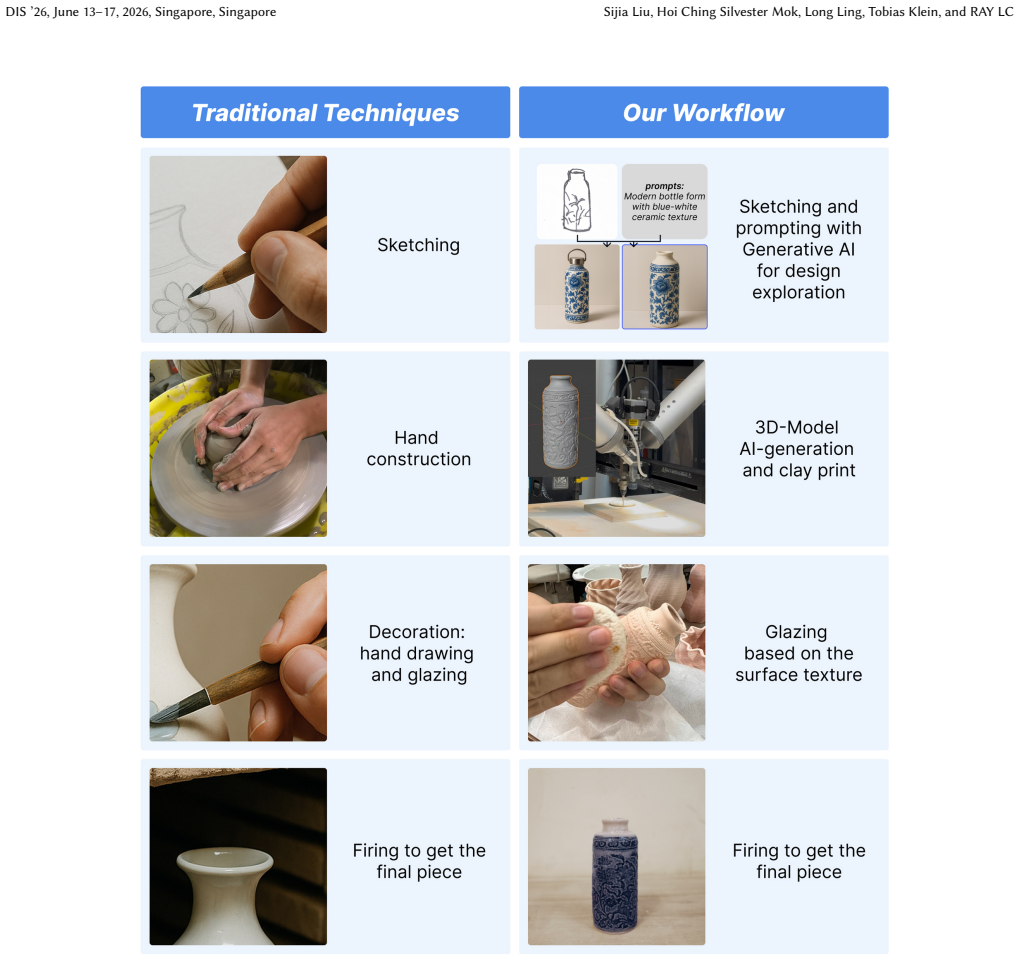
Chinese ceramic-making involves complex and interdependent steps, making it technically demanding. Digital fabrication methods attempt to make the process more accessible, but for craft-creators, technical challenges such as CAD and CAM skills remain major obstacles. To address this, we designed a hybrid workflow that integrates Generative AI with clay 3D printing to support new creative possibilities. We evaluated the workflow through ClayScape, a design tool that operationalizes this approach, with four ceramic creators. Our findings show that the workflow supports accessible ceramic creation while revealing both expanded opportunities for creative exploration and challenges in balancing agency and control. This work demonstrates how hybrid workflows can lower barriers to digital fabrication while supporting creative possibilities in culturally grounded ceramic practices.
Editorial analysis
A structured set of objections, weighed in public.
Referee Report
Summary. The paper presents ClayScape, a hybrid workflow and associated design tool that integrates generative AI with clay 3D printing to enable creation of Chinese-style ceramics. It argues that this approach lowers barriers posed by CAD/CAM skills for craft practitioners. The workflow is evaluated via sessions with four ceramic creators, yielding qualitative findings that the system supports accessible ceramic creation while surfacing expanded creative opportunities alongside challenges in balancing user agency and system control.
Significance. If the evaluation claims hold, the work contributes a concrete example of GenAI-augmented digital fabrication tailored to culturally grounded craft practices, which could inform broader HCI efforts to make technical fabrication tools more approachable for non-expert makers.
major comments (3)
- [Evaluation] Evaluation section: the description of the study with four ceramic creators supplies no information on recruitment criteria, session protocol, data collection instruments, or analysis method (e.g., whether thematic analysis was used or how inter-rater reliability was assessed). Without these details the reported themes on accessibility and agency cannot be assessed for soundness.
- [Findings] Findings: the central claims that the workflow 'supports accessible ceramic creation' and reveals 'expanded opportunities for creative exploration and challenges in balancing agency and control' rest exclusively on qualitative feedback from N=4 without quantitative metrics, a comparison condition, or discussion of participant diversity or thematic saturation. This sample size is load-bearing for the generalization implied by the abstract and conclusion.
- [Workflow] Workflow description: the integration of GenAI (prompt engineering, model choice, post-processing steps for 3D-printable output) is described at a high level only; concrete examples of prompts, parameter mappings, or failure modes are needed to allow readers to evaluate the technical novelty and reproducibility of the hybrid approach.
minor comments (1)
- [Abstract] Abstract: the phrase 'our findings show' is used without indicating that the evidence is qualitative and drawn from a small sample; a brief qualifier would improve clarity.
Simulated Author's Rebuttal
Thank you for your detailed and constructive review. We appreciate the feedback highlighting areas where methodological transparency, claim qualification, and technical specificity can be strengthened. We address each major comment below and indicate planned revisions.
read point-by-point responses
-
Referee: [Evaluation] Evaluation section: the description of the study with four ceramic creators supplies no information on recruitment criteria, session protocol, data collection instruments, or analysis method (e.g., whether thematic analysis was used or how inter-rater reliability was assessed). Without these details the reported themes on accessibility and agency cannot be assessed for soundness.
Authors: We agree that additional methodological details are required for transparency and replicability. In the revised manuscript, we will expand the Evaluation section to specify: recruitment criteria (experienced ceramic creators with at least two years of practice, recruited through local studios and online craft communities, with varying levels of digital tool familiarity); session protocol (90-120 minute sessions including tool tutorial, hands-on design task for a Chinese-style ceramic, and semi-structured interview); data collection instruments (audio recordings, screen captures, observation notes, and post-session questionnaires); and analysis method (thematic analysis following Braun and Clarke's six-phase approach, with two authors performing independent coding and resolving disagreements via discussion to ensure consistency). revision: yes
-
Referee: [Findings] Findings: the central claims that the workflow 'supports accessible ceramic creation' and reveals 'expanded opportunities for creative exploration and challenges in balancing agency and control' rest exclusively on qualitative feedback from N=4 without quantitative metrics, a comparison condition, or discussion of participant diversity or thematic saturation. This sample size is load-bearing for the generalization implied by the abstract and conclusion.
Authors: We acknowledge the limitations inherent in a small exploratory sample and agree that the abstract and conclusion should avoid implying broad generalization. The evaluation was designed as an initial qualitative probe into a novel workflow, consistent with HCI practices for early tool assessment. We will revise the abstract and conclusion to explicitly frame the work as exploratory, add a Limitations section addressing the N=4 sample, absence of quantitative metrics or control conditions, participant diversity (all with Chinese cultural ties and ceramic experience but differing ages and digital skills), and note that themes were consistent yet saturation was not fully claimed. Future work with larger samples and quantitative comparisons will be suggested. revision: partial
-
Referee: [Workflow] Workflow description: the integration of GenAI (prompt engineering, model choice, post-processing steps for 3D-printable output) is described at a high level only; concrete examples of prompts, parameter mappings, or failure modes are needed to allow readers to evaluate the technical novelty and reproducibility of the hybrid approach.
Authors: We will revise the Workflow section to include concrete details supporting reproducibility and technical evaluation. Additions will cover: sample prompts (e.g., 'Generate a 3D-printable Chinese dragon vase model with traditional motifs, optimized for clay extrusion with 2-4mm wall thickness'); model choices and pipeline (Midjourney for 2D ideation, followed by 3D conversion via specific tools like TripoSR, then slicing adjustments); parameter mappings (AI output scale mapped to 150-300mm height, texture parameters tuned to minimize overhangs for print success); and failure modes with mitigations (e.g., non-manifold meshes causing print failures, addressed via automated repair; culturally mismatched outputs refined through user prompts and post-processing). These examples will clarify the hybrid GenAI integration. revision: yes
Circularity Check
No significant circularity detected
full rationale
The paper is a qualitative HCI design study describing a hybrid GenAI-clay 3D printing workflow and evaluating it via sessions with four ceramic creators. No equations, parameters, derivations, or fitted models exist that could reduce to self-definitional inputs, fitted predictions, or self-citation chains. Claims about accessibility, creative exploration, and agency-control trade-offs are presented as observations from thematic analysis of participant feedback, without any mathematical or logical structure that collapses by construction to the inputs. This is a standard non-circular qualitative evaluation.
Axiom & Free-Parameter Ledger
Reference graph
Works this paper leans on
-
[1]
Meshy AI. 2025. Meshy AI - The #1 AI 3D Model Generator for Creators. https: //www.meshy.ai/ Accessed: 2025-07-23
2025
-
[2]
Fiona Bell, Erin Mcclure, Camila Friedman-Gerlicz, Ruby Ta, and Leah Buechley
-
[3]
InProceedings of the 2024 CHI Conference on Human Factors in Computing Systems (CHI ’24)
Shape-Changing Clay-Dough: Taking a Material-Oriented Approach to 3D Printing Ceramic Forms. InProceedings of the 2024 CHI Conference on Human Factors in Computing Systems (CHI ’24). Association for Computing Machinery, New York, NY, USA, 1–19. doi:10.1145/3613904.3642246
-
[4]
Samuelle Bourgault. 2023. Developing Action-Oriented Systems for Manual- Computational Craft Workflows. InAdjunct Proceedings of the 36th Annual ACM Symposium on User Interface Software and Technology(San Francisco, CA, USA) (UIST ’23 Adjunct). Association for Computing Machinery, New York, NY, USA, Article 106, 5 pages. doi:10.1145/3586182.3616708
-
[5]
Samuelle Bourgault, Alejandro Aponte, Megumi Ondo, Emilie Yu, and Jennifer Jacobs. 2025. WORM: Programming Collaborative Robots Through Manual Actions for Craft-Aligned Digital Fabrication. InProceedings of the 38th Annual ACM Symposium on User Interface Software and Technology (UIST ’25). Association for Computing Machinery, New York, NY, USA, Article 10...
-
[6]
Samuelle Bourgault, Pilar Wiley, Avi Farber, and Jennifer Jacobs. 2023. CoilCAM: Enabling Parametric Design for Clay 3D Printing Through an Action-Oriented Toolpath Programming System. InProceedings of the 2023 CHI Conference on Human Factors in Computing Systems (CHI ’23). Association for Computing Ma- chinery, New York, NY, USA, 1–16. doi:10.1145/354454...
-
[7]
Virginia Braun and Victoria Clarke. 2006. Using thematic analysis in psychol- ogy.Qualitative Research in Psychology3, 2 (Jan. 2006), 77–101. doi:10.1191/ 1478088706qp063oa
2006
-
[8]
Kim, and Nadir Weibel
Chen Chen, Cuong Nguyen, Thibault Groueix, Vladimir G. Kim, and Nadir Weibel
-
[9]
MemoVis: A GenAI-Powered Tool for Creating Companion Reference Images for 3D Design Feedback.ACM Trans. Comput.-Hum. Interact.31, 5 (Nov. 2024), 67:1–67:41. doi:10.1145/3694681 TLDR: MemoVis, a text editor interface that assists feedback providers in creating reference images with generative AI driven by the feedback comments, is introduced, with a novel ...
-
[10]
Li-Yuan Chiou, Peng-Kai Hung, Rung-Huei Liang, and Chun-Teng Wang. 2023. Designing with AI: An Exploration of Co-Ideation with Image Generators. In Proceedings of the 2023 ACM Designing Interactive Systems Conference (DIS ’23). Association for Computing Machinery, New York, NY, USA, 1941–1954. doi:10. 1145/3563657.3596001
-
[11]
Peter Dalsgaard and Kim Halskov. 2012. Reflective design documentation. In Proceedings of the Designing Interactive Systems Conference(Newcastle Upon Tyne, United Kingdom)(DIS ’12). Association for Computing Machinery, New York, NY, USA, 428–437. doi:10.1145/2317956.2318020
-
[12]
Ashley Del Valle, Mert Toka, and Jennifer Jacobs. 2024. Engaging Young People in the Expressive Opportunities of Digital Fabrication Through Craft-Oriented CAM-Based Design. InProceedings of the 2024 ACM Designing Interactive Sys- tems Conference(Copenhagen, Denmark)(DIS ’24). Association for Computing Machinery, New York, NY, USA, 1162–1176. doi:10.1145/...
-
[13]
Laura Devendorf, Katya Arquilla, Sandra Wirtanen, Allison Anderson, and Steven Frost. 2020. Craftspeople as Technical Collaborators: Lessons Learned through an Experimental Weaving Residency. InProceedings of the 2020 CHI Conference on Hu- man Factors in Computing Systems(Honolulu, HI, USA)(CHI ’20). Association for Computing Machinery, New York, NY, USA,...
-
[14]
Laura Devendorf, Leah Buechley, Noura Howell, Jennifer Jacobs, Cindy Hsin-Liu Kao, Martin Murer, Daniela Rosner, Nica Ross, Robert Soden, Jared Tso, and Clement Zheng. 2023. Towards Mutual Benefit: Reflecting on Artist Residencies as a Method for Collaboration in DIS. InCompanion Publication of the 2023 ACM Designing Interactive Systems Conference(Pittsbu...
-
[15]
Laura Devendorf and Daniela K. Rosner. 2017. Beyond Hybrids: Metaphors and Margins in Design. InProceedings of the 2017 Conference on Designing Interactive Systems(Edinburgh, United Kingdom)(DIS ’17). Association for Computing Machinery, New York, NY, USA, 995–1000. doi:10.1145/3064663.3064705
-
[16]
Nir Dick, Naama Glauber, Adi Yehezkeli, Moran Mizrahi, Shani Reches, Maiayn Ben-Yona, Anna Carmi, and Amit Zoran. 2018. Design with Minimal Intervention: Drawing with Light and Cracks. InProceedings of the 2018 Designing Interactive Systems Conference (DIS ’18). Association for Computing Machinery, New York, NY, USA, 1107–1120. doi:10.1145/3196709.3196814
-
[17]
Elran, Yuval Harel, and Amit R
Sharan R. Elran, Yuval Harel, and Amit R. Zoran. 2023. Fine Motor Skills: Oper- ating standard robotic fabrication as a generative system.Proc. ACM Comput. Graph. Interact. Tech.6, 2 (Aug. 2023), 30:1–30:9. doi:10.1145/3597627 TLDR: This work presents a digital agent that manipulates clay while allowing the material’s internal dynamics to play a dominant ...
-
[18]
Sharan R. Elran and Amit R. Zoran. 2022. The Ghost in The Machine: Digital Stylization and Expressive Re-Materialization of Ancient Ceramics.Proc. ACM Comput. Graph. Interact. Tech.5, 4 (Sept. 2022), 44:1–44:8. doi:10.1145/3533609
-
[19]
Sharan R. Elran and Amit R. Zoran. 2024. Probabilistic Craft- Materialization of generated images using digital and traditional craft.Proc. ACM Comput. Graph. Interact. Tech.7, 4 (July 2024), 63:1–63:10. doi:10.1145/3664209 TLDR: The paper shows how materialization re-asserts the human role in this new collaborative environment and how the tangible object...
-
[20]
Filippo Andrea Fanni, Fabio Pellacini, Riccardo Scateni, and Andrea Giachetti
-
[21]
PAVEL: Decorative Patterns with Packed Volumetric Elements.ACM Trans. Graph.41, 2, Article 19 (Jan. 2022), 15 pages. doi:10.1145/3502802
-
[22]
Faraz Faruqi, Ahmed Katary, Tarik Hasic, Amira Abdel-Rahman, Nayeemur Rahman, Leandra Tejedor, Mackenzie Leake, Megan Hofmann, and Stefanie Mueller. 2023. Style2Fab: Functionality-Aware Segmentation for Fabricating Personalized 3D Models with Generative AI. InProceedings of the 36th Annual ACM Symposium on User Interface Software and Technology(San Franci...
-
[23]
Faraz Faruqi, Maxine Perroni-Scharf, Jaskaran Singh Walia, Yunyi Zhu, Shuyue Feng, Donald Degraen, and Stefanie Mueller. 2025. TactStyle: Generating Tactile Textures with Generative AI for Digital Fabrication. InProceedings of the 2025 CHI Conference on Human Factors in Computing Systems (CHI ’25). Association for Computing Machinery, New York, NY, USA, A...
-
[24]
Camila Friedman-Gerlicz, Deanna Gelosi, Fiona Bell, and Leah Buechley. 2024. WeaveSlicer: Expanding the Range of Printable Geometries in Clay. InProceedings of the 2024 CHI Conference on Human Factors in Computing Systems (CHI ’24). Association for Computing Machinery, New York, NY, USA, 1–16. doi:10.1145/ 3613904.3642622
-
[25]
Devon Frost, Raina Lee, Eun-Ha Paek, and Jennifer Jacobs. 2024. SketchPath: Using Digital Drawing to Integrate the Gestural Qualities of Craft in CAM-Based Clay 3D Printing. InProceedings of the 2024 CHI Conference on Human Factors in Computing Systems (CHI ’24). Association for Computing Machinery, New York, NY, USA, 1–16. doi:10.1145/3613904.3642684 TLD...
-
[26]
William Gaver. 2012. What should we expect from research through design?. In Proceedings of the SIGCHI Conference on Human Factors in Computing Systems (CHI ’12). Association for Computing Machinery, New York, NY, USA, 937–946. doi:10.1145/2207676.2208538 TLDR: It is suggested that the design research community should be wary of impulses towards convergen...
-
[27]
Geoffrey Gowlland. 2009. Style, Skill and Modernity in the Zisha Pot- tery of China.The Journal of Modern Craft2, 2 (2009), 129–141. arXiv:https://doi.org/10.2752/174967809X463079 doi:10.2752/174967809X463079
-
[28]
Bo Han, Jared Lim, Kianne Lim, Adam Choo, Ching Chiuan Yen, Genevieve Ang, and Clement Zheng. 2025. Slip Casting as a Machine for Making Textured Ceramic Interfaces. InProceedings of the 2025 CHI Conference on Human Factors in Computing Systems (CHI ’25). Association for Computing Machinery, New York, NY, USA, 1–18. doi:10.1145/3706598.3714396
-
[29]
Yuanning Han, Ziyi Qiu, Jiale Cheng, and RAY LC. 2024. When Teams Embrace AI: Human Collaboration Strategies in Generative Prompting in a Creative Design Task. InProceedings of the CHI Conference on Human Factors in Computing Systems (CHI ’24). Association for Computing Machinery, New York, NY, USA, 1–14. doi:10.1145/3613904.3642133
-
[30]
Zhiting He, Jiayi Su, Li Chen, Tianqi Wang, and RAY LC. 2025. "I Recall the Past": Exploring How People Collaborate with Generative AI to Create Cultural Heritage Narratives.Proceedings of the ACM on Human-Computer Interaction9, CSCW 108 (Oct. 2025), 30. doi:10.1145/3711006
-
[31]
Mare Hirsch, Gabrielle Benabdallah, Jennifer Jacobs, and Nadya Peek. 2023. Nothing Like Compilation: How Professional Digital Fabrication Workflows Go Beyond Extruding, Milling, and Machines.ACM Trans. Comput.-Hum. Interact. 31, 1, Article 13 (Nov. 2023), 45 pages. doi:10.1145/3609328
-
[32]
Jennifer Jacobs and Leah Buechley. 2013. Codeable objects: computational design and digital fabrication for novice programmers. InProceedings of the SIGCHI Conference on Human Factors in Computing Systems(Paris, France)(CHI ’13). Association for Computing Machinery, New York, NY, USA, 1589–1598. doi:10. 1145/2470654.2466211
-
[33]
Jennifer Jacobs, David Mellis, Amit Zoran, Cesar Torres, Joel Brandt, and Theresa Jean Tanenbaum. 2016. Digital Craftsmanship: HCI Takes on Tech- nology as an Expressive Medium. InProceedings of the 2016 ACM Conference Companion Publication on Designing Interactive Systems(Brisbane, QLD, Aus- tralia)(DIS ’16 Companion). Association for Computing Machinery...
-
[34]
Jennifer Jacobs, Emilie Yu, Mackenzie Leake, Nadya Peek, Hannah Twigg-Smith, and Emily Whiting. 2025. Computational Craft: Computational Fabrication Meth- ods for Enabling Craft Production in Textiles and Ceramics. InProceedings of the Special Interest Group on Computer Graphics and Interactive Techniques Conference Courses (SIGGRAPH Courses ’25). Associa...
-
[35]
Hongfei Ji, Peiyu Hu, and Dina EL-Zanfaly. 2025. Reshaping Craft Learning: Insights from Designing an AI-Augmented MR System for Wheel-Throwing. InProceedings of the 2025 ACM Designing Interactive Systems Conference (DIS ’25). Association for Computing Machinery, New York, NY, USA, 2549–2573. doi:10.1145/3715336.3735844
-
[36]
Yi Ji, Shengyang Zhong, Yihui Cai, Junxian Lin, and Zhenni Li. 2024. An Immer- sive Embodied Interaction Artwork of Cantonese Porcelain. InProceedings of the Eleventh International Symposium of Chinese CHI(Denpasar, Bali, Indonesia) (CHCHI ’23). Association for Computing Machinery, New York, NY, USA, 361–366. doi:10.1145/3629606.3629641
-
[37]
Harry H. Jiang, Lauren Brown, Jessica Cheng, Mehtab Khan, Abhishek Gupta, Deja Workman, Alex Hanna, Johnathan Flowers, and Timnit Gebru. 2023. AI Art and its Impact on Artists. InProceedings of the 2023 AAAI/ACM Conference on AI, Ethics, and Society(Montréal, QC, Canada)(AIES ’23). Association for Computing Machinery, New York, NY, USA, 363–374. doi:10.11...
-
[38]
Jia Jing and Roslina Ismail. 2023. Examining The Continuation of Tradition from The Heritage Construction of Three Ceramic Education Models in Contemporary China.INTERNATIONAL JOURNAL OF ACADEMIC RESEARCH IN BUSINESS AND SOCIAL SCIENCES(2023)
2023
-
[39]
Ray Lc. 2021. Imitations of Immortality: Learning from Human Imitative Exam- ples in Transformer Poetry Generation. 1–9. doi:10.1145/3483529.3483537
-
[40]
Ray LC and Mizuho Kappa. 2022. Presentation of Self in Machine Life : A human-machine performance. In2022 IEEE VIS Arts Program (VISAP). 12–13. doi:10.1109/VISAP57411.2022.00009
-
[41]
Contradiction pushes me to improvise
RAY LC, Sihuang Man, Xiying Bao, Jinhan Wan, Bo Wen, and Zijing Song. 2023. "Contradiction pushes me to improvise": Performer Expressivity and Engagement in Distanced Movement Performance Paradigms.Proceedings of the ACM on Human-Computer Interaction7, CSCW2 (Oct. 2023), 333:1–333:26. doi:10.1145/ 3610182
2023
-
[42]
Seung Won Lee, Tae Hee Jo, Semin Jin, Jiin Choi, Kyungwon Yun, Sergio Bromberg, Seonghoon Ban, and Kyung Hoon Hyun. 2024. The Impact of Sketch- guided vs. Prompt-guided 3D Generative AIs on the Design Exploration Process. InProceedings of the 2024 CHI Conference on Human Factors in Computing Sys- tems (CHI ’24). Association for Computing Machinery, New Yo...
-
[43]
Yu-Hsu Lee and Chun-Yao Chiu. 2023. The Impact of AI Text-to-Image Gen- erator on Product Styling Design. InHuman Interface and the Management of Information: Thematic Area, HIMI 2023, Held as Part of the 25th HCI Interna- tional Conference, HCII 2023, Copenhagen, Denmark, July 23–28, 2023, Proceedings, Part I(Copenhagen, Denmark). Springer-Verlag, Berlin...
-
[44]
Zibo Lin and Xiaodie Shi. 2021. Comparative Study on Modern Ceramic Art in China and the West Based on Cultural and Psychological Differences. In Proceedings of the 6th International Conference on Arts, Design and Contemporary Education (ICADCE 2020). Atlantis Press, 142–147. doi:10.2991/assehr.k.210106. 028
-
[45]
Fangfang Liu and Honggang Xu. 2024. Craft making: Tradi- tional and creative trajectories in Jingdezhen, China.Asia Pacific Viewpoint65, 2 (2024), 263–275. doi:10.1111/apv.12407 _eprint: https://onlinelibrary.wiley.com/doi/pdf/10.1111/apv.12407
-
[46]
Sijia Liu, Ray LC, Kexue Fu, Qian Wan, Pinyao Liu, and Jussi Holopainen. 2024. Dreamscaping: Supporting Creativity By Drawing Inspiration from Dreams. DIS ’26, June 13–17, 2026, Singapore, Singapore Sijia Liu, Hoi Ching Silvester Mok, Long Ling, Tobias Klein, and RAY LC InProceedings of the 16th Conference on Creativity & Cognition (C&C ’24). Associat...
-
[47]
Salt is the Soul of Hakka Baked Chicken
Sijia Liu, Xiaoke Zeng, Fengyihan Wu, Shu Ye, Bowen Liu, Sydney Cheung, Richard William Allen, and RAY LC. 2025. "Salt is the Soul of Hakka Baked Chicken": Reimagining Traditional Chinese Culinary ICH for Modern Contexts Without Losing Tradition. InCreativity and Cognition (C&C ’25). Association for Computing Machinery, New York, NY, USA, 11. doi:10.1145/...
-
[48]
Zhicong Lu, Peng Tan, Yi Ji, and Xiaojuan Ma. 2022. The Crafts+Fabrication Workshop: Engaging Students with Intangible Cultural Heritage-Oriented Cre- ative Design. InDesigning Interactive Systems Conference. ACM, Virtual Event Australia, 1071–1084. doi:10.1145/3532106.3533525
-
[49]
Shiran Magrisso, Moran Mizrahi, and Amit Zoran. 2018. Digital Joinery For Hybrid Carpentry. InProceedings of the 2018 CHI Conference on Human Factors in Computing Systems(Montreal QC, Canada)(CHI ’18). Association for Computing Machinery, New York, NY, USA, 1–11. doi:10.1145/3173574.3173741
-
[50]
Atefeh Mahdavi Goloujeh, Anne Sullivan, and Brian Magerko. 2024. Is It AI or Is It Me? Understanding Users’ Prompt Journey with Text-to-Image Generative AI Tools. InProceedings of the CHI Conference on Human Factors in Computing Systems (CHI ’24). Association for Computing Machinery, New York, NY, USA, 1–13. doi:10.1145/3613904.3642861
-
[51]
Leo McElroy and Lingdong Huang. 2023. PotScript: a visual grammar for sculpting with functions. InProceedings of the 8th ACM Symposium on Computational Fabrication(New York City, NY, USA)(SCF ’23). Association for Computing Machinery, New York, NY, USA, Article 9, 9 pages. doi:10.1145/3623263.3623357
-
[52]
Ilan E Moyer, Samuelle Bourgault, Devon Frost, and Jennifer Jacobs. 2024. Throw- ing Out Conventions: Reimagining Craft-Centered CNC Tool Design through the Digital Pottery Wheel. InProceedings of the 2024 CHI Conference on Hu- man Factors in Computing Systems(Honolulu, HI, USA)(CHI ’24). Associa- tion for Computing Machinery, New York, NY, USA, Article 3...
-
[53]
Michael Muller and Allison Druin. 2002. Participatory Design: The Third Space in HCI.Handbook of HCI(Jan. 2002)
2002
-
[54]
Nithikul Nimkulrat. 2012. Hands-on Intellect: Integrating Craft Practice into Design Research.International Journal of Design6 (12 2012), 1–14
2012
-
[55]
OpenAI. [n. d.]. Introducing ChatGPT. https://openai.com/index/chatgpt/
-
[56]
Joyce Passananti, Ana Cardenas Gasca, Jennifer Jacobs, and Tobias Höllerer. 2024. Augmented Reality for Digital Fabrication: Evaluating impact of AR visualization of machine toolpaths for Clay 3D printing. In2024 IEEE International Symposium on Mixed and Augmented Reality Adjunct (ISMAR-Adjunct). IEEE, 465–468
2024
- [57]
-
[58]
Pierson, Victoria, and Albert Museum
S. Pierson, Victoria, and Albert Museum. 2009.Chinese Ceramics. Harry N. Abrams. https://books.google.com.hk/books?id=7gDsAAAAMAAJ
2009
-
[59]
John A Pope. 1958. Chinese Celadon Wares
1958
-
[60]
Robin Rombach, Andreas Blattmann, Dominik Lorenz, Patrick Esser, and Björn Ommer. 2022. High-Resolution Image Synthesis with Latent Diffusion Models. doi:10.48550/arXiv.2112.10752 arXiv:2112.10752 [cs]
-
[61]
Monica Silva Lovato, Jeff Suina, Jared Tso, Alexis Kaminsky, Camila Friedman- Gerlicz, and Leah Buechley. 2025. American Indian Pottery and Clay 3D Printing: An Exploration of Opportunities and Risks in Professional Practice. InProceedings of the 2025 CHI Conference on Human Factors in Computing Systems (CHI ’25). Association for Computing Machinery, New ...
-
[62]
Exploitation of the Works of Nature·Pottery
Yingxing Song. 1637.Tiangong Kaiwu: Tao Yan (The Making of Pottery). https: //www.chineseclassic.com/content/1261 Translated title: "Exploitation of the Works of Nature·Pottery". Original work in Chinese. Accessed: 2025-08-20
2025
-
[63]
Marc Steen. 2013. Co-Design as a Process of Joint Inquiry and Imagination. Design Issues29, 2 (April 2013), 16–28. doi:10.1162/DESI_a_00207
-
[64]
Blair Subbaraman and Nadya Peek. 2024. Playing the Print: MIDI-Based Fabrica- tion Interfaces to Explore and Document Material Behavior. InExtended Abstracts of the CHI Conference on Human Factors in Computing Systems(Honolulu, HI, USA)(CHI EA ’24). Association for Computing Machinery, New York, NY, USA, Article 267, 8 pages. doi:10.1145/3613905.3650966
-
[65]
Lucy Suchman. 1993. Working relations of technology production and use. Computer supported cooperative work2, 1 (1993), 21–39
1993
-
[66]
Haruki Takahashi and Jeeeun Kim. 2019. 3D Pen + 3D Printer: Exploring the Role of Humans and Fabrication Machines in Creative Making. InProceedings of the 2019 CHI Conference on Human Factors in Computing Systems(Glasgow, Scotland Uk)(CHI ’19). Association for Computing Machinery, New York, NY, USA, 1–12. doi:10.1145/3290605.3300525
-
[67]
Kengo Tanaka, Tatsuki Fushimi, Ayaka Tsutsui, and Yoichi Ochiai. 2023. Text to Haptics: Method and Case Studies of Designing Tactile Graphics for Inclusive Tac- tile Picture Books by Digital Fabrication and Generative AI. InACM SIGGRAPH 2023 Labs(Los Angeles, CA, USA)(SIGGRAPH ’23). Association for Computing Machinery, New York, NY, USA, Article 10, 2 pag...
-
[68]
Ye Tao, Xiaohui Fu, Jiaying Wu, Ze Bian, Aiyu Zhu, Qi Bao, Weiyue Zheng, Yubo Wang, Bin Zhu, Cheng Yang, and Chuyi Zhou. 2025. AIFiligree: A Generative AI Framework for Designing Exquisite Filigree Artworks. InProceedings of the 2025 CHI Conference on Human Factors in Computing Systems (CHI ’25). Association for Computing Machinery, New York, NY, USA, 1–1...
-
[69]
Ye Tao, Shuhong Wang, Junzhe Ji, Linlin Cai, Hongmei Xia, Zhiqi Wang, Jinghai He, Yitao Fan, Shengzhang Pan, Jinghua Xu, Cheng Yang, Lingyun Sun, and Guanyun Wang. 2023. 4Doodle: 4D Printing Artifacts Without 3D Printers. In Proceedings of the 2023 CHI Conference on Human Factors in Computing Systems (CHI ’23). Association for Computing Machinery, New Yor...
-
[70]
Alexandre Thiault, Telo Philippe, Amal Dev Parakkat, Elmar Eisemann, Ra- manathan Muthuganapathy, and Takeo Igarashi. 2025. SpineLoft: Interactive Spine-based 2D-to-3D Modeling. InProceedings of the 2025 CHI Conference on Human Factors in Computing Systems (CHI ’25). Association for Computing Ma- chinery, New York, NY, USA, 1–16. doi:10.1145/3706598.37134...
-
[71]
David R. Thomas. 2006. A General Inductive Approach for Analyzing Qualitative Evaluation Data.American Journal of Evaluation27, 2 (June 2006), 237–246. doi:10.1177/1098214005283748
-
[72]
Mert Toka, Samuelle Bourgault, Camila Friedman-Gerlicz, and Jennifer Jacobs
-
[73]
InProceedings of the 36th Annual ACM Symposium on User Interface Software and Technology (UIST ’23)
An Adaptable Workflow for Manual-Computational Ceramic Surface Orna- mentation. InProceedings of the 36th Annual ACM Symposium on User Interface Software and Technology (UIST ’23). Association for Computing Machinery, New York, NY, USA, 1–15. doi:10.1145/3586183.3606726 TLDR: An interactive design workflow, CeramWrap, in which craftspeople can procedurall...
-
[74]
Mert Toka, Devon Frost, Samuelle Bourgault, Avi Farber, Camila Friedman- Gerlicz, Raina Lee, Eun-Ha Paek, Pilar Wiley, and Jennifer Jacobs. 2024. Practice- driven Software Development: A Collaborative Method for Digital Fabrication Systems Research in a Residency Program. InProceedings of the 2024 ACM Design- ing Interactive Systems Conference (DIS ’24). ...
-
[75]
Tripo3D. 2025. Tripo3D - AI-Powered 3D Design. https://www.tripo3d.ai Accessed: 2025-07-23
2025
-
[76]
Dishita G Turakhia, Paulo Blikstein, Nathan R Holbert, Marcelo Worsley, Jen- nifer Jacobs, Fraser Anderson, Jun Gong, Kayla DesPortes, and Stefanie Mueller
-
[77]
Reimagining Systems for Learning Hands-on Creative and Maker Skills. InExtended Abstracts of the 2022 CHI Conference on Human Factors in Comput- ing Systems(New Orleans, LA, USA)(CHI EA ’22). Association for Computing Machinery, New York, NY, USA, Article 94, 7 pages. doi:10.1145/3491101.3503732
-
[78]
1989.A handbook of Chinese ceramics
Suzanne G Valenstein. 1989.A handbook of Chinese ceramics. Metropolitan museum of art
1989
-
[79]
Huanchen Wang, Tianrun Qiu, Jiaping Li, Zhicong Lu, and Yuxin Ma. 2025. HarmonyCut: Supporting Creative Chinese Paper-cutting Design with Form and Connotation Harmony. InProceedings of the 2025 CHI Conference on Human Factors in Computing Systems (CHI ’25). Association for Computing Machinery, New York, NY, USA, 1–22. doi:10.1145/3706598.3714159 TLDR: Har...
-
[80]
David Wicks. 2017. The Coding Manual for Qualitative Researchers (3rd edition). Qualitative Research in Organizations and Management: An International Journal 12, 2 (June 2017), 169–170. doi:10.1108/QROM-08-2016-1408
discussion (0)
Sign in with ORCID, Apple, or X to comment. Anyone can read and Pith papers without signing in.