Recognition: unknown
What is The Probability That A Random Graph With A Given Degree Sequence is Connected?
Pith reviewed 2026-05-07 15:26 UTC · model grok-4.3
The pith
A random graph with a prescribed degree sequence is connected with high probability provided there are sufficiently few vertices of degree 1 or 2.
A machine-rendered reading of the paper's core claim, the machinery that carries it, and where it could break.
Core claim
Let G(D) be a graph chosen uniformly at random among all graphs with a given feasible degree sequence D having no isolated vertices and m edges. The authors upper-bound the probability that G(D) is disconnected in terms of the numbers of vertices of low degree. Their main results are that this probability is o(1) whenever there are o(√m) degree-1 vertices and o(m) degree-2 vertices, and that it is O(n⁴/m⁶) when there are no degree-1 or degree-2 vertices.
What carries the argument
Upper bounds on the disconnection probability of the uniform random graph G(D) derived from counting arguments that depend on the counts of degree-1 and degree-2 vertices.
If this is right
- The graph is asymptotically almost surely connected whenever there are o(√m) degree-1 vertices and o(m) degree-2 vertices.
- An explicit polynomial upper bound O(n^4/m^6) holds on the disconnection probability when the minimum degree is at least 3.
- The combinatorial tools developed apply directly to obtain similar disconnection bounds for other small values of d.
- Connectivity holds with high probability in the uniform model under the same low-degree conditions that are already known to be sufficient in the configuration model.
Where Pith is reading between the lines
- The bounds suggest that in large networks with prescribed degrees, the total number of degree-1 and degree-2 vertices controls the chance of small isolated components forming.
- Because the uniform model and configuration model are close in total variation for many degree sequences, the same conditions likely guarantee connectivity in the configuration model as well.
- Numerical checks on small n with all degrees at least 3 could verify whether the O(n^4/m^6) bound is sharp or can be improved.
Load-bearing premise
The degree sequence must be graphical with no zero-degree vertices so that the uniform distribution over realizing graphs is well-defined.
What would settle it
Generate many realizations of a specific graphical degree sequence with no degree-1 or degree-2 vertices and large m, then measure the empirical fraction that are disconnected and check whether it stays below C n^4/m^6 for moderate constants C.
Figures


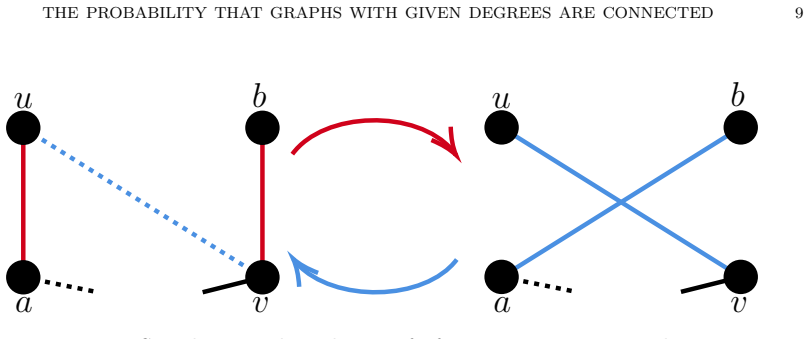

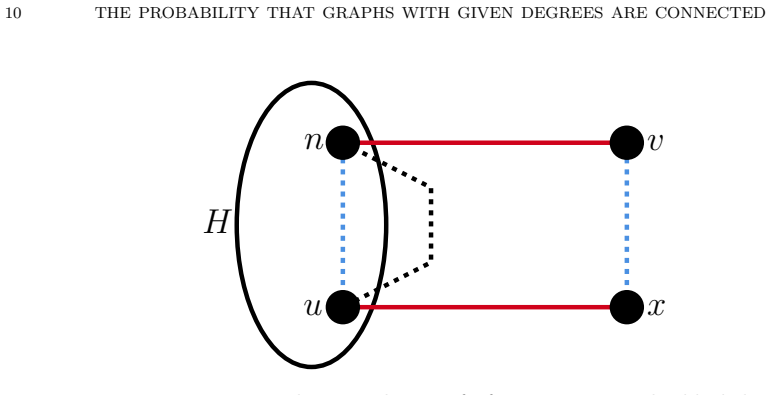


read the original abstract
An $n$-tuple $D=(d(1),\dots,d(n))$ is a \emph{feasible degree sequence} if there is a graph on $\{1,\dots,n\}$ such that $i$ has degree $d(i)$. Any such graph will have $m=\sum_{i=1}^n d(i)/2$ edges. Letting $G(D)$ be a graph chosen uniformly from those with the given degree sequence, we upper-bound the probability that $G(D)$ is disconnected based on the number of vertices of degree $d$ for small $d$, and develop a powerful tool for proving such bounds. If there are any vertices of degree zero the probability $G$ is disconnected is $1$, so we assume there are no such vertices. Our results then imply that if there are $o(\sqrt{m})$ vertices of degree $1$ and $o(m)$ vertices of degree 2 then with high probability $G$ is connected, while if there are no vertices of degree 1 or 2 then the probability $G$ is disconnected is $O(\frac{n^4}{m^6})$.
Editorial analysis
A structured set of objections, weighed in public.
Referee Report
Summary. The manuscript develops a combinatorial-probabilistic tool to upper-bound the disconnection probability of the uniform random graph G(D) on a feasible degree sequence D with no zero-degree vertices and m edges. It concludes that o(√m) degree-1 vertices together with o(m) degree-2 vertices imply that G(D) is connected with high probability, while the absence of both degree-1 and degree-2 vertices yields a disconnection probability of O(n⁴/m⁶). The bounds are obtained directly from the developed tool without parameter fitting.
Significance. If the stated bounds hold, the work supplies concrete, quantitative criteria for connectivity in the uniform model over prescribed degree sequences, extending classical results on random graphs with given degrees. The general tool for deriving disconnection bounds is a strength that may apply to other properties; the argument is direct, handles feasibility and minimum-degree conditions explicitly, and avoids circularity. This is a useful advance for network modeling and random-graph theory.
minor comments (2)
- [Abstract] Abstract: the phrase 'develop a powerful tool' would be strengthened by a one-sentence indication of the tool's main mechanism (e.g., counting or coupling argument) so readers can assess its scope immediately.
- [Introduction] The definition m = (1/2)∑ d(i) is used throughout; a single early display equation collecting all standing notation would improve readability.
Simulated Author's Rebuttal
We thank the referee for their positive assessment and recommendation to accept the manuscript. We are pleased that the significance of the combinatorial-probabilistic tool and its direct bounds on disconnection probability were recognized.
read point-by-point responses
-
Referee: No major comments were provided; the report consists of a summary, significance statement, and acceptance recommendation.
Authors: We appreciate the referee's recognition that the bounds hold directly from the developed tool without parameter fitting, that the argument handles feasibility and minimum-degree conditions explicitly, and that the tool may apply to other properties. This aligns with our goals of extending classical results on random graphs with given degrees. revision: no
Circularity Check
No significant circularity; derivation is self-contained combinatorial argument
full rationale
The paper develops an upper bound on the disconnection probability for the uniform model G(D) on feasible degree sequences with no isolated vertices, using direct combinatorial-probabilistic tools. The stated implications (whp connectivity when o(√m) degree-1 vertices and o(m) degree-2 vertices; O(n⁴/m⁶) bound with no degree-1 or -2 vertices) follow from this bound under the explicitly stated feasibility and minimum-degree conditions. No load-bearing steps reduce by construction to fitted parameters, self-definitions, or self-citation chains; the argument is independent of the target results and does not rename known patterns or smuggle ansatzes via prior work by the same authors.
Axiom & Free-Parameter Ledger
axioms (2)
- domain assumption D is a feasible (graphical) degree sequence
- domain assumption No vertices of degree zero
Forward citations
Cited by 1 Pith paper
-
The number and structure of connected graphs with a fixed degree sequence
The number of connected graphs with a given sparse degree sequence is identified up to exponential order by viewing them as giant components in a suitably chosen configuration model and applying a switching argument.
Reference graph
Works this paper leans on
-
[1]
Weighted sums of certain dependent random variables.Tohoku Mathematical Journal, 19(3):357 – 367, 1967
Kazuoki Azuma. Weighted sums of certain dependent random variables.Tohoku Mathematical Journal, 19(3):357 – 367, 1967. 14
1967
-
[2]
Bekessy, P
A. Bekessy, P. Bekessy, and Janos Komlos. Asymptotic enumeration of regular matrices. Studia Scientiarum Mathematicarum Hungarica, 7, 01 1972. 3
1972
-
[3]
Random regular graphs of non-constant degree: Connectivity and hamiltonicity.Combinatorics, Probability and Computing, 11(3):249–261,
Colin Cooper, Alan Frieze, and Bruce Reed. Random regular graphs of non-constant degree: Connectivity and hamiltonicity.Combinatorics, Probability and Computing, 11(3):249–261,
-
[4]
Critical window for connectivity in the config- uration model.Combinatorics, Probability and Computing, 26(5):660–680, 2017
Lorenzo Federico and Remco Van der Hofstad. Critical window for connectivity in the config- uration model.Combinatorics, Probability and Computing, 26(5):660–680, 2017. 5
2017
-
[5]
Subgraph probability of random graphs with specified degrees and applications to chromatic number and connectivity.Random Structures & Algorithms, 62(4):911–934, 2023
Pu Gao and Yuval Ohapkin. Subgraph probability of random graphs with specified degrees and applications to chromatic number and connectivity.Random Structures & Algorithms, 62(4):911–934, 2023. 5, 27
2023
-
[6]
A remark on the existence of finite graphs.Casopis Pest
V´ aclav Havel. A remark on the existence of finite graphs.Casopis Pest. Mat., 80:477–480,
-
[7]
How to determine if a random graph with a fixed degree sequence has a giant component.Probability Theory and Related Fields, 170(1):263–310, 2018
Felix Joos, Guillem Perarnau, Dieter Rautenbach, and Bruce Reed. How to determine if a random graph with a fixed degree sequence has a giant component.Probability Theory and Related Fields, 170(1):263–310, 2018. 5
2018
-
[8]
Sparse random graphs with a given degree sequence
Tomasz Luczak. Sparse random graphs with a given degree sequence. InRandom Graphs, volume 2, pages 165–182, 1992. 5
1992
-
[9]
Subgraphs of random graphs with specified degrees
Brendan D McKay. Subgraphs of random graphs with specified degrees. InCongressus Nu- merantium Volume 33, pages 213–223, 1981. 3
1981
-
[10]
A critical point for random graphs with a given degree sequence.Random Structures & Algorithms, 6(2-3):161–180, 1995
Michael Molloy and Bruce Reed. A critical point for random graphs with a given degree sequence.Random Structures & Algorithms, 6(2-3):161–180, 1995. 5
1995
-
[11]
James K. Senior. Partitions and their representative graphs.American Journal of Mathemat- ics, 73(3):663–689, 1951. 3
1951
-
[12]
The asymptotic connectivity of labelled regular graphs.Journal of Combinatorial Theory, Series B, 31(2):156–167, 1981
Nicholas C Wormald. The asymptotic connectivity of labelled regular graphs.Journal of Combinatorial Theory, Series B, 31(2):156–167, 1981. 2, 3, 5
1981
-
[13]
Nicholas C. Wormald. The asymptotic distribution of short cycles in random regular graphs. Journal of Combinatorial Theory, Series B, 31(2):168–182, 1981. 1
1981
discussion (0)
Sign in with ORCID, Apple, or X to comment. Anyone can read and Pith papers without signing in.