Recognition: unknown
Imprint of domain wall annihilation on induced gravitational waves
Pith reviewed 2026-05-07 15:48 UTC · model grok-4.3
The pith
Domain wall annihilation imprints a two-peaked spectrum on induced gravitational waves via an early matter-dominated phase.
A machine-rendered reading of the paper's core claim, the machinery that carries it, and where it could break.
Core claim
During annihilation of domain walls, most energy is transferred to the scalar responsible for the original Z2 breaking and to any coupled species. Provided the scalar lives long enough, its delayed decay creates an early matter-dominated phase that amplifies induced gravitational waves sourced by primordial perturbations. The subsequent transition back to radiation domination injects entropy that dilutes the domain-wall contribution while preserving the enhanced induced signal, thereby producing a gravitational-wave spectrum containing two separate peaks that are in principle detectable across complementary frequency bands.
What carries the argument
The temporary early matter-dominated era driven by the long-lived scalar produced in domain-wall annihilation, which amplifies primordial-perturbation-induced gravitational waves before entropy dilution occurs.
If this is right
- The gravitational-wave spectrum develops two distinct peaks separated by the duration of the matter-dominated phase.
- Multi-band detectors can observe the lower-frequency peak from the amplified induced waves and the higher-frequency peak from the diluted domain-wall contribution.
- The relative heights and frequency locations of the peaks encode the energy scale of the Z2 breaking and the lifetime of the scalar.
- Entropy injection at the end of the matter era suppresses the direct domain-wall gravitational-wave signal while leaving the induced component enhanced.
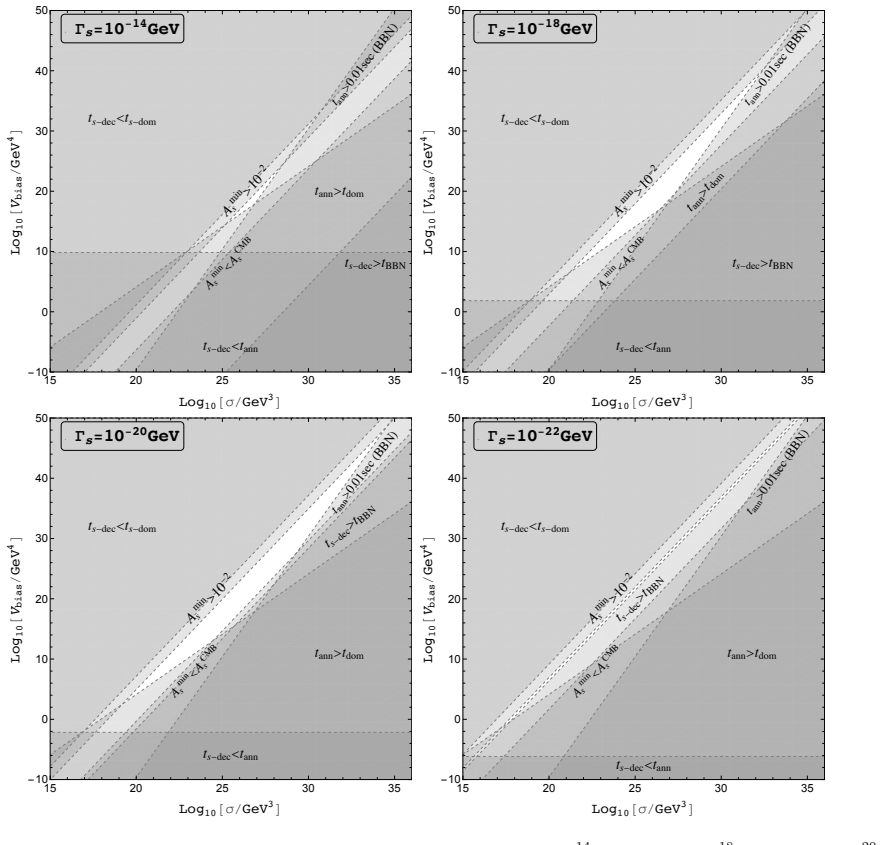
- The parameter space for detectable signals is explored by varying the symmetry-breaking scale and scalar lifetime.
Where Pith is reading between the lines
- Non-detection in planned pulsar-timing and space-based interferometers could place upper limits on the scalar lifetime relative to the annihilation temperature.
- The two-peak morphology may help distinguish this source from purely inflationary or phase-transition gravitational-wave backgrounds in combined data sets.
- If the scalar couples to Standard Model particles, its late decay could also produce observable entropy or baryon-asymmetry effects testable by other cosmological probes.
Load-bearing premise
The scalar field produced during domain wall annihilation must live long enough after the walls disappear to drive an early matter-dominated phase before it decays.
What would settle it
Observation of an induced gravitational-wave spectrum that shows neither the predicted amplitude boost nor the two-peak structure arising from an intervening matter-dominated era would falsify the mechanism.
Figures



read the original abstract
Domain wall annihilation can leave a distinctive imprint on the induced gravitational wave spectrum. During annihilation, most of the domain wall energy transforms into the scalar field responsible for the initial $\mathbb{Z}_2$ symmetry breaking that created the walls, along with any coupled species. If the produced scalar is sufficiently long-lived, its delayed decay drives an early matter-dominated phase following domain wall annihilation, significantly amplifying induced gravitational waves from primordial perturbations. The subsequent transition to radiation domination dilutes the domain wall contribution through entropy injection while preserving the enhanced induced signal. This creates a gravitational wave spectrum with two distinct peaks detectable across complementary frequency bands. We explore the observable parameter space and demonstrate how multi-band detection can probe early universe symmetry breaking.
Editorial analysis
A structured set of objections, weighed in public.
Referee Report
Summary. The manuscript argues that domain wall annihilation following Z_2 symmetry breaking can produce a distinctive two-peak signature in the induced gravitational wave spectrum. Most of the wall energy converts to a long-lived scalar (plus coupled species); if the scalar lifetime is long enough to drive an early matter-dominated era, induced GWs from primordial perturbations are amplified. Subsequent scalar decay injects entropy, diluting the domain-wall contribution while preserving the enhanced induced signal, yielding two observable peaks across complementary frequency bands. The authors map the viable parameter space in the scalar lifetime and symmetry-breaking scale.
Significance. If the mechanism and its parameter-space mapping hold, the work supplies a concrete, falsifiable link between high-scale symmetry breaking and multi-band GW observations. It extends standard induced-GW calculations by incorporating a transient matter-dominated phase and entropy dilution, offering a new handle on early-universe phase transitions that could be tested with LISA, PTA, and future detectors.
major comments (2)
- [§3 and §4] The central two-peak claim is conditional on the scalar being sufficiently long-lived to drive a prolonged early matter-dominated era after annihilation. The manuscript states this condition but does not provide a quantitative lower bound on the lifetime in terms of the annihilation time or the symmetry-breaking scale, nor does it show how the induced-GW enhancement factor scales when the condition is only marginally satisfied.
- [§4] The parameter-space exploration in §4 treats the scalar lifetime and symmetry-breaking scale as independent free parameters. No scan or exclusion plot is shown that incorporates the requirement that the scalar must remain long-lived while still decaying before BBN; this omission makes it difficult to judge how large a fraction of the quoted observable region survives realistic model-building constraints.
minor comments (2)
- [Abstract and §1] The abstract and introduction refer to 'complementary frequency bands' without specifying which detectors (LISA, PTA, etc.) are expected to cover each peak; adding a brief sentence or footnote would improve clarity.
- [§2] The notation for the GW energy-density spectrum is introduced without an explicit definition of the frequency variable or the normalization convention used for the two peaks; a short paragraph in §2 would remove ambiguity.
Simulated Author's Rebuttal
We thank the referee for the careful reading of our manuscript and the positive recommendation for minor revision. The comments have helped us strengthen the presentation of the conditions for the two-peak signature and the viability of the parameter space. We address each major comment below and have revised the manuscript accordingly.
read point-by-point responses
-
Referee: [§3 and §4] The central two-peak claim is conditional on the scalar being sufficiently long-lived to drive a prolonged early matter-dominated era after annihilation. The manuscript states this condition but does not provide a quantitative lower bound on the lifetime in terms of the annihilation time or the symmetry-breaking scale, nor does it show how the induced-GW enhancement factor scales when the condition is only marginally satisfied.
Authors: We agree that a quantitative lower bound on the scalar lifetime would make the central claim more precise. In the revised manuscript we have added an explicit derivation of the minimum lifetime τ_φ ≳ (t_ann / t_dom) × (ρ_wall / ρ_rad) required for the scalar to drive a prolonged matter-dominated era after domain-wall annihilation, expressed in terms of the annihilation time t_ann and the symmetry-breaking scale v. We have also included a supplementary figure that shows the scaling of the induced-GW enhancement factor as a function of the ratio τ_φ / t_ann in the marginally satisfied regime, confirming that the two-peak structure persists (albeit with reduced contrast) down to the boundary of the condition. revision: yes
-
Referee: [§4] The parameter-space exploration in §4 treats the scalar lifetime and symmetry-breaking scale as independent free parameters. No scan or exclusion plot is shown that incorporates the requirement that the scalar must remain long-lived while still decaying before BBN; this omission makes it difficult to judge how large a fraction of the quoted observable region survives realistic model-building constraints.
Authors: We thank the referee for highlighting this important consistency check. In the revised version we have performed a joint scan over the scalar lifetime and symmetry-breaking scale that enforces both the lower bound for matter domination (derived in response to the first comment) and the upper bound from BBN (decay temperature T_decay ≳ 1 MeV). The updated §4 now contains an exclusion plot in the (τ_φ, v) plane that shades the viable region satisfying all constraints; the plot explicitly indicates the surviving fraction of the previously quoted observable parameter space, which remains O(1) for the phenomenologically interesting range. revision: yes
Circularity Check
No significant circularity; derivation is self-contained
full rationale
The paper describes a sequence of standard cosmological processes: domain wall annihilation producing a long-lived scalar that drives an early matter-dominated era, amplifying induced GWs from primordial perturbations, followed by entropy dilution upon decay. No equations or claims in the abstract reduce by construction to fitted inputs, self-definitions, or self-citation chains. The central result (two-peak GW spectrum) follows directly from the stated physical assumptions without renaming known results or smuggling ansatze. The derivation relies on independent cosmological dynamics rather than internal loops.
Axiom & Free-Parameter Ledger
free parameters (2)
- scalar field lifetime
- symmetry breaking scale
axioms (3)
- domain assumption Z2 symmetry breaking leads to domain wall formation
- standard math Induced gravitational waves arise from scalar perturbations in radiation domination
- domain assumption Entropy injection from scalar decay transitions to radiation domination
Reference graph
Works this paper leans on
-
[1]
Once formed, their energy density dilutes slower (ρDW ∝t −1) in comparison to that of radiation and mat- ter, causing them to rapidly dominate the energy budget of the Universe. This famous DW problem can be re- solved by destabilizing the walls through explicit break- ing of the discrete symmetry [63] and introducing biased conditions at the time of form...
work page internal anchor Pith review Pith/arXiv arXiv 2026
-
[2]
The NANOGrav 15-year Data Set: Evidence for a Gravitational-Wave Background
G. Agazieet al.(NANOGrav), Astrophys. J. Lett.951, L8 (2023), arXiv:2306.16213 [astro-ph.HE]
work page internal anchor Pith review arXiv 2023
-
[3]
A. Afzalet al.(NANOGrav), Astrophys. J. Lett.951, L11 (2023), arXiv:2306.16219 [astro-ph.HE]
-
[4]
L. P. Grishchuk, Sov. Phys. JETP40, 409 (1975)
1975
-
[5]
A. A. Starobinsky, JETP Lett.30, 682 (1979)
1979
-
[6]
M. C. Guzzetti, N. Bartolo, M. Liguori, and S. Matar- rese, Riv. Nuovo Cim.39, 399 (2016), arXiv:1605.01615 [astro-ph.CO]
work page Pith review arXiv 2016
-
[7]
M. Giovannini, Phys. Rev. D58, 083504 (1998), arXiv:hep-ph/9806329
-
[8]
M. Giovannini, Phys. Rev. D60, 123511 (1999), arXiv:astro-ph/9903004
-
[9]
A. Riazuelo and J.-P. Uzan, Phys. Rev. D62, 083506 (2000), arXiv:astro-ph/0004156
-
[10]
N. Seto and J. Yokoyama, J. Phys. Soc. Jap.72, 3082 (2003), arXiv:gr-qc/0305096
- [11]
-
[12]
Y. Gouttenoire, G. Servant, and P. Simakachorn, (2021), arXiv:2111.01150 [hep-ph]
- [13]
-
[14]
A. Chakraborty, M. R. Haque, D. Maity, and R. Mon- dal, (2023), arXiv:2304.13637 [astro-ph.CO]
- [15]
- [16]
- [17]
-
[18]
Matarrese, O
S. Matarrese, O. Pantano, and D. Saez, Phys. Rev. D 47, 1311 (1993)
1993
-
[19]
S. Matarrese, O. Pantano, and D. Saez, Phys. Rev. Lett.72, 320 (1994), arXiv:astro-ph/9310036
-
[20]
S. Matarrese, S. Mollerach, and M. Bruni, Phys. Rev. D58, 043504 (1998), arXiv:astro-ph/9707278
-
[21]
S. Mollerach, D. Harari, and S. Matarrese, Phys. Rev. D69, 063002 (2004), arXiv:astro-ph/0310711
- [22]
-
[23]
D. Baumann, P. J. Steinhardt, K. Takahashi, and K. Ichiki, Phys. Rev. D76, 084019 (2007), arXiv:hep- th/0703290
-
[24]
Dom` enech, Universe7, 398 (2021), arXiv:2109.01398 [gr-qc]
G. Domènech, Universe7, 398 (2021), arXiv:2109.01398 [gr-qc]
-
[25]
R. Roshan and G. White, Rev. Mod. Phys.97, 015001 (2025), arXiv:2401.04388 [hep-ph]
-
[26]
Winicour, Astrophys
J. Winicour, Astrophys. J.182, 919 (1973)
1973
-
[27]
C. J. Hogan, Mon. Not. Roy. Astron. Soc.218, 629 (1986)
1986
-
[28]
Cosmological phase transitions: From perturbative particle physics to gravitational waves,
P. Athron, C. Balázs, A. Fowlie, L. Morris, and L. Wu, (2023), arXiv:2305.02357 [hep-ph]
-
[29]
C. Caprini, R. Durrer, and X. Siemens, Phys. Rev. D 82, 063511 (2010), arXiv:1007.1218 [astro-ph.CO]
-
[30]
Z. Arzoumanianet al.(NANOGrav), Phys. Rev. Lett. 127, 251302 (2021), arXiv:2104.13930 [astro-ph.CO]
-
[31]
X. Xueet al., Phys. Rev. Lett.127, 251303 (2021), arXiv:2110.03096 [astro-ph.CO]
-
[32]
P. Di Bari, D. Marfatia, and Y.-L. Zhou, JHEP10, 193 (2021), arXiv:2106.00025 [hep-ph]
- [33]
-
[34]
X. Siemens, V. Mandic, and J. Creighton, Phys. Rev. Lett.98, 111101 (2007), arXiv:astro-ph/0610920
-
[35]
Cosmic String Interpretation of NANOGrav Pulsar Timing Data,
J. Ellis and M. Lewicki, Phys. Rev. Lett.126, 041304 (2021), arXiv:2009.06555 [astro-ph.CO]
- [36]
-
[37]
From NANOGrav to LIGO with metastable cosmic strings,
W. Buchmuller, V. Domcke, and K. Schmitz, Phys. Lett. B811, 135914 (2020), arXiv:2009.10649 [astro- ph.CO]
-
[38]
Has NANOGrav found first evidence for cosmic strings?,
S. Blasi, V. Brdar, and K. Schmitz, Phys. Rev. Lett. 126, 041305 (2021), arXiv:2009.06607 [astro-ph.CO]
- [39]
- [40]
- [41]
- [42]
- [43]
- [44]
- [45]
-
[46]
Domènech, (2024), arXiv:2402.17388 [gr-qc]
G. Domènech, (2024), arXiv:2402.17388 [gr-qc]
-
[47]
New Ideas on the For- mationandAstrophysicalDetectionofPrimordialBlack Holes,
M. M. Flores and A. Kusenko, “New Ideas on the For- mationandAstrophysicalDetectionofPrimordialBlack Holes,” (2025) arXiv:2404.05430 [astro-ph.CO]
-
[48]
D. del Corral, K. S. Kumar, and J. Marto, Phys. Dark Univ.49, 101991 (2025), arXiv:2504.05875 [astro- ph.CO]
- [49]
- [50]
- [51]
- [52]
- [53]
- [54]
-
[55]
Vilenkin, Phys
A. Vilenkin, Phys. Rept.121, 263 (1985)
1985
-
[56]
E. W. Kolb and M. S. Turner,The Early Universe, Vol. 69 (1990)
1990
-
[57]
Decay of metastable topological defects,
J. Preskill and A. Vilenkin, Phys. Rev. D47, 2324 (1993), arXiv:hep-ph/9209210
-
[58]
Vilenkin and E
A. Vilenkin and E. P. S. Shellard,Cosmic strings and other topological defects(1994)
1994
-
[59]
T. D. Lee, Phys. Rept.9, 143 (1974)
1974
- [60]
- [61]
- [62]
- [63]
-
[64]
G. B. Gelmini, M. Gleiser, and E. W. Kolb, Phys. Rev. D39, 1558 (1989)
1989
- [65]
- [66]
- [67]
-
[68]
A review of gravitational waves from cosmic domain walls
K. Saikawa, Universe3, 40 (2017), arXiv:1703.02576 [hep-ph]
work page Pith review arXiv 2017
- [69]
- [70]
-
[71]
S. Bhattacharya, N. Mondal, R. Roshan, and D. Vat- syayan, JCAP06, 029 (2024), arXiv:2312.15053 [hep- ph]
- [72]
-
[73]
Y. Gouttenoire, S. F. King, R. Roshan, X. Wang, G. White, and M. Yamazaki, Phys. Rev. D112, 075007 (2025), arXiv:2501.16414 [hep-ph]
-
[74]
L. M. Widrow, Phys. Rev. D40, 1002 (1989)
1989
-
[75]
H. Assadullahi and D. Wands, Phys. Rev. D79, 083511 10 (2009), arXiv:0901.0989 [astro-ph.CO]
-
[76]
K. Jedamzik, M. Lemoine, and J. Martin, JCAP09, 034 (2010), arXiv:1002.3039 [astro-ph.CO]
-
[77]
L. Alabidi, K. Kohri, M. Sasaki, and Y. Sendouda, JCAP05, 033 (2013), arXiv:1303.4519 [astro-ph.CO]
-
[78]
K. Kohri and T. Terada, Phys. Rev. D97, 123532 (2018), arXiv:1804.08577 [gr-qc]
-
[79]
K. Inomata, K. Kohri, T. Nakama, and T. Ter- ada, Phys. Rev. D100, 043532 (2019), [Erratum: Phys.Rev.D 108, 049901 (2023)], arXiv:1904.12879 [astro-ph.CO]
-
[80]
K. Inomata, K. Kohri, T. Nakama, and T. Terada, JCAP10, 071 (2019), [Erratum: JCAP 08, E01 (2023)], arXiv:1904.12878 [astro-ph.CO]
discussion (0)
Sign in with ORCID, Apple, or X to comment. Anyone can read and Pith papers without signing in.