Recognition: unknown
EOS-Bench: A Comprehensive Benchmark for Earth Observation Satellite Scheduling
Pith reviewed 2026-05-07 14:21 UTC · model grok-4.3
The pith
EOS-Bench supplies 1,390 realistic scenarios and 13,900 instances to compare Earth observation satellite schedulers on quality and speed.
A machine-rendered reading of the paper's core claim, the machinery that carries it, and where it could break.
Core claim
EOS-Bench is established as a unified open framework that generates 1,390 scenarios and 13,900 benchmark instances by integrating high-fidelity orbital dynamics and platform constraints, covering small-scale cases through large coordination problems with up to 1,000 satellites. A scenario characterisation scheme quantifies difficulty via opportunity density, task flexibility, conflict intensity, and satellite congestion. A multidimensional protocol then evaluates solvers on task profit, completion rate, workload balance, timeliness, and runtime, demonstrating that the benchmark distinguishes performance across scales and conditions for mixed-integer programming, heuristics, meta-heuristics,,
What carries the argument
The EOS-Bench scenario generator that couples high-fidelity orbital dynamics with platform constraints to produce instances, together with the difficulty characterisation scheme and the five-metric evaluation protocol.
If this is right
- Researchers can now run controlled comparisons of mixed-integer programming, heuristics, meta-heuristics, and reinforcement learning on identical scenario sets.
- Trade-offs between solution quality and computational runtime become measurable across small, medium, and large problem scales.
- The characterisation scheme allows systematic study of how opportunity density and conflict intensity affect solver success.
- The open testbed supports reproducible extension to new algorithms and to both agile and non-agile satellite settings.
Where Pith is reading between the lines
- Widespread adoption could standardise evaluation practices and reduce duplicated effort in developing schedulers for operational missions.
- The same generation approach might be adapted to related large-scale scheduling domains such as drone fleet routing or ground station tasking.
- Future work could test whether the benchmark instances predict performance on proprietary real-world datasets from specific satellite operators.
Load-bearing premise
The generated scenarios with integrated high-fidelity orbital dynamics and platform constraints accurately represent the structural difficulty and real-world complexity of actual Earth observation satellite scheduling problems.
What would settle it
If algorithms ranked highly by EOS-Bench produce markedly worse schedules on real satellite mission data than lower-ranked ones, or if real problems show different difficulty patterns than the generated set, the benchmark's representativeness would be falsified.
Figures





read the original abstract
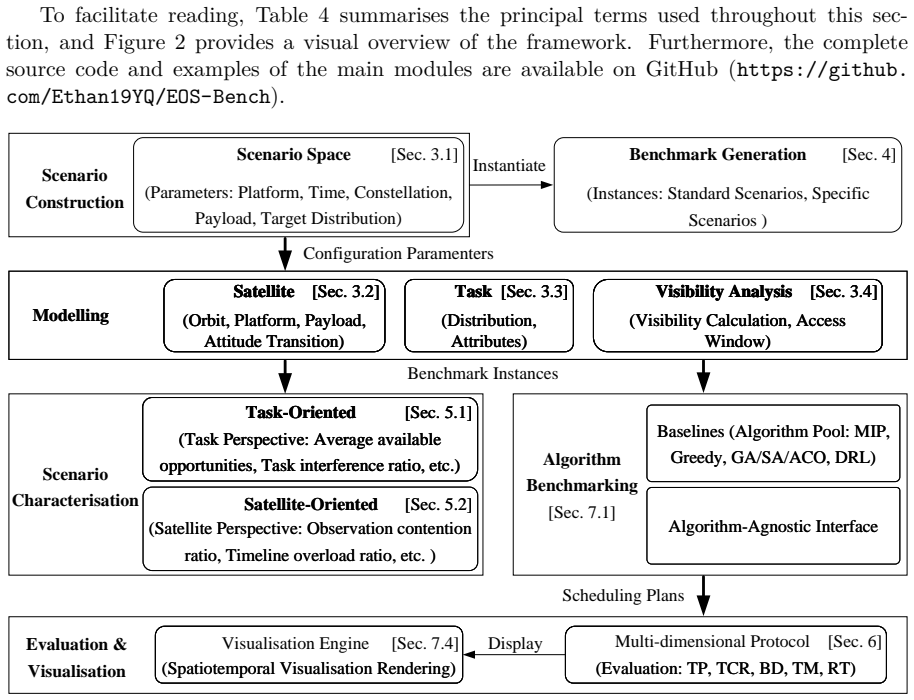
Earth observation satellite imaging scheduling is a challenging NP-hard combinatorial optimisation problem central to space mission operations. While next-generation agile Earth observation satellites (EOS) increase operational flexibility, they also significantly raise scheduling complexity. The lack of a unified, open-source benchmark makes it difficult to compare algorithms across studies. This paper introduces EOS-Bench, a comprehensive framework for systematic and reproducible evaluation of scheduling methods. By integrating high-fidelity orbital dynamics and platform constraints, EOS-Bench generates 1,390 scenarios and 13,900 benchmark instances, spanning from small-scale validation cases to large coordination problems with up to 1,000 satellites and 10,000 requests. We further propose a scenario characterisation scheme to quantify structural difficulty based on factors such as opportunity density, task flexibility, conflict intensity, and satellite congestion. A multidimensional evaluation protocol is introduced, assessing performance across five metrics: task profit, completion rate, workload balance, timeliness, and runtime. The framework is evaluated using mixed-integer programming, heuristics, meta-heuristics, and deep reinforcement learning across both agile and non-agile settings. Results show that EOS-Bench effectively distinguishes solver performance across scales and conditions, revealing trade-offs between solution quality and computational efficiency, and providing deeper insight into scenario complexity. EOS-Bench offers a unified and extensible open testbed for advancing research in Earth observation satellite scheduling. The code and data are available at https://github.com/Ethan19YQ/EOS-Bench.
Editorial analysis
A structured set of objections, weighed in public.
Referee Report
Summary. The paper introduces EOS-Bench, an open benchmark framework for Earth observation satellite (EOS) scheduling. It generates 1,390 scenarios and 13,900 instances using high-fidelity orbital dynamics and platform constraints, covering agile and non-agile cases from small validation instances to large problems with up to 1,000 satellites and 10,000 requests. A characterization scheme quantifies structural difficulty via opportunity density, task flexibility, conflict intensity, and satellite congestion. A multidimensional evaluation protocol assesses solvers (MIP, heuristics, meta-heuristics, DRL) on five metrics: task profit, completion rate, workload balance, timeliness, and runtime. Results indicate the benchmark distinguishes performance across scales and conditions while revealing quality-efficiency trade-offs.
Significance. If the synthetic scenarios prove representative of real operational complexity, EOS-Bench fills a notable gap by supplying a unified, extensible, and publicly available testbed (with code and data at the cited GitHub repository) for comparing optimization and learning-based methods on an NP-hard problem. This could standardize evaluations, enable reproducible cross-study comparisons, and accelerate progress on agile EOS scheduling where flexibility increases both capability and difficulty.
major comments (2)
- [§3] §3 (Scenario Generation and Characterization): The 1,390 scenarios are produced from high-fidelity orbital dynamics and platform constraints, yet no quantitative comparison is reported against real historical schedules or operator-provided instances (e.g., no Kolmogorov-Smirnov tests or moment-matching on opportunity density or conflict intensity distributions). Because the central claim that EOS-Bench 'provides deeper insight into scenario complexity' rests on these instances reflecting actual structural difficulty, the absence of external validation leaves open the possibility that reported solver distinctions are generator-specific artifacts.
- [§5] §5 (Evaluation Protocol and Results): The multidimensional protocol reports trade-offs across scales, but without a sensitivity analysis that perturbs generation parameters (e.g., varying conflict intensity thresholds or orbital assumptions) and re-ranks the MIP/heuristic/DRL solvers, it is unclear whether the observed performance distinctions are robust or tied to the particular synthetic model. This directly affects the claim that the benchmark 'effectively distinguishes solver performance across scales and conditions.'
minor comments (2)
- [Abstract] The derivation of the 13,900 instances from the 1,390 scenarios (apparently 10 instances per scenario) should be stated explicitly in the text or a table, including how random seeds or perturbations are applied.
- A summary table listing the ranges or distributions of the four characterization metrics across the scenario set would help readers assess coverage without consulting the repository.
Simulated Author's Rebuttal
We thank the referee for the constructive and detailed feedback on EOS-Bench. The comments highlight important aspects of external validation and robustness that we address point by point below. We indicate the revisions we will incorporate where feasible.
read point-by-point responses
-
Referee: [§3] §3 (Scenario Generation and Characterization): The 1,390 scenarios are produced from high-fidelity orbital dynamics and platform constraints, yet no quantitative comparison is reported against real historical schedules or operator-provided instances (e.g., no Kolmogorov-Smirnov tests or moment-matching on opportunity density or conflict intensity distributions). Because the central claim that EOS-Bench 'provides deeper insight into scenario complexity' rests on these instances reflecting actual structural difficulty, the absence of external validation leaves open the possibility that reported solver distinctions are generator-specific artifacts.
Authors: We acknowledge that a direct quantitative comparison to real historical schedules would provide stronger support for the representativeness of the generated scenarios. Real operational EOS scheduling data is typically proprietary and unavailable for public benchmarking due to mission sensitivities. Our generation process employs established high-fidelity orbital dynamics and constraint models drawn from the peer-reviewed literature on EOS operations. The proposed characterization scheme focuses on measurable structural properties (opportunity density, task flexibility, conflict intensity, satellite congestion) that are recognized in the domain as primary drivers of scheduling difficulty. In the revised manuscript we will expand §3 with an explicit limitations subsection that discusses the synthetic nature of the benchmark, cites the validation status of the underlying models, and clarifies that EOS-Bench is intended as a standardized, extensible testbed rather than a replica of any single operator’s dataset. We cannot perform Kolmogorov-Smirnov or moment-matching tests without access to the requisite real instances. revision: partial
-
Referee: [§5] §5 (Evaluation Protocol and Results): The multidimensional protocol reports trade-offs across scales, but without a sensitivity analysis that perturbs generation parameters (e.g., varying conflict intensity thresholds or orbital assumptions) and re-ranks the MIP/heuristic/DRL solvers, it is unclear whether the observed performance distinctions are robust or tied to the particular synthetic model. This directly affects the claim that the benchmark 'effectively distinguishes solver performance across scales and conditions.'
Authors: We agree that an explicit sensitivity analysis would strengthen the robustness claim. Although the existing 1,390 scenarios already span wide ranges of scales and structural conditions, we did not systematically perturb isolated generation parameters (such as conflict-intensity thresholds) and re-rank solvers. In the revised version we will add a dedicated sensitivity subsection in §5. For a representative subset of scenarios we will vary key parameters (conflict intensity, task flexibility, and orbital assumptions within realistic bounds) and report whether the relative ordering of MIP, heuristic, meta-heuristic, and DRL solvers remains consistent across the five metrics. This analysis will be included in the next manuscript version. revision: yes
- Quantitative comparison of scenario distributions against real historical or operator-provided EOS schedules (e.g., via Kolmogorov-Smirnov tests or moment matching), because such detailed instances are not publicly available.
Circularity Check
No significant circularity; benchmark results are direct empirical evaluations on externally supplied generated instances.
full rationale
The paper generates 1,390 scenarios from high-fidelity orbital dynamics and platform constraints, defines a characterisation scheme (opportunity density, task flexibility, conflict intensity, satellite congestion), runs MIP, heuristics, meta-heuristics and DRL solvers, and reports performance on five metrics. No derivation step reduces a claimed distinction or insight to a quantity defined by the paper's own fitted parameters or prior self-citations. The central claim rests on observable differences across the supplied instances rather than any self-referential prediction or uniqueness theorem. Code and data are released publicly, allowing independent reproduction outside the paper's internal choices.
Axiom & Free-Parameter Ledger
axioms (1)
- domain assumption High-fidelity orbital dynamics and platform constraints can be faithfully encoded in the scenario generator
Reference graph
Works this paper leans on
-
[1]
X. Wang, G. Wu, W. Pedrycz, L. Xing, Agile earth observation satellite scheduling over 20 years: Formulations, methods, and future directions, IEEE Systems Journal 15 (2020) 3881–3892. doi: 10.1109/JSYST.2020.2997050
-
[2]
Y. Gu, C. Han, Y. Chen, S. Liu, X. Wang, Large region targets observation schedul- ing by multiple satellites using resampling particle swarm optimization, IEEE Trans- actions on Aerospace and Electronic Systems 59 (2022) 1800–1815. doi: 10.1109/TAES. 2022.3205565
-
[3]
Y. Gu, H. Liu, T. Pan, S. Bai, J. Liu, Y. Wu, G. Wu, Ensemble time freedom heuristic and intelligent optimization algorithm for relay satellites scheduling considering multi- type task requirements, Expert Systems with Applications 316 (2026) 131815. doi: 10. 1016/j.eswa.2026.131815
-
[4]
L. Michel, G. Verfaillie, F. Jouhaud, J.-M. Lachiver, N. Bataille, Selecting and scheduling observations of agile satellites, Aerospace Science and Technology 6 (2002) 367–381. doi:10.1016/S1270-9638(02)01173-2
-
[5]
B. Ferrari, J.-F. Cordeau, M. Delorme, M. Iori, R. Orosei, Satellite scheduling problems: A survey of applications in earth and outer space observation, Computers & Operations Research 173 (2025) 106875. doi: 10.1016/j.cor.2024.106875
-
[6]
Y. Chen, J. Lu, R. He, J. Ou, An efficient local search heuristic for earth observation satellite integrated scheduling problems, Applied Sciences 10 (2020) 5616. doi: 10.3390/ app10165616
2020
-
[8]
L. Wei, Y. Chen, M. Chen, Y.-W. Chen, Deep reinforcement learning and parameter transfer based approach for the multi-objective agile earth observation satellite scheduling problem, Applied Soft Computing 110 (2021) 107607. doi: 10.1016/j.asoc.2021.107607. 62
-
[10]
Y. Rocha, G. O. Chagas, L. C. Coelho, A. Subramanian, The integrated agile earth observation satellite scheduling problem, Computers & Operations Research 184 (2025) 107212. doi: 10.1016/j.cor.2025.107212
-
[11]
A. E. Vasegaard, A. K. Larsen, EOSpython version 0.0.11: A framework for sce- nario generation and a solution system for the agile earth observation satellite schedul- ing problem, arXiv preprint arXiv:2410.13462 (2024). doi: 10.48550/arXiv.2410.13462. arXiv:2410.13462
- [12]
-
[13]
P. W. Kenneally, S. Piggott, H. Schaub, Basilisk: A flexible, scalable and modular astrodynamics simulation framework, Journal of aerospace information systems 17 (2020) 496–507. doi: 10.2514/1.I010762
-
[14]
P. Tangpattanakul, N. Jozefowiez, P. Lopez, A multi-objective local search heuristic for scheduling earth observations taken by an agile satellite, European Journal of Operational Research 245 (2015) 542–554. doi: 10.1016/j.ejor.2015.03.011
-
[15]
X. Liu, G. Laporte, Y. Chen, R. He, An adaptive large neighborhood search metaheuristic for agile satellite scheduling with time-dependent transition time, Computers & Opera- tions Research 86 (2017) 41–53. doi: 10.1016/j.cor.2017.04.006
-
[16]
G. Peng, G. Song, Y. He, J. Yu, S. Xiang, L. Xing, P. Vansteenwegen, Solving the agile earth observation satellite scheduling problem with time-dependent transition times, IEEE Transactions on Systems, Man, and Cybernetics: Systems 52 (2022) 1614–1625. doi:10.1109/TSMC.2020.3031738
-
[17]
G. Peng, R. Dewil, C. Verbeeck, A. Gunawan, L. Xing, P. Vansteenwegen, Agile earth observation satellite scheduling: An orienteering problem with time-dependent profits and travel times, Computers & Operations Research 111 (2019) 84–98. doi: 10.1016/j.cor. 2019.05.030
-
[18]
G. Peng, G. Song, L. Xing, A. Gunawan, P. Vansteenwegen, An exact algorithm for agile earth observation satellite scheduling with time-dependent profits, Computers & Operations Research 120 (2020) 104946. doi: 10.1016/j.cor.2020.104946
-
[19]
F. Perea, R. Vazquez, J. Galán-Vioque, Swath-acquisition planning in multiple-satellite missions: an exact and heuristic approach, IEEE Transactions on Aerospace and Elec- tronic Systems 51 (2015) 1717–1725. doi: 10.1109/TAES.2015.130751. 63
-
[20]
X.-W. Wang, Z. Chen, C. Han, Scheduling for single agile satellite, redundant targets problem using complex networks theory, Chaos, Solitons & Fractals 83 (2016) 125–132. doi:10.1016/j.chaos.2015.12.003
-
[21]
C. G. Valicka, D. Garcia, A. Staid, J.-P. Watson, G. Hackebeil, S. Rathinam, L. Ntaimo, Mixed-integer programming models for optimal constellation scheduling given cloud cover uncertainty, European Journal of Operational Research 275 (2019) 431–445. doi: 10.1016/ j.ejor.2018.11.043
2019
-
[22]
X. Wang, Y. Gu, G. Wu, J. R. Woodward, Robust scheduling for multiple agile earth ob- servation satellites under cloud coverage uncertainty, Computers & Industrial Engineering 156 (2021) 107292. doi: 10.1016/j.cie.2021.107292
-
[23]
C. He, Y. Dong, H. Li, Y. Liew, Reasoning-based scheduling method for agile earth observation satellite with multi-subsystem coupling, Remote Sensing 15 (2023) 1577. doi:10.3390/rs15061577
-
[24]
C. A. Rigo, L. O. Seman, E. Camponogara, E. Morsch Filho, E. A. Bezerra, P. Munari, A branch-and-price algorithm for nanosatellite task scheduling to improve mission quality- of-service, European Journal of Operational Research 303 (2022) 168–183. doi: 10.1016/ j.ejor.2022.02.040
2022
-
[25]
X. Wang, R. Leus, C. Han, Fixed interval scheduling of multiple earth observation satel- lites with multiple observations, in: 2018 9th International Conference on Mechanical and Aerospace Engineering (ICMAE), IEEE, 2018, pp. 28–33. doi: 10.1109/ICMAE.2018. 8467667
-
[26]
E. Camponogara, L. O. Seman, C. A. Rigo, E. Morsch Filho, B. F. Ribeiro, E. A. Bezerra, A continuous-time formulation for optimal task scheduling and quality-of- service assurance in nanosatellites, Computers & Operations Research 147 (2022) 105945. doi:10.1016/j.cor.2022.105945
-
[27]
L. O. Seman, C. A. Rigo, E. Camponogara, P. Munari, E. A. Bezerra, Improving energy aware nanosatellite task scheduling by a branch-cut-and-price algorithm, Computers & Operations Research 158 (2023) 106292. doi: 10.1016/j.cor.2023.106292
-
[28]
R. Tharmarasa, T. Kirubarajan, J. Berger, M. C. Florea, Mixed open-and-closed loop satellite task planning, in: 2019 22th International Conference on Information Fusion (FU- SION), IEEE, Ottawa, ON, Canada, 2019, pp. 1–8. doi: 10.23919/FUSION43075.2019. 9011405
-
[29]
G. Wu, Z. Xiang, Y. Wang, Y. Gu, W. Pedrycz, Improved adaptive large neighborhood search algorithm based on the two-stage framework for scheduling multiple super-agile satellites, IEEE Transactions on Aerospace and Electronic Systems 60 (2024) 7185–7200. doi:10.1109/TAES.2024.3416427. 64
-
[30]
M. Barkaoui, J. Berger, A new hybrid genetic algorithm for the collection scheduling problem for a satellite constellation, Journal of the Operational Research Society 71 (2020) 1390–1410. doi: 10.1080/01605682.2019.1609891
-
[31]
Z. Chang, Z. Zhou, L. Xing, F. Yao, Integrated scheduling problem for earth observa- tion satellites based on three modeling frameworks: An adaptive bi-objective memetic algorithm, Memetic Computing 13 (2021) 203–226. doi: 10.1007/s12293-021-00333-w
-
[32]
G. Wu, Q. Luo, X. Du, Y. Chen, P. N. Suganthan, X. Wang, Ensemble of metaheuristic and exact algorithm based on the divide-and-conquer framework for multisatellite obser- vation scheduling, IEEE Transactions on Aerospace and Electronic Systems 58 (2022) 4396–4408. doi: 10.1109/TAES.2022.3160993
-
[33]
J. Qi, M. Hu, L. Xing, A decompose-and-learn multi-objective algorithm for scheduling large-scale earth observation satellites, Swarm and Evolutionary Computation 92 (2025) 101792. doi: 10.1016/j.swevo.2024.101792
-
[34]
L. Liu, Z. Dong, H. Su, D. Yu, A study of distributed earth observation satellites mission scheduling method based on game-negotiation mechanism, Sensors 21 (2021) 6660. doi: 10. 3390/s21196660
2021
-
[35]
H. Fan, Z. Yang, X. Zhang, S. Wu, J. Long, L. Liu, A novel multi-satellite and multi- task scheduling method based on task network graph aggregation, Expert Systems with Applications 205 (2022) 117565. doi: 10.1016/j.eswa.2022.117565
-
[36]
H. Sun, W. Xia, Z. Wang, X. Hu, Agile earth observation satellite scheduling algorithm for emergency tasks based on multiple strategies, Journal of Systems Science and Systems Engineering 30 (2021) 626–646. doi: 10.1007/s11518-021-5506-4
-
[37]
T. Stollenwerk, V. Michaud, E. Lobe, M. Picard, A. Basermann, T. Botter, Agile earth ob- servation satellite scheduling with a quantum annealer, IEEE Transactions on Aerospace and Electronic Systems 57 (2021) 3520–3528. doi: 10.1109/TAES.2021.3088490
-
[38]
S. Rainjonneau, I. Tokarev, S. Iudin, S. Rayaprolu, K. Pinto, D. Lemtiuzhnikova, M. Koblan, E. Barashov, M. Kordzanganeh, M. Pflitsch, A. Melnikov, Quantum al- gorithms applied to satellite mission planning for earth observation, IEEE Journal of Selected Topics in Applied Earth Observations and Remote Sensing 16 (2023) 7062–7075. doi:10.1109/JSTARS.2023.3287154
-
[39]
X. Sun, Y. Ren, L. Yu, Adaptive-strategies-based quantum genetic algorithm for agile earth observation satellite scheduling problem, IEEE Aerospace and Electronic Systems Magazine 40 (2025) 4–15. doi: 10.1109/MAES.2025.3547993
-
[40]
X. Sun, Y. Ren, L. Yu, Multi-adaptive strategies-based higher-order quantum genetic algorithm for agile remote sensing satellite scheduling problem, Sensors 24 (2024) 4938. doi:10.3390/s24154938. 65
-
[41]
V. Marchioli, M. Boggio, D. Volpe, L. Massotti, C. Novara, Quantum optimization for closed-loop scheduling of earth observation satellite formation, SN Computer Science 6 (2025) 739. doi: 10.1007/s42979-025-04252-2
-
[43]
A. Herrmann, H. Schaub, A comparative analysis of reinforcement learning algorithms for earth-observing satellite scheduling, Frontiers in Space Technologies 4 (2023) 1263489. doi:10.3389/frspt.2023.1263489
-
[44]
Y. Song, J. Ou, W. Pedrycz, P. N. Suganthan, X. Wang, L. Xing, Y. Zhang, Generalized model and deep reinforcement learning-based evolutionary method for multitype satellite observation scheduling, IEEE Transactions on Systems, Man, and Cybernetics: Systems 54 (2024) 2576–2589. doi: 10.1109/TSMC.2023.3345928
-
[45]
Z. Wen, L. Li, J. Song, S. Zhang, H. Hu, Scheduling single-satellite observation and transmission tasks by using hybrid actor-critic reinforcement learning, Advances in Space Research 71 (2023) 3883–3896. doi: 10.1016/j.asr.2022.10.024
-
[46]
Z. Wen, Y. Liu, S. Zhang, H. Hu, Scheduling observation tasks for large-scale satellite constellation, Journal of Physics: Conference Series 2746 (2024) 012040. doi: 10.1088/ 1742-6596/2746/1/012040
2024
-
[47]
Z. Li, X. Zhu, C. Liu, J. Song, Y. Liu, C. Yin, W. Sun, Dynamic task scheduling optimiza- tion by rolling horizon deep reinforcement learning for distributed satellite system, Expert Systems with Applications 289 (2025) 128350. doi: 10.1016/j.eswa.2025.128350
-
[48]
B. Li, M. Chen, L. Xing, Y. Chen, Y. Chen, Optimizing time-dependent multi-agile earth observation satellite scheduling problem using deep Q-learning and ensemble heuristics, Information Sciences 712 (2025) 122140. doi: 10.1016/j.ins.2025.122140
-
[49]
Z. Liu, W. Xiong, Z. Jia, C. Han, Two-stage deep reinforcement learning method for agile optical satellite scheduling problem, Complex & Intelligent Systems 11 (2025) 35. doi:10.1007/s40747-024-01667-x
-
[50]
G. Li, X. Li, J. Li, J. Chen, X. Shen, PTMB: An online satellite task scheduling framework based on pre-trained markov decision process for multi-task scenario, Knowledge-Based Systems 284 (2024) 111339. doi: 10.1016/j.knosys.2023.111339
-
[51]
Y. Liu, Z. Wen, S. Zhang, H. Hu, Learning-based constellation scheduling for time- sensitive space multi-target collaborative observation, Advances in Space Research 73 (2024) 4751–4766. doi: 10.1016/j.asr.2024.02.013
-
[52]
W. Yao, X. Shen, G. Zhang, Z. Lu, J. Wang, Y. Song, Z. Li, A spiking neural network based proximal policy optimization method for multi-point imaging mission scheduling 66 of earth observation satellite, Swarm and Evolutionary Computation 94 (2025) 101867. doi:10.1016/j.swevo.2025.101867
-
[53]
X. Chen, T. Tian, G. Dai, M. Wang, Z. Song, L. Xing, Deep reinforcement learning- based resource allocation method for multi-satellite scheduling, Computers & Operations Research 181 (2025) 107088. doi: 10.1016/j.cor.2025.107088
-
[54]
X. Chen, T. Tian, G. Dai, M. Wang, Z. Song, W. Zheng, Q. Zhou, A conflict rain- bow DQN-based two-stage optimization framework for multiple agile satellites schedul- ing, IEEE Transactions on Aerospace and Electronic Systems 61 (2025) 7251–7263. doi:10.1109/TAES.2025.3538476
-
[55]
L. He, X. Liu, G. Laporte, Y. Chen, Y. Chen, An improved adaptive large neighbor- hood search algorithm for multiple agile satellites scheduling, Computers & Operations Research 100 (2018) 12–25. doi: 10.1016/j.cor.2018.06.020
-
[56]
Y. Chen, M. Xu, X. Shen, G. Zhang, Z. Lu, J. Xu, A multi-objective modeling method of multi-satellite imaging task planning for large regional mapping. remote sens. 2020; 12: 344, Remote Sensing 12 (2020) 344. doi: 10.3390/rs12030344
-
[57]
Y. Chen, X. Shen, G. Zhang, Z. Lu, Large-scale multi-objective imaging satellite task planning algorithm for vast area mapping, Remote Sensing 15 (2023) 4178. doi: 10.3390/ rs15174178
2023
-
[59]
X. Wu, Y. Yang, Y. Xie, Q. Ma, Z. Zhang, Multiregion mission planning by satellite swarm using simulated annealing and neighborhood search, IEEE Transactions on Aerospace and Electronic Systems 60 (2023) 1416–1439. doi: 10.1109/TAES.2023.3337066
-
[60]
X. Zeng, R. Yuan, L. Yang, X. Huang, S. Li, Long-term multi-region observation schedul- ing for large-scale constellations via two-stage hybrid planning, Aerospace Science and Technology 169 (2025) 111358. doi: 10.1016/j.ast.2025.111358
-
[62]
X. Han, M. Yang, S. Wang, T. Chao, Continuous monitoring scheduling for moving targets by earth observation satellites, Aerospace Science and Technology 140 (2023) 108422. doi: 10.1016/j.ast.2023.108422
-
[63]
Y. Cong, X. Mei, S. Sun, T. Liu, G. Guan, C. Wei, Autonomous collaborative observation method for time-sensitive moving target tracking by satellite swarms, Advances in Space Research 75 (2025) 5615–5629. doi: 10.1016/j.asr.2025.01.012. 67
-
[64]
X. Wang, G. Song, R. Leus, C. Han, Robust earth observation satellite scheduling with uncertainty of cloud coverage, IEEE Transactions on Aerospace and Electronic Systems 56 (2019) 2450–2461. doi: 10.1109/TAES.2019.2947978
-
[65]
C. Han, Y. Gu, G. Wu, X. Wang, Simulated annealing-based heuristic for multiple agile satellites scheduling under cloud coverage uncertainty, IEEE Transactions on Systems, Man, and Cybernetics: Systems 53 (2022) 2863–2874. doi: 10.1109/TSMC.2022.3220534
-
[66]
L. He, B. Liang, J. Li, M. Sheng, Joint observation and transmission scheduling in agile satellite networks, IEEE Transactions on Mobile Computing 21 (2022) 4381–4396. doi:10.1109/TMC.2021.3076088
-
[67]
G. Yu, K. Zhang, Research on the integrated scheduling of imaging and data transmission for earth observation satellites, Algorithms 18 (2025) 418. doi: 10.3390/a18070418
-
[69]
J. Wang, X. Zhu, L. T. Yang, J. Zhu, M. Ma, Towards dynamic real-time scheduling for multiple earth observation satellites, Journal of Computer and System Sciences 81 (2015) 110–124. doi: 10.1016/j.jcss.2014.06.016
-
[70]
Z. Chang, Z. Zhou, Three multi-objective memetic algorithms for observation schedul- ing problem of active-imaging agile earth observation satellites, Annals of Operations Research 346 (2025) 861–893. doi: 10.1007/s10479-024-06156-5
-
[71]
H. Li, Y. Li, Y. Liu, K. Zhang, X. Li, Y. Li, S. Zhao, A multi-objective dynamic mission- scheduling algorithm considering perturbations for earth observation satellites, Aerospace 11 (2024) 643. doi: 10.3390/aerospace11080643
-
[72]
L. Ren, X. Ning, Z. Wang, A competitive markov decision process model and a recursive reinforcement-learning algorithm for fairness scheduling of agile satellites, Computers & Industrial Engineering 169 (2022) 108242. doi: 10.1016/j.cie.2022.108242
-
[73]
X. Li, C. Sun, H. Fan, J. Yang, Remote-sensing satellite mission scheduling optimisation method under dynamic mission priorities, Mathematics 12 (2024) 1704. doi: 10.3390/ math12111704
2024
-
[74]
D.-H. Cho, J.-H. Kim, H.-L. Choi, J. Ahn, Optimization-based scheduling method for agile earth-observing satellite constellation, Journal of Aerospace Information Systems 15 (2018) 611–626. doi: 10.2514/1.I010620
-
[75]
J. Bonnet, M.-P. Gleizes, E. Kaddoum, S. Rainjonneau, G. Flandin, Multi-satellite mis- sion planning using a self-adaptive multi-agent system, in: 2015 IEEE 9th International Conference on Self-Adaptive and Self-Organizing Systems, IEEE, Cambridge, MA, USA, 2015, pp. 11–20. doi: 10.1109/SASO.2015.9. 68
-
[76]
G. Povéda, O. Regnier-Coudert, F. Teichteil-Königsbuch, G. Dupont, A. Arnold, J. Guerra, M. Picard, Evolutionary approaches to dynamic earth observation satel- lites mission planning under uncertainty, in: Proceedings of the Genetic and Evolu- tionary Computation Conference, ACM, Prague, Czech Republic, 2019, pp. 1302–1310. doi:10.1145/3321707.3321859
-
[77]
F. Cividanes, M. Ferreira, F. Kucinskis, An extended HTN language for onboard planning and acting applied to a goal-based autonomous satellite, IEEE Aerospace and Electronic Systems Magazine 36 (2021) 32–50. doi: 10.1109/MAES.2021.3070857
-
[78]
Hilton, K
S. Hilton, K. Thangavel, A. Gardi, R. Sabatini, Intelligent mission planning for au- tonomous distributed satellite systems, Acta Astronautica 225 (2024) 857–869. doi: 10. 1016/j.actaastro.2024.08.050
2024
- [79]
-
[80]
IEEE Geosci Remote Sens Lett 14(8):1288–1292
W. Huang, H. Wang, J. Wu, H. Hou, J. Li, Z. Li, Y. Song, A reinforcement learning- enhanced dung beetle optimization approach for agile earth observation satellite schedul- ing, IEEE Geoscience and Remote Sensing Letters 22 (2025) 1–5. doi: 10.1109/LGRS. 2025.3527925
-
[81]
D. Eddy, M. Kochenderfer, Markov decision processes for multi-objective satellite task planning, in: 2020 IEEE Aerospace Conference, IEEE, Big Sky, MT, USA, 2020, pp. 1–12. doi: 10.1109/AERO47225.2020.9172258
-
[82]
H. Wang, W. Huang, S. Magnússon, T. Lindgren, R. Wang, Y. Song, A strategy fusion- based multiobjective optimization approach for agile earth observation satellite scheduling problem, IEEE Transactions on Geoscience and Remote Sensing 62 (2024) 1–14. doi: 10. 1109/TGRS.2024.3472749
-
[83]
J. Secker, K. Biron, D. Dessureault, P. Lamontagne, R. Rear, Automated collection planning for civilian and commercial satellite imagery, and definition and exploitation of the collection asset specification data structure, IEEE Journal of Selected Topics in Applied Earth Observations and Remote Sensing 18 (2025) 9764–9797. doi: 10.1109/ JSTARS.2025.3555925
-
[84]
S. Hosseinabadi, M. Ranjbar, S. Ramyar, M. Amel-Monirian, Scheduling a constellation of agile earth observation satellites with preemption, Journal of Quality Engineering and Production Optimization 2 (2017) 47–64. doi: 10.22070/JQEPO.2017.1776.1037
-
[85]
H. Li, Y. Liu, B. Deng, Y. Li, X. Li, Y. Li, T. Zhang, S. Zhao, A two-stage schedul- ing algorithm based on pointer network with attention mechanism for micro-nano earth observation satellite constellation, Chinese Journal of Aeronautics 38 (2025) 103567. doi:10.1016/j.cja.2025.103567. 69
-
[86]
Herrmann, J
A. Herrmann, J. V. Carneiro, H. Schaub, Reinforcement learning for the multi-satellite earth-observing scheduling problem, in: M. Sandnas, D. B. Spencer (Eds.), Proceedings of the 44th Annual American Astronautical Society Guidance, Navigation, and Control Conference, 2022, volume 179, Springer International Publishing, Cham, 2024, pp. 1351–
2022
discussion (0)
Sign in with ORCID, Apple, or X to comment. Anyone can read and Pith papers without signing in.