Recognition: unknown
At the Edge of the Heart: ULP FPGA-Based CNN for On-Device Cardiac Feature Extraction in Smart Health Sensors for Astronauts
Pith reviewed 2026-05-07 14:22 UTC · model grok-4.3
The pith
An FPGA-based CNN enables real-time seismocardiography classification at 98% accuracy using only 8.55 mW.
A machine-rendered reading of the paper's core claim, the machinery that carries it, and where it could break.
Core claim
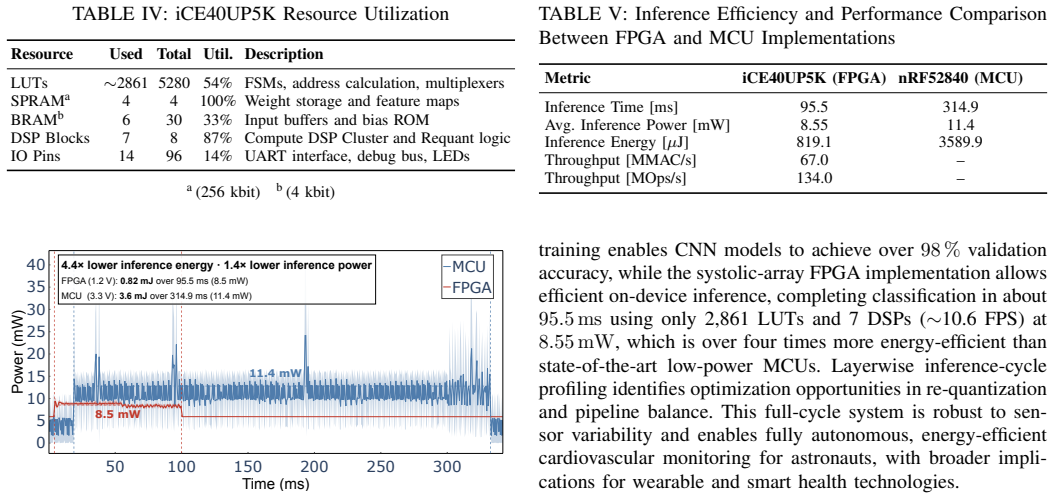
The implementation achieves a validation accuracy of 98% while consuming only 8.55 mW, completing inference in 95.5 ms with minimal hardware resources (2,861 LUTs and 7 DSP blocks). These results demonstrate that fully on-device SCG-based cardiac feature extraction is feasible on resource-constrained hardware, enabling energy-efficient, autonomous health monitoring for astronauts in long-duration space missions.
What carries the argument
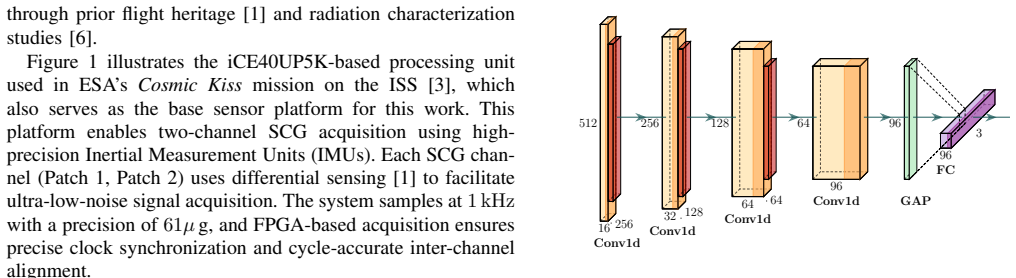
Systolic-array accelerator with quantization-aware training that supports integer-only inference on the Lattice iCE40UP5K FPGA.
If this is right
- Real-time cardiac feature extraction becomes possible directly on battery-powered wearables without external processors.
- Power draw low enough to support continuous monitoring throughout long-duration space missions.
- Hardware footprint small enough to fit inside compact astronaut health sensors.
- The same quantized systolic design can be reused for other vibration-based physiological signals.
Where Pith is reading between the lines
- The approach could transfer to terrestrial remote patient monitoring where power and size are also limited.
- Signal patterns in microgravity may differ enough to require retraining or additional calibration data.
- Combining this SCG classifier with other on-device sensors could create multi-modal health dashboards.
- Radiation resilience of the chosen FPGA may allow similar accelerators in other high-radiation environments.
Load-bearing premise
The SCG dataset and validation conditions represent the cardiac vibration signals astronauts would produce under microgravity and spaceflight stressors.
What would settle it
Running the trained model on SCG recordings collected from human subjects in simulated microgravity or actual spaceflight and measuring whether accuracy remains near 98%.
Figures



read the original abstract
The convergence of accelerating human spaceflight ambitions and critical terrestrial health monitoring demands is driving unprecedented requirements for reliable, real-time feature extraction on extremely resource-constrained wearable health sensors. We present an ultra-low-power (ULP) Field-Programmable Gate Array (FPGA) based solution for real-time Seismocardiography (SCG) feature classification using Convolutional Neural Networks (CNNs). Our approach combines quantization-aware training with a systolic-array accelerator to enable efficient integer-only inference on the Lattice iCE40UP5K FPGA, which offers an ideal platform for battery-powered deployments -- particularly in space environments -- thanks to its power efficiency and radiation resilience. The implementation achieves a validation accuracy of 98% while consuming only 8.55 mW, completing inference in 95.5 ms with minimal hardware resources (2,861 LUTs and 7 DSP blocks). These results demonstrate that fully on-device SCG-based cardiac feature extraction is feasible on resource-constrained hardware, enabling energy-efficient, autonomous health monitoring for astronauts in long-duration space missions.
Editorial analysis
A structured set of objections, weighed in public.
Referee Report
Summary. The manuscript presents a quantized CNN systolic-array accelerator implemented on the Lattice iCE40UP5K FPGA for real-time classification of seismocardiography (SCG) signals. It reports 98% validation accuracy, 8.55 mW power consumption, 95.5 ms inference latency, and resource usage of 2,861 LUTs with 7 DSP blocks, achieved via quantization-aware training and integer-only inference. The work is motivated by on-device cardiac monitoring for astronauts but presents the space context primarily as application framing rather than a validated claim on microgravity data.
Significance. If the measured metrics hold under independent reproduction, the result is significant for demonstrating that accurate CNN inference for physiological signal classification is feasible on ultra-low-power FPGAs with minimal resources. The explicit inclusion of quantization-aware training procedure, exact layer dimensions, integer-only inference schedule, and post-place-and-route power measurements on the target device provides a reproducible implementation path that strengthens the contribution to edge ML hardware design.
major comments (2)
- [§4] §4 (or equivalent results section): the 98% validation accuracy is reported as a single scalar without accompanying details on dataset size, class distribution, train/validation split methodology, or any form of cross-validation or hold-out testing. This information is load-bearing for assessing whether the accuracy reflects genuine generalization rather than favorable partitioning or post-training tuning, directly affecting the central performance claim.
- [Abstract and §1] Abstract and §1: the SCG dataset and validation conditions are not shown to be representative of cardiac vibration signals under microgravity or spaceflight stressors (e.g., no mention of altered signal characteristics due to fluid shifts or vibration environments). While the paper correctly frames this as motivation rather than a tested claim, the absence of even a brief discussion of domain-shift risks weakens the applicability argument for the astronaut use case.
minor comments (2)
- [Table 1] Table 1 (resource utilization): the reported LUT and DSP counts should be accompanied by the exact post-PAR clock frequency and the breakdown of BRAM usage to allow direct comparison with other iCE40UP5K designs.
- [§3.2] §3.2 (quantization section): the bit-width choices for weights and activations are stated but the sensitivity analysis or ablation showing why 8-bit integer was selected over 4-bit or 16-bit is not provided; a short table would clarify the accuracy-power trade-off.
Simulated Author's Rebuttal
We thank the referee for the constructive and detailed feedback, which highlights important aspects for strengthening the manuscript's claims on validation robustness and applicability framing. We address each major comment below with honest responses and indicate planned revisions.
read point-by-point responses
-
Referee: [§4] §4 (or equivalent results section): the 98% validation accuracy is reported as a single scalar without accompanying details on dataset size, class distribution, train/validation split methodology, or any form of cross-validation or hold-out testing. This information is load-bearing for assessing whether the accuracy reflects genuine generalization rather than favorable partitioning or post-training tuning, directly affecting the central performance claim.
Authors: We agree that the absence of these details limits the ability to fully assess generalization. The current manuscript reports the 98% validation accuracy as a scalar without specifying dataset size, class balance, split methodology, or cross-validation procedures. In the revised version, we will expand §4 to include: the total number of SCG recordings and samples used, the class distribution (e.g., proportions of normal vs. feature-specific classes), the train/validation split ratio and selection method (e.g., stratified random split with percentages), and explicit confirmation of hold-out testing. If k-fold cross-validation was performed during development, we will describe the procedure and any variance in results. These additions will be supported by the existing experimental setup without changing the reported accuracy metric. revision: yes
-
Referee: [Abstract and §1] Abstract and §1: the SCG dataset and validation conditions are not shown to be representative of cardiac vibration signals under microgravity or spaceflight stressors (e.g., no mention of altered signal characteristics due to fluid shifts or vibration environments). While the paper correctly frames this as motivation rather than a tested claim, the absence of even a brief discussion of domain-shift risks weakens the applicability argument for the astronaut use case.
Authors: We acknowledge that while the space context is correctly presented as motivational framing rather than a validated claim, the lack of any discussion on domain-shift risks does weaken the applicability argument. Our experiments rely on terrestrial SCG datasets, and we do not have access to microgravity-specific data for direct validation. In the revision, we will add a concise paragraph in §1 (and reference it in the abstract if space permits) explicitly discussing potential domain shifts, including effects like fluid redistribution altering cardiac vibration patterns and spacecraft vibration noise. We will note these as limitations and suggest future directions such as domain adaptation techniques. This addition addresses the concern directly while preserving the honest framing of the work as a hardware proof-of-concept. revision: yes
Circularity Check
No significant circularity; results are measured implementation outcomes
full rationale
The manuscript reports a concrete FPGA implementation (quantization-aware training, systolic array on iCE40UP5K, post-P&R power/latency/resource measurements) whose central metrics (98% validation accuracy, 8.55 mW, 95.5 ms, 2,861 LUTs, 7 DSPs) are obtained by direct synthesis and execution on the target hardware. No equations, uniqueness theorems, or fitted-parameter predictions are presented that reduce to the inputs by construction. The SCG dataset usage and space-motivation framing are external to any derivation chain and do not create self-referential loops. This is the most common honest finding for implementation papers whose claims rest on measured hardware results rather than analytic derivations.
Axiom & Free-Parameter Ledger
free parameters (2)
- Quantization bit width
- CNN layer dimensions and filter counts
axioms (1)
- domain assumption SCG time-series contain classifiable cardiac features that a CNN can extract after quantization
Reference graph
Works this paper leans on
-
[1]
A differential BCG sensor system for long term health monitoring experiment on the ISS,
U. Kulau, J. Rust, D. Szafranski, M. Drobczyk, and U.-V . Albrecht, “A differential BCG sensor system for long term health monitoring experiment on the ISS,” in2022 18th International Conference on Distributed Computing in Sensor Systems (DCOSS). IEEE, 2022, pp. 85–92
2022
-
[2]
Wireless Compose-2: A wireless communication network with a ballistocardiography smart-shirt experiment in the ISS Columbus module,
M. Drobczyk, A. L ¨ubken, C. Strowik, U. Kulau, J. Rust, J. Beringer, and U.-V . Albrecht, “Wireless Compose-2: A wireless communication network with a ballistocardiography smart-shirt experiment in the ISS Columbus module,” in2021 IEEE International Conference on Wireless for Space and Extreme Environments (WiSEE). IEEE, 2021, pp. 103– 108
2021
-
[3]
A wireless communication network with a ballistocar- diography experiment on the ISS: Scenario, components and preflight demonstration,
M. Drobczyk, A. L ¨ubken, C. Strowik, U.-V . Albrecht, J. Rust, J. Beringer, and U. Kulau, “A wireless communication network with a ballistocar- diography experiment on the ISS: Scenario, components and preflight demonstration,”IEEE Journal of Radio Frequency Identification, vol. 6, pp. 258–268, 2022
2022
-
[4]
Deep learning predicts cardiac output from seismocardiographic signals in heart failure,
J. Wang, S. M. Nouraie, N. J. Kelly, and S. Y . Chan, “Deep learning predicts cardiac output from seismocardiographic signals in heart failure,” The American journal of cardiology, 2025
2025
-
[5]
Application of machine learning algorithms for SCG signal classification,
N. Konnova, M. Basarab, and V . Khaperskaya, “Application of machine learning algorithms for SCG signal classification,” in2020 International Conference on Image, Video Processing and Artificial Intelligence, vol. 11584. SPIE, 2020, pp. 374–379
2020
-
[6]
ISFD: Efficient and fault-tolerant in-system-failure-detection for LP FPGA- based smart-sensors in space expeditions,
K. M. A. Rahman, T. Dirkes, B. Delfs, V . Wyrwoll, and U. Kulau, “ISFD: Efficient and fault-tolerant in-system-failure-detection for LP FPGA- based smart-sensors in space expeditions,” in2024 20th International Conference on Distributed Computing in Smart Systems and the Internet of Things (DCOSS-IoT). IEEE, 2024, pp. 74–83
2024
-
[7]
The NASA twins study: A multidimensional analysis of a year-long human spaceflight,
F. E. Garrett-Bakelman, M. Darshi, S. J. Green, R. C. Gur, L. Lin, B. R. Macias, M. J. McKenna, C. Meydan, T. Mishra, J. Nasriniet al., “The NASA twins study: A multidimensional analysis of a year-long human spaceflight,”Science, vol. 364, no. 6436, p. eaau8650, 2019
2019
-
[8]
Ballis- tocardiography and seismocardiography: A review of recent advances,
O. T. Inan, P.-F. Migeotte, K.-S. Park, M. Etemadi, K. Tavakolian, R. Casanella, J. Zanetti, J. Tank, I. Funtova, G. K. Prisket al., “Ballis- tocardiography and seismocardiography: A review of recent advances,” IEEE Journal of Biomedical and Health Informatics, vol. 19, no. 4, pp. 1414–1427, 2015
2015
-
[9]
Recent advances in seismocardiography,
A. Taebi, B. E. Solar, A. J. Bomar, R. H. Sandler, and H. A. Mansy, “Recent advances in seismocardiography,”Journal of Biomedical Engi- neering and Medical Imaging, vol. 6, no. 1, pp. 1–12, 2019
2019
-
[10]
Systolic time intervals in heart failure in man,
A. M. Weissler, W. S. Harris, and C. D. Schoenfeld, “Systolic time intervals in heart failure in man,”Circulation, vol. 37, no. 2, pp. 149–159, 1968
1968
-
[11]
Diastolic time – stress for the heart: A new index of myocardial perfusion,
T. Bombardini, V . Gemignani, E. Bianchini, L. Furlan, L. Pratali, and E. Picano, “Diastolic time – stress for the heart: A new index of myocardial perfusion,”European Heart Journal Supplements, vol. 11, no. Supplement E, pp. E12–E18, 2009
2009
-
[12]
Going deeper with embedded FPGA platform for convolutional neural network,
J. Qiu, J. Wang, S. Yao, K. Guo, B. Li, E. Zhou, J. Yu, T. Tang, N. Xu, S. Songet al., “Going deeper with embedded FPGA platform for convolutional neural network,” inProceedings of the 2016 ACM/SIGDA international symposium on field-programmable gate arrays, 2016, pp. 26–35
2016
-
[13]
DNNBuilder: An automated tool for building high-performance DNN hardware accelerators for FPGAs,
X. Zhang, J. Wang, C. Zhu, Y . Lin, J. Xiong, W.-m. Hwu, and D. Chen, “DNNBuilder: An automated tool for building high-performance DNN hardware accelerators for FPGAs,” in2018 IEEE/ACM International Conference on Computer-Aided Design (ICCAD). IEEE, 2018, pp. 1–8
2018
-
[14]
A survey of design and optimization for systolic array-based DNN accelerators,
R. Xu, S. Ma, Y . Guo, and D. Li, “A survey of design and optimization for systolic array-based DNN accelerators,”ACM Computing Surveys, vol. 56, no. 1, pp. 1–37, 2023
2023
-
[15]
Automated systolic array architecture synthesis for high throughput CNN inference on FPGAs,
X. Wei, C. H. Yu, P. Zhang, Y . Chen, Y . Wang, H. Hu, Y . Liang, and J. Cong, “Automated systolic array architecture synthesis for high throughput CNN inference on FPGAs,” inProceedings of the 54th Annual Design Automation Conference 2017, 2017, pp. 1–6
2017
-
[16]
Quantization and training of neural networks for efficient integer-arithmetic-only inference,
B. Jacob, S. Kligys, B. Chen, M. Zhu, M. Tang, A. Howard, H. Adam, and D. Kalenichenko, “Quantization and training of neural networks for efficient integer-arithmetic-only inference,” inProceedings of the IEEE conference on computer vision and pattern recognition, 2018, pp. 2704– 2713
2018
-
[17]
Fbgemm: Enabling high-performance low- precision deep learning inference,
D. Khudia, J. Huang, P. Basu, S. Deng, H. Liu, J. Park, and M. Smelyan- skiy, “FBGEMM: Enabling high-performance low-precision deep learn- ing inference,”arXiv preprint arXiv:2101.05615, 2021
-
[18]
Kung,Why systolic architecture?Design Research Center, Carnegie-Mellon University Pittsburgh, PA, USA, 1982
H.-T. Kung,Why systolic architecture?Design Research Center, Carnegie-Mellon University Pittsburgh, PA, USA, 1982
1982
-
[19]
A systematic methodology for characterizing scalability of DNN accelerators using SCALE-Sim,
A. Samajdar, J. M. Joseph, Y . Zhu, P. Whatmough, M. Mattina, and T. Krishna, “A systematic methodology for characterizing scalability of DNN accelerators using SCALE-Sim,” in2020 IEEE International Symposium on Performance Analysis of Systems and Software (ISPASS). IEEE, 2020, pp. 58–68
2020
-
[20]
Gemmini: Enabling systematic deep- learning architecture evaluation via full-stack integration,
H. Genc, S. Kim, A. Amid, A. Haj-Ali, V . Iyer, P. Prakash, J. Zhao, D. Grubb, H. Liew, H. Maoet al., “Gemmini: Enabling systematic deep- learning architecture evaluation via full-stack integration,” in2021 58th ACM/IEEE Design Automation Conference (DAC). IEEE, 2021, pp. 769–774
2021
-
[21]
In-datacenter perfor- mance analysis of a tensor processing unit,
N. P. Jouppi, C. Young, N. Patil, D. Patterson, G. Agrawal, R. Bajwa, S. Bates, S. Bhatia, N. Boden, A. Borcherset al., “In-datacenter perfor- mance analysis of a tensor processing unit,” inProceedings of the 44th annual international symposium on computer architecture, 2017, pp. 1– 12
2017
-
[22]
[Online]
Lattice Semiconductor Corporation,iCE40 UltraPlus Family Data Sheet, Lattice Semiconductor, Hillsboro, OR, USA, 2025, document Number: DS-02008, Version 2.4. [Online]. Available: https://www.latticesemi.com/
2025
-
[23]
Identify- ing gravity-related artifacts on ballistocardiography signals by comparing weightlessness and normal gravity recordings (ARTIFACTS): Protocol for an observational study,
U.-V . Albrecht, A. Mielitz, K. M. A. Rahman, U. Kulauet al., “Identify- ing gravity-related artifacts on ballistocardiography signals by comparing weightlessness and normal gravity recordings (ARTIFACTS): Protocol for an observational study,”JMIR Research Protocols, vol. 13, no. 1, p. e63306, 2024
2024
-
[24]
Wavelet-driven denoising and cross-axis fusion for automated SCG systolic/diastolic window extraction,
K. Rahman, U.-V . Albrecht, and U. Kulau, “Wavelet-driven denoising and cross-axis fusion for automated SCG systolic/diastolic window extraction,” inProceedings of the 22nd GI/ITG KuVS Fachgespr ¨ach Sensornetze (FGSN), 2025
2025
-
[25]
Label Studio: Data labeling software,
M. Tkachenko, M. Malyuk, A. Holmanyuk, and N. Liubimov, “Label Studio: Data labeling software,” 2020-2025, open source software available from https://github.com/HumanSignal/label-studio. [Online]. Available: https://github.com/HumanSignal/label-studio
2020
-
[26]
Decoupled weight decay regularization,
I. Loshchilov and F. Hutter, “Decoupled weight decay regularization,”
-
[27]
Decoupled Weight Decay Regularization
[Online]. Available: https://arxiv.org/abs/1711.05101
work page internal anchor Pith review arXiv
discussion (0)
Sign in with ORCID, Apple, or X to comment. Anyone can read and Pith papers without signing in.