Non-uniqueness of nonlinear Markov processes in the sense of McKean associated with parabolic PDEs
Pith reviewed 2026-05-07 15:14 UTC · model grok-4.3
The pith
Nonlinear Markov processes in the McKean sense associated with parabolic PDEs are not uniquely determined by their one-dimensional time marginals.
A machine-rendered reading of the paper's core claim, the machinery that carries it, and where it could break.
Core claim
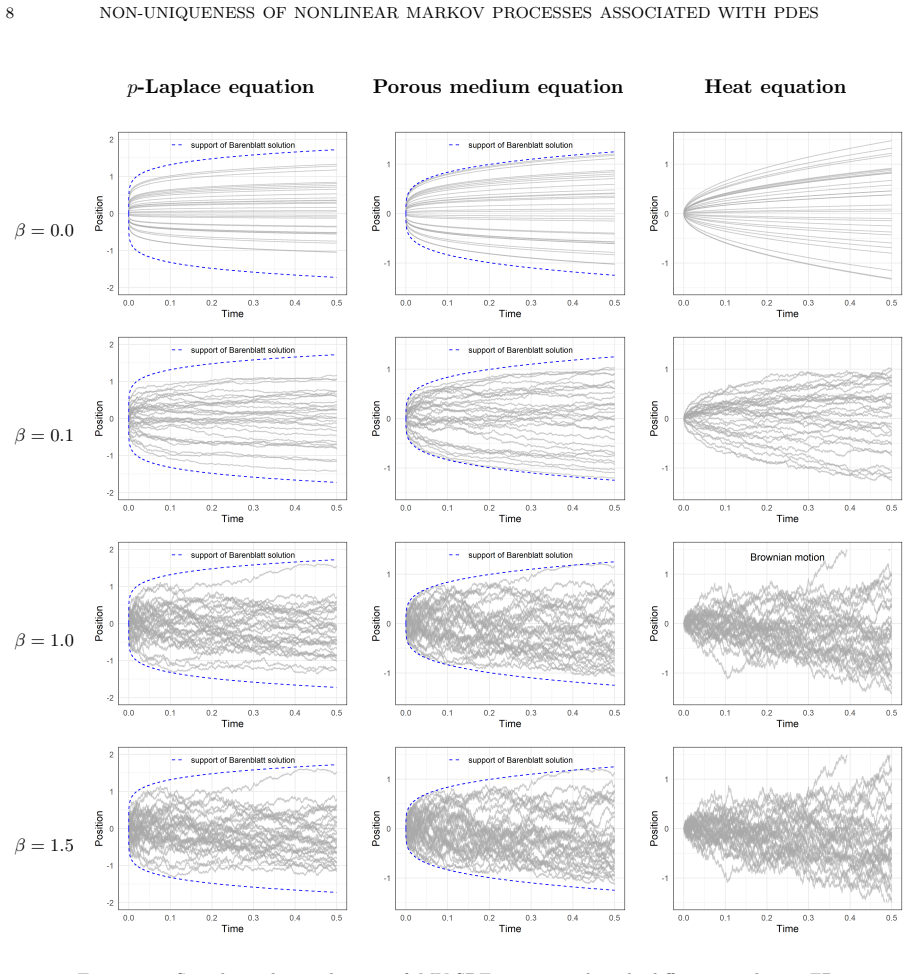
We derive a general scheme to construct infinitely many probabilistic counterparts for solutions to nonlinear PDEs by recasting the latter as different nonlinear Fokker-Planck equations and by constructing, for each of these equations, a solution to the associated McKean-Vlasov SDE with one-dimensional time marginal densities given by the PDE solution. We utilize this scheme to prove that nonlinear Markov processes in the sense of McKean are not uniquely determined by their one-dimensional time marginals. This is in sharp contrast to the case of classical Markov processes. We demonstrate our results by constructing a continuum of nonlinear Markov processes with one-dimensional time marginals
What carries the argument
McKean-Vlasov SDE whose coefficients are chosen so that its one-dimensional marginal densities solve a chosen nonlinear Fokker-Planck equation equivalent to the original PDE.
If this is right
- A continuum of distinct nonlinear Markov processes exists whose one-dimensional marginal densities are the Barenblatt solutions of the porous-medium and p-Laplace equations.
- The same continuum exists for the fundamental solution of the heat equation.
- Nonlinear Markov processes are uniquely determined by their two-dimensional time marginals.
- The different McKean-Vlasov equations constructed for the porous-medium equation are consistent with corresponding gradient-flow interpretations in the sense of Otto calculus.
- A novel martingale representation holds for the p-Laplace Barenblatt solutions.
Where Pith is reading between the lines
- Higher-order marginals or pathwise regularity conditions become necessary to select a unique nonlinear Markov process when only the PDE solution is given.
- Particle approximations based on different choices of the underlying McKean-Vlasov equation may converge to the same density while producing different sample-path statistics.
- The non-uniqueness may extend to other linear or semilinear PDEs when they are viewed through families of nonlinear Fokker-Planck recastings.
Load-bearing premise
Every nonlinear PDE solution under consideration can be recast as a nonlinear Fokker-Planck equation for which a McKean-Vlasov SDE exists whose one-dimensional marginals coincide with the PDE solution.
What would settle it
An explicit nonlinear PDE together with two distinct McKean-Vlasov SDEs whose solutions share identical one-dimensional marginal densities but cannot be distinguished on path space.
Figures



read the original abstract
We derive a general scheme to construct infinitely many probabilistic counterparts for solutions to nonlinear PDEs by recasting the latter as different nonlinear Fokker--Planck equations and by constructing, for each of these equations, a solution to the associated McKean--Vlasov SDE with one-dimensional time marginal densities given by the PDE solution. We utilize this scheme to prove that nonlinear Markov processes in the sense of McKean as introduced by Rehmeier--R\"ockner (J.\,Theor.\,Probab. 38, 60 (2025)) are not uniquely determined by their one-dimensional time marginals. This is in sharp contrast to the case of classical Markov processes, which are uniquely determined by their one-dimensional time marginals. We demonstrate our results by constructing a continuum of nonlinear Markov processes with one-dimensional time marginal densities given by the Barenblatt solutions to the porous medium and $p$-Laplace equations, as well as by the fundamental solution to the heat equation. This includes a novel martingale representation for the $p$-Laplace Barenblatt solutions. We also prove that a nonlinear Markov process is uniquely determined by its two-dimensional time marginals. Moreover, for the porous medium equation, we show that the different McKean--Vlasov SDEs we investigate are consistent with corresponding gradient flow interpretations of the equation in the sense of Otto calculus.
Editorial analysis
A structured set of objections, weighed in public.
Referee Report
Summary. The paper develops a general scheme to recast solutions of nonlinear parabolic PDEs (such as Barenblatt profiles for the porous-medium and p-Laplace equations, and the fundamental solution of the heat equation) as nonlinear Fokker-Planck equations with different law-dependent coefficients b(·,·,μ) and σ(·,·,μ). For each such recasting it constructs a McKean-Vlasov SDE whose solution process has exactly the prescribed one-dimensional marginals, thereby producing a continuum of distinct nonlinear Markov processes (in the Rehmeier-Röckner sense) sharing the same marginal flow. The manuscript also proves that two-dimensional marginals determine the process uniquely and verifies consistency with Otto-calculus gradient-flow structures for the porous-medium case, including a novel martingale representation for the p-Laplace Barenblatt solution.
Significance. If the existence and marginal-matching claims are fully substantiated, the result supplies a concrete, falsifiable demonstration that nonlinear Markov processes are not uniquely determined by one-dimensional marginals, in sharp contrast to the classical Markov case. The explicit constructions, the two-dimensional uniqueness theorem, and the gradient-flow consistency are genuine strengths that would advance the probabilistic theory of nonlinear PDEs.
major comments (3)
- §3 (general scheme) and §4.1–4.3 (explicit constructions): the central non-uniqueness claim rests on the existence of weak solutions to each of the constructed McKean-Vlasov SDEs that possess precisely the PDE marginals. The manuscript invokes a martingale-problem approach and a novel representation for the p-Laplace case, but does not supply the requisite a-priori estimates or tightness arguments that guarantee weak existence when the coefficients become degenerate on the compact support of the Barenblatt profile. Without these verifications the continuum of processes collapses to a single (or empty) set.
- §4.2 (p-Laplace Barenblatt): the passage from the new martingale representation to an actual weak solution of the time-inhomogeneous SDE with frozen measure μ_t requires verification that the resulting integrands remain in L^2 and that the quadratic variation matches the prescribed diffusion coefficient; this step is only sketched and is load-bearing for the claimed non-uniqueness in the p-Laplace family.
- §2.2 (definition of nonlinear Markov process): the scheme assumes that every nonlinear PDE solution under consideration admits at least one nonlinear Fokker-Planck recasting for which a McKean-Vlasov SDE exists; the paper does not state the precise coefficient regularity or monotonicity conditions that would guarantee this existence for arbitrary parabolic nonlinearities, leaving the scope of the general scheme unclear.
minor comments (3)
- Notation for the law-dependent coefficients b(x,t,μ) and σ(x,t,μ) is introduced in §2 but used inconsistently in the SDE statements of §3; a single displayed equation collecting all coefficient choices would improve readability.
- The two-dimensional marginal uniqueness proof in §5 is self-contained and elegant, yet the statement of the theorem should explicitly list the moment or integrability assumptions inherited from the one-dimensional marginals.
- Several references to the 2025 Rehmeier-Röckner paper appear without page numbers; adding them would facilitate verification of the adopted definition.
Simulated Author's Rebuttal
We thank the referee for the thorough and constructive report. The comments correctly identify areas where additional rigor is needed to substantiate the existence claims and to clarify the scope of the general scheme. We address each major comment below and indicate the corresponding revisions.
read point-by-point responses
-
Referee: §3 (general scheme) and §4.1–4.3 (explicit constructions): the central non-uniqueness claim rests on the existence of weak solutions to each of the constructed McKean-Vlasov SDEs that possess precisely the PDE marginals. The manuscript invokes a martingale-problem approach and a novel representation for the p-Laplace case, but does not supply the requisite a-priori estimates or tightness arguments that guarantee weak existence when the coefficients become degenerate on the compact support of the Barenblatt profile. Without these verifications the continuum of processes collapses to a single (or empty) set.
Authors: We agree that the weak existence of the McKean-Vlasov SDEs must be established with explicit estimates, especially under degeneracy. In the revised manuscript we will insert a new subsection after §3 that derives uniform moment bounds from the PDE energy estimates and uses the compact support of the Barenblatt profiles to obtain tightness in C([0,T];P(R^d)) via Aldous' criterion. For the porous-medium and heat-equation cases the coefficients remain bounded on the support; for the p-Laplace family the novel martingale representation supplies the necessary integrability. revision: yes
-
Referee: §4.2 (p-Laplace Barenblatt): the passage from the new martingale representation to an actual weak solution of the time-inhomogeneous SDE with frozen measure μ_t requires verification that the resulting integrands remain in L^2 and that the quadratic variation matches the prescribed diffusion coefficient; this step is only sketched and is load-bearing for the claimed non-uniqueness in the p-Laplace family.
Authors: We will expand the argument in §4.2 into a complete proof. Using the explicit martingale representation, we will verify that each integrand belongs to L^2(μ_t) by direct computation with the known decay and regularity of the Barenblatt density. We will then show that the quadratic variation process equals the integral of the squared diffusion coefficient against μ_t, thereby confirming that the constructed process solves the time-inhomogeneous SDE with the required marginals. revision: yes
-
Referee: §2.2 (definition of nonlinear Markov process): the scheme assumes that every nonlinear PDE solution under consideration admits at least one nonlinear Fokker-Planck recasting for which a McKean-Vlasov SDE exists; the paper does not state the precise coefficient regularity or monotonicity conditions that would guarantee this existence for arbitrary parabolic nonlinearities, leaving the scope of the general scheme unclear.
Authors: The general scheme is presented as a constructive template that applies to any nonlinear Fokker-Planck equation for which a suitable McKean-Vlasov SDE can be shown to exist; the manuscript demonstrates the template on three concrete families rather than claiming universality. To remove ambiguity we will add a short remark in §2.2 and §3 stating that the coefficients are required to satisfy local Lipschitz continuity away from the support boundary together with linear growth, with degeneracy treated separately via the support properties of each example. This clarification does not change the statements or proofs of the main theorems. revision: partial
Circularity Check
Derivation self-contained via explicit constructions and new scheme
full rationale
The paper establishes non-uniqueness by deriving a general scheme that recasts a given nonlinear PDE solution as multiple distinct nonlinear Fokker-Planck equations, then constructs McKean-Vlasov SDE solutions (including a novel martingale representation for the p-Laplace Barenblatt case) whose one-dimensional marginals match the PDE solution. These constructions, together with the independent proof that two-dimensional marginals determine the process uniquely and the consistency check with Otto-calculus gradient flows for the porous-medium case, supply the load-bearing content. The single reference to Rehmeier-Röckner (2025) is used only to name the class of objects under study and does not enter the derivations or reduce any claimed result to a prior self-citation.
Axiom & Free-Parameter Ledger
axioms (2)
- domain assumption Existence of weak solutions to McKean-Vlasov SDEs under suitable coefficient conditions
- domain assumption Nonlinear PDE solutions admit multiple equivalent nonlinear Fokker-Planck formulations
Reference graph
Works this paper leans on
- [1]
- [2]
- [3]
-
[4]
[BR20] V. Barbu and M. R¨ ockner. From nonlinear Fokker–Planck equations to solutions of distribution dependent SDE. The Annals of Probability , 48(4):1902 – 1920,
work page 1902
- [5]
-
[6]
[McK66] H. P. McKean. A Class of Markov Processes Associated with Nonlinear Parabolic Equations. Proceedings of the National Academy of Sciences of the United States of America, 56(6):1907–1911,
work page 1907
- [7]
-
[8]
[TM16] A. Taghvaei and P. G. Mehta. An optimal transport formulation of the linear feed- back particle filter. In 2016 American Control Conference (ACC), pages 3614–3619,
work page 2016
-
[9]
[ZK50] Y. B. Zel’dovich and A. S. Kompaneets. Towards a theory of heat conduction with thermal conductivity depending on the temperature. In Collection of Papers Dedi- cated to the 70th Birthday of Academician A. F. Ioffe , pages 61–71. Izd. Akad. Nauk SSSR, Moscow, 1950
work page 1950
discussion (0)
Sign in with ORCID, Apple, or X to comment. Anyone can read and Pith papers without signing in.