Recognition: unknown
Variational Neural Belief Parameterizations for Robust Dexterous Grasping under Multimodal Uncertainty
Pith reviewed 2026-05-07 15:32 UTC · model grok-4.3
The pith
A variational Gaussian-mixture belief enables faster, more robust dexterous grasping by optimizing risk-sensitive objectives directly.
A machine-rendered reading of the paper's core claim, the machinery that carries it, and where it could break.
Core claim
By representing the belief over contact parameters and object pose with a differentiable Gaussian mixture and using Gumbel-Softmax for component selection along with reparameterization tricks, the method enables pathwise gradients through a CVaR surrogate, allowing direct optimization of robust grasping policies that outperform particle-filter based MPC in success rate and speed.
What carries the argument
The variational neural belief parameterization, which uses a Gaussian mixture model with Gumbel-Softmax selection and location-scale reparameterization to make samples differentiable functions of the belief parameters for CVaR optimization.
If this is right
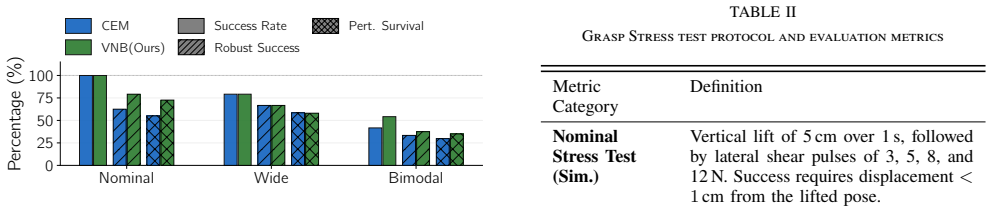
- Improves robust grasp success under contact-parameter uncertainty and exogenous force perturbations in simulation.
- Reduces planning time by roughly an order of magnitude relative to particle-filter model-predictive control.
- Validates grasp-and-lift success on a real serial-chain robot arm with multifingered hand under object-pose uncertainty.
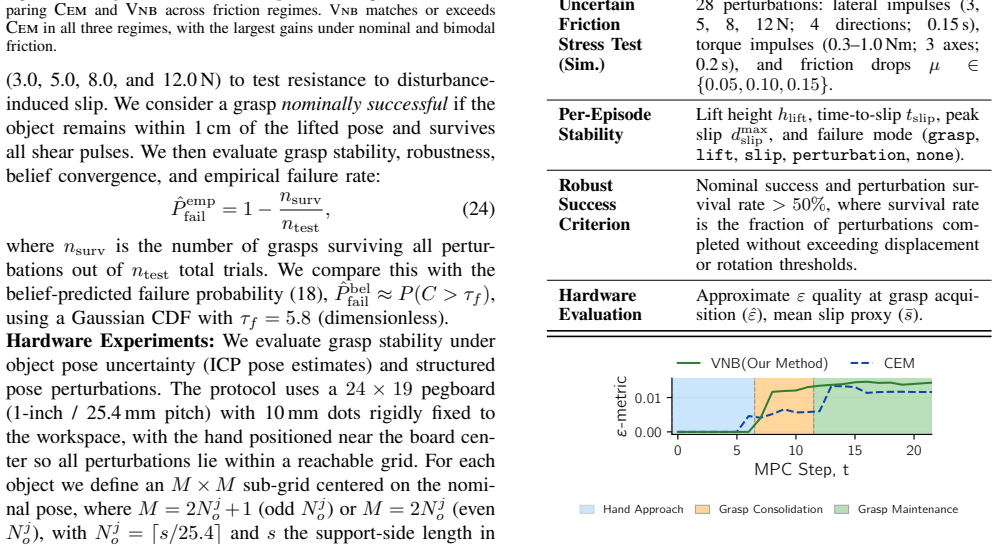
- Achieves higher tactile grasp-quality proxy and terminates in fewer steps with less wall-clock time than Gaussian baseline.
- Calibrates risk more accurately with mean absolute calibration error below 0.14 compared to 0.58 for Cross-Entropy Method.
Where Pith is reading between the lines
- The method may apply to other robotics tasks involving stochastic contact and sensing uncertainties.
- Combining this with learned dynamics models could enhance performance in more complex environments.
- The speed improvements suggest potential for online replanning in dynamic settings.
Load-bearing premise
A finite Gaussian mixture plus variational inference yields a sufficiently accurate and differentiable approximation to the true multimodal posterior over latent contact parameters and object pose for the CVaR objective to produce reliable robustness gains.
What would settle it
Observing whether the variational method maintains higher grasp success than particle filters when the posterior is highly multimodal and not well-approximated by a small number of Gaussians.
Figures




read the original abstract
Contact variability, sensing uncertainty, and external disturbances make grasp execution stochastic. Expected-quality objectives ignore tail outcomes and often select grasps that fail under adverse contact realizations. Risk-sensitive POMDPs address this failure mode, but many use particle-filter beliefs that scale poorly, obstruct gradient-based optimization, and estimate Conditional Value-at-Risk (CVaR) with high-variance approximations. We instead formulate grasp acquisition as variational inference over latent contact parameters and object pose, representing the belief with a differentiable Gaussian mixture. We use Gumbel-Softmax component selection and location-scale reparameterization to express samples as smooth functions of the belief parameters, enabling pathwise gradients through a differentiable CVaR surrogate for direct optimization of tail robustness. In simulation, our variational neural belief improves robust grasp success under contact-parameter uncertainty and exogenous force perturbations while reducing planning time by roughly an order of magnitude relative to particle-filter model-predictive control. On a serial-chain robot arm with a multifingered hand, we validate grasp-and-lift success under object-pose uncertainty against a Gaussian baseline. Both methods succeed on the tested perturbations, but our controller terminates in fewer steps and less wall-clock time while achieving a higher tactile grasp-quality proxy. Our learned belief also calibrates risk more accurately, keeping mean absolute calibration error below 0.14 across tested simulation regimes, compared with 0.58 for a Cross-Entropy Method planner.
Editorial analysis
A structured set of objections, weighed in public.
Referee Report
Summary. The paper formulates dexterous grasp acquisition as variational inference over latent contact parameters and object pose, using a differentiable Gaussian-mixture belief with Gumbel-Softmax component selection and location-scale reparameterization. This enables pathwise gradients through a differentiable CVaR surrogate, allowing direct optimization of tail-robust objectives. In simulation the method reports higher robust grasp success under contact uncertainty and force perturbations, plus an order-of-magnitude reduction in planning time versus particle-filter MPC; on hardware it shows faster termination and higher tactile-quality proxy than a Gaussian baseline, with both succeeding on tested perturbations and improved calibration (MAE <0.14 vs 0.58 for CEM).
Significance. If the central claims hold, the work supplies a scalable, gradient-friendly belief representation that addresses the scalability and differentiability limitations of particle-filter approaches to risk-sensitive POMDPs in grasping. The technical device of combining Gumbel-Softmax with reparameterization to obtain low-variance CVaR gradients is a concrete contribution that could transfer to other contact-rich tasks. The reported calibration improvement and planning-time gains are practically relevant, though the absence of error bars and limited hardware evidence for multimodal robustness temper the strength of the overall result.
major comments (3)
- [Experiments] Experiments section: performance deltas (success rates, planning time, calibration MAE) are presented without error bars, confidence intervals, or statistical significance tests, and without exact baseline implementations or ablation on mixture-component count and CVaR alpha. These omissions make it impossible to verify that the reported improvements are robust rather than artifacts of particular random seeds or hyper-parameter choices.
- [Hardware Experiments] Hardware validation paragraph: both the variational method and the Gaussian baseline are reported to succeed on the tested object-pose perturbations, yet no failure cases for the baseline under multimodal contact uncertainty are shown. Consequently the hardware results demonstrate efficiency and proxy-quality gains but do not provide direct evidence that the multimodal posterior approximation translates into robustness advantages on the physical system.
- [Belief Parameterization] Method section on belief parameterization: the claim that a finite Gaussian mixture plus variational inference yields a sufficiently accurate approximation to the true multimodal posterior for reliable CVaR optimization rests on the weakest assumption identified in the review; no diagnostic (e.g., posterior predictive checks or comparison against a high-fidelity sampler) is supplied to quantify approximation error under the contact-parameter regimes used in the CVaR objective.
minor comments (2)
- [CVaR Optimization] Notation for the differentiable CVaR surrogate should be introduced with an explicit equation number and a short derivation showing how the Gumbel-Softmax and reparameterization yield an unbiased gradient estimator.
- [Figures] Figure captions for simulation and hardware results should state the number of trials, random seeds, and exact values of alpha and mixture components used.
Simulated Author's Rebuttal
We thank the referee for the constructive and detailed comments, which help clarify the strengths and limitations of our work. We address each major comment point by point below and outline the revisions we will make to the manuscript.
read point-by-point responses
-
Referee: [Experiments] Experiments section: performance deltas (success rates, planning time, calibration MAE) are presented without error bars, confidence intervals, or statistical significance tests, and without exact baseline implementations or ablation on mixture-component count and CVaR alpha. These omissions make it impossible to verify that the reported improvements are robust rather than artifacts of particular random seeds or hyper-parameter choices.
Authors: We agree that the lack of error bars, confidence intervals, statistical tests, and ablations weakens the ability to assess robustness. In the revised manuscript we will report means and standard deviations over at least five independent random seeds for all simulation metrics, include paired statistical significance tests against baselines, document the precise baseline implementations (including particle count and CEM parameters), and add an ablation study on the number of mixture components and CVaR alpha values to confirm that performance gains hold across reasonable hyper-parameter settings. revision: yes
-
Referee: [Hardware Experiments] Hardware validation paragraph: both the variational method and the Gaussian baseline are reported to succeed on the tested object-pose perturbations, yet no failure cases for the baseline under multimodal contact uncertainty are shown. Consequently the hardware results demonstrate efficiency and proxy-quality gains but do not provide direct evidence that the multimodal posterior approximation translates into robustness advantages on the physical system.
Authors: We acknowledge that the hardware trials were conducted under object-pose uncertainty and therefore do not directly exhibit failure modes of the Gaussian baseline under multimodal contact uncertainty. Inducing repeatable multimodal contact uncertainty on hardware is practically difficult. The multimodal robustness claims are supported by the simulation results under explicit contact-parameter uncertainty. In revision we will clarify the scope of the hardware experiments, discuss the challenges of hardware multimodal testing, and report any incidental observations of grasp quality differences that occurred during the physical trials. revision: partial
-
Referee: [Belief Parameterization] Method section on belief parameterization: the claim that a finite Gaussian mixture plus variational inference yields a sufficiently accurate approximation to the true multimodal posterior for reliable CVaR optimization rests on the weakest assumption identified in the review; no diagnostic (e.g., posterior predictive checks or comparison against a high-fidelity sampler) is supplied to quantify approximation error under the contact-parameter regimes used in the CVaR objective.
Authors: The referee is correct that direct quantification of approximation error would strengthen the justification for using the finite Gaussian mixture. While the reported calibration MAE already provides an indirect validation of belief quality for the CVaR objective, it does not fully characterize posterior fidelity. We will add posterior predictive checks and side-by-side comparisons of samples drawn from the variational Gaussian mixture versus a high-fidelity particle-filter sampler in representative contact-parameter regimes to better support the modeling assumption. revision: yes
Circularity Check
No circularity: standard VI tools applied to robotics domain with empirical validation
full rationale
The derivation formulates grasp planning as variational inference over contact parameters and pose using a differentiable Gaussian mixture belief, Gumbel-Softmax selection, and location-scale reparameterization to enable pathwise gradients through a CVaR surrogate. These are standard techniques from the VI literature applied to the domain; the reported gains in robust success rate, planning time, and calibration error are measured directly from simulation rollouts against particle-filter MPC and hardware trials against a Gaussian baseline. No equation reduces a performance metric to a fitted parameter by construction, no self-citation chain bears the central claim, and no ansatz or uniqueness result is smuggled in. The method is therefore self-contained against external benchmarks.
Axiom & Free-Parameter Ledger
free parameters (2)
- Number of Gaussian mixture components
- CVaR risk level alpha
axioms (2)
- domain assumption Contact variability and object pose uncertainty admit a multimodal distribution that a finite Gaussian mixture can approximate sufficiently well for planning.
- standard math Gumbel-Softmax and location-scale reparameterization yield unbiased pathwise gradients for the CVaR surrogate.
Reference graph
Works this paper leans on
-
[1]
Pose Error Robust Grasping From Contact Wrench Space Metrics,
J. Weisz and P. K. Allen, “Pose Error Robust Grasping From Contact Wrench Space Metrics,” in2012 IEEE International Conference On Robotics and Automation, pp. 557–562, 2012. ISSN: 1050-4729
2012
-
[2]
Toward An Analytic Theory of Intrinsic Robustness for Dexterous Grasping,
A. H. Li, P. Culbertson, and A. D. Ames, “Toward An Analytic Theory of Intrinsic Robustness for Dexterous Grasping,” in2024 IEEE/RSJ International Conference on Intelligent Robots and Systems (IROS), pp. 2992–2999, 2024. ISSN: 2153-0866
2024
-
[3]
GraspIt! A Versatile Simulator for Robotic Grasping,
A. T. Miller and P. K. Allen, “GraspIt! A Versatile Simulator for Robotic Grasping,”IEEE Robotics & Automation Magazine, vol. 11, no. 4, pp. 110–122, 2004
2004
-
[4]
TPGP: Temporal-Parametric Optimization with Deep Grasp Prior for Dexterous Motion Planning,
H. Li, Q. Ye, Y. Huo, Q. Liu, S. Jiang, T. Zhou, X. Li, Y. Zhou, and J. Chen, “TPGP: Temporal-Parametric Optimization with Deep Grasp Prior for Dexterous Motion Planning,” in2024 IEEE International Conference on Robotics and Automation (ICRA), pp. 18106–18112, 2024
2024
-
[5]
Synthesizing Diverse and Physically Stable Grasps With Arbitrary Hand Structures Using Differentiable Force Closure Estimator,
T. Liu, Z. Liu, Z. Jiao, Y. Zhu, and S.-C. Zhu, “Synthesizing Diverse and Physically Stable Grasps With Arbitrary Hand Structures Using Differentiable Force Closure Estimator,”IEEE Robotics and Automa- tion Letters, vol. 7, no. 1, pp. 470–477, 2022
2022
-
[6]
Deep Learning Approaches to Grasp Synthesis: A Review,
R. Newbury, M. Gu, L. Chumbley, A. Mousavian, C. Eppner, J. Leit- ner, J. Bohg, A. Morales, T. Asfour, D. Kragic, D. Fox, and A. Cosgun, “Deep Learning Approaches to Grasp Synthesis: A Review,”IEEE Transactions on Robotics, vol. 39, no. 5, pp. 3994–4015, 2023
2023
-
[7]
Neu- ralGrasps: Learning Implicit Representations for Grasps of Multiple Robotic Hands,
N. Khargonkar, N. Song, Z. Xu, B. Prabhakaran, and Y. Xiang, “Neu- ralGrasps: Learning Implicit Representations for Grasps of Multiple Robotic Hands,” 2022
2022
-
[8]
Dex- GraspNet: A Large-Scale Robotic Dexterous Grasp Dataset for General Objects Based on Simulation,
R. Wang, J. Zhang, J. Chen, Y. Xu, P. Li, T. Liu, and H. Wang, “Dex- GraspNet: A Large-Scale Robotic Dexterous Grasp Dataset for General Objects Based on Simulation,” 2023
2023
-
[9]
Deep Varia- tional Bayes Filters: Unsupervised Learning of State Space Models from Raw Data,
M. Karl, M. Soelch, J. Bayer, and P. van der Smagt, “Deep Varia- tional Bayes Filters: Unsupervised Learning of State Space Models from Raw Data,” inInternational Conference on Learning Represen- tations (ICLR), 2017
2017
-
[10]
Dex-Net 2.0: Deep Learning to Plan Robust Grasps with Synthetic Point Clouds and Analytic Grasp Metrics,
J. Mahler, J. Liang, S. Niyaz, M. Laskey, R. Doan, X. Liu, J. A. Ojea, and K. Goldberg, “Dex-Net 2.0: Deep Learning to Plan Robust Grasps with Synthetic Point Clouds and Analytic Grasp Metrics,”Robotics: Science and Systems (RSS), 2017
2017
-
[11]
Planning and Acting in Partially Observable Stochastic Domains,
L. P. Kaelbling, M. L. Littman, and A. R. Cassandra, “Planning and Acting in Partially Observable Stochastic Domains,”Artificial Intelli- gence, vol. 101, no. 1, pp. 99–134, 1998
1998
-
[12]
Thrun, W
S. Thrun, W. Burgard, and D. Fox,Probabilistic Robotics. MIT Press, 2005
2005
-
[13]
Improved Particle Filter Al- gorithm for Multi-Target Detection and Tracking,
Y. Cheng, W. Ren, C. Xiu, and Y. Li, “Improved Particle Filter Al- gorithm for Multi-Target Detection and Tracking,”Sensors (Basel, Switzerland), vol. 24, no. 14, p. 4708, 2024
2024
-
[14]
Maintaining Multimodality through Mixture Tracking,
J. Vermaak, A. Doucet, and P. P ´erez, “Maintaining Multimodality through Mixture Tracking,” inProceedings Ninth IEEE International Conference on Computer Vision, pp. 1110–1116 vol.2, 2003
2003
-
[15]
Categorical Reparameterization with Gumbel-Softmax,
E. Jang, S. Gu, and B. Poole, “Categorical Reparameterization with Gumbel-Softmax,” 2017
2017
-
[16]
Auto-Encoding Variational Bayes
D. P. Kingma and M. Welling, “Auto-Encoding Variational Bayes,” arXiv preprint arXiv:1312.6114, 2013
work page internal anchor Pith review arXiv 2013
-
[17]
Monte Carlo Methods for Value-at- Risk and Conditional Value-at-Risk: A Review,
L. J. Hong, Z. Hu, and G. Liu, “Monte Carlo Methods for Value-at- Risk and Conditional Value-at-Risk: A Review,”ACM Transactions on Modeling and Computer Simulation, vol. 24, no. 4, pp. 22:1–22:37, 2014
2014
-
[18]
Belief- Space Planning Assuming Maximum Likelihood Observations,
R. Platt Jr, L. P. Kaelbling, T. Lozano-Perez, and R. Tedrake, “Belief- Space Planning Assuming Maximum Likelihood Observations,” in Robotics: Science and Systems, vol. 6, pp. 37–44, 2010
2010
-
[19]
Global Localization of Objects via Touch,
A. Petrovskaya and O. Khatib, “Global Localization of Objects via Touch,”IEEE Transactions on Robotics, vol. 27, no. 3, pp. 569–585, 2011
2011
-
[20]
Particle MPC for Uncertain and Learning-Based Control,
R. Dyro, J. Harrison, A. Sharma, and M. Pavone, “Particle MPC for Uncertain and Learning-Based Control,” in2021 IEEE/RSJ Interna- tional Conference on Intelligent Robots and Systems (IROS), pp. 7127– 7134, 2021. ISSN: 2153-0866
2021
-
[21]
LQG-MP: Optimized Path Planning for Robots with Motion Uncertainty and Imperfect State Information,
J. van den Berg, P. Abbeel, and K. Goldberg, “LQG-MP: Optimized Path Planning for Robots with Motion Uncertainty and Imperfect State Information,”The International Journal of Robotics Research, vol. 30, no. 7, pp. 895–913, 2011
2011
-
[22]
Risk-Aware Motion Planning and Control Using CVaR-Constrained Optimization,
A. Hakobyan, G. C. Kim, and I. Yang, “Risk-Aware Motion Planning and Control Using CVaR-Constrained Optimization,”IEEE Robotics and Automation Letters, vol. 4, no. 4, pp. 4538–4545, 2019
2019
-
[23]
Variational Infer- ence: A Review for Statisticians,
D. M. Blei, A. Kucukelbir, and J. D. McAuliffe, “Variational Infer- ence: A Review for Statisticians,”Journal of the American Statistical Association, vol. 112, no. 518, pp. 859–877, 2017
2017
-
[24]
Learning and Policy Search in Stochastic Dynamical Systems with Bayesian Neural Networks,
S. Depeweg, J. M. Hern ´andez-Lobato, F. Doshi-Velez, and S. Udluft, “Learning and Policy Search in Stochastic Dynamical Systems with Bayesian Neural Networks,” inInternational Conference on Learning Representations (ICLR), 2017
2017
-
[25]
Deep Rein- forcement Learning in a Handful of Trials Using Probabilistic Dynam- ics Models,
K. Chua, R. Calandra, R. McAllister, and S. Levine, “Deep Rein- forcement Learning in a Handful of Trials Using Probabilistic Dynam- ics Models,” inAdvances in Neural Information Processing Systems (NeurIPS), pp. 4754–4765, 2018
2018
-
[26]
Safety-Aware Reinforcement Learning for Control via Risk-Sensitive Action-Value Iteration and Quantile Regression,
C. Enwerem, A. G. Puranic, J. S. Baras, and C. Belta, “Safety-Aware Reinforcement Learning for Control via Risk-Sensitive Action-Value Iteration and Quantile Regression,” in2025 IEEE 64th Conference on Decision and Control (CDC), pp. 4890–4895, IEEE, 2025
2025
-
[27]
Distri- butional Reinforcement Learning with Quantile Regression,
W. Dabney, M. Rowland, M. G. Bellemare, and R. Munos, “Distri- butional Reinforcement Learning with Quantile Regression,” inPro- ceedings of the AAAI Conference on Artificial Intelligence, vol. 32, 2018
2018
-
[28]
Probabilistic Differential Dynamic Pro- gramming,
Y. Pan and E. A. Theodorou, “Probabilistic Differential Dynamic Pro- gramming,” inAdvances in Neural Information Processing Systems, vol. 27, Curran Associates, Inc., 2014
2014
-
[29]
R. M. Murray, Z. Li, and S. S. Sastry,A Mathematical Introduction to Robotic Manipulation. CRC Press, 1 ed., 2017
2017
-
[30]
Grasping,
D. Prattichizzo and J. C. Trinkle, “Grasping,” inSpringer Handbook of Robotics(B. Siciliano and O. Khatib, eds.), pp. 671–700, Springer Berlin Heidelberg, 2008
2008
-
[31]
Optimization of Conditional Value- at-Risk,
R. T. Rockafellar and S. Uryasev, “Optimization of Conditional Value- at-Risk,”Journal of Risk, vol. 2, no. 3, pp. 21–42, 2000
2000
-
[32]
Implicit Neural Representations with Periodic Activa- tion Functions,
V. Sitzmann, J. N. Martel, A. W. Bergman, D. B. Lindell, and G. Wetzstein, “Implicit Neural Representations with Periodic Activa- tion Functions,”Advances in Neural Information Processing Systems (NeurIPS), vol. 33, pp. 7462–7473, 2020
2020
-
[33]
Global Convergence of Langevin Dynamics Based Algorithms for Nonconvex Optimization,
P. Xu, J. Chen, D. Zou, and Q. Gu, “Global Convergence of Langevin Dynamics Based Algorithms for Nonconvex Optimization,” inAd- vances in Neural Information Processing Systems, vol. 31, Curran As- sociates, Inc., 2018
2018
-
[34]
Planning Optimal Grasps,
C. Ferrari and J. Canny, “Planning Optimal Grasps,”IEEE Inter- national Conference on Robotics and Automation (ICRA), vol. 3, pp. 2290–2295, 1992
1992
-
[35]
Sample-Efficient Cross-Entropy Method for Real-time Planning,
C. Pinneri, S. Sawant, S. Blaes, J. Achterhold, J. Stueckler, M. Ro- linek, and G. Martius, “Sample-Efficient Cross-Entropy Method for Real-time Planning,” inProceedings of the 2020 Conference on Robot Learning, pp. 1049–1065, PMLR, 2021
2020
-
[36]
Coefficient of Friction Reference Chart,
Schneider & Company, “Coefficient of Friction Reference Chart,”
-
[37]
25, 2026
Accessed: Feb. 25, 2026
2026
-
[38]
The YCB Object and Model Set: Towards Common Bench- marks for Manipulation Research,
B. Calli, A. Walsman, A. Singh, S. Srinivasa, P. Abbeel, and A. M. Dollar, “The YCB Object and Model Set: Towards Common Bench- marks for Manipulation Research,” in2015 International Conference on Advanced Robotics (ICAR), pp. 510–517, 2015
2015
-
[39]
Envelope Quantile Regression,
S. Ding, Z. Su, G. Zhu, and L. Wang, “Envelope Quantile Regression,” Statistica Sinica, 2019
2019
-
[40]
The Envelope Theorem in Dynamic Optimization,
J. T. LaFrance and L. D. Barney, “The Envelope Theorem in Dynamic Optimization,”Journal of Economic Dynamics and Control, vol. 15, no. 2, pp. 355–385, 1991. Appendix A. Pathwise Risk Gradients via Action Optimization Theorem 1(Reparameterized CVaR Gradient).Letb(ϕ)be a reparameterizable belief distribution with samplesθ i = g(ϵi,ϕ),ϵ i ∼p(ϵ), and letC:R d...
1991
discussion (0)
Sign in with ORCID, Apple, or X to comment. Anyone can read and Pith papers without signing in.