Recognition: unknown
Solvable Random Unitary Dynamics in a Disordered Tomonaga-Luttinger Liquid
Pith reviewed 2026-05-07 16:11 UTC · model grok-4.3
The pith
The frame potential of a disordered Tomonaga-Luttinger liquid has a closed-form expression showing power-law decay at early times followed by saturation to a plateau set by one coupling parameter.
A machine-rendered reading of the paper's core claim, the machinery that carries it, and where it could break.
Core claim
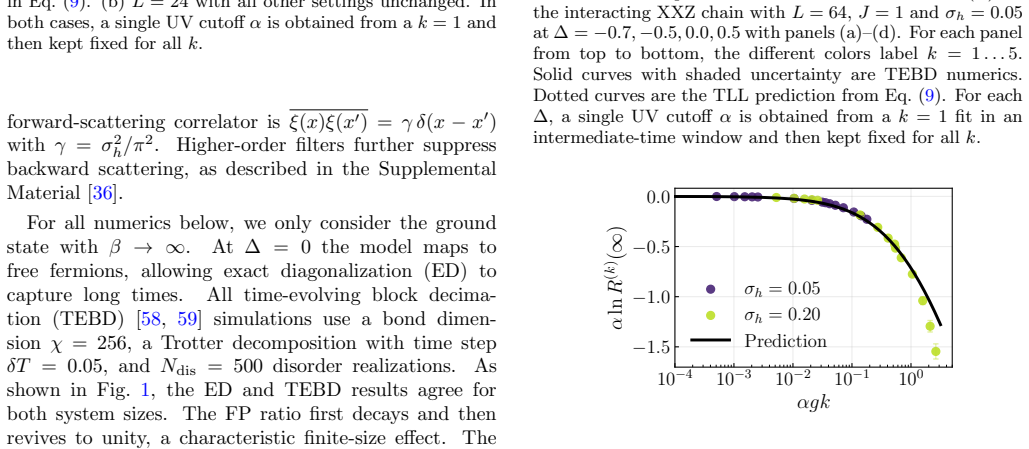
We derive a closed-form expression for the frame potential of a Tomonaga-Luttinger liquid with quenched Gaussian forward-scattering disorder. Exploiting the exactly quadratic structure of the disorder-averaged Keldysh action, we show that the frame potential decays as a power law at early times and saturates to a late-time plateau controlled by a single coupling parameter. Taking the random field XXZ spin chain as a specific microscopic realization, we show that the strongest randomness is achieved near the Heisenberg ferromagnetic point and can be exponentially enhanced through a multiple-quench protocol, with validation across the gapless phase.
What carries the argument
The exactly quadratic disorder-averaged Keldysh action, which enables direct closed-form computation of the frame potential for the unitary dynamics.
Load-bearing premise
The disorder-averaged Keldysh action remains exactly quadratic for the chosen Gaussian forward-scattering disorder.
What would settle it
An experiment or numerical simulation measuring the frame potential versus time in a Tomonaga-Luttinger liquid with forward-scattering disorder and finding that it neither follows the predicted early-time power-law decay nor saturates to a plateau set by one coupling parameter would disprove the closed-form result.
Figures




read the original abstract
Disordered one-dimensional interacting systems have long been characterized via conventional correlation functions. A complementary quantum-information perspective quantifies the randomness of the unitary ensemble dynamics generated by a quantum system through the frame potential, which serves as a practical diagnostic for quantum algorithmic performance. However, no analytical treatment has yet been achieved for experimentally accessible interacting one-dimensional systems. In this Letter, we derive a closed-form expression for the frame potential of a Tomonaga-Luttinger liquid with quenched Gaussian forward-scattering disorder. Exploiting the exactly quadratic structure of the disorder-averaged Keldysh action, we show that the frame potential decays as a power law at early times and saturates to a late-time plateau controlled by a single coupling parameter. Taking the random field XXZ spin chain as a specific microscopic realization, we show that the strongest randomness is achieved near the Heisenberg ferromagnetic point and can be exponentially enhanced through a multiple-quench protocol. We validate our results across the entire gapless phase, with direct implications for algorithm design in analog quantum simulation platforms.
Editorial analysis
A structured set of objections, weighed in public.
Referee Report
Summary. The manuscript derives a closed-form expression for the frame potential of a Tomonaga-Luttinger liquid subject to quenched Gaussian forward-scattering disorder. Exploiting the exactly quadratic structure of the disorder-averaged Keldysh action, the authors show that the frame potential exhibits power-law decay at early times and saturates at late times to a plateau controlled by a single coupling parameter. They illustrate the result with the random-field XXZ chain, identify the Heisenberg ferromagnetic point as maximizing randomness, and discuss a multiple-quench protocol for exponential enhancement, with validation stated across the gapless phase.
Significance. If the central derivation holds, the work supplies the first analytical treatment of frame potentials in an experimentally accessible interacting one-dimensional system. The exact quadratic solvability of the averaged Keldysh action is a clear strength, yielding closed-form expressions without uncontrolled approximations and enabling falsifiable predictions for quantum-information diagnostics. This has immediate relevance for algorithm design and randomness benchmarking in analog quantum simulators.
minor comments (2)
- The single coupling parameter that controls the late-time plateau is central to the result; a brief explicit statement (e.g., in the paragraph following Eq. (X) or in the discussion of the two-point Keldysh correlators) confirming that it is obtained directly from the microscopic disorder variance, independent of any frame-potential data, would eliminate any possible appearance of circularity.
- The validation statement in the abstract and conclusion is brief; adding one sentence that specifies the observable or numerical protocol used to confirm the closed-form expression across the gapless phase would improve clarity for readers.
Simulated Author's Rebuttal
We thank the referee for their positive summary, recognition of the significance of our results, and recommendation for minor revision. No major comments were raised in the report.
Circularity Check
No significant circularity identified
full rationale
The derivation begins from the standard quadratic Tomonaga-Luttinger Hamiltonian plus Gaussian forward-scattering disorder. The disorder average produces a non-local quadratic term in the Keldysh action with no higher-order vertices, yielding an exactly solvable Gaussian theory. Frame-potential expressions then follow directly from the resulting two-point correlators on the Keldysh contour. The early-time power-law decay and late-time plateau (controlled by the disorder strength) are computed outputs of this Gaussian theory rather than inputs or self-referential fits. No self-citations, ansatzes, or uniqueness theorems are invoked to close the argument; the construction is self-contained against the microscopic model.
Axiom & Free-Parameter Ledger
free parameters (1)
- single coupling parameter
axioms (2)
- domain assumption Exactly quadratic structure of the disorder-averaged Keldysh action
- domain assumption Quenched Gaussian forward-scattering disorder
Reference graph
Works this paper leans on
-
[1]
Jerome and C
D. Jerome and C. Bourbonnais, Quasi one-dimensional organic conductors: from Fr¨ ohlich conductivity and Peierls insulating state to magnetically-mediated super- conductivity, a retrospective, Comptes Rendus. Physique 25, 17 (2024)
2024
-
[2]
Tarucha, T
S. Tarucha, T. Saku, Y. Tokura, and Y. Hirayama, Sharvin resistance and its breakdown observed in long ballistic channels, Phys. Rev. B47, 4064 (1993)
1993
-
[3]
O. M. Auslaender, H. Steinberg, A. Yacoby, Y. Tserkovnyak, B. I. Halperin, K. W. Baldwin, L. N. Pfeiffer, and K. W. West, Spin-charge separation and localization in one dimension, Science308, 88 (2005)
2005
-
[4]
Bockrath, D
M. Bockrath, D. H. Cobden, J. Lu, A. G. Rinzler, R. E. Smalley, L. Balents, and P. L. McEuen, Luttinger-liquid behaviour in carbon nanotubes, Nature397, 598 (1999)
1999
-
[5]
D. A. Tennant, R. A. Cowley, S. E. Nagler, and A. M. Tsvelik, Measurement of the spin-excitation continuum in one-dimensional KCuF 3 using neutron scattering, Phys. Rev. B52, 13368 (1995)
1995
-
[6]
M. A. Cazalilla, R. Citro, T. Giamarchi, E. Orignac, and M. Rigol, One dimensional bosons: From condensed mat- ter systems to ultracold gases, Rev. Mod. Phys.83, 1405 (2011)
2011
-
[7]
Fazio, K.-H
R. Fazio, K.-H. Wagenblast, C. Winkelholz, and G. Sch¨ on, Tunneling into one-dimensional Josephson chains and Luttinger liquids, Physica B222, 364 (1996)
1996
-
[8]
L. I. Glazman and A. I. Larkin, New quantum phase in a one-dimensional Josephson array, Phys. Rev. Lett.79, 3736 (1997)
1997
-
[9]
Giamarchi and H
T. Giamarchi and H. J. Schulz, Anderson localization and interactions in one-dimensional metals, Phys. Rev. B37, 325 (1988)
1988
-
[10]
Giamarchi,Quantum Physics in One Dimension, In- ternational Series of Monographs on Physics, Vol
T. Giamarchi,Quantum Physics in One Dimension, In- ternational Series of Monographs on Physics, Vol. 121 (Clarendon Press, Oxford, 2004)
2004
-
[11]
Pal and D
A. Pal and D. A. Huse, Many-body localization phase transition, Phys. Rev. B82, 174411 (2010)
2010
-
[12]
D. A. Abanin, E. Altman, I. Bloch, and M. Serbyn, Col- loquium: Many-body localization, thermalization, and entanglement, Rev. Mod. Phys.91, 021001 (2019). 6
2019
-
[13]
Schreiber, S
M. Schreiber, S. S. Hodgman, P. Bordia, H. P. L¨ uschen, M. H. Fischer, R. Vosk, E. Altman, U. Schneider, and I. Bloch, Observation of many-body localization of inter- acting fermions in a quasirandom optical lattice, Science 349, 842 (2015)
2015
-
[14]
yoon Choi, S
J. yoon Choi, S. Hild, J. Zeiher, P. Schauß, A. Rubio- Abadal, T. Yefsah, V. Khemani, D. A. Huse, I. Bloch, and C. Gross, Exploring the many-body localization transition in two dimensions, Science352, 1547 (2016)
2016
-
[15]
Collins and P
B. Collins and P. ´Sniady, Integration with Respect to the Haar Measure on Unitary, Orthogonal and Symplectic Group, Commun. Math. Phys.264, 773 (2006)
2006
-
[16]
A. J. Scott, Optimizing quantum process tomography with unitary2-designs, J. Phys. A: Math. Theor.41, 055308 (2008)
2008
-
[17]
Vermersch, A
B. Vermersch, A. Elben, L. M. Sieberer, N. Y. Yao, and P. Zoller, Probing scrambling using statistical correla- tions between randomized measurements, Phys. Rev. X 9, 021061 (2019)
2019
- [18]
-
[19]
A. W. Harrow and R. A. Low, Random quantum circuits are approximate 2-designs, Commun. Math. Phys.291, 257 (2009)
2009
-
[20]
F. G. S. L. Brand˜ ao, A. W. Harrow, and M. Horodecki, Local random quantum circuits are approximate polynomial-designs, Commun. Math. Phys.346, 397 (2016)
2016
-
[21]
Haferkamp, Random quantum circuits are approxi- mate unitaryt-designs in depthO(nt 5+o(1)), Quantum 6, 795 (2022)
J. Haferkamp, Random quantum circuits are approxi- mate unitaryt-designs in depthO(nt 5+o(1)), Quantum 6, 795 (2022)
2022
-
[22]
Schuster, J
T. Schuster, J. Haferkamp, and H.-Y. Huang, Random unitaries in extremely low depth, Science389, 92 (2025)
2025
-
[23]
Nakata, C
Y. Nakata, C. Hirche, M. Koashi, and A. Winter, Ef- ficient quantum pseudorandomness with nearly time- independent hamiltonian dynamics, Phys. Rev. X7, 021006 (2017)
2017
-
[24]
Onorati, O
E. Onorati, O. Buerschaper, M. Kliesch, W. Brown, A. H. Werner, and J. Eisert, Mixing properties of stochastic quantum hamiltonians, Commun. Math. Phys.355, 905 (2017)
2017
- [25]
-
[26]
Sachdev and J
S. Sachdev and J. Ye, Gapless spin-fluid ground state in a random quantum heisenberg magnet, Phys. Rev. Lett. 70, 3339 (1993)
1993
-
[27]
Kitaev, A simple model of quantum holography, Talks at KITP, University of California, Santa Barbara (2015), accessed 2025-10-16
A. Kitaev, A simple model of quantum holography, Talks at KITP, University of California, Santa Barbara (2015), accessed 2025-10-16
2015
-
[28]
Maldacena and D
J. Maldacena and D. Stanford, Remarks on the sachdev– ye–kitaev model, Phys. Rev. D94, 106002 (2016)
2016
-
[29]
Cotler, N
J. Cotler, N. Hunter-Jones, J. Liu, and B. Yoshida, Chaos, complexity, and random matrices, J. High Energy Phys.2017(11)
2017
-
[30]
Gharibyan, M
H. Gharibyan, M. Hanada, S. H. Shenker, and M. Tezuka, Onset of random matrix behavior in scrambling systems, J. High Energy Phys.2018(7)
2018
-
[31]
S.-K. Jian, G. S. Bentsen, and B. Swingle, Linear growth of circuit complexity from brownian dynamics, J. High Energy Phys.2023(08), 190
2023
-
[32]
Tiutiakina, A
A. Tiutiakina, A. D. Luca, and J. de Nardis, Frame po- tential of brownian syk model of majorana and dirac fermions, J. High Energy Phys.2024(01), 115
2024
-
[33]
D. Gross, K. Audenaert, and J. Eisert, Evenly distributed unitaries: On the structure of unitary designs, J. Math. Phys.48, 10.1063/1.2716992 (2007)
-
[34]
D. A. Roberts and B. Yoshida, Chaos and complexity by design, J. High Energy Phys.2017(4)
2017
-
[35]
Kamenev,Field Theory of Non-Equilibrium Systems (Cambridge University Press, 2011)
A. Kamenev,Field Theory of Non-Equilibrium Systems (Cambridge University Press, 2011)
2011
-
[36]
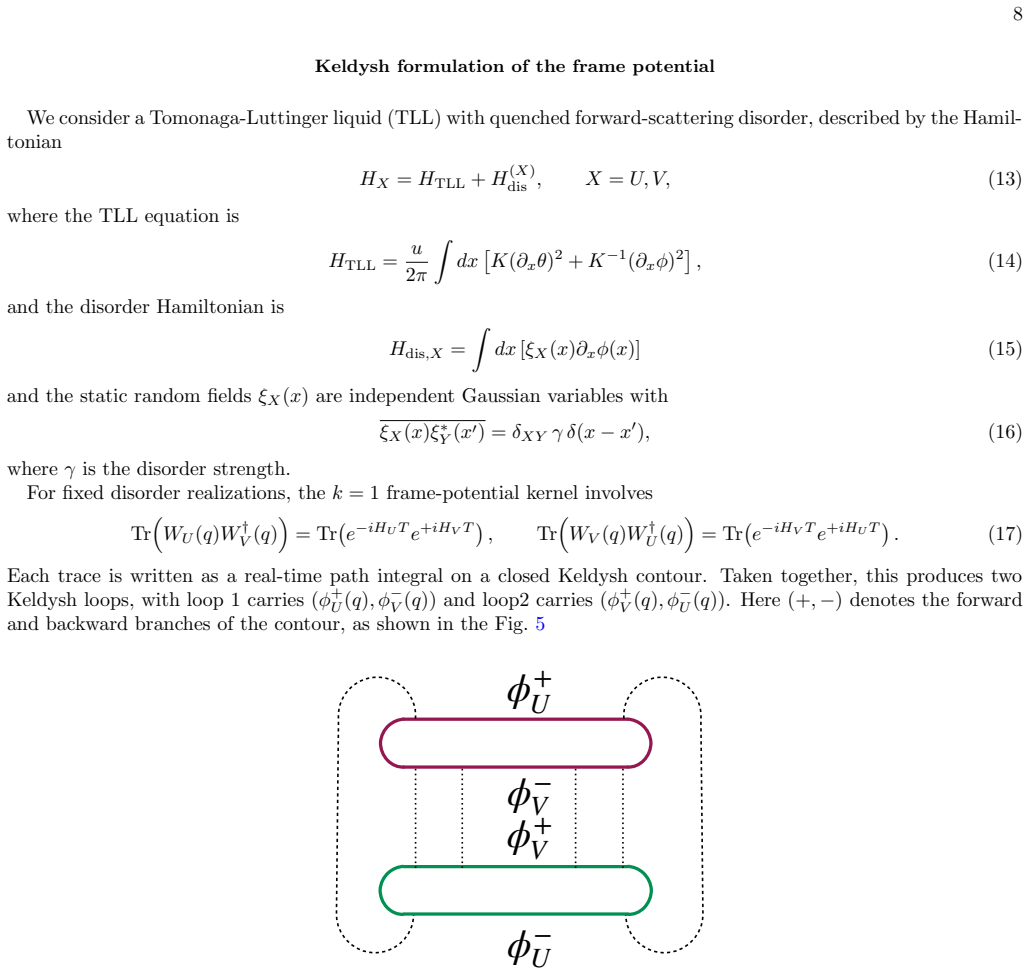
(A) The Keldysh formulation of the frame potential
See the supplemental material for details. (A) The Keldysh formulation of the frame potential. (B) The eval- uation of the frame potential in the TLL, including short- time, long-time, and strong-disorder limits. (C) The gen- eralization of FP to arbitraryk. (D) The multiple-quench protocol (E) The higher-order filter construction. (F) Ad- ditional numeri...
-
[37]
D. A. Harville,Matrix Algebra From a Statistician ’s Per- spective(Springer-Verlag, New York, 1997)
1997
-
[38]
H. G. Krojanski and D. Suter, Reduced decoherence in large quantum registers, Phys. Rev. Lett.97, 150503 (2006)
2006
-
[39]
Lovri´ c, H
M. Lovri´ c, H. G. Krojanski, and D. Suter, Decoherence in large quantum registers under variable interaction with the environment, Phys. Rev. A75, 042305 (2007)
2007
-
[40]
Li, T.-G
Y. Li, T.-G. Zhou, Z. Wu, P. Peng, S. Zhang, R. Fu, R. Zhang, W. Zheng, P. Zhang, H. Zhai, X. Peng, and J. Du, Emergent universal quench dynamics in randomly interacting spin models, Nat. Phys.20, 1966 (2024)
1966
-
[41]
Li, T.-G
Y.-C. Li, T.-G. Zhou, S. Zhang, Z. Wu, L. Zhao, H. Yin, X. An, H. Zhai, P. Zhang, X. Peng, and J. Du, Error- Resilient Reversal of Quantum Chaotic Dynamics En- abled by Scramblons, Phys. Rev. Lett.136, 060403 (2026)
2026
-
[42]
J. Choi, S. Choi, G. Kucsko, P. C. Maurer, B. J. Shields, H. Sumiya, S. Onoda, J. Isoya, E. Demler, F. Jelezko, N. Y. Yao, and M. D. Lukin, Depolarization dynamics in a strongly interacting solid-state spin ensemble, Phys. Rev. Lett.118, 093601 (2017)
2017
-
[43]
Kucsko, S
G. Kucsko, S. Choi, J. Choi, P. C. Maurer, H. Zhou, R. Landig, H. Sumiya, S. Onoda, J. Isoya, F. Jelezko, E. Demler, N. Y. Yao, and M. D. Lukin, Critical thermal- ization of a disordered dipolar spin system in diamond, Phys. Rev. Lett.121, 023601 (2018)
2018
-
[44]
K. R. A. Hazzard, B. Gadway, M. Foss-Feig, B. Yan, S. A. Moses, J. P. Covey, N. Y. Yao, M. D. Lukin, J. Ye, D. S. Jin, and A. M. Rey, Many-Body Dynamics of Dipolar Molecules in an Optical Lattice, Phys. Rev. Lett.113, 195302 (2014)
2014
-
[45]
B. Yan, S. A. Moses, B. Gadway, J. P. Covey, K. R. A. Hazzard, A. M. Rey, D. S. Jin, and J. Ye, Realizing a lattice spin model with polar molecules, Nature501, 521 (2013)
2013
-
[46]
Schauß, M
P. Schauß, M. Cheneau, M. Endres, T. Fukuhara, S. Hild, A. Omran, T. Pohl, C. Gross, S. Kuhr, and I. Bloch, Observation of spatially ordered structures in a two- dimensional Rydberg gas, Nature491, 87 (2012)
2012
-
[47]
Smale, P
S. Smale, P. He, B. A. Olsen, K. G. Jackson, H. Sharum, S. Trotzky, J. Marino, A. M. Rey, and J. H. Thywissen, Observation of a transition between dynamical phases in a quantum degenerate Fermi gas, Sci. Adv.5, eaax1568 (2019)
2019
-
[48]
Signoles, T
A. Signoles, T. Franz, R. Ferracini Alves, M. G¨ arttner, S. Whitlock, G. Z¨ urn, and M. Weidem¨ uller, Glassy Dy- namics in a Disordered Heisenberg Quantum Spin Sys- tem, Phys. Rev. X11, 011011 (2021). 7
2021
-
[49]
Conformal symmetry and its breaking in two dimensional Nearly Anti-de-Sitter space
J. Maldacena, D. Stanford, and Z. Yang, Confor- mal symmetry and its breaking in two-dimensional nearly anti-de sitter space, PTEP2016, 12C104 (2016), arXiv:1606.01857
work page Pith review arXiv 2016
-
[50]
Bagrets, A
D. Bagrets, A. Altland, and A. Kamenev, Sachdev–ye– kitaev model as liouville quantum mechanics, Nucl. Phys. B911, 191 (2016)
2016
-
[51]
Gu, X.-L
Y. Gu, X.-L. Qi, and D. Stanford, Local criticality, diffu- sion and chaos in generalized sachdev–ye–kitaev models, J. High Energy Phys.2017(05), 125
2017
-
[52]
Song, C.-M
X.-Y. Song, C.-M. Jian, and L. Balents, Strongly corre- lated metal built from sachdev–ye–kitaev models, Phys. Rev. Lett.119, 216601 (2017)
2017
-
[53]
Vermersch, A
B. Vermersch, A. Elben, M. Dalmonte, J. I. Cirac, and P. Zoller, Unitaryn-designs via random quenches in atomic hubbard and spin models: Application to the measurement of r´ enyi entropies, Phys. Rev. A97, 023604 (2018)
2018
-
[54]
A. A. Mele, Introduction to Haar Measure Tools in Quan- tum Information: A Beginner’s Tutorial, Quantum8, 1340 (2024)
2024
-
[55]
Three Hamiltonians are Sufficient for Unitary $k$-Design in Temporal Ensemble
Y.-N. Zhou, T.-G. Zhou, and J. Sonner, Three hamil- tonians are sufficient for unitaryk-design in temporal ensemble (2026), arXiv:2604.04205 [quant-ph]
work page internal anchor Pith review Pith/arXiv arXiv 2026
-
[56]
F. D. M. Haldane, General relation of correlation expo- nents and spectral properties of one-dimensional fermi systems: Application to the anisotropics= 1 2 heisen- berg chain, Phys. Rev. Lett.45, 1358 (1980)
1980
-
[57]
Luther and I
A. Luther and I. Peschel, Calculation of critical expo- nents in two dimensions from quantum field theory in one dimension, Phys. Rev. B12, 3908 (1975)
1975
-
[58]
Vidal, Efficient classical simulation of slightly entan- gled quantum computations, Phys
G. Vidal, Efficient classical simulation of slightly entan- gled quantum computations, Phys. Rev. Lett.91, 147902 (2003)
2003
-
[59]
Schollw¨ ock, The density-matrix renormalization group in the age of matrix product states, Ann
U. Schollw¨ ock, The density-matrix renormalization group in the age of matrix product states, Ann. Phys.326, 96 (2011)
2011
-
[60]
Elben, B
A. Elben, B. Vermersch, M. Dalmonte, J. I. Cirac, and P. Zoller, R´ enyi entropies from random quenches in atomic hubbard and spin models, Phys. Rev. Lett.120, 050406 (2018)
2018
-
[61]
k−1X i=0 ∂xΨ4i+1(x, t)−∂ xΨ4i+4(x, t) #
P. Roushan, C. Neill, J. Tangpanitanon, V. M. Bastidas, A. Megrant, R. Barends, Y. Chen, Z. Chen, B. Chiaro, A. Dunsworth, A. Fowler, B. Foxen, M. Giustina, E. Jef- frey, J. Kelly, E. Lucero, J. Mutus, M. Neeley, C. Quin- tana, D. Sank, A. Vainsencher, J. Wenner, T. White, H. Neven, D. G. Angelakis, and J. Martinis, Spectro- scopic signatures of localizat...
2017
discussion (0)
Sign in with ORCID, Apple, or X to comment. Anyone can read and Pith papers without signing in.