Recognition: unknown
New insights into the brightarrow c bar{u}q puzzle through Top-Bottom synergies
Pith reviewed 2026-05-07 15:51 UTC · model grok-4.3
The pith
Collider bounds on scalar doublets resist relaxation from top-pair rates
A machine-rendered reading of the paper's core claim, the machinery that carries it, and where it could break.
Core claim
Additional SU(2)_L scalar doublets cannot easily accommodate the non-leptonic B decay anomalies because collider bounds from charged Higgs and ttbar searches remain robust even with increased top-pair branching ratios, and typical extensions via power corrections or multiple scalars stay constrained by measurements.
What carries the argument
The top-bottom synergy in models with extra weak scalar doublets, where bottom-quark decay rates are linked to collider signatures in charged Higgs and ttbar final states.
Load-bearing premise
New physics effects are captured by additional SU(2)_L scalar doublets whose collider signatures are dominated by charged Higgs and top-pair production without compensating contributions from the rest of the model spectrum.
What would settle it
Observation of a charged Higgs boson in the relevant mass range and with couplings that simultaneously fit the B-decay anomalies while respecting current ttbar limits, or a clear excess in ttbar rates that matches the required branching without violating other searches.
Figures




read the original abstract
Anomalies in the non-leptonic $\bar{B}^0\rightarrow D^{(*)+}K^{(*)-}$ and $\bar{B}^0_s\rightarrow D^{(*)+}_s\pi^-$ decays may be an indication of physics beyond the Standard Model, but the large deviations require strongly coupled new physics that should be visible at colliders. We explore three new directions that could lead to viable new physics models, performing a detailed collider study to examine the possible weakening of previously known constraints on additional $SU(2)_L$ doublets. Our results show that, despite the difficulty of probing $t\bar{t}$ final states, increasing the branching ratio to this decay mode does not significantly weaken the bounds on weak doublet scalars, as additionally existing charged Higgs searches are equally strong. Beyond this, we analyse a potentially large breakdown of QCD factorisation by including large-power corrections to $B$ decays, and the effect of diluting collider searches with multi-scalar extensions. We find that these typical model-building routes for constructing a viable scenario remain constrained by collider measurements, indicating that these non-leptonic anomalies remain among the most puzzling discrepancies from the SM.
Editorial analysis
A structured set of objections, weighed in public.
Referee Report
Summary. The manuscript examines anomalies in non-leptonic B decays (B0 → D(*)K(*)- and Bs → Ds(*)π-) that deviate from Standard Model expectations and may indicate strongly coupled new physics. Focusing on extensions with additional SU(2)_L scalar doublets, the authors investigate three potential resolutions: (i) increasing the branching ratio to ttbar final states, (ii) incorporating large power corrections to QCD factorization in B decays, and (iii) diluting collider signals via multi-scalar spectra. Through detailed LHC recasts of charged Higgs and top-pair searches plus parameter scans, they conclude that these routes do not sufficiently relax existing bounds, leaving the anomalies in tension with collider data.
Significance. If the numerical results hold, the work demonstrates the robustness of LHC constraints against standard model-building strategies, reinforcing the difficulty of reconciling non-leptonic B anomalies with simple BSM scenarios. Credit is given for the concrete collider recasts, the inclusion of power-correction estimates, and the multi-doublet dilution scans, which provide falsifiable, quantitative limits rather than qualitative arguments. This strengthens the case that these flavor discrepancies remain among the more puzzling deviations from the SM.
minor comments (3)
- The abstract and introduction refer to the 'b→c ūq puzzle' without a dedicated reference to the specific experimental measurements or anomaly significance; adding one or two key citations (e.g., to the relevant LHCb or Belle papers) would improve context.
- In the collider simulation section (likely §3 or §4), the Monte Carlo tools, parton-shower settings, and luminosity assumptions used for the ttbar and charged-Higgs recasts are not stated explicitly; this information is needed for reproducibility of the exclusion contours.
- Figure captions for the multi-scalar dilution plots should clarify the exact number of doublets scanned and the color coding for different mass hierarchies to avoid ambiguity in interpreting the weakening of bounds.
Simulated Author's Rebuttal
We thank the referee for their positive assessment of our manuscript and for recommending minor revision. The referee's summary accurately reflects our analysis of the non-leptonic B decay anomalies and the three directions explored to potentially relax collider bounds on additional SU(2)_L scalar doublets. We appreciate the credit given for the concrete LHC recasts, power-correction estimates, and multi-doublet scans. We will implement the minor revisions in the next version of the manuscript.
Circularity Check
No significant circularity detected
full rationale
The paper derives collider bounds on SU(2)_L doublet scalars from independent LHC searches (charged Higgs and ttbar recasts) that are not fitted to the B-decay anomaly data. Power-correction estimates and multi-doublet dilution scans use standard QCD and parameter-space methods without reducing to self-defined inputs or self-citation chains. No step equates a prediction to its own fitted parameter by construction, and external benchmarks remain independent of the present results.
Axiom & Free-Parameter Ledger
axioms (1)
- domain assumption Standard Model provides accurate baseline for non-leptonic B decay rates absent new physics
invented entities (1)
-
additional SU(2)_L scalar doublets
no independent evidence
Reference graph
Works this paper leans on
-
[1]
NP is hiding in discovery modes that are difficult to constrain, namely through top-philic components that are systematics-limited due to large, acciden- tal signal-background interference [15]
-
[2]
QCD is not as well under control as we believe and creates tension in theBsector through unexpect- edly large power corrections
-
[3]
Colourless scalar doublet model
The NP sector contains multiple new particles, which dilutes collider bounds (e.g. nHDM for n >2). We set out to discover how these three scenarios, and their interplay, affect the viability of a specific NP hy- pothesis, namely a two-Higgs-doublet model (2HDM). II. OVERVIEW OF NEW PHYSICS IN NON-LEPTONIC B MESON DECAYS As discussed, the processes ¯B0 →D ...
-
[4]
bump-hunting
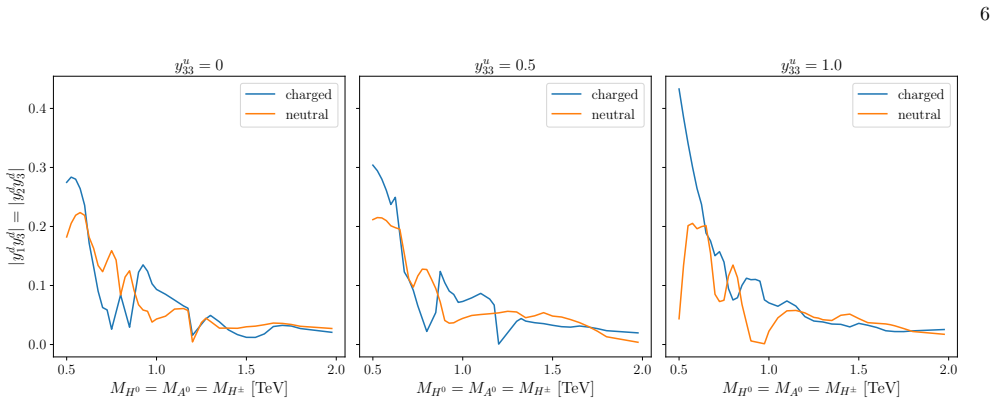
Re- sults are presented as a function of the product|y d 1 yd 3 |, withy u 33 fixed to a benchmark value drawn from the set {0,0.5,1}. The couplingy d 1 is scanned over the range [0.01,0.8] andy d 3 over [0.01,1.5]. The exclusion bound- ary is then defined as the maximum value of|y d 1 yd 3 |con- sistent with the observed cross-section upper limits at eac...
2016
-
[5]
washed out
and [20], but as we have just discussed, such a large effect would not agree with some reasonable expectation about the hierarchy of non-factorisable effects in different hadronicBdecay modes. Given that, in the case of−10% power corrections, the required size of the BSM interaction is reduced by more than half, we consider whether such large effects can ...
-
[6]
that NP is hiding in discovery modes that are dif- ficult to constrain, specifically through top-philic components,
-
[7]
that QCD is not as well under control as we be- lieve and creates tension in theBsector through unexpectedly large power corrections,
-
[8]
pollution
that the NP sector contains multiple new particles, which dilutes collider bounds, all of which, a priori, are reasonable and plausible. Firstly, we demonstrated that, despite the substantial interference and background effects in searches fort¯tfinal states, our reanalysis of dijet searches remains sensitive to the neutral component, even with a large br...
2020
- [9]
-
[10]
M. Bordone, N. Gubernari, T. Huber, M. Jung, and D. van Dyk, Eur. Phys. J. C80, 951 (2020), arXiv:2007.10338 [hep-ph]
- [11]
- [12]
- [13]
-
[14]
A. Lenz and G. Tetlalmatzi-Xolocotzi, JHEP07, 177 (2020), arXiv:1912.07621 [hep-ph]
-
[15]
M. Alguer´ o, A. Crivellin, S. Descotes-Genon, J. Ma- tias, and M. Novoa-Brunet, JHEP04, 066 (2021), arXiv:2011.07867 [hep-ph]
- [16]
- [17]
- [18]
-
[19]
M. Bordone, A. Greljo, and D. Marzocca, JHEP08, 036 (2021), arXiv:2103.10332 [hep-ph]
-
[20]
O. Atkinson, C. Englert, M. Kirk, and G. Tetlalmatzi- Xolocotzi, Eur. Phys. J. C85, 258 (2025), arXiv:2411.00940 [hep-ph]
-
[21]
Aadet al.(ATLAS), JHEP08, 013 (2024), arXiv:2404.18986 [hep-ex]
G. Aadet al.(ATLAS), JHEP08, 013 (2024), arXiv:2404.18986 [hep-ex]
-
[22]
A. Hayrapetyanet al.(CMS), Rept. Prog. Phys.88, 127801 (2025), arXiv:2507.05119 [hep-ex]
-
[23]
K. J. F. Gaemers and F. Hoogeveen, Phys. Lett. B146, 347 (1984)
1984
-
[24]
Non-Leptonic Weak Decays of B Mesons
M. Neubert and B. Stech, Adv. Ser. Direct. High Energy Phys.15, 294 (1998), arXiv:hep-ph/9705292
work page Pith review arXiv 1998
- [25]
- [26]
- [27]
- [28]
- [29]
-
[30]
Navaset al.(Particle Data Group), Phys
S. Navaset al.(Particle Data Group), Phys. Rev. D110, 030001 (2024)
2024
-
[31]
Semileptonic b- Hadron Decays, Determination ofV cb,V ub,
S. Navaset al.(Particle Data Group), “Semileptonic b- Hadron Decays, Determination ofV cb,V ub,” (2024), PDG Review
2024
-
[32]
van Dyket al.(EOS Authors), Eur
D. van Dyket al.(EOS Authors), Eur. Phys. J. C82, 569 (2022), arXiv:2111.15428 [hep-ph]
-
[33]
M. Aaboudet al.(ATLAS), Phys. Rev. Lett.121, 081801 (2018), arXiv:1804.03496 [hep-ex]
- [34]
-
[35]
Tumasyanet al.(CMS), JHEP07, 161 (2023), [Erra- tum: JHEP 25, 113 (2020)], arXiv:2206.09997 [hep-ex]
A. Tumasyanet al.(CMS), JHEP07, 161 (2023), [Erra- tum: JHEP 25, 113 (2020)], arXiv:2206.09997 [hep-ex]
-
[36]
Aadet al.(ATLAS), JHEP03, 145 (2020), arXiv:1910.08447 [hep-ex]
G. Aadet al.(ATLAS), JHEP03, 145 (2020), arXiv:1910.08447 [hep-ex]
-
[37]
J. Alwall, R. Frederix, S. Frixione, V. Hirschi, F. Maltoni, O. Mattelaer, H. S. Shao, T. Stelzer, P. Torrielli, and M. Zaro, JHEP07, 079 (2014), arXiv:1405.0301 [hep- ph]
work page internal anchor Pith review arXiv 2014
-
[38]
LHAPDF6: parton density access in the LHC precision era
A. Buckley, J. Ferrando, S. Lloyd, K. Nordstr¨ om, B. Page, M. R¨ ufenacht, M. Sch¨ onherr, and G. Watt, Eur. Phys. J. C75, 132 (2015), arXiv:1412.7420 [hep- ph]
work page Pith review arXiv 2015
- [39]
-
[40]
E. Conte and B. Fuks, Int. J. Mod. Phys. A33, 1830027 (2018), arXiv:1808.00480 [hep-ph]
-
[41]
B. Dumont, B. Fuks, S. Kraml, S. Bein, G. Chalons, E. Conte, S. Kulkarni, D. Sengupta, and C. Wymant, Eur. Phys. J. C75, 56 (2015), arXiv:1407.3278 [hep-ph]. 11
-
[42]
E. Conte, B. Dumont, B. Fuks, and C. Wymant, Eur. Phys. J. C74, 3103 (2014), arXiv:1405.3982 [hep-ph]
- [43]
- [44]
-
[45]
A comprehensive guide to the physics and usage of PYTHIA 8.3
C. Bierlichet al., SciPost Phys. Codeb.2022, 8 (2022), arXiv:2203.11601 [hep-ph]
work page internal anchor Pith review arXiv 2022
- [46]
-
[47]
Speysidehep/spey: v0.2.6,
J. Y. Araz, “Speysidehep/spey: v0.2.6,” (2025)
2025
-
[48]
T. Huber and G. Tetlalmatzi-Xolocotzi, Eur. Phys. J. C 82, 210 (2022), arXiv:2111.06418 [hep-ph]
-
[49]
R. Berthiaume, B. Bhattacharya, R. Boumris, A. Jean, S. Kumbhakar, and D. London, Phys. Rev. Lett.133, 211802 (2024), arXiv:2311.18011 [hep-ph]
- [50]
-
[51]
M. Burgos Marcos, M. Reboud, and K. K. Vos, JHEP 03, 227 (2026), arXiv:2504.05209 [hep-ph]
-
[52]
W.-S. Fang, T. Huber, X.-Q. Li, E. Malami, and G. Tetlalmatzi-Xolocotzi, (2026), arXiv:2604.19612 [hep- ph]
work page internal anchor Pith review Pith/arXiv arXiv 2026
- [53]
-
[54]
Grinstein, M
B. Grinstein, M. J. Savage, and M. B. Wise, Nucl. Phys. B319, 271 (1989)
1989
- [55]
-
[56]
S. J¨ ager, M. Kirk, A. Lenz, and K. Leslie, Phys. Rev. D 97, 015021 (2018), arXiv:1701.09183 [hep-ph]
-
[57]
S. J¨ ager, M. Kirk, A. Lenz, and K. Leslie, JHEP 03, 122 (2020), [Erratum: JHEP 04, 094 (2023)], arXiv:1910.12924 [hep-ph]
- [58]
-
[59]
J. Aebischer, J. Kumar, P. Stangl, and D. M. Straub, Eur. Phys. J. C79, 509 (2019), arXiv:1810.07698 [hep- ph]
-
[60]
Stangl, PoSTOOLS2020, 035 (2021), arXiv:2012.12211 [hep-ph]
P. Stangl, PoSTOOLS2020, 035 (2021), arXiv:2012.12211 [hep-ph]
-
[61]
Schaelet al.(ALEPH and DELPHI and L3 and OPAL and SLD), Phys
S. Schaelet al.(ALEPH, DELPHI, L3, OPAL, SLD, LEP Electroweak Working Group, SLD Electroweak Group, SLD Heavy Flavour Group), Phys. Rept.427, 257 (2006), arXiv:hep-ex/0509008
-
[62]
Banerjeeet al.(Heavy Flavor Averaging Group (HFLAV)), Phys
S. Banerjeeet al.(Heavy Flavor Averaging Group (HFLAV)), Phys. Rev. D113, 012008 (2026), arXiv:2411.18639 [hep-ex]
-
[63]
PDG 2024 results,
Y. S. Amhiset al.(HFLAV), “PDG 2024 results,” (2024), HFLAV averages for PDG 2024
2024
- [64]
-
[65]
Bazavovet al.(Fermilab Lattice, MILC), Phys
A. Bazavovet al.(Fermilab Lattice, MILC), Phys. Rev. D93, 113016 (2016), arXiv:1602.03560 [hep-lat]
- [66]
- [67]
- [68]
discussion (0)
Sign in with ORCID, Apple, or X to comment. Anyone can read and Pith papers without signing in.