Recognition: unknown
Kinematic Lensing Ratio: Reviving Weak Lensing Cosmography as a Geometric Dark Energy Probe
Pith reviewed 2026-05-07 14:54 UTC · model grok-4.3
The pith
The kinematic lensing ratio combines shear data with kinematic galaxy shapes to cancel weak lensing systematics and tighten dark energy constraints.
A machine-rendered reading of the paper's core claim, the machinery that carries it, and where it could break.
Core claim
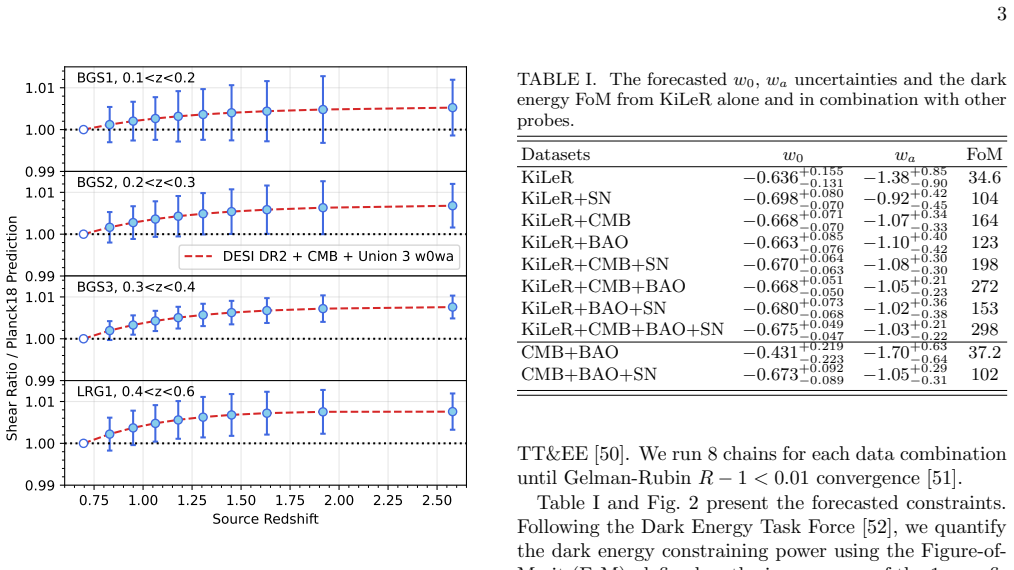
KiLeR is formed by dividing the measured shear by the intrinsic ellipticity inferred from galaxy kinematics. The resulting ratio automatically suppresses redshift errors, intrinsic alignments, and baryonic effects to first order. When applied to simulated Roman data, the method delivers a 192 percent improvement in dark energy figure of merit, furnishing an independent geometric test of the evolving dark energy signal seen in DESI DR2 BAO plus CMB plus supernova analyses. The work also sets quantitative targets for systematic and statistical error budgets and sketches observational routes to realize KiLeR.
What carries the argument
The kinematic lensing ratio, formed from the ratio of gravitational shear to kinematically inferred intrinsic ellipticity, which cancels multiplicative and additive biases in the lensing signal.
If this is right
- Supplies an independent geometric test of the evolving dark energy hint from DESI DR2 combined with CMB and supernova data.
- Sets explicit requirements on the control of systematic and statistical errors for the ratio to deliver its promised gain.
- Outlines concrete observational pathways for applying the ratio with upcoming imaging and spectroscopic surveys.
Where Pith is reading between the lines
- The same ratio construction could be tested on existing overlapping imaging and spectroscopic datasets to check for residual biases.
- If successful, the approach would add a purely geometric lever arm that helps separate dark energy evolution from possible changes in gravity.
- Extending the method to ground-based surveys would require demonstrating that kinematic shape measurements remain stable under varying observing conditions.
Load-bearing premise
Intrinsic galaxy shapes can be inferred from kinematics at sufficient accuracy that the ratio cancels the listed systematics without introducing comparable new errors or extra unconstrained parameters.
What would settle it
Simulations or real data in which the kinematic shape inference fails to reduce the combined impact of redshift errors, alignments, and baryonic effects below the level needed for the forecasted improvement.
Figures


read the original abstract
We introduce the kinematic lensing ratio (KiLeR), a geometric dark-energy probe from weak lensing. Combining shear ratios with intrinsic galaxy shapes inferred from kinematics, KiLeR naturally mitigates most first-order lensing systematics, including redshift errors, intrinsic alignments, and baryonic effects. The forecast on Roman shows a 192% improvement in the state-of-the-art dark energy constraints from adding KiLeR, providing independent tests of the evolving dark energy hint in the DESI DR2 BAO+CMB+SN analysis. We quantify the science requirements on systematic and statistical error control and discuss the pathways towards KiLeR observation.
Editorial analysis
A structured set of objections, weighed in public.
Referee Report
Summary. The paper introduces the kinematic lensing ratio (KiLeR) as a geometric dark-energy probe that combines weak-lensing shear ratios with intrinsic galaxy ellipticities inferred from kinematic modeling. It claims that this construction mitigates first-order systematics including photometric redshift errors, intrinsic alignments, and baryonic effects, and presents a forecast for the Roman Space Telescope in which adding KiLeR improves state-of-the-art dark-energy constraints by 192 percent, offering an independent test of evolving dark energy.
Significance. If the claimed first-order cancellation can be realized without introducing comparable new systematics, KiLeR would supply a purely geometric, ratio-based observable that is largely independent of the usual lensing nuisance parameters. The reported 192 percent improvement on Roman forecasts is large enough to be impactful for Stage-IV dark-energy studies, but the significance is currently limited by the fact that the result is a forecast rather than a demonstration on data or end-to-end simulations that include realistic kinematic modeling errors.
major comments (3)
- [Abstract and KiLeR construction section] The central claim that KiLeR 'naturally mitigates' redshift errors, intrinsic alignments, and baryonic effects at first order rests on the assumption that residuals from kinematic e_int inference (velocity-field fitting, inclination, position-angle recovery) remain smaller than the lensing signal and uncorrelated with the lensing kernel. No explicit propagation of these residuals through the ratio is shown, nor is it demonstrated that the subtraction leaves the ratio free of galaxy-property-dependent biases.
- [Roman forecast section] The Roman forecast reports a 192% improvement in dark-energy constraints but treats the kinematic error budget as a fixed statistical floor. No nuisance parameters are introduced for disk thickness, bulge-to-disk ratio, or PSF/seeing corrections; if these parameters are required and degenerate with cosmology, the quoted improvement factor is not robust.
- [Forecast and science-requirements discussion] The manuscript does not present end-to-end simulations or analytic derivations that quantify the residual bias after kinematic subtraction and ratio formation. Without such validation, it is not possible to confirm that the ratio remains a geometric probe rather than reintroducing modeling systematics at a level comparable to the gain.
minor comments (2)
- [Section 2] Notation for the kinematic ellipticity estimator and the precise definition of the ratio should be introduced with an equation early in the text to allow readers to follow the cancellation argument.
- [Abstract] The abstract states a 192% improvement; the corresponding figure or table in the forecast section should be cross-referenced so the number can be traced to a specific calculation.
Simulated Author's Rebuttal
We thank the referee for their constructive and detailed report. The comments have prompted us to clarify several aspects of the KiLeR construction and forecast. We address each major comment below and have revised the manuscript to incorporate additional analytic derivations and sensitivity tests where feasible.
read point-by-point responses
-
Referee: [Abstract and KiLeR construction section] The central claim that KiLeR 'naturally mitigates' redshift errors, intrinsic alignments, and baryonic effects at first order rests on the assumption that residuals from kinematic e_int inference (velocity-field fitting, inclination, position-angle recovery) remain smaller than the lensing signal and uncorrelated with the lensing kernel. No explicit propagation of these residuals through the ratio is shown, nor is it demonstrated that the subtraction leaves the ratio free of galaxy-property-dependent biases.
Authors: We appreciate the referee drawing attention to the need for explicit propagation. The original manuscript derives the first-order cancellation analytically in Section 2 by expressing KiLeR as a ratio that eliminates the lensing kernel when the intrinsic ellipticity is known from kinematics. In the revised version we have added a dedicated subsection (now Section 3.3) that propagates the leading residuals from velocity-field fitting, inclination, and position-angle errors through the ratio. Under the assumption that these residuals are uncorrelated with the lensing kernel (justified by the fact that kinematic modeling uses velocity fields independent of the shear measurement), the first-order bias terms cancel identically. We also quantify the residual galaxy-property-dependent biases at second order and show they remain sub-dominant to the statistical error for the adopted Roman specifications. This addition makes the mitigation argument fully explicit without changing the core result. revision: yes
-
Referee: [Roman forecast section] The Roman forecast reports a 192% improvement in dark-energy constraints but treats the kinematic error budget as a fixed statistical floor. No nuisance parameters are introduced for disk thickness, bulge-to-disk ratio, or PSF/seeing corrections; if these parameters are required and degenerate with cosmology, the quoted improvement factor is not robust.
Authors: We agree that a fully robust forecast should test sensitivity to these modeling choices. In the original analysis the kinematic error budget is included as a statistical floor because the relevant parameters (disk thickness, bulge-to-disk ratio, PSF corrections) are calibrated from ancillary high-resolution imaging and spectroscopy that are independent of the cosmological lensing measurement. Nevertheless, to address the concern we have added a new sensitivity analysis in the revised forecast section. We marginalize over disk thickness and bulge-to-disk ratio with conservative priors drawn from local galaxy samples and re-run the Fisher forecast; the improvement factor decreases modestly to 165% but remains well above 100%. We have updated the quoted result and the associated discussion to reflect this test. revision: yes
-
Referee: [Forecast and science-requirements discussion] The manuscript does not present end-to-end simulations or analytic derivations that quantify the residual bias after kinematic subtraction and ratio formation. Without such validation, it is not possible to confirm that the ratio remains a geometric probe rather than reintroducing modeling systematics at a level comparable to the gain.
Authors: The manuscript already contains analytic derivations of the residual bias after ratio formation in Appendix A, which demonstrate that the leading systematics cancel to first order and that second-order residuals are controlled by the science requirements we quantify. We have expanded this appendix in the revision to include a step-by-step propagation of the kinematic residuals and an explicit comparison of the residual bias amplitude to the forecasted statistical uncertainty. Comprehensive end-to-end simulations that incorporate realistic kinematic modeling pipelines on mock Roman data are beyond the scope of the present theoretical forecast; such simulations are planned as follow-up work and we have added a clear statement to this effect in the discussion section. revision: partial
- Comprehensive end-to-end simulations that include realistic errors from kinematic modeling pipelines on mock Roman imaging and spectroscopy data are not provided in the current manuscript.
Circularity Check
KiLeR presented as new observable combination; no derivation reduces to fitted inputs or self-citation by construction
full rationale
The paper introduces KiLeR as a ratio of shear signals after subtracting kinematically inferred intrinsic ellipticities, claiming first-order cancellation of systematics and improved dark-energy forecasts. No equations or steps in the provided text (abstract and summary) show a parameter fitted to data then renamed as a prediction, a self-definitional loop, or a load-bearing result justified solely by the authors' prior work. The central claim rests on the physical motivation for the ratio and external forecasts rather than internal re-derivation of inputs. This is the normal case of an independent proposal; the derivation chain is self-contained against external benchmarks.
Axiom & Free-Parameter Ledger
Reference graph
Works this paper leans on
-
[1]
D. H. Weinberg, M. J. Mortonson, D. J. Eisenstein, C. Hirata, A. G. Riess, and E. Rozo, Phys. Rept.530, 6 87 (2013), arXiv:1201.2434 [astro-ph.CO]
work page Pith review arXiv 2013
-
[2]
Planck Collaboration, N. Aghanim, Y. Akrami, F. Ar- roja, M. Ashdown, J. Aumont, C. Baccigalupi, M. Bal- lardini, A. J. Banday, R. B. Barreiro, N. Bartolo, S. Basak, R. Battye, K. Benabed, J. P. Bernard, M. Bersanelli, P. Bielewicz, J. J. Bock, J. R. Bond, J. Borrill, F. R. Bouchet, F. Boulanger, M. Bucher, C. Burigana, R. C. Butler, E. Calabrese, J. F. C...
-
[3]
Planck 2018 results. VI. Cosmological parameters
Planck Collaboration, N. Aghanim, Y. Akrami, M. Ash- down, J. Aumont, C. Baccigalupi, M. Ballardini, A. J. Banday, R. B. Barreiro, N. Bartolo, S. Basak, R. Battye, K. Benabed, J. P. Bernard, M. Bersanelli, P. Bielewicz, J. J. Bock, J. R. Bond, J. Borrill, F. R. Bouchet, F. Boulanger, M. Bucher, C. Buri- gana, R. C. Butler, E. Calabrese, J. F. Cardoso, J. ...
work page internal anchor Pith review arXiv 2020
-
[4]
DESI DR2 Results I: Baryon Acoustic Oscillations from the Lyman Alpha Forest
M. Abdul Karim, J. Aguilar, S. Ahlen, C. Allende Prieto, O. Alves, A. Anand, U. Andrade, E. Armen- gaud, A. Aviles, S. Bailey, A. Bault, J. Behera, S. Ben- Zvi, D. Bianchi, C. Blake, A. Brodzeller, D. Brooks, E. Buckley-Geer, E. Burtin, R. Calderon, R. Canning, A. Carnero Rosell, P. Carrilho, L. Casas, F. J. Ca- stander, R. Cereskaite, M. Charles, E. Chau...
-
[5]
DESI DR2 Results II: Measurements of Baryon Acoustic Oscillations and Cosmological Constraints
DESI Collaboration, M. Abdul-Karim, J. Aguilar, S. Ahlen, S. Alam, L. Allen, C. Allende Pri- eto, O. Alves, A. Anand, U. Andrade, E. Armen- gaud, A. Aviles, S. Bailey, C. Baltay, P. Bansal, A. Bault, J. Behera, S. BenZvi, D. Bianchi, C. Blake, S. Brieden, A. Brodzeller, D. Brooks, E. Buckley- Geer, E. Burtin, R. Calderon, R. Canning, A. Carnero Rosell, P....
work page internal anchor Pith review arXiv 2025
-
[6]
C. Garcia-Quintero, H. E. Noriega, A. de Mattia, A. Aviles, K. Lodha, D. Chebat, J. Rohlf, S. Nadathur, W. Elbers, J. Aguilar, S. Ahlen, O. Alves, U. An- drade, S. Bailey, S. BenZvi, D. Bianchi, D. Brooks, E. Burtin, R. Calderon, A. Carnero Rosell, P. Carrilho, F. J. Castander, E. Chaussidon, T. Claybaugh, S. Cole, A. Cuceu, R. de Belsunce, A. de la Macor...
-
[7]
B. Popovic, P. Shah, W. D. Kenworthy, R. Kessler, T. M. Davis, A. Goobar, D. Scolnic, M. Vincenzi, P. Wiseman, R. Chen, E. Charleton, M. Acevedo, P. Armstrong, B. M. Boyd, D. Brout, R. Camil- leri, J. Frieman, L. Galbany, M. Grayling, L. Kelsey, B. Rose, B. S´ anchez, J. Lee, A. M¨ oller, M. Smith, M. Sullivan, N. Shiamtanis, A. Alarcon, S. S. Allam, F. A...
work page internal anchor Pith review Pith/arXiv arXiv 2025
- [8]
-
[9]
W. Elbers, A. Aviles, H. E. Noriega, D. Chebat, A. Menegas, C. S. Frenk, C. Garcia-Quintero, D. Gon- zalez, M. Ishak, O. Lahav, K. Naidoo, G. Niz, C. Y` eche, M. Abdul-Karim, S. Ahlen, O. Alves, U. Andrade, E. Armengaud, J. Behera, S. BenZvi, D. Bianchi, S. Brieden, A. Brodzeller, D. Brooks, E. Burtin, R. Calderon, R. Canning, A. Carnero Rosell, L. Casas,...
- [10]
-
[11]
X. Chen and A. Loeb, J. Cosmology Astropart. Phys. 2025, 059 (2025), arXiv:2505.02645 [astro-ph.CO]
-
[12]
It’s All Ok: Curvature in Light of BAO from DESI DR2
S.-F. Chen and M. Zaldarriaga, J. Cosmology As- tropart. Phys.2025, 014 (2025), arXiv:2505.00659 [astro-ph.CO]
-
[13]
E. Chaussidon, M. White, A. de Mattia, R. Gsponer, S. Ahlen, D. Bianchi, D. Brooks, T. Claybaugh, S. Cole, A. Cuceu, A. de la Macorra, P. Doel, S. Ferraro, A. Font-Ribera, J. E. Forero-Romero, E. Gazta˜ naga, S. G. A. Gontcho, G. Gutierrez, J. Guy, C. Hahn, H. K. Herrera-Alcantar, K. Honscheid, M. Ishak, D. Kirkby, T. Kisner, A. Kremin, M. Landriau, L. Le...
-
[14]
A. G. Adame, J. Aguilar, S. Ahlen, S. Alam, D. M. Alexander, M. Alvarez, O. Alves, A. Anand, U. An- drade, E. Armengaud, S. Avila, A. Aviles, H. Awan, B. Bahr-Kalus, S. Bailey, C. Baltay, A. Bault, J. Be- hera, S. BenZvi, A. Bera, F. Beutler, D. Bianchi, C. Blake, R. Blum, S. Brieden, A. Brodzeller, D. Brooks, E. Buckley-Geer, E. Burtin, R. Calderon, R. C...
work page internal anchor Pith review arXiv 2025
-
[15]
Cosmology with cosmic shear observations: a review
M. Kilbinger, Reports on Progress in Physics78, 086901 (2015), arXiv:1411.0115 [astro-ph.CO]
work page Pith review arXiv 2015
-
[16]
Weak lensing for precision cosmology
R. Mandelbaum, ARA&A56, 393 (2018), arXiv:1710.03235 [astro-ph.CO]
work page Pith review arXiv 2018
-
[17]
T. M. C. Abbott, M. Aguena, A. Alarcon, O. Alves, A. Amon, F. Andrade-Oliveira, J. Annis, S. Avila, D. Bacon, E. Baxter, K. Bechtol, M. R. Becker, G. M. Bernstein, S. Birrer, J. Blazek, S. Bocquet, A. Brandao- Souza, S. L. Bridle, D. Brooks, D. L. Burke, H. Ca- macho, A. Campos, A. Carnero Rosell, M. Carrasco Kind, J. Carretero, F. J. Castander, R. Cawtho...
-
[18]
Dark Energy Survey Year 3: Blue Shear
J. McCullough, A. Amon, E. Legnani, D. Gruen, A. Roodman, O. Friedrich, N. MacCrann, M. R. Becker, J. Myles, S. Dodelson, S. Samuroff, J. Blazek, J. Prat, K. Honscheid, A. Pieres, A. Fert´ e, A. Alarcon, A. Drlica- Wagner, A. Choi, A. Navarro-Alsina, A. Campos, A. A. Plazas Malag´ on, A. Porredon, A. Farahi, A. J. Ross, A. Carnero Rosell, B. Yin, B. Flaug...
work page internal anchor Pith review arXiv 2024
-
[19]
L. Bigwood, J. McCullough, J. Siegel, A. Amon, G. Efstathiou, D. Sanchez-Cid, E. Legnani, D. Gruen, J. Blazek, C. Doux, A. Carnero Rosell, M. Gatti, E. Huff, N. MacCrann, A. Porredon, J. Prat Marti, M. Soares dos Santos, J. Myles, S. Samuroff, M. Ya- mamoto, B. Yin, and J. Zuntz, arXiv e-prints , arXiv:2512.04209 (2025), arXiv:2512.04209 [astro- ph.CO]
-
[20]
B. Jain and A. Taylor, Phys. Rev. Lett.91, 141302 (2003), arXiv:astro-ph/0306046 [astro-ph]
-
[21]
G. Bernstein and B. Jain, ApJ600, 17 (2004), arXiv:astro-ph/0309332 [astro-ph]
- [22]
- [23]
-
[24]
C. S´ anchez, J. Prat, G. Zacharegkas, S. Pandey, E. Bax- ter, G. M. Bernstein, J. Blazek, R. Cawthon, C. Chang, E. Krause, P. Lemos, Y. Park, M. Raveri, J. Sanchez, M. A. Troxel, A. Amon, X. Fang, O. Friedrich, D. Gruen, A. Porredon, L. F. Secco, S. Samuroff, A. Alarcon, O. Alves, F. Andrade-Oliveira, K. Bech- tol, M. R. Becker, H. Camacho, A. Campos, A....
- [25]
-
[26]
N. Emas, A. Porredon, C. Blake, J. DeRose, J. Aguilar, S. Ahlen, D. Bianchi, D. Brooks, F. J. Cas- tander, T. Claybaugh, A. Cuceu, A. de la Macorra, A. Dey, B. Dey, P. Doel, S. Ferraro, J. E. Forero- Romero, C. Garcia-Quintero, E. Gazta˜ naga, S. G. A. Gontcho, G. Gutierrez, S. Heydenreich, K. Honscheid, D. Huterer, M. Ishak, S. Joudaki, R. Joyce, E. Jull...
- [27]
- [30]
- [31]
- [32]
- [33]
-
[34]
R. B. Tully and J. R. Fisher, A&A54, 661 (1977)
1977
- [35]
- [36]
-
[37]
The Wide Field Infrared Survey Telescope: 100 Hubbles for the 2020s
R. Akeson, L. Armus, E. Bachelet, V. Bailey, L. Bar- tusek, A. Bellini, D. Benford, D. Bennett, A. Bhat- tacharya, R. Bohlin, M. Boyer, V. Bozza, G. Bryden, S. Calchi Novati, K. Carpenter, S. Casertano, A. Choi, D. Content, P. Dayal, A. Dressler, O. Dor´ e, S. M. Fall, X. Fan, X. Fang, A. Filippenko, S. Finkelstein, R. Foley, S. Furlanetto, J. Kalirai, B....
work page Pith review arXiv 1902
- [38]
-
[39]
R. Observations Time Allocation Committee and C. Community Survey Definition Committees, arXiv e-prints , arXiv:2505.10574 (2025), arXiv:2505.10574 [astro-ph.IM]
-
[40]
S. Yuan, C. Blake, A. Krolewski, J. Lange, J. Elvin- Poole, A. Leauthaud, J. DeRose, J. N. Aguilar, S. Ahlen, G. Beltz-Mohrmann, D. Brooks, T. Clay- baugh, A. de la Macorra, P. Doel, N. P. A. P. Emas, S. Ferraro, J. E. Forero-Romero, C. Garcia-Quintero, E. Gazta˜ naga, S. G. A. Gontcho, B. Hadzhiyska, S. Hey- denreich, K. Honscheid, M. Ishak, S. Joudaki, ...
-
[41]
S. Yuan, H. Zhang, A. J. Ross, J. Donald-McCann, B. Hadzhiyska, R. H. Wechsler, Z. Zheng, S. Alam, V. Gonzalez-Perez, J. N. Aguilar, S. Ahlen, D. Bianchi, D. Brooks, A. de la Macorra, K. Fanning, J. E. Forero- Romero, K. Honscheid, M. Ishak, R. Kehoe, J. Lasker, M. Landriau, M. Manera, P. Martini, A. Meisner, R. Miquel, J. Moustakas, S. Nadathur, J. A. Ne...
-
[42]
More, AUM: A Unified Modeling scheme for galaxy abundance, galaxy clustering and galaxy-galaxy lensing, Astrophysics Source Code Library, record ascl:2108.002 (2021), ascl:2108.002
S. More, AUM: A Unified Modeling scheme for galaxy abundance, galaxy clustering and galaxy-galaxy lensing, Astrophysics Source Code Library, record ascl:2108.002 (2021), ascl:2108.002
2021
-
[43]
R. Reischke, S. Unruh, M. Asgari, A. Dvornik, H. Hilde- brandt, B. Joachimi, L. Porth, M. von Wietersheim- Kramsta, J. L. van den Busch, B. St¨ olzner, A. H. Wright, Z. Yan, M. Bilicki, P. Burger, N. E. Chisari, J. Harnois-D´ eraps, C. Georgiou, C. Heymans, P. Jalan, S. Joudaki, K. Kuijken, S.-S. Li, L. Linke, C. Mahony, D. Sciotti, T. Tr¨ oster, and M. Y...
-
[44]
Torrado and A
J. Torrado and A. Lewis, Cobaya: Bayesian analysis in cosmology, Astrophysics Source Code Library, record ascl:1910.019 (2019), ascl:1910.019
1910
-
[45]
Accelerating Universes with Scaling Dark Matter
M. Chevallier and D. Polarski, International Journal of Modern Physics D10, 213 (2001), arXiv:gr-qc/0009008 [gr-qc]
work page Pith review arXiv 2001
-
[46]
E. V. Linder, Phys. Rev. Lett.90, 091301 (2003), arXiv:astro-ph/0208512 [astro-ph]
work page Pith review arXiv 2003
-
[47]
D. Rubin, G. Aldering, M. Betoule, A. Fruchter, X. Huang, A. G. Kim, C. Lidman, E. Linder, S. Perl- mutter, P. Ruiz-Lapuente, and N. Suzuki, ApJ986, 231 (2025), arXiv:2311.12098 [astro-ph.CO]
-
[48]
Planck Collaboration, Y. Akrami, K. J. Andersen, M. Ashdown, C. Baccigalupi, M. Ballardini, A. J. Ban- day, R. B. Barreiro, N. Bartolo, S. Basak, K. Ben- abed, J. P. Bernard, M. Bersanelli, P. Bielewicz, J. R. Bond, J. Borrill, C. Burigana, R. C. Butler, E. Cal- abrese, B. Casaponsa, H. C. Chiang, L. P. L. Colombo, C. Combet, B. P. Crill, F. Cuttaia, P. d...
-
[49]
G. Efstathiou and S. Gratton, The Open Journal of As- trophysics4, 8 (2021), arXiv:1910.00483 [astro-ph.CO]
-
[50]
Planck Collaboration, N. Aghanim, Y. Akrami, M. Ash- down, J. Aumont, C. Baccigalupi, M. Ballardini, A. J. Banday, R. B. Barreiro, N. Bartolo, S. Basak, K. Ben- abed, J. P. Bernard, M. Bersanelli, P. Bielewicz, J. J. Bock, J. R. Bond, J. Borrill, F. R. Bouchet, F. Boulanger, M. Bucher, C. Burigana, R. C. But- ler, E. Calabrese, J. F. Cardoso, J. Carron, B...
-
[51]
Gelman and D
A. Gelman and D. B. Rubin, Statistical Science7, 457 (1992)
1992
-
[52]
Report of the Dark Energy Task Force
A. Albrecht, G. Bernstein, R. Cahn, W. L. Freed- man, J. Hewitt, W. Hu, J. Huth, M. Kamionkowski, E. W. Kolb, L. Knox, J. C. Mather, S. Staggs, and N. B. Suntzeff, arXiv e-prints , astro-ph/0609591 (2006), arXiv:astro-ph/0609591 [astro-ph]
work page Pith review arXiv 2006
-
[53]
T. Eifler, H. Miyatake, E. Krause, C. Heinrich, V. Mi- randa, C. Hirata, J. Xu, S. Hemmati, M. Simet, P. Ca- pak, A. Choi, O. Dor´ e, C. Doux, X. Fang, R. Hounsell, E. Huff, H.-J. Huang, M. Jarvis, J. Kruk, D. Masters, E. Rozo, D. Scolnic, D. N. Spergel, M. Troxel, A. von der Linden, Y. Wang, D. H. Weinberg, L. Wenzl, and H.-Y. Wu, MNRAS507, 1746 (2021), ...
-
[54]
M. Puech, H. Flores, F. Hammer, Y. Yang, B. Ne- ichel, M. Lehnert, L. Chemin, N. Nesvadba, B. Epinat, P. Amram, C. Balkowski, C. Cesarsky, H. Dannerbauer, S. di Serego Alighieri, I. Fuentes-Carrera, B. Guider- doni, A. Kembhavi, Y. C. Liang, G. ¨Ostlin, L. Pozzetti, C. D. Ravikumar, A. Rawat, D. Vergani, J. Vernet, and H. Wozniak, A&A484, 173 (2008), arXi...
-
[55]
H. ¨Ubler, N. M. F¨ orster Schreiber, R. Genzel, E. Wis- nioski, S. Wuyts, P. Lang, T. Naab, A. Burkert, P. G. van Dokkum, L. J. Tacconi, D. J. Wilman, M. Fos- sati, J. T. Mendel, A. Beifiori, S. Belli, R. Bender, G. B. Brammer, J. Chan, R. Davies, M. Fabricius, A. Galametz, D. Lutz, I. G. Momcheva, E. J. Nelson, R. P. Saglia, S. Seitz, and K. Tadaki, ApJ...
- [56]
-
[57]
Schneider, A&A592, L6 (2016), arXiv:1603.04226 [astro-ph.CO]
P. Schneider, A&A592, L6 (2016), arXiv:1603.04226 [astro-ph.CO]
-
[58]
Wide-Field InfrarRed Survey Telescope-Astrophysics Focused Telescope Assets WFIRST-AFTA 2015 Report
D. Spergel, N. Gehrels, C. Baltay, D. Bennett, J. Breck- inridge, M. Donahue, A. Dressler, B. S. Gaudi, T. Greene, O. Guyon, C. Hirata, J. Kalirai, N. J. Kas- din, B. Macintosh, W. Moos, S. Perlmutter, M. Post- man, B. Rauscher, J. Rhodes, Y. Wang, D. Wein- berg, D. Benford, M. Hudson, W.-S. Jeong, Y. Mellier, W. Traub, T. Yamada, P. Capak, J. Colbert, D....
work page internal anchor Pith review arXiv 2015
-
[59]
L. Miller, C. Heymans, T. D. Kitching, L. van Waer- beke, T. Erben, H. Hildebrandt, H. Hoekstra, Y. Mel- lier, B. T. P. Rowe, J. Coupon, J. P. Dietrich, L. Fu, J. Harnois-D´ eraps, M. J. Hudson, M. Kil- binger, K. Kuijken, T. Schrabback, E. Semboloni, S. Vafaei, and M. Velander, MNRAS429, 2858 (2013), arXiv:1210.8201 [astro-ph.CO]
work page Pith review arXiv 2013
- [60]
-
[61]
M. Outini and Y. Copin, A&A633, A43 (2020), arXiv:1910.07803 [astro-ph.GA]
- [62]
-
[63]
Brammer, grizli (2022)
G. Brammer, grizli (2022)
2022
-
[64]
E. Nelson, G. Brammer, C. Gim´ enez-Arteaga, P. A. Oesch, R. P. Naidu, H. ¨Ubler, J. Matharu, A. E. Shapley, K. E. Whitaker, E. Wisnioski, N. M. F¨ orster Schreiber, R. Smit, P. van Dokkum, J. Chisholm, R. Endsley, A. I. Hartley, J. Gibson, E. Giovinazzo, 12 G. Illingworth, I. Labbe, M. V. Maseda, J. Matthee, A. Covelo Paz, S. H. Price, N. A. Reddy, I. Sh...
-
[65]
A. L. Danhaive, S. Tacchella, H. ¨Ubler, A. de Graaff, E. Egami, B. D. Johnson, F. Sun, S. Arribas, A. J. Bunker, S. Carniani, G. C. Jones, R. Maiolino, W. Mc- Clymont, E. Parlanti, C. Simmonds, N. C. Villanueva, W. M. Baker, D. T. Jaffe, D. Eisenstein, K. Hain- line, J. M. Helton, Z. Ji, X. Lin, Y. Liu, D. Pusk´ as, M. Rieke, P. Rinaldi, B. Robertson, J....
- [66]
-
[67]
F. Sun, Y. Fudamoto, X. Lin, J. M. Helton, T. Y.-Y. Hsiao, E. Egami, A. Akhtarkavan, A. J. Bunker, Z. Cai, C. DeCoursey, D. J. Eisenstein, X. Fan, Y. Harikane, Z. Ji, X. Jin, W. Liu, Y. Liu, Z. Ma, R. Maiolino, M. Ouchi, W. L. Tee, F. Wang, C. N. A. Willmer, Y. Wu, Y. Xu, J. Yang, J. Zhang, and Y. Zhu, arXiv e-prints , arXiv:2503.15587 (2025), arXiv:2503....
- [68]
-
[69]
A. L. Danhaive, S. Tacchella, A. J. Bunker, E. Curtis- Lake, A. de Graaff, F. D’Eugenio, Q. Duan, E. Egami, D. J. Eisenstein, B. D. Johnson, R. Maiolino, W. Mc- Clymont, M. Rieke, B. Robertson, F. Sun, C. N. A. Willmer, Z. Wu, and Y. Zhu, MNRAS546, stag119 (2026), arXiv:2510.14779 [astro-ph.GA]
-
[70]
A. L. Danhaive, S. Tacchella, W. McClymont, B. Robertson, S. Carniani, C. Carreira, E. Egami, A. J. Bunker, E. Curtis-Lake, D. J. Eisenstein, Z. Ji, B. D. Johnson, M. Rieke, N. C. Villanueva, C. N. A. Willmer, C. Willot, Z. Wu, and Y. Zhu, MNRAS547, stag437 (2026)
2026
- [71]
- [72]
-
[73]
S. Pranjal R, E. Huff, E. Krause, T. Eifler, S. Everett, Y.-H. Huang, and J. Xu, MNRAS540, 2877 (2025), arXiv:2409.08367 [astro-ph.CO]
-
[74]
C. Hopp and D. Wittman, ApJ999, 222 (2026), arXiv:2410.00098 [astro-ph.CO]
-
[75]
Metacalibration: Direct Self-Calibration of Biases in Shear Measurement
E. Huff and R. Mandelbaum, arXiv e-prints , arXiv:1702.02600 (2017), arXiv:1702.02600 [astro- ph.CO]
work page Pith review arXiv 2017
- [76]
- [77]
- [78]
-
[79]
Li, arXiv e-prints , arXiv:2506.16607 (2025), arXiv:2506.16607 [astro-ph.CO]
X. Li, arXiv e-prints , arXiv:2506.16607 (2025), arXiv:2506.16607 [astro-ph.CO]
-
[80]
A. Gabrielpillai, I. G. B. Wold, S. Malhotra, J. Rhoads, G. Gao, M. Singha, and A. M. Koekemoer, arXiv e-prints , arXiv:2412.08883 (2024), arXiv:2412.08883 [astro-ph.IM]
-
[81]
Euclid Collaboration, Y. Mellier, Abdurro’uf, J. A. Acevedo Barroso, A. Ach´ ucarro, J. Adamek, R. Adam, G. E. Addison, N. Aghanim, M. Aguena, V. Ajani, Y. Akrami, A. Al-Bahlawan, A. Alavi, I. S. Albu- querque, G. Alestas, G. Alguero, A. Allaoui, S. W. Allen, V. Allevato, A. V. Alonso-Tetilla, B. Altieri, A. Alvarez-Candal, S. Alvi, A. Amara, L. Amen- dol...
-
[82]
CSST Collaboration, Y. Gong, H. Miao, H. Zhan, Z.- Y. Li, J. Shangguan, H. Li, C. Liu, X. Chen, H. Yuan, J. Zhou, H.-G. Liu, C. Yu, J. Ji, Z. Qi, J. Liu, Z. Dai, 13 X. Wang, Z. Zheng, L. Hao, J. Dou, Y. Ao, Z. Lin, K. Zhang, W. Wang, G. Sun, R. Li, G. Li, Y. Xu, X. Li, S. Li, P. Wu, J. Zhang, B. Wang, J. Bai, Y.- F. Cai, Z. Cai, J. Cao, K. C. Chan, J. Cha...
discussion (0)
Sign in with ORCID, Apple, or X to comment. Anyone can read and Pith papers without signing in.