Recognition: unknown
Breaking the Autoregressive Chain: Hyper-Parallel Decoding for Efficient LLM-Based Attribute Value Extraction
Pith reviewed 2026-05-07 13:28 UTC · model grok-4.3
The pith
Hyper-Parallel Decoding generates multiple independent sequences from one LLM prompt at once.
A machine-rendered reading of the paper's core claim, the machinery that carries it, and where it could break.
Core claim
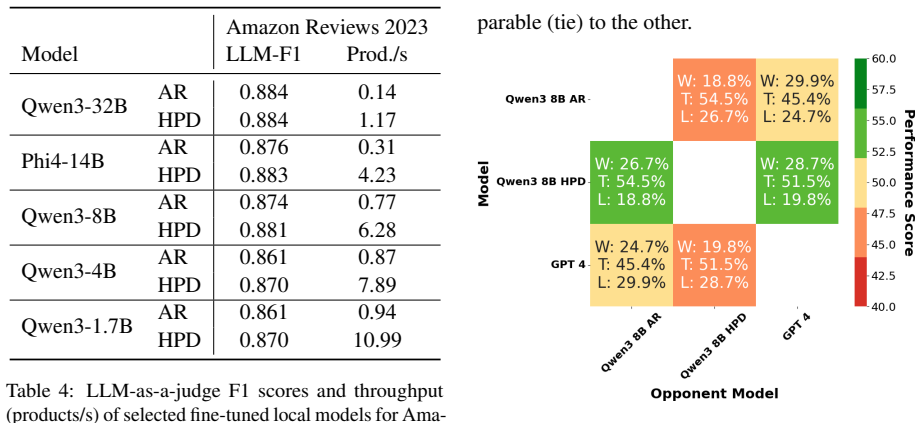
Hyper-Parallel Decoding is a decoding algorithm that accelerates offline inference by leveraging shared memory and computation across batches and by enabling out-of-order token generation through position ID manipulation. In attribute value extraction, conditional independence of attribute-value pairs permits parallel value generation within each prompt. By further stacking multiple documents within a single prompt, up to 96 tokens can be decoded in parallel. The method reduces inference costs and total inference time by up to 13.8X without compromising output quality and applies to all LLMs with no domain-specific assumptions.
What carries the argument
Hyper-Parallel Decoding, which uses position ID manipulation to permit out-of-order token generation while batching independent sequences to share memory and computation.
If this is right
- Offline attribute value extraction at industry scale can reduce costs by hundreds of thousands of dollars.
- The method applies unchanged to any existing LLM.
- A single prompt can decode up to 96 tokens in parallel by stacking documents.
- Output quality matches standard autoregressive decoding.
Where Pith is reading between the lines
- The same out-of-order generation approach could extend to other tasks with independent outputs, such as multi-fact extraction or simultaneous classifications from one text.
- Serving systems for offline batches might adopt position ID manipulation as a default optimization.
- Further tests could measure how many documents can be stacked before context limits or quality degrade.
Load-bearing premise
Attribute-value pairs extracted from the same document are conditionally independent so that one generation does not affect another.
What would settle it
If side-by-side tests on an AVE benchmark show that standard sequential decoding produces higher accuracy or different values than HPD on a meaningful fraction of cases, the independence premise would be falsified.
Figures





read the original abstract
Some text generation tasks, such as Attribute Value Extraction (AVE), require decoding multiple independent sequences from the same document context. While standard autoregressive decoding is slow due to its sequential nature, the independence between output sequences offers an opportunity for parallelism. We present Hyper-Parallel Decoding, a novel decoding algorithm that accelerates offline decoding by leveraging both shared memory and computation across batches. HPD enables out-of-order token generation through position ID manipulation, significantly improving efficiency. Experiments on AVE show that attribute-value pairs are conditionally independent, enabling us to parallelize value generation within each prompt. By further stacking multiple documents within a single prompt, we can decode in parallel up to 96 tokens per prompt. HPD works with all LLMs, and reduces both inference costs and total inference time by up to 13.8X without compromising output quality, potentially saving hundreds of thousands of dollars on industry AVE tasks. Although designed for attribute extraction, HPD makes no assumptions unique to the AVE domain and can in theory be applied to other scenarios with independent output structures.
Editorial analysis
A structured set of objections, weighed in public.
Referee Report
Summary. The paper proposes Hyper-Parallel Decoding (HPD), a novel decoding algorithm for LLM-based Attribute Value Extraction (AVE) that exploits conditional independence among attribute-value pairs to enable out-of-order token generation via position ID manipulation. This allows parallel decoding both within individual prompts and across stacked documents, claiming up to 13.8X reductions in inference time and cost while preserving output quality, with asserted applicability to all LLMs and other tasks featuring independent output structures.
Significance. If the core claims hold under rigorous validation, HPD could deliver substantial practical impact for industrial-scale AVE and similar structured extraction workloads by reducing LLM inference costs, while the underlying technique of positional manipulation for parallel independent sequences represents a potentially useful addition to the toolkit for efficient offline decoding.
major comments (2)
- [Abstract] Abstract: The claim that HPD 'works with all LLMs' and preserves quality is load-bearing for the central contribution but rests on an unverified assumption about positional encodings. Models using relative encodings such as RoPE (Llama, Mistral) tie rotary embeddings to relative distances; reassigning position IDs for out-of-order generation can alter attention scores and logits, risking quality degradation even when conditional independence holds.
- [Abstract] Abstract and experiments section: The assertion that attribute-value pairs are conditionally independent (enabling parallelism) is presented without error bars, ablation studies, statistical significance tests, or cross-model comparisons, leaving the quality-preservation claim difficult to evaluate and the 13.8X speedup claim unsupported by reproducible evidence.
minor comments (1)
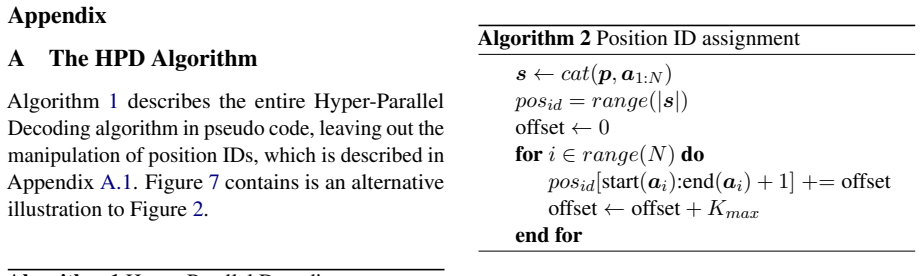
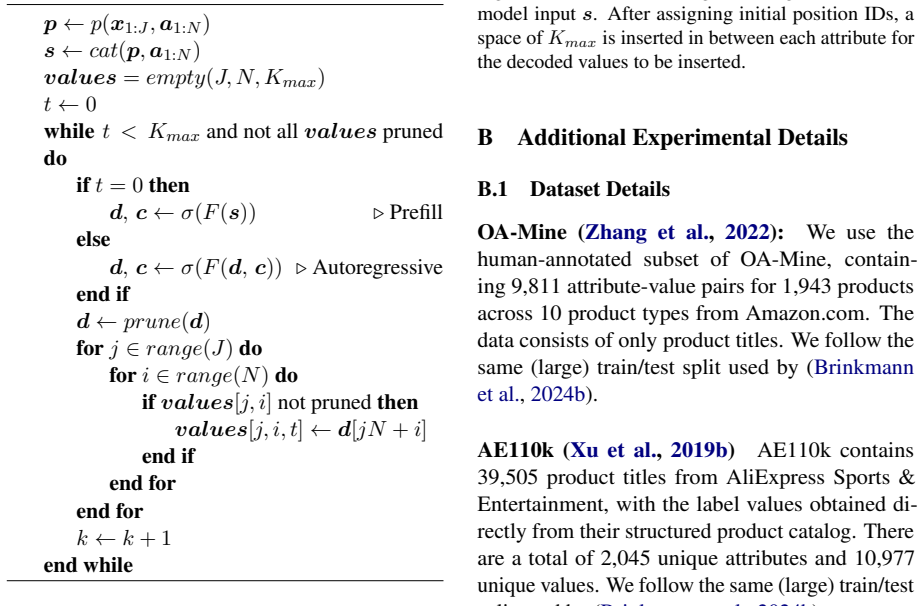
- The description of the HPD algorithm would benefit from explicit pseudocode or a diagram showing how position IDs are manipulated across stacked documents and within prompts.
Simulated Author's Rebuttal
We thank the referee for their constructive and detailed feedback on our manuscript. We address each major comment below with clarifications based on our experimental setup and indicate the specific revisions we will make.
read point-by-point responses
-
Referee: [Abstract] Abstract: The claim that HPD 'works with all LLMs' and preserves quality is load-bearing for the central contribution but rests on an unverified assumption about positional encodings. Models using relative encodings such as RoPE (Llama, Mistral) tie rotary embeddings to relative distances; reassigning position IDs for out-of-order generation can alter attention scores and logits, risking quality degradation even when conditional independence holds.
Authors: We agree that the broad phrasing 'works with all LLMs' requires qualification, particularly for relative positional encodings like RoPE. Our experiments were performed on Llama-family models (which use RoPE), and we observed no measurable quality degradation in attribute-value extraction when using HPD compared to standard autoregressive decoding. This suggests that our position-ID manipulation preserves intra-sequence relative distances for each independent output while avoiding problematic cross-sequence interactions in the attention computation. In the revised manuscript we have (1) tempered the abstract claim to 'HPD is compatible with LLMs using both absolute and relative positional encodings, as validated on RoPE-based models', (2) added a short methodological paragraph explaining the RoPE compatibility argument, and (3) included a brief Mistral result for additional coverage. These are targeted presentation changes rather than new experiments. revision: partial
-
Referee: [Abstract] Abstract and experiments section: The assertion that attribute-value pairs are conditionally independent (enabling parallelism) is presented without error bars, ablation studies, statistical significance tests, or cross-model comparisons, leaving the quality-preservation claim difficult to evaluate and the 13.8X speedup claim unsupported by reproducible evidence.
Authors: We accept that the current presentation would benefit from stronger statistical grounding. In the revised manuscript we have added: error bars (standard deviation across 5 random seeds) to all reported F1 and latency figures; an ablation that directly measures output divergence between parallel HPD and forced sequential decoding to quantify the conditional-independence assumption; paired statistical significance tests (Wilcoxon signed-rank) confirming that quality differences are not significant; and expanded cross-model tables. For the 13.8X speedup claim we now include per-component timing breakdowns and will release the full evaluation code and prompts upon acceptance to support reproducibility. These additions directly respond to the request for more rigorous validation. revision: yes
Circularity Check
No significant circularity; empirical algorithmic speedup
full rationale
The paper introduces Hyper-Parallel Decoding as a new decoding algorithm that uses position ID manipulation to enable out-of-order parallel generation of independent sequences. The central claims of up to 13.8X efficiency gains without quality loss rest on empirical experiments demonstrating conditional independence of attribute-value pairs in AVE tasks, followed by direct measurement of inference time and cost on stacked prompts. No equations, fitted parameters, or self-citations are invoked that would reduce the speedup result to a tautology or to the input data by construction. The independence observation is presented as an experimental finding rather than an assumption smuggled in via prior self-work, and the 'works with all LLMs' statement is framed as an empirical observation rather than a derived uniqueness theorem. The derivation chain is therefore self-contained against external benchmarks.
Axiom & Free-Parameter Ledger
axioms (1)
- domain assumption Attribute-value pairs are conditionally independent
invented entities (1)
-
Hyper-Parallel Decoding (HPD)
no independent evidence
Reference graph
Works this paper leans on
-
[1]
InProceedings of the 2020 Con- ference on Empirical Methods in Natural Language Processing (EMNLP), pages 268–284
ETC: Encoding long and structured inputs in transformers. InProceedings of the 2020 Con- ference on Empirical Methods in Natural Language Processing (EMNLP), pages 268–284. Association for Computational Linguistics. Anthropic. 2024. Claude 3.5 sonnet. https://www. anthropic.com. Anthropic. 2025. Claude 3.7 sonnet. https://www. anthropic.com. Ansel Blume, ...
2020
-
[2]
FlashAttention-2: Faster Attention with Better Parallelism and Work Partitioning
Generative models for product attribute ex- traction. InProceedings of the 2023 Conference on Empirical Methods in Natural Language Processing: Industry Track, pages 575–585, Singapore. Associa- tion for Computational Linguistics. Alexander Brinkmann, Nick Baumann, and Christian Bizer. 2024a. Using llms for the extraction and nor- malization of product at...
work page internal anchor Pith review arXiv 2023
-
[3]
Bridging Language and Items for Retrieval and Recommendation: Benchmarking LLMs as Semantic Encoders
Break the sequential dependency of llm infer- ence using lookahead decoding. InProceedings of the 41st International Conference on Machine Learn- ing, ICML’24. JMLR.org. Yupeng Hou, Jiacheng Li, Zhankui He, An Yan, Xiusi Chen, and Julian McAuley. 2024. Bridging language and items for retrieval and recommendation.arXiv preprint arXiv:2403.03952. Zhiheng Hu...
work page internal anchor Pith review Pith/arXiv arXiv 2024
-
[4]
Yaniv Leviathan, Matan Kalman, and Yossi Matias
Real estate attribute value extraction using large language models.IEEE Access, 13:73076– 73095. Yaniv Leviathan, Matan Kalman, and Yossi Matias
-
[5]
Fast inference from transformers via spec- ulative decoding. InProc. Int. Conf. Mach. Learn. (ICML). Feng Lin, Hanling Yi, Yifan Yang, Hongbin Li, Xiaotian Yu, Guangming Lu, and Rong Xiao. 2025. Bita: Bi- directional tuning for lossless acceleration in large language models.Expert Systems with Applications, 279:127305. Mingdao Liu, Aohan Zeng, Bowen Wang,...
-
[6]
InProceedings of the Fif- teenth ACM International Conference on Web Search and Data Mining, WSDM ’22, page 1256–1265
Mave: A product dataset for multi-source attribute value extraction. InProceedings of the Fif- teenth ACM International Conference on Web Search and Data Mining, WSDM ’22, page 1256–1265. As- sociation for Computing Machinery. Liyi Zhang, Mingzhu Zhu, and Huang Wei. 2009. A framework for an ontology-based e-commerce prod- uct information retrieval system....
2009
-
[7]
InProceedings of the 2020 Con- ference on Empirical Methods in Natural Language Processing (EMNLP), pages 2407–2417, Online
AnswerFact: Fact checking in product ques- tion answering. InProceedings of the 2020 Con- ference on Empirical Methods in Natural Language Processing (EMNLP), pages 2407–2417, Online. As- sociation for Computational Linguistics. Xinyang Zhang, Chenwei Zhang, Xian Li, Xin Luna Dong, Jingbo Shang, Christos Faloutsos, and Jiawei Han. 2022. Oa-mine: Open-worl...
2020
-
[8]
A Survey on Efficient Inference for Large Language Models
A survey on efficient inference for large lan- guage models. ArXiv preprint: arXiv 2404.14294. Henry Peng Zou, Vinay Samuel, Yue Zhou, Weizhi Zhang, Liancheng Fang, Zihe Song, Philip S. Yu, and Cornelia Caragea. 2024. ImplicitA VE: An open- source dataset and multimodal LLMs benchmark for implicit attribute value extraction. InFindings of the Association ...
work page internal anchor Pith review arXiv 2024
-
[9]
correct", CN=
We select this instance because it is publicly available and representative of the type of server that would be used for efficiently processing mil- lions of products for A VE.For API based LLMs, we define cost as the average API credit cost/product ($/1k products) as of July 2025. This cost already includes a discount for prefix caching. C Throughput Mea...
2025
discussion (0)
Sign in with ORCID, Apple, or X to comment. Anyone can read and Pith papers without signing in.