Recognition: unknown
Recurrence-Based Nonlinear Vocal Dynamics as Digital Biomarkers for Depression Detection from Conversational Speech
Pith reviewed 2026-05-07 12:44 UTC · model grok-4.3
The pith
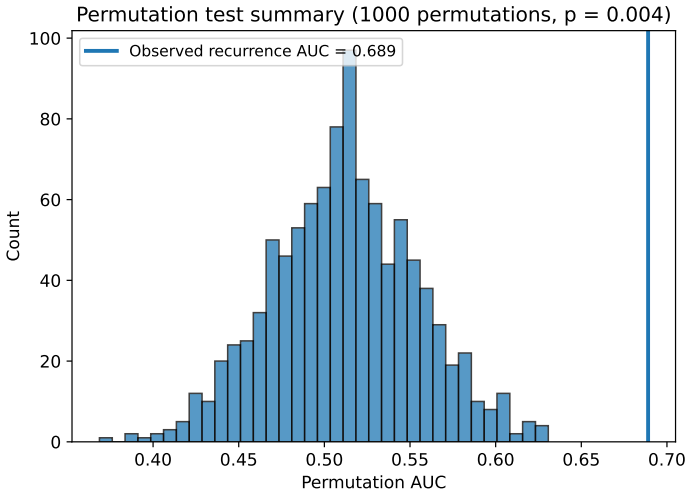
Depression alters recurrence patterns in vocal state trajectories during conversation, allowing nonlinear biomarkers to detect it with mean AUC 0.689 that exceeds static acoustic and other baselines.
A machine-rendered reading of the paper's core claim, the machinery that carries it, and where it could break.
Core claim
Depression is characterized by altered recurrence structure in conversational vocal dynamics. When frame-level COVAREP trajectories are treated as nonlinear dynamical systems, the resulting recurrence-based biomarkers from 74 vocal channels yield a mean cross-validated AUC of 0.689. This exceeds performance from static acoustic baselines, entropy-dynamics features, Hurst exponent features, determinism features, and Lyapunov-like instability proxies, with permutation testing confirming statistical significance at p=0.004.
What carries the argument
Recurrence-based biomarkers extracted from the state-space trajectories of frame-level COVAREP vocal features, which quantify how often and in what patterns the vocal system revisits acoustic states over time.
If this is right
- Vocal recurrence measures capture temporal organization in speech that static acoustic descriptors miss, improving classification of depression.
- Nonlinear dynamical modeling of vocal channels supplies a new class of digital biomarkers for psychiatric conditions.
- Logistic regression on these features supports reliable detection in cross-validated settings from the DAIC-WOZ depression subset.
- The approach generalizes beyond single summary statistics to the full revisitation patterns in vocal state space.
Where Pith is reading between the lines
- Similar recurrence analysis could be tested on speech data from other conditions that affect vocal motor control, such as anxiety or neurological disorders.
- The biomarkers might be incorporated into mobile apps for continuous monitoring if they prove stable across languages and recording devices.
- Combining recurrence features with other dynamical measures could further raise detection accuracy while keeping the method parameter-light.
Load-bearing premise
The assumption that recurrence structure observed in vocal trajectories directly reflects depression-related changes in vocal dynamics and that the labeled conversational recordings accurately capture this without major confounds from labeling or recording conditions.
What would settle it
An independent dataset of conversational speech showing no reliable difference in recurrence metrics between depressed and non-depressed speakers would falsify the claim that altered recurrence structure serves as a depression biomarker.
Figures



read the original abstract
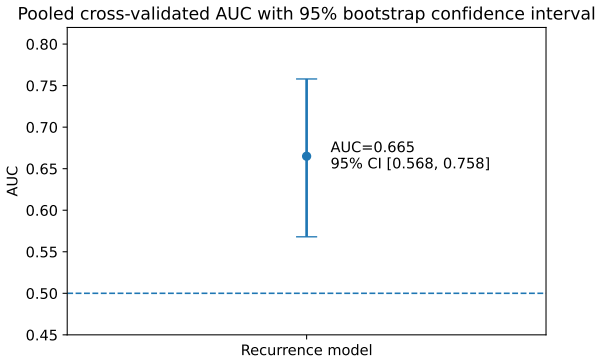
Digital biomarkers for depression have largely relied on static acoustic descriptors, pooled summary statistics, or conventional machine learning representations. Such approaches may miss nonlinear temporal organization embedded in conversational vocal dynamics. We hypothesized that depression is associated with altered recurrence structure in vocal state trajectories, reflecting changes in how the vocal system revisits acoustic states over time. Using the depression subset of the DAIC-WOZ corpus with 142 labeled participants, we modeled frame-level COVAREP trajectories as nonlinear dynamical systems and derived recurrence-based biomarkers from 74 vocal channels. Logistic regression with feature selection and stratified cross-validation evaluated classification performance. Recurrence-based biomarkers achieved a mean cross-validated AUC of 0.689, exceeding static acoustic baselines, entropy-dynamics features, Hurst exponent features, determinism features, and Lyapunov-like instability proxies. Permutation testing indicated statistical significance with $p=0.004$. Pooled cross-validated predictions yielded AUC 0.665 with a 95\% bootstrap confidence interval of [0.568, 0.758]. These findings suggest that depression may be characterized by altered recurrence structure in conversational vocal dynamics and support nonlinear state-space analysis as a promising direction for digital psychiatric biomarkers.
Editorial analysis
A structured set of objections, weighed in public.
Referee Report
Summary. The paper claims that modeling frame-level COVAREP acoustic trajectories from the DAIC-WOZ depression subset (142 participants) as nonlinear dynamical systems yields recurrence-based biomarkers that, when fed to logistic regression with feature selection and stratified cross-validation, achieve a mean cross-validated AUC of 0.689. This exceeds static acoustic, entropy-dynamics, Hurst-exponent, determinism, and Lyapunov-like baselines, with a permutation test p=0.004; pooled predictions give AUC 0.665 [0.568, 0.758]. The central hypothesis is that depression alters the recurrence structure of vocal state trajectories.
Significance. If the performance metrics prove robust, the work provides evidence that recurrence quantification analysis can extract temporal organization in conversational speech missed by conventional static or linear features, supporting nonlinear state-space methods as a viable direction for speech-based psychiatric biomarkers. The explicit comparison against multiple dynamical and static baselines on a public corpus is a strength.
major comments (1)
- [Methods] Methods (description of classifier): The statement 'Logistic regression with feature selection and stratified cross-validation' does not specify whether feature selection (univariate filtering, regularization, etc.) was performed inside each CV fold or on the full 142-participant dataset before partitioning. If the latter, test-fold information leaks into feature choice, inflating the reported mean AUC of 0.689 and rendering the permutation p=0.004 unreliable because the null distribution does not repeat the selection step. This directly affects the claim of superiority over the listed baselines.
minor comments (2)
- [Abstract] Abstract/Methods: Exact recurrence-plot parameters (embedding dimension, time delay, radius, minimum line length, etc.) for the 74 COVAREP channels are not stated, preventing independent verification or reproduction of the biomarker extraction.
- [Results] Results: No details are given on how class imbalance or speaker-level variability was handled within the stratified CV (e.g., speaker-independent partitioning, weighting, or oversampling), which is relevant for interpreting the AUC on a depression-labeled corpus.
Simulated Author's Rebuttal
We thank the referee for their thorough review and constructive feedback on our manuscript. We address the major comment on the cross-validation and feature selection procedure below.
read point-by-point responses
-
Referee: [Methods] Methods (description of classifier): The statement 'Logistic regression with feature selection and stratified cross-validation' does not specify whether feature selection (univariate filtering, regularization, etc.) was performed inside each CV fold or on the full 142-participant dataset before partitioning. If the latter, test-fold information leaks into feature choice, inflating the reported mean AUC of 0.689 and rendering the permutation p=0.004 unreliable because the null distribution does not repeat the selection step. This directly affects the claim of superiority over the listed baselines.
Authors: We thank the referee for highlighting this important methodological detail. The original manuscript did not explicitly state whether feature selection was nested inside the cross-validation folds. In our analysis, feature selection was performed within each training fold of the stratified cross-validation (using the training data only) to prevent any leakage from the held-out test set. The permutation test likewise repeated the full pipeline—including feature selection—for each permutation. We will revise the Methods section to explicitly describe this nested procedure, specify the feature selection approach employed, and confirm that the same nested structure was used for all baseline comparisons. This revision will ensure full transparency and support the validity of the reported AUC and p-value. revision: yes
Circularity Check
No circularity: empirical feature extraction and cross-validated classification on external labeled data
full rationale
The paper extracts recurrence-based features from COVAREP trajectories in the DAIC-WOZ corpus and evaluates them via logistic regression with stratified cross-validation, reporting an empirical AUC of 0.689 against baselines. No equations, first-principles derivations, or predictions are presented that reduce by construction to fitted parameters or self-referential definitions. The central result is a data-driven performance metric on held-out folds from an external corpus; it does not invoke self-citations as load-bearing uniqueness theorems, smuggle ansatzes, or rename known results as novel organization. The approach remains self-contained against external benchmarks with no reduction of the reported statistic to its own inputs.
Axiom & Free-Parameter Ledger
axioms (2)
- domain assumption Frame-level COVAREP trajectories can be modeled as nonlinear dynamical systems whose recurrence structure captures depression-related vocal changes.
- domain assumption The DAIC-WOZ depression subset provides reliable labels and representative conversational speech for biomarker evaluation.
Reference graph
Works this paper leans on
-
[1]
Detecting depression with audio/text sequence modeling of interviews
Tuka Al Hanai, Mohammad Ghassemi, and James Glass. Detecting depression with audio/text sequence modeling of interviews. InInterspeech, pages 1716–1720, 2018
2018
-
[2]
A review of depression and suicide risk assessment using speech analysis
Nicholas Cummins, Stefan Scherer, Jarek Krajewski, Sebastian Schnieder, Julien Epps, and Thomas Quatieri. A review of depression and suicide risk assessment using speech analysis. Speech Communication, 71:10–49, 2015
2015
-
[3]
Covarep: A collaborative voice analysis repository for speech technologies
Gilles Degottex, John Kane, Thomas Drugman, Tuomo Raitio, and Stefan Scherer. Covarep: A collaborative voice analysis repository for speech technologies. InICASSP, pages 960–964, 2014
2014
-
[4]
Simsensei kiosk: A virtual human interviewer for healthcare decision support
David DeVault, Ron Artstein, Grace Benn, et al. Simsensei kiosk: A virtual human interviewer for healthcare decision support. InProceedings of AAMAS, 2014
2014
-
[5]
Oliffson Kamphorst, and David Ruelle
Jean-Pierre Eckmann, S. Oliffson Kamphorst, and David Ruelle. Recurrence plots of dynamical systems.Europhysics Letters, 4(9):973–977, 1987
1987
-
[6]
Fractal dynamics in physiology: Alterations with disease and aging
Ary Goldberger et al. Fractal dynamics in physiology: Alterations with disease and aging. PNAS, 99(Suppl. 1):2466–2472, 2002
2002
-
[7]
Lucas, Giota Stratou, Stefan Scherer, Angela Nazar- ian, Rachel Wood, Jill Boberg, David DeVault, Stacy Marsella, and David Traum
Jonathan Gratch, Ron Artstein, Gale M. Lucas, Giota Stratou, Stefan Scherer, Angela Nazar- ian, Rachel Wood, Jill Boberg, David DeVault, Stacy Marsella, and David Traum. The distress analysis interview corpus of human and computer interviews. InProceedings of LREC, pages 3123–3128, 2014
2014
-
[8]
H. E. Hurst. Long-term storage capacity of reservoirs.Transactions of the ASCE, 116:770–799, 1951
1951
-
[9]
Cambridge University Press, 2004
Holger Kantz and Thomas Schreiber.Nonlinear Time Series Analysis. Cambridge University Press, 2004
2004
-
[10]
Automated assessment of psychiatric disorders using speech.Laryngoscope Investigative Otolaryngology, 5:96–116, 2020
Daniel Low, Kate Bentley, and Satrajit Ghosh. Automated assessment of psychiatric disorders using speech.Laryngoscope Investigative Otolaryngology, 5:96–116, 2020
2020
-
[11]
Carmen Romano, Marco Thiel, and Jurgen Kurths
Norbert Marwan, M. Carmen Romano, Marco Thiel, and Jurgen Kurths. Recurrence plots for the analysis of complex systems.Physics Reports, 438:237–329, 2007
2007
-
[12]
Scikit-learn: Machine learning in python.Journal of Machine Learning Research, 12:2825–2830, 2011
Fabian Pedregosa et al. Scikit-learn: Machine learning in python.Journal of Machine Learning Research, 12:2825–2830, 2011
2011
-
[13]
C. K. Peng, Shlomo Havlin, H. Eugene Stanley, and Ary Goldberger. Quantification of scaling exponents in nonstationary time series.Chaos, 5:82–87, 1995
1995
-
[14]
Approximate entropy as a measure of system complexity.PNAS, 88:2297–2301, 1991
Steven Pincus. Approximate entropy as a measure of system complexity.PNAS, 88:2297–2301, 1991. 11
1991
-
[15]
Physiological time-series analysis using approximate entropy and sample entropy.American Journal of Physiology, 278:H2039–H2049, 2000
Joshua Richman and J Randall Moorman. Physiological time-series analysis using approximate entropy and sample entropy.American Journal of Physiology, 278:H2039–H2049, 2000
2000
-
[16]
A practical method for calculating largest lyapunov exponents.Physica D, 65:117–134, 1993
Michael Rosenstein, James Collins, and Carlo De Luca. A practical method for calculating largest lyapunov exponents.Physica D, 65:117–134, 1993
1993
-
[17]
CRC Press, 2018
Steven Strogatz.Nonlinear Dynamics and Chaos. CRC Press, 2018
2018
-
[18]
Determining lyapunov exponents from a time series.Physica D, 16:285–317, 1985
Alan Wolf, Jack Swift, Harry Swinney, and John Vastano. Determining lyapunov exponents from a time series.Physica D, 16:285–317, 1985. 12
1985
discussion (0)
Sign in with ORCID, Apple, or X to comment. Anyone can read and Pith papers without signing in.