Recognition: unknown
A Category-Theoretic Framework from Biological Mechanics to Engineered Stimulus-Response Systems
Pith reviewed 2026-05-07 12:54 UTC · model grok-4.3
The pith
Category theory turns biological stimulus-response systems into composable, verifiable engineered actuators via structure-preserving functors.
A machine-rendered reading of the paper's core claim, the machinery that carries it, and where it could break.
Core claim
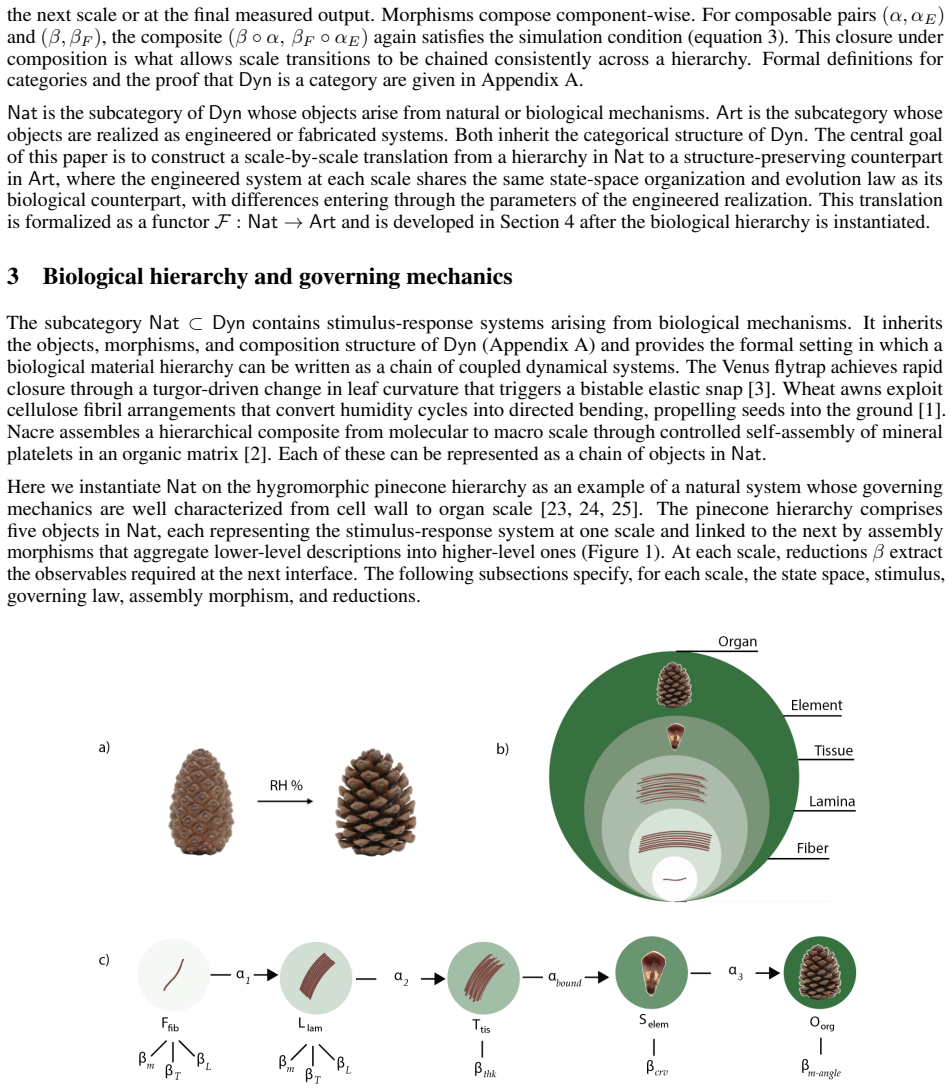
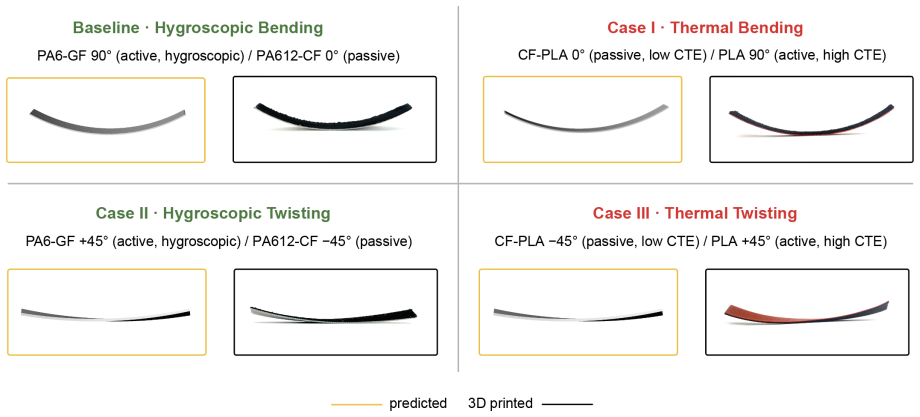
The paper claims that compositionality functions as a generative and system-level verifiable method for mechanical material design. It does so by defining categories of stimulus-response dynamical systems, equipping them with a structure-preserving implementation functor from biological mechanics to engineered systems, and adding a machine-agnostic specification layer that links intent to fabrication programs. Instantiation on the pinecone hierarchy produces four actuator classes, one obtained solely by composing prior components, which are then realized via parametric scripts, 3D printing, and experimental tests that match model predictions derived from the same pipeline.
What carries the argument
The structure-preserving implementation functor from the category of biological stimulus-response systems to the category of engineered systems, which carries compositional structure and physical consistency across levels of abstraction.
If this is right
- Composition of validated components produces new functional actuators without additional manual derivation.
- Parametric scripts generated from the formal specifications preserve the original compositional structure during fabrication.
- The pipeline yields actuator designs that span multiple stimulus types and kinematic responses.
- Experimental results on the fabricated parts align with model predictions obtained directly from the category-theoretic description.
- Compositionality supplies both a descriptive language and a generative, system-level verification method for mechanical material design.
Where Pith is reading between the lines
- The same functor-based translation could be applied to other hierarchical biological systems such as plant or animal tissues to generate adaptive structures.
- The machine-agnostic specification layer opens a route for coupling the framework with automated search or optimization routines to explore larger design spaces.
- The approach may support modular design of larger systems where multiple stimulus-response units must interact while preserving overall physical consistency.
Load-bearing premise
The structure-preserving implementation functor from biological mechanics to engineered systems accurately captures and preserves all necessary physical properties and behaviors across abstraction levels without loss or inconsistency.
What would settle it
Fabricate the four actuator classes and measure their stimulus-response behavior; significant deviation from the predictions generated by the compositional pipeline would show that the functor failed to preserve the required physical properties.
Figures




read the original abstract
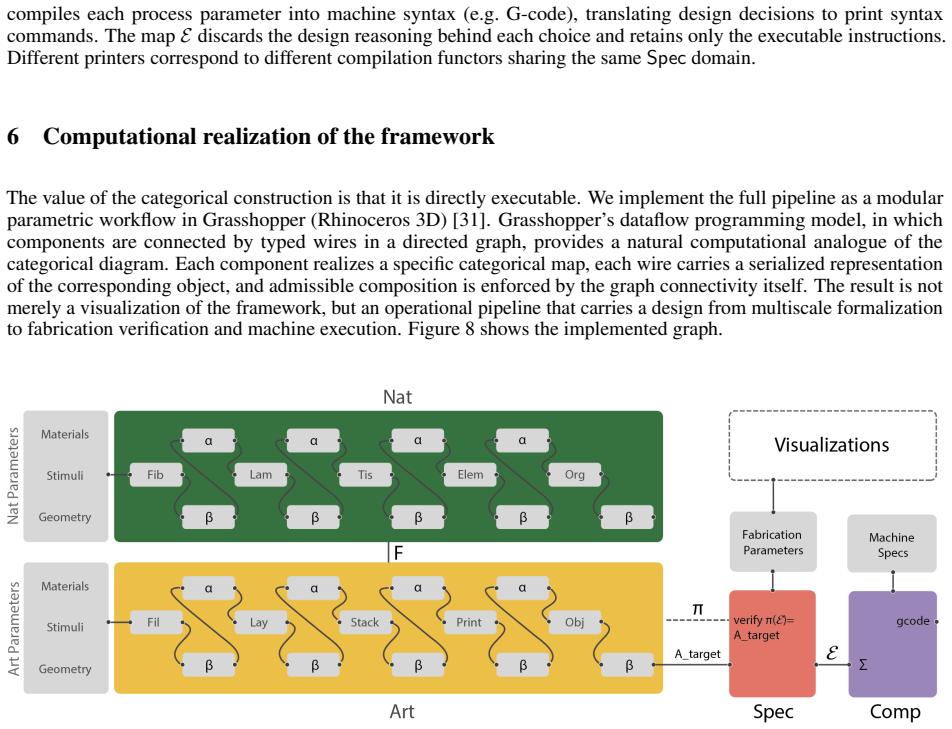
Natural materials achieve adaptive behavior through hierarchical organization and coupled mechanisms across scales. Their translation into engineering, however, remains largely heuristic. What is missing is a formal translation framework that carries biological design logic into engineered realization while preserving physical consistency across levels of abstraction. Here we present a category theoretic compositional framework for verified nature-derived design. The framework defines a category of stimulus response dynamical systems with natural and artificial subcategories. It introduces a structure preserving implementation functor from biological mechanics to engineered systems. It also formalizes a machine agnostic specification layer that links behavioral intent to executable fabrication programs. We instantiate the framework on the hygromorphic pinecone hierarchy as a representative biological case. We implement the full pipeline in Grasshopper, where formal specifications are translated into modular parametric scripts that preserve the compositional structure of the model. The resulting designs are fabricated by fused filament fabrication, evaluated experimentally, and tested against model predictions derived from the pipeline. The current implementation generates four actuator classes spanning two stimulus types and two kinematic responses. One actuator arises purely through composition from previously validated components, without additional manual derivation. The results show that compositionality can function not just as a descriptive language, but as a generative and system level verifiable method for mechanical material design. More broadly, the work provides a concrete route for embedding formal multiscale reasoning within increasingly computational, generative, and physics-driven design workflows.
Editorial analysis
A structured set of objections, weighed in public.
Referee Report
Summary. The manuscript proposes a category-theoretic framework for translating biological stimulus-response systems into engineered designs. It defines a category of stimulus-response dynamical systems with natural and artificial subcategories, introduces a structure-preserving implementation functor from biological mechanics to engineered systems, and formalizes a machine-agnostic specification layer linking behavioral intent to fabrication programs. The framework is instantiated on the hygromorphic pinecone hierarchy, implemented via Grasshopper scripts to generate four actuator classes (spanning two stimuli and two kinematic responses), with one actuator arising purely through composition. These designs are fabricated by fused filament fabrication and experimentally validated against model predictions derived from the pipeline.
Significance. If the central claims hold, the work demonstrates that compositionality can serve as a generative and system-level verifiable method for mechanical material design rather than merely a descriptive tool. The experimental validation across multiple actuator classes and the purely compositional result provide concrete evidence of applicability, potentially enabling formal multiscale reasoning in computational, physics-driven design workflows for soft matter and bio-inspired engineering.
major comments (3)
- [Definition of the structure-preserving implementation functor] The definition of the structure-preserving implementation functor (in the framework section following the category definitions): the manuscript asserts that this functor maps biological stimulus-response systems to engineered realizations while preserving all necessary physical behaviors across abstraction levels, but provides no derivation showing that the functor commutes with relevant physical operators (e.g., those for constitutive relations or energy balances). Experimental agreement in the fabricated cases does not establish that the categorical structure itself enforces preservation, as opposed to the specific parametric choices in the Grasshopper implementation.
- [Results on the compositional actuator] The results section on the compositional actuator (the one arising purely through composition from previously validated components): while this is presented as a key demonstration of the framework's generative power, the manuscript does not verify that the composed model's predictions remain accurate without re-fitting or that the composition preserves the physical consistency of the individual components' models. This is load-bearing for the claim that compositionality functions as a system-level verifiable method.
- [Experimental validation and pipeline implementation] The experimental validation and pipeline implementation (Grasshopper scripts and fabrication/evaluation sections): details on error analysis, how physical consistency is enforced in the modular parametric scripts, and full derivations of the model predictions are insufficient. Without these, it is unclear whether the reported agreement with experiments supports the functor's structure-preserving property or relies on case-specific tuning for the four actuator classes.
minor comments (2)
- [Abstract and introduction] The abstract and introduction could more explicitly distinguish between the categorical structure's role and the role of the chosen parametric implementations to avoid potential overstatement of the framework's independence from implementation details.
- Notation for the categories, subcategories, and functor could benefit from additional concrete examples or diagrams early in the text to improve accessibility for readers in soft matter physics without prior category theory background.
Simulated Author's Rebuttal
We thank the referee for the constructive and detailed comments, which help clarify the presentation of our category-theoretic framework. We respond to each major comment below, indicating revisions where appropriate.
read point-by-point responses
-
Referee: The definition of the structure-preserving implementation functor (in the framework section following the category definitions): the manuscript asserts that this functor maps biological stimulus-response systems to engineered realizations while preserving all necessary physical behaviors across abstraction levels, but provides no derivation showing that the functor commutes with relevant physical operators (e.g., those for constitutive relations or energy balances). Experimental agreement in the fabricated cases does not establish that the categorical structure itself enforces preservation, as opposed to the specific parametric choices in the Grasshopper implementation.
Authors: The implementation functor is defined to act on the category of stimulus-response dynamical systems by mapping objects (systems) and morphisms (stimulus-response relations) such that composition is preserved by construction. This ensures that the structural properties of the biological models, including their dynamical consistency, are carried into the engineered realizations without requiring case-by-case re-derivation. While the manuscript does not include an explicit general proof that the functor commutes with arbitrary physical operators outside the hygromorphic class, the definition is constructed to respect the relevant operators for the systems under consideration. The Grasshopper scripts implement this mapping directly rather than through independent tuning. We will revise the framework section to include an explicit statement clarifying the preservation properties by definition of the functor. revision: partial
-
Referee: The results section on the compositional actuator (the one arising purely through composition from previously validated components): while this is presented as a key demonstration of the framework's generative power, the manuscript does not verify that the composed model's predictions remain accurate without re-fitting or that the composition preserves the physical consistency of the individual components' models. This is load-bearing for the claim that compositionality functions as a system-level verifiable method.
Authors: The compositional actuator is generated solely by applying the composition operation in the category to the previously validated component models. Because the functor preserves composition, the predictions for the composed system are obtained directly from the component predictions without additional fitting or manual adjustment. We will add a dedicated paragraph in the results section (and corresponding supplementary note) that explicitly verifies this by comparing the composed predictions against the experimental data for the new actuator, confirming no re-fitting was performed and that physical consistency is inherited from the components. revision: yes
-
Referee: The experimental validation and pipeline implementation (Grasshopper scripts and fabrication/evaluation sections): details on error analysis, how physical consistency is enforced in the modular parametric scripts, and full derivations of the model predictions are insufficient. Without these, it is unclear whether the reported agreement with experiments supports the functor's structure-preserving property or relies on case-specific tuning for the four actuator classes.
Authors: We agree that expanded details on these aspects will strengthen the manuscript. The modular parametric scripts are written to mirror the functorial mappings and compositional structure, thereby enforcing consistency at the level of the category rather than through ad-hoc adjustments. We will revise the methods and results sections to include quantitative error analysis (with error bars and statistical measures), full derivations of the model predictions for each actuator class, and a description of how the scripts maintain physical consistency through their modular, structure-preserving design. These additions will appear in the main text and supplementary information. revision: yes
Circularity Check
No significant circularity; framework definitions and experimental validation remain independent
full rationale
The paper introduces a new category of stimulus-response dynamical systems, defines natural and artificial subcategories, and introduces a structure-preserving implementation functor as part of the framework construction. It then instantiates the framework on the pinecone hierarchy, encodes formal specifications into Grasshopper parametric scripts that preserve compositional structure, fabricates four actuator classes via FFF, and compares outcomes to model predictions generated from the same pipeline. The experimental agreement constitutes external physical validation rather than an internal reduction. No equations or fitted parameters are presented as 'predictions' that collapse to the fitting data by construction. No self-citations appear as load-bearing premises, and no uniqueness theorems or ansatzes are imported from prior author work. The derivation chain therefore remains self-contained: the functor is defined to preserve structure, the implementation follows that definition, and success is measured against fabricated hardware rather than against the definitions themselves.
Axiom & Free-Parameter Ledger
Forward citations
Cited by 1 Pith paper
-
Harness Engineering as Categorical Architecture
Categorical Architecture triple (G, Know, Phi) supplies the formal theory for composing LLM agent harnesses with structurally preserved certificates.
Reference graph
Works this paper leans on
-
[1]
& Fratzl, P
Elbaum, R., Zaltzman, L., Burgert, I. & Fratzl, P. The role of wheat awns in the seed dispersal unit.Science316, 884–886 (2007)
2007
-
[2]
Cartwright, J. H. & Checa, A. G. The dynamics of nacre self-assembly.Journal of the Royal Society Interface4, 491–504 (2007)
2007
-
[3]
M., Dumais, J
Forterre, Y ., Skotheim, J. M., Dumais, J. & Mahadevan, L. How the venus flytrap snaps.Nature433, 421–425 (2005)
2005
-
[4]
Wegst, U. G. K., Bai, H., Saiz, E., Tomsia, A. P. & Ritchie, R. O. Bioinspired structural materials.Nature Materials14, 23–36 (2015)
2015
-
[5]
& Buehler, M
Barthelat, F., Yin, Z. & Buehler, M. J. Structure and mechanics of interfaces in biological materials.Nature Reviews Materials1, 16007 (2016)
2016
-
[6]
Mohammed, J. S. & Murphy, W. L. Bioinspired design of dynamic materials.Advanced Materials21, 2361–2374 (2009)
2009
-
[7]
5 (Harvard University Press, 1964)
Alexander, C.Notes on the Synthesis of F orm, vol. 5 (Harvard University Press, 1964)
1964
-
[8]
I.Category Theory for the Sciences(MIT Press, 2014)
Spivak, D. I.Category Theory for the Sciences(MIT Press, 2014)
2014
-
[9]
& Zardini, G.Applied Compositional Thinking for Engineering(work-in-progress book, 2024)
Censi, A., Lorand, J. & Zardini, G.Applied Compositional Thinking for Engineering(work-in-progress book, 2024). URLhttps://bit.ly/3qQNrdR
2024
-
[10]
Spivak, D. I. & Kent, R. E. Ologs: a categorical framework for knowledge representation.PloS One7, e24274 (2012)
2012
-
[11]
Schultz, P., Spivak, D. I. & Vasilakopoulou, C. Dynamical systems and sheaves.Applied Categorical Structures 28, 1–57 (2020)
2020
-
[12]
A mathematical theory of co-design.arXiv preprint arXiv:1512.08055(2015)
Censi, A. A mathematical theory of co-design.arXiv preprint arXiv:1512.08055(2015)
-
[13]
& Frazzoli, E
Zardini, G., Censi, A. & Frazzoli, E. Co-design of autonomous systems: From hardware selection to control synthesis. In2021 European Control Conference (ECC), 682–689 (2021)
2021
-
[14]
Zardini, G.Co-design of complex systems: From autonomy to future mobility systems. Ph.D. thesis, ETH Zurich (2023)
2023
-
[15]
& Coecke, B
Abramsky, S. & Coecke, B. Categorical quantum mechanics.Handbook of quantum logic and quantum structures 2, 261–325 (2009)
2009
-
[16]
Giesa, T., Spivak, D. I. & Buehler, M. J. Category theory based solution for the building block replacement problem in materials design.Advanced Engineering Materials14, 810–817 (2012)
2012
-
[17]
Giesa, T., Spivak, D. I. & Buehler, M. J. Reoccurring patterns in hierarchical protein materials and music: the power of analogies.BioNanoScience1, 153–161 (2011)
2011
-
[18]
B., Giesa, T., Spivak, D
Brommer, D. B., Giesa, T., Spivak, D. I. & Buehler, M. J. Categorical prototyping: Incorporating molecular mechanisms into 3d printing.Nanotechnology27, 24002 (2016)
2016
-
[19]
Buehler, M. J. Generative retrieval-augmented ontologic graph and multiagent strategies for interpretive large language model-based materials design.ACS Engineering Au4, 241–277 (2024)
2024
-
[20]
Buehler, M. J. Self-organizing graph reasoning evolves into a critical state for continuous discovery through structural–semantic dynamics.Chaos: An Interdisciplinary Journal of Nonlinear Science35(2025)
2025
-
[21]
Buehler, M. J. FieldPerceiver: Domain agnostic transformer model to predict multiscale physical fields and nonlinear material properties through neural ologs.Materials Today57, 9–25 (2022)
2022
-
[22]
& Buehler, M
Marom, L. & Buehler, M. J. Frontiers of biological material intelligence.MRS Bulletin1–13 (2025)
2025
-
[23]
Zhang, C.et al.Hygromechanical mechanisms of wood cell wall revealed by molecular modeling and mixture rule analysis.Science Advances7, eabi8919 (2021)
2021
-
[24]
Quan, H., Pirosa, A., Yang, W., Ritchie, R. O. & Meyers, M. A. Hydration-induced reversible deformation of the pine cone.Acta biomaterialia128, 370–383 (2021)
2021
-
[25]
& Mahadevan, L
Reyssat, E. & Mahadevan, L. Hygromorphs: from pine cones to biomimetic bilayers.Journal of the Royal Society Interface6, 951–957 (2009)
2009
-
[26]
Analysis of bi-metal thermostats.Journal of the Optical Society of America11, 233–255 (1925)
Timoshenko, S. Analysis of bi-metal thermostats.Journal of the Optical Society of America11, 233–255 (1925). 22
1925
-
[27]
S., Matsumoto, E
Gladman, A. S., Matsumoto, E. A., Nuzzo, R. G., Mahadevan, L. & Lewis, J. A. Biomimetic 4d printing.Nature Materials15, 413–418 (2016)
2016
-
[28]
& Kelch, S
Lendlein, A. & Kelch, S. Shape-memory polymers.Angewandte Chemie International Edition41, 2034 (2002)
2034
-
[29]
Taylor, D. L. & in het Panhuis, M. Self-healing hydrogels.Advanced Materials28, 9060–9093 (2016)
2016
-
[30]
4d printing: Multi-material shape change.Architectural Design84, 116–121 (2014)
Tibbits, S. 4d printing: Multi-material shape change.Architectural Design84, 116–121 (2014)
2014
-
[31]
Rhinoceros 3d, version 8 (2024)
Robert McNeel & Associates. Rhinoceros 3d, version 8 (2024). URLhttps://www.rhino3d.com
2024
-
[32]
& Sharon, E
Armon, S., Efrati, E., Kupferman, R. & Sharon, E. Geometry and mechanics in the opening of chiral seed pods. Science333, 1726–1730 (2011)
2011
-
[33]
& Zardini, G
Huang, Y . & Zardini, G. Distributional uncertainty and adaptive decision-making in system co-design.arXiv e-printsarXiv–2603 (2026)
2026
-
[34]
& Buehler, M
Ghafarollahi, A. & Buehler, M. J. SciAgents: Automating scientific discovery through bioinspired multi-agent intelligent graph reasoning.Advanced Materials37, 2413523 (2025)
2025
-
[35]
Buehler, M. J. Accelerating scientific discovery with generative knowledge extraction, graph-based representation, and multimodal intelligent graph reasoning.Machine Learning: Science and Technology(2024)
2024
-
[36]
I., Giesa, T., Wood, E
Spivak, D. I., Giesa, T., Wood, E. & Buehler, M. J. Category theoretic analysis of hierarchical protein materials and social networks.PLoS ONE6, e23911 (2011)
2011
- [37]
discussion (0)
Sign in with ORCID, Apple, or X to comment. Anyone can read and Pith papers without signing in.