Recognition: unknown
Simulation of complex DNA damage enhancement and biological effect validation for Proton-CAT
Pith reviewed 2026-05-07 11:48 UTC · model grok-4.3
The pith
15N enrichment in tumors amplifies complex DNA damage from alpha and carbon particles during proton therapy.
A machine-rendered reading of the paper's core claim, the machinery that carries it, and where it could break.
Core claim
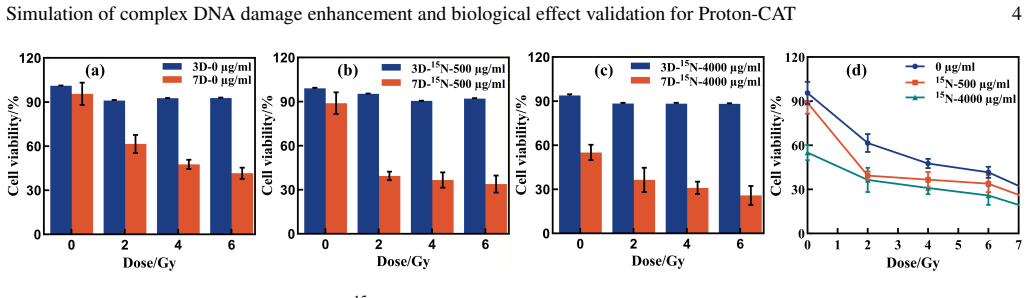
Under 30 percent 15N conditions, alpha-particle induced DSB++ rose by 175.19 percent and 12C-particle induced DSB++ rose by 52.94 percent. In vitro experiments found that 500 micrograms per milliliter of 15N-Glu produced no significant cytotoxicity on its own, yet after 2 Gy irradiation the treated cells showed a net 15.41 percent drop in viability relative to controls. The authors conclude that the Proton-CAT effect arises mainly from this increase in complex DNA damage rather than from other mechanisms.
What carries the argument
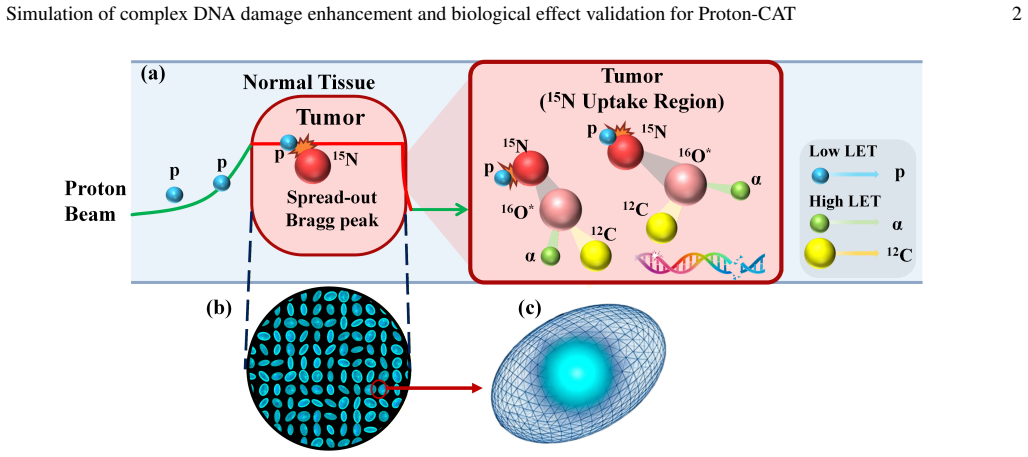
The Proton-CAT method, in which 15N enrichment inside tumors selectively amplifies complex double-strand breaks produced by secondary alpha and carbon ions generated during proton irradiation.
If this is right
- Proton-CAT supplies a multi-scale framework that links DNA-level simulations directly to measured cell survival.
- 15N-Glu can be delivered at high concentration without intrinsic toxicity, clearing one practical barrier to use.
- The dominant mechanism is the rise in complex DNA damage, so further gains would come from maximizing that damage class rather than other endpoints.
- The approach gives a concrete route to raise the biological effectiveness of proton beams without changing the physical beam properties.
Where Pith is reading between the lines
- If selective tumor enrichment proves feasible in patients, the same physical dose could produce greater tumor control or allow dose reduction to spare normal tissue.
- The carrier choice and enrichment level used here could be tested against other nitrogen-rich compounds or different particle energies to optimize uptake.
- Because the simulations are parameter-free in the damage step once 15N fraction is fixed, the method invites rapid screening of alternative isotopes or beam combinations.
- Translation would require checking whether 15N uptake alters tumor metabolism or immune response in addition to DNA damage.
Load-bearing premise
That 15N can be enriched to 30 percent inside human tumors in vivo using a glutamine carrier without off-target uptake or changes in particle transport that would reduce the predicted damage gain.
What would settle it
An in vivo measurement of actual 15N concentration achieved in tumor versus normal tissue after 15N-Glu dosing, followed by irradiation and direct counting of DSB++ yields to check whether the simulated 175 percent increase occurs.
Figures


read the original abstract
Proton therapy has been rapidly advancing due to its excellent conformal index, but its relatively low relative biological effect (RBE) has somewhat limited its therapeutic efficacy for certain tumors. To address this, we previously proposed a nitrogen-targeting Proton-Carbon-Alpha-Therapy (Proton-CAT) enhancement method. In this letter, we present combined multi-scale DNA damage simulations and in vitro cell experiments, further investigating the mechanism of the Proton-CAT. It has been show that $^{15}$N enrichment significantly enhances complex DNA damage induced by high linear energy transfer(LET) particles within tumor regions. Under 30\% $^{15}$N conditions, $\alpha$ and $^{12}$C particle induced DSB++ increased by 175.19\% and 52.94\%, respectively. Furthermore, in vitro cell experiments using $^{15}$N-glutamine ($^{15}$N-Glu) as the $^{15}$N carrier indicated that high concentrations of $^{15}$N-Glu did not bring about significant cytotoxicity. Following 2 Gy irradiation, the cell viability in the 500 $\mu$g/mL $^{15}$N-Glu treated group exhibited a net reduction of about 15.41\% compared to the control group.This indicates that the enhanced effect of Proton-CAT primarily stems from increased complex DNA damage. This work provides a theoretical basis and multi-scale research framework for the development of the Proton-CAT.
Editorial analysis
A structured set of objections, weighed in public.
Referee Report
Summary. The manuscript proposes Proton-CAT, an enhancement to proton therapy via 15N enrichment in tumors. Multi-scale Monte Carlo simulations show that 30% 15N enrichment increases complex DNA damage (DSB++) by 175.19% for α particles and 52.94% for 12C particles. In vitro experiments with 15N-glutamine as carrier report no significant baseline cytotoxicity at 500 μg/mL and a 15.41% net reduction in cell viability after 2 Gy irradiation, which the authors attribute primarily to the simulated damage enhancement.
Significance. If the central claims hold after addressing verification gaps, the work would provide a concrete multi-scale framework (simulation plus cell-culture validation) for selectively boosting the relative biological effectiveness of proton therapy through nitrogen targeting, addressing a known limitation of proton beams for radioresistant tumors.
major comments (4)
- [Abstract] Abstract: The reported DSB++ increases (175.19% for α, 52.94% for 12C) are given as point values with no error bars, confidence intervals, or description of how DSB++ is defined and scored in the Monte Carlo runs; without these the numerical claims cannot be assessed for robustness or post-hoc selection.
- [In vitro cell experiments] In vitro results: Only viability is measured after 2 Gy irradiation; no direct quantification of DNA double-strand breaks or complex damage (γ-H2AX foci, comet assay, or PFGE) is reported in the 15N-Glu treated cells, leaving the causal attribution to the simulated DSB++ enhancement unverified.
- [Simulation setup] Simulation methods: No details are supplied on the Monte Carlo code, particle transport parameters, DNA geometry model, or the precise implementation of the 30% 15N enrichment fraction, preventing evaluation of model dependence or reproducibility of the reported damage yields.
- [Experimental validation] Irradiation conditions: The in vitro arm uses 2 Gy irradiation but does not specify the particle type or LET spectrum, while the simulations are performed with α and 12C particles; this mismatch weakens the direct link between the predicted damage enhancement and the observed viability change.
minor comments (1)
- [Abstract] The abstract contains a grammatical error ('It has been show' should read 'It has been shown').
Simulated Author's Rebuttal
We thank the referee for the constructive comments on our manuscript. We address each major point below and have prepared revisions to the manuscript to incorporate the suggestions where feasible.
read point-by-point responses
-
Referee: [Abstract] Abstract: The reported DSB++ increases (175.19% for α, 52.94% for 12C) are given as point values with no error bars, confidence intervals, or description of how DSB++ is defined and scored in the Monte Carlo runs; without these the numerical claims cannot be assessed for robustness or post-hoc selection.
Authors: We agree that the abstract would benefit from additional details. We define DSB++ as complex double-strand breaks involving additional lesions within a short DNA segment. The reported increases are mean values from extensive Monte Carlo simulations. In the revision, we will add a definition of DSB++ and include error bars or confidence intervals derived from the simulation ensemble to demonstrate robustness. revision: yes
-
Referee: [In vitro cell experiments] In vitro results: Only viability is measured after 2 Gy irradiation; no direct quantification of DNA double-strand breaks or complex damage (γ-H2AX foci, comet assay, or PFGE) is reported in the 15N-Glu treated cells, leaving the causal attribution to the simulated DSB++ enhancement unverified.
Authors: The referee is correct that direct DNA damage assays are not reported. Our in vitro component uses cell viability to validate the biological relevance of the simulated damage enhancement. We will revise the discussion to note this as a limitation and to better justify the attribution based on the consistency between simulation and viability results. Direct assays would require further experiments not included in the current study. revision: partial
-
Referee: [Simulation setup] Simulation methods: No details are supplied on the Monte Carlo code, particle transport parameters, DNA geometry model, or the precise implementation of the 30% 15N enrichment fraction, preventing evaluation of model dependence or reproducibility of the reported damage yields.
Authors: We will add a comprehensive description of the Monte Carlo simulation setup, including the code used, transport parameters, DNA geometry model, and the method for implementing the 30% 15N enrichment, in the revised manuscript to allow for reproducibility and evaluation of the results. revision: yes
-
Referee: [Experimental validation] Irradiation conditions: The in vitro arm uses 2 Gy irradiation but does not specify the particle type or LET spectrum, while the simulations are performed with α and 12C particles; this mismatch weakens the direct link between the predicted damage enhancement and the observed viability change.
Authors: We will specify the irradiation conditions, including particle type and relevant LET details, in the methods section. The simulations target α and 12C to illustrate the enhancement mechanism in Proton-CAT, and we will add text explaining how the in vitro results with 2 Gy irradiation support the overall biological effect predicted by the simulations. revision: yes
- Direct experimental quantification of complex DNA damage in the treated cells.
Circularity Check
No significant circularity; independent Monte Carlo simulations and cell assays
full rationale
The paper's core results come from two independent sources: Monte Carlo DNA-damage simulations that compute DSB++ yields under varying 15N fractions, and separate in-vitro viability measurements on 15N-Glu-treated cells after 2 Gy irradiation. Neither step defines its output in terms of the other by construction, nor does any equation or fit rename a fitted parameter as a 'prediction.' The prior proposal of Proton-CAT is cited only as background; the present claims rest on new simulation runs and new experimental data rather than on a self-citation chain or ansatz smuggled from earlier work. The interpretive statement that viability reduction 'primarily stems from' increased complex damage is an inference, not a definitional reduction. The derivation chain is therefore self-contained against external benchmarks.
Axiom & Free-Parameter Ledger
free parameters (1)
- 15N enrichment fraction
axioms (2)
- domain assumption Monte-Carlo track-structure codes correctly predict the yield of complex DSBs from high-LET particles in the presence of 15N
- domain assumption In-vitro cell viability after 2 Gy irradiation with 15N-Glu is a valid proxy for in-vivo tumor response
Reference graph
Works this paper leans on
-
[1]
author author G. Delaney , author S. Jacob , author C. Featherstone , \ and\ author M. Barton ,\ title title The role of radiotherapy in cancer treatment: estimating optimal utilization from a review of evidence-based clinical guidelines , \ https://doi.org/10.1002/cncr.21324 journal journal Cancer-Am. Cancer. Soc \ volume 104 ,\ pages 1129--1137 ( year 2...
-
[2]
author author P. G. \ Prasanna , author K. Rawojc , author C. Guha , author J. C. \ Buchsbaum , author J. U. \ Miszczyk , \ and\ author C. N. \ Coleman ,\ title title Normal tissue injury induced by photon and proton therapies: Gaps and opportunities , \ https://doi.org/10.1016/j.ijrobp.2021.02.043 journal journal Int. J. Radiat. Oncol. Biol. Phys \ volum...
-
[3]
author author S. A. \ Buzdar , author M. A. \ Rao , \ and\ author A. Nazir ,\ title title An analysis of depth dose characteristics of photon in water , \ https://jamc.ayubmed.edu.pk/index.php/jamc/article/view/3139 journal journal J. Ayub. Med. Coll. Abbottabad \ volume 21 ,\ pages 41--45 ( year 2009 ) NoStop
2009
-
[4]
author author R. Ahmad , author A. Barcellini , author K. Baumann , author M. Benje , author T. Bender , author P. Bragado , author A. Charalampopoulou , author R. Chowdhury , author A. J. \ Davis , author D. K. \ Ebner , et al. ,\ title title Particle beam radiobiology status and challenges: a ptcog radiobiology subcommittee report , \ https://doi.org/10...
-
[5]
author author L. Deng , author Z. Sun , author J. Wu , author Z. He , author Z. He , \ and\ author Z. Hu ,\ title title Proton therapy in combination with secondary neutron capture therapy: A monte carlo simulation study , \ https://doi.org/10.1016/j.nimb.2025.165973 journal journal Nucl. Instrum. Meth. B \ volume 571 ,\ pages 165973 ( year 2026 ) NoStop
-
[6]
author author O. Mohamad , author B. J. \ Sishc , author J. Saha , author A. Pompos , author A. Rahimi , author M. D. \ Story , author A. J. \ Davis , \ and\ author D. N. \ Kim ,\ title title Carbon ion radiotherapy: a review of clinical experiences and preclinical research, with an emphasis on dna damage/repair , \ https://doi.org/10.3390/cancers9060066 ...
-
[7]
author author M. Durante , author R. Orecchia , \ and\ author J. S. \ Loeffler ,\ title title Charged-particle therapy in cancer: clinical uses and future perspectives , \ https://doi.org/10.1038/nrclinonc.2017.30 journal journal Nat. Rev. Clin. Oncol \ volume 14 ,\ pages 483--495 ( year 2017 ) NoStop
-
[8]
Relative biological effectiveness (RBE) values for proton beam therapy
author author H. Paganetti ,\ title title Relative biological effectiveness (rbe) values for proton beam therapy. variations as a function of biological endpoint, dose, and linear energy transfer , \ https://doi.org/10.1088/0031-9155/59/22/R419 journal journal Phys. Med. Biol \ volume 59 ,\ pages R419 ( year 2014 ) NoStop
-
[9]
author author M. McIntyre , author P. Wilson , author P. Gorayski , \ and\ author E. Bezak ,\ title title A systematic review of let-guided treatment plan optimisation in proton therapy: identifying the current state and future needs , \ https://doi.org/10.3390/cancers15174268 journal journal Cancers \ volume 15 ,\ pages 4268 ( year 2023 ) NoStop
-
[10]
NRG Oncology White Paper on the Relative Biological Effectiveness in Proton Therapy
author author H. Paganetti , author C. B. \ Simone II , author W. R. \ Bosch , author D. Haas-Kogan , author D. G. \ Kirsch , author H. Li , author X. Liang , author W. Liu , author A. Mahajan , author M. D. \ Story , et al. ,\ title title Nrg oncology white paper on the relative biological effectiveness in proton therapy , \ https://doi.org/10.1016/j.ijr...
-
[11]
author author Z. Sun , author Z. He , author H. Rao , author Z. He , author J. Wu , author L. Deng , author Z. Chen , author J. Jiang , author H. Zhu , author B. Zou , et al. ,\ title title Proton-cat: A strategy for enhanced proton therapy , \ https://doi.org/10.1063/5.0272319 journal journal Appl. Phys. Lett \ volume 127 ( year 2025 ),\ https://doi.org/...
-
[12]
author author J. Wu , author Z. He , author Z. Sun , author L. Deng , author Z. He , author X. Wang , author L. Li , author S. Lu , \ and\ author Z. Hu ,\ title title Spread-out bragg peak monte carlo simulation of proton therapy with 15n-targeted in situ generation of 12c ions and -particles , \ https://doi.org/10.1063/5.0302593 journal journal J. Appl. ...
-
[13]
author author Z. He , author Z. He , author M. Duan , author J. Wu , author L. Deng , author Z. Chen , author S. Zhang , \ and\ author Z. Hu ,\ title title Effect of the ^ 15 n(p, ) ^ 12 c reaction on the kinetic energy release of water-molecule fragmentation , \ https://doi.org/10.1103/3wls-bwyp journal journal Physical Review A \ volume 112 ,\ pages 052...
-
[14]
author author S. Incerti , author I. Kyriakou , author M. Bernal , author M. Bordage , author Z. Francis , author S. Guatelli , author V. Ivanchenko , author M. Karamitros , author N. Lampe , author S. B. \ Lee , et al. ,\ title title Geant4-dna example applications for track structure simulations in liquid water: a report from the geant4-dna project , \ ...
-
[15]
author author I. Plante \ and\ author L. Devroye ,\ title title Considerations for the independent reaction times and step-by-step methods for radiation chemistry simulations , \ https://doi.org/10.1016/j.radphyschem.2017.03.021 journal journal Radi. Phys. Chem \ volume 139 ,\ pages 157--172 ( year 2017 ) NoStop
-
[16]
author author K. P. \ Chatzipapas , author N. H. \ Tran , author M. Dordevic , author S. Zivkovic , author S. Zein , author W.-G. \ Shin , author D. Sakata , author N. Lampe , author J. M. \ Brown , author A. Ristic-Fira , et al. ,\ title title Simulation of dna damage using geant4-dna: an overview of the “moleculardna” example application , \ https://doi...
-
[17]
author author Y. Lu , author Z. Xu , author L. Zhang , author Z. Wang , author T. Li , \ and\ author M. S. \ Khan ,\ title title Geant4 simulations of the neutron beam characteristics for 9be/7li targets bombarded by the low energy protons , \ https://doi.org/10.1016/j.nimb.2021.09.005 journal journal Nucl. Instrum. Meth. B \ volume 506 ,\ pages 8--14 ( y...
-
[18]
author author C. Z. \ Jarlskog \ and\ author H. Paganetti ,\ title title Physics settings for using the geant4 toolkit in proton therapy , \ https://doi.org/10.1109/TNS.2008.922816 journal journal IEEE. T. Nucl. Sci \ volume 55 ,\ pages 1018--1025 ( year 2008 ) NoStop
-
[19]
author author S. Meylan , author S. Incerti , author M. Karamitros , author N. Tang , author M. Bueno , author I. Clairand , \ and\ author C. Villagrasa ,\ title title Simulation of early dna damage after the irradiation of a fibroblast cell nucleus using geant4-dna , \ https://doi.org/10.1038/s41598-017-11851-4 journal journal Sci. Rep \ volume 7 ,\ page...
-
[20]
de la Fuente Rosales , author S
author author L. de la Fuente Rosales , author S. Incerti , author Z. Francis , \ and\ author M. A. \ Bernal ,\ title title Accounting for radiation-induced indirect damage on dna with the geant 4-dna code , \ https://doi.org/10.1016/j.ejmp.2018.06.006 journal journal Phys. Medica \ volume 51 ,\ pages 108--116 ( year 2018 ) NoStop
-
[21]
author author N. Lampe , author M. Karamitros , author V. Breton , author J. M. \ Brown , author D. Sakata , author D. Sarramia , \ and\ author S. Incerti ,\ title title Mechanistic dna damage simulations in geant4-dna part 2: Electron and proton damage in a bacterial cell , \ https://doi.org/10.1016/j.ejmp.2017.12.008 journal journal Phys. Medica \ volum...
-
[22]
author author V. Mladenova , author E. Mladenov , author M. Stuschke , \ and\ author G. Iliakis ,\ title title Dna damage clustering after ionizing radiation and consequences in the processing of chromatin breaks , \ https://doi.org/10.3390/molecules27051540 journal journal Molecules \ volume 27 ,\ pages 1540 ( year 2022 ) NoStop
-
[23]
author author R. Chapman \ and\ author A. MacLeod ,\ title title The mechanism of the ^ 16 O (p, p ) ^ 12 C and ^ 12 Ne (p, p ) ^ 16 O reactions at 13 mev , \ https://doi.org/10.1016/0375-9474(67)90007-3 journal journal Nucl. Phys. A \ volume 94 ,\ pages 324--336 ( year 1967 ) NoStop
-
[24]
author author R. Chapman \ and\ author A. Macleod ,\ title title Proton nuclear reaction cross sections in oxygen and neon at 13 mev , \ https://doi.org/10.1016/0375-9474(67)90006-1 journal journal Nucl. Phys. A \ volume 94 ,\ pages 313--323 ( year 1967 ) NoStop
-
[25]
author author L. Khalef , author R. Lydia , author K. Filicia , \ and\ author B. Moussa ,\ title title Cell viability and cytotoxicity assays: Biochemical elements and cellular compartments , \ https://doi.org/10.1002/cbf.4007 journal journal Cell. Biochem. Funct \ volume 42 ,\ pages e4007 ( year 2024 ) NoStop
-
[26]
author author A. Adan , author Y. Kiraz , \ and\ author Y. Baran ,\ title title Cell proliferation and cytotoxicity assays , \ http://dx.doi.org/10.2174/1389201017666160808160513 journal journal Curr. Pharm. Biotechno \ volume 17 ,\ pages 1213--1221 ( year 2016 ) NoStop
-
[27]
author author R. Mirzayans , author B. Andrais , author A. Scott , \ and\ author D. Murray ,\ title title New insights into p53 signaling and cancer cell response to dna damage: implications for cancer therapy , \ https://doi.org/10.1155/2012/170325 journal journal BioMed. Res. Int \ volume 2012 ,\ pages 170325 ( year 2012 ) NoStop
-
[28]
author author C. Fournier \ and\ author G. Taucher-Scholz ,\ title title Radiation induced cell cycle arrest: an overview of specific effects following high-let exposure , \ https://doi.org/10.1016/S0167-8140(04)80031-8 journal journal Radiother. Oncol \ volume 73 ,\ pages S119--S122 ( year 2004 ) NoStop
-
[29]
author author B. Bouda\" ffa , author P. Cloutier , author D. Hunting , author M. A. \ Huels , \ and\ author L. Sanche ,\ title title Resonant formation of dna strand breaks by low-energy (3 to 20 ev) electrons , \ https://doi.org/10.1126/science.287.5458.1658 journal journal Science \ volume 287 ,\ pages 1658--1660 ( year 2000 ) NoStop
-
[30]
author author J. Cadet , author T. Delatour , author T. Douki , author D. Gasparutto , author J.-P. \ Pouget , author J.-L. \ Ravanat , \ and\ author S. Sauvaigo ,\ title title Hydroxyl radicals and dna base damage , \ https://doi.org/10.1016/S0027-5107(99)00004-4 journal journal Mutat. Res-Fund. Mol. M \ volume 424 ,\ pages 9--21 ( year 1999 ) NoStop
discussion (0)
Sign in with ORCID, Apple, or X to comment. Anyone can read and Pith papers without signing in.