Recognition: unknown
Population synthesis of Be X-ray binaries in the Small Magellanic Cloud: angular momentum recycling and stable mass transfer
Pith reviewed 2026-05-07 10:40 UTC · model grok-4.3
The pith
Models with always-stable Roche-lobe overflow and tidal angular-momentum recycling best reproduce the observed Be X-ray binaries in the Small Magellanic Cloud.
A machine-rendered reading of the paper's core claim, the machinery that carries it, and where it could break.
Core claim
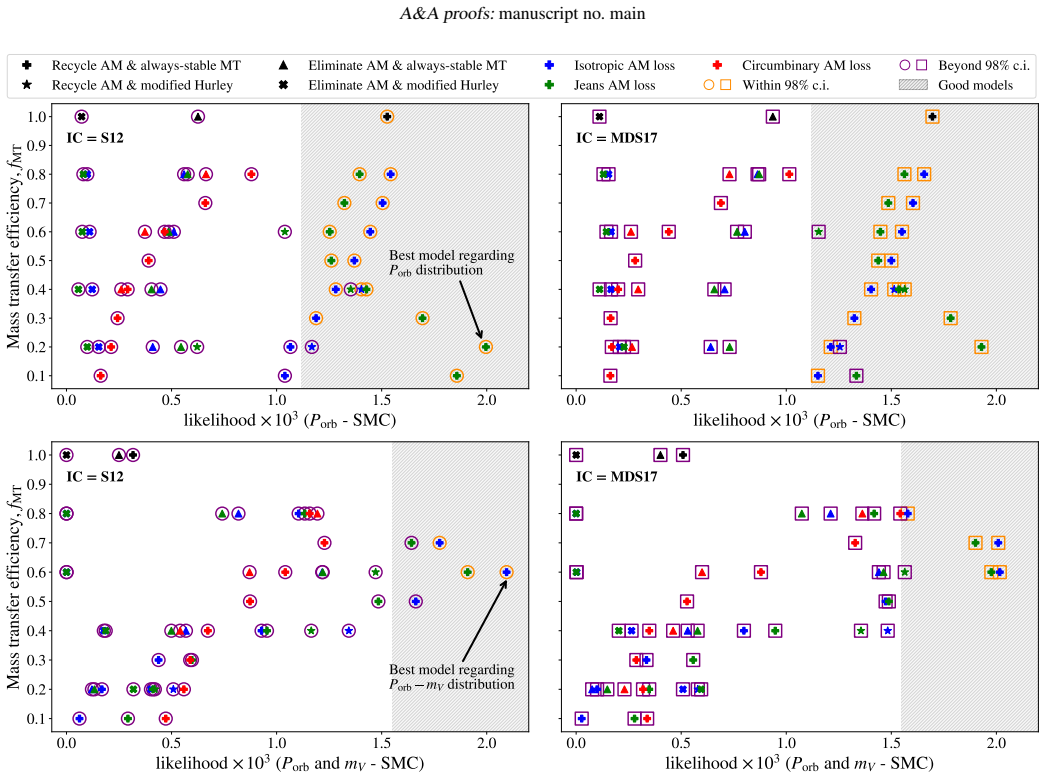
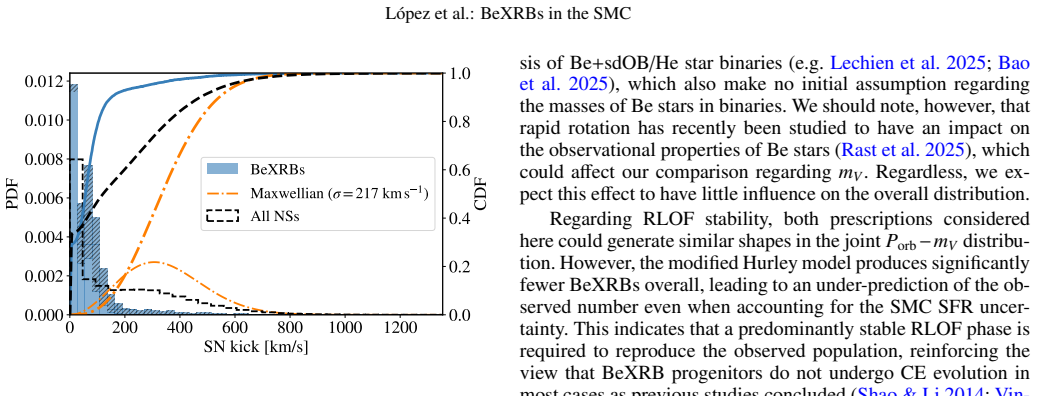
The paper establishes that models in which mass transfer via Roche-lobe overflow is assumed to be always stable and angular momentum is recycled back into the orbit through tides when the accretor approaches critical rotation provide the best match to observations. The best-fitting models additionally favor low natal kicks below 100 km/s, a moderate mass-transfer efficiency near 0.6, a minimum Be threshold spin close to critical rotation, and strong suppression of accretion onto neutron stars by the propeller effect. The observable population is especially sensitive to the propeller treatment, which controls the X-ray luminosity of wide, low-accretion-rate systems.
What carries the argument
The central mechanism is the combination of always-stable Roche-lobe overflow and tidal angular-momentum recycling inside the SEVN binary population synthesis code, used to generate synthetic populations that are then compared via likelihood methods to the observed orbital-period and V-band magnitude distributions.
If this is right
- Low natal kicks of at most 100 km/s are required to match the observed population.
- A mass-transfer efficiency of approximately 0.6 is favored over other tested values.
- The propeller effect must strongly suppress accretion in wide systems to regulate their X-ray luminosities.
- The Be threshold spin must lie close to critical rotation for the models to reproduce the data.
Where Pith is reading between the lines
- Similar modeling with stable mass transfer and tidal recycling may improve population predictions for BeXRBs in other low-metallicity dwarf galaxies.
- The role of tides in returning angular momentum could reduce predicted merger rates for compact-object binaries more generally.
- Precise spin measurements of Be stars in a larger SMC sample could directly test the critical-rotation threshold used in the models.
Load-bearing premise
The observed SMC BeXRB population is nearly complete and well-characterized, so that synthetic populations can be compared directly to the data without large unmodeled selection effects.
What would settle it
A future census that substantially revises the total number of SMC BeXRBs or shifts their orbital-period distribution, especially at long periods, in a way that cannot be explained by incompleteness corrections would rule out the preferred models.
Figures


read the original abstract
Be X-ray binaries (BeXRBs) are key laboratories to constrain binary interaction processes such as mass transfer, angular-momentum transport, and natal kicks. The Small Magellanic Cloud (SMC), hosting a nearly complete and well-characterized BeXRB population, offers a unique opportunity to test these physical processes at low metallicity. We aim to identify the combination of binary-evolution parameters that simultaneously reproduces the observed number and the joint distribution of orbital period and optical magnitude of SMC BeXRBs. We performed an extensive grid analysis of binary population-synthesis models exploring different mass transfer efficiencies, angular-momentum transport prescriptions and Roche-lobe overflow stability criteria. We also considered the impact of natal kicks, and that of the propeller effect of rotating magnetic fields of neutron stars. Synthetic populations obtained with the binary population synthesis code \textsc{sevn} are statistically compared to observations using likelihood-based methods applied to the orbital period and $V$-band magnitude distributions, together with requirements on the total number of systems. We find that models in which mass transfer via Roche-lobe overflow is assumed to be always stable and angular momentum is recycled back into the orbit through tides when the accretor approaches critical rotation provide the best match to observations. Our best-fitting models favor low natal kicks ($\lesssim 100\ \rm km\ s^{-1}$), a moderate mass transfer efficiency ($f_{\rm MT} \simeq 0.6$), a minimum Be threshold spin close to critical rotation, and a strong suppression of accretion onto neutron stars due to the propeller effect. Specifically, the observable population is highly sensitive to the treatment of the propeller effect, which regulates the X-ray luminosity of wide, low-accretion-rate systems.
Editorial analysis
A structured set of objections, weighed in public.
Referee Report
Summary. The manuscript performs an extensive grid of binary population synthesis simulations with the SEVN code for Be X-ray binaries in the SMC. It varies parameters including mass transfer efficiency f_MT, angular momentum transport prescriptions (with tidal recycling when the accretor nears critical rotation), RLOF stability criteria (favoring always stable), natal kick velocities, and the propeller effect. Synthetic populations are compared to observations via likelihood methods on the joint orbital period and V-band magnitude distributions, along with total system counts. The authors conclude that models assuming always-stable Roche-lobe overflow, tidal angular-momentum recycling, low natal kicks (≲100 km/s), moderate f_MT ≈0.6, near-critical Be spin threshold, and strong propeller suppression provide the best match to the observed SMC BeXRB population.
Significance. If validated, this work offers valuable constraints on binary evolution at low metallicity, particularly mass transfer stability and angular momentum recycling in BeXRBs. The SMC's nearly complete population enables direct comparison, and the highlighted sensitivity to the propeller effect underscores its role in regulating X-ray luminosities of wide systems. Strengths include the broad parameter exploration and use of likelihood-based statistical comparison.
major comments (3)
- The likelihood-based comparison of synthetic to observed distributions (as described in the abstract) lacks details on error bars, completeness corrections, or how post-hoc model selection affects the central claim; this undermines confidence in the robustness of the statistical support for the best-fitting models.
- The preference for strong propeller suppression and always-stable RLOF may be biased by unmodeled X-ray selection effects, as the comparison applies only a total-number cut and raw distributions without explicit survey flux limits or period-dependent detection probabilities (see skeptic note on observable population).
- The identification of 'best-fitting' models by maximizing agreement with the orbital-period and magnitude distributions used to score them introduces potential circularity, where the reported match is partly by construction rather than an independent test.
minor comments (2)
- Clarify the exact implementation of the tidal angular momentum recycling prescription and how it differs from standard treatments in the binary evolution module.
- Provide more details on the grid resolution, sampling of explored parameters, and any convergence tests to allow reproducibility of the reported best-fit values.
Simulated Author's Rebuttal
We thank the referee for their constructive and detailed report. We address each major comment below and indicate where revisions will be made to improve clarity and robustness.
read point-by-point responses
-
Referee: The likelihood-based comparison of synthetic to observed distributions (as described in the abstract) lacks details on error bars, completeness corrections, or how post-hoc model selection affects the central claim; this undermines confidence in the robustness of the statistical support for the best-fitting models.
Authors: We agree that the statistical methodology section would benefit from greater detail. In the revised manuscript we will expand the description of the likelihood calculation to include how uncertainties on the observed distributions are estimated (via bootstrap resampling of the SMC catalog), explicitly state the completeness level of the BeXRB sample used, and clarify that model ranking is performed by maximizing the joint likelihood on period-magnitude while imposing an independent constraint on total system number. This should address concerns about post-hoc selection. revision: yes
-
Referee: The preference for strong propeller suppression and always-stable RLOF may be biased by unmodeled X-ray selection effects, as the comparison applies only a total-number cut and raw distributions without explicit survey flux limits or period-dependent detection probabilities (see skeptic note on observable population).
Authors: This is a valid concern. Our current comparison uses the observed (optically selected) population and applies only a total-number filter; we did not incorporate explicit X-ray flux limits or period-dependent detection probabilities. In the revision we will add a dedicated subsection discussing possible X-ray selection biases and their potential impact on the inferred propeller strength. However, a full forward-modeling of survey-specific selection functions lies beyond the scope of the present grid study; we will note this limitation and test sensitivity to a simple luminosity threshold. revision: partial
-
Referee: The identification of 'best-fitting' models by maximizing agreement with the orbital-period and magnitude distributions used to score them introduces potential circularity, where the reported match is partly by construction rather than an independent test.
Authors: We recognize the risk of circularity when the same observables are used both for fitting and for reporting goodness-of-fit. To mitigate this, the revised manuscript will include an additional validation step: we will compare the best-fitting models against an observable not entering the likelihood (e.g., the predicted distribution of Be-star spin periods or the fraction of systems above a given X-ray luminosity threshold) and report the outcome. The total-number constraint already serves as a partially independent check. revision: partial
Circularity Check
No significant circularity in parameter grid search and likelihood comparison
full rationale
The paper performs an explicit grid exploration over binary-evolution parameters (mass-transfer efficiency, angular-momentum prescriptions, RLOF stability criteria, natal kicks, propeller treatment) and selects the best-matching subset by applying likelihood-based comparison to the observed orbital-period and V-magnitude distributions together with a total-number constraint. This is standard model selection; the physical assumptions are independent inputs and the reported match is the output of the comparison, not a quantity defined in terms of itself. No equations or steps in the abstract reduce by construction to the fitted quantities, no self-citation is invoked as a uniqueness theorem, and no ansatz is smuggled. The propeller-effect sensitivity is an explored model variation whose effect on the observable population is stated as a finding, not presupposed.
Axiom & Free-Parameter Ledger
free parameters (3)
- mass transfer efficiency f_MT
- natal kick velocity dispersion
- minimum Be threshold spin
axioms (2)
- domain assumption Roche-lobe overflow is always stable
- domain assumption Angular momentum is recycled into the orbit via tides when the accretor nears critical rotation
Reference graph
Works this paper leans on
-
[1]
Abac, A. G., Abouelfettouh, I., Acernese, F., et al. 2025, arXiv e-prints, arXiv:2508.18082 Abdusalam, K., Ablimit, I., Hashim, P., et al. 2020, ApJ, 902, 125 Antoniou, V . & Zezas, A. 2016, MNRAS, 459, 528 Artymowicz, P. & Lubow, S. H. 1994, ApJ, 421, 651 Asplund, M., Grevesse, N., Sauval, A. J., & Scott, P. 2009, ARA&A, 47, 481 Baade, D. 1988, in IAU Sy...
work page internal anchor Pith review arXiv 2025
-
[2]
These limitations hinder a fully consistent comparison equivalent to that performed for the SMC
do not provide systematically tabulatedV-band magnitudes. These limitations hinder a fully consistent comparison equivalent to that performed for the SMC. Hence, we restrict the comparison to the orbital period distribu- tion, which is the most robustly measured observable. We examine whether the models that successfully reproduce the SMC population are a...
2023
-
[3]
This choice primarily affects the absolute number of predicted systems, which plays a secondary role in the present orbital period comparison
Although the SFH of the MW is complex and spatially structured, we assume for simplicity a constant SFR of 2 M ⊙ yr−1. This choice primarily affects the absolute number of predicted systems, which plays a secondary role in the present orbital period comparison. For the present study we use stellar tracks representative of MW metallicity with Z=Z ⊙ =0.0142...
2009
-
[4]
for the MW. Models with a black diamond contour denote models that are in statistical agreement with both theP orb distribution of the MW and the jointP orb −m V distribution further combined with the total number of the SMC (see Fig. 1). 0 1 2 3 4 5 6 log(Porb [day]) 0.0 0.2 0.4 0.6 0.8 1.0 1.2e 0 8 16 24 32 0 1 2 3 4 5 60 200 Fortin+2023 0 1000.0 0.2 0....
2023
discussion (0)
Sign in with ORCID, Apple, or X to comment. Anyone can read and Pith papers without signing in.