Recognition: unknown
On the existence and properties of Alexandroff paratopological groups
Pith reviewed 2026-05-07 11:48 UTC · model grok-4.3
The pith
No non-discrete Alexandroff topology can turn a group into a topological group.
A machine-rendered reading of the paper's core claim, the machinery that carries it, and where it could break.
Core claim
The paper establishes that there do not exist any non-discrete Alexandroff topological groups. Motivated by this, it introduces Alexandroff paratopological groups, derives their fundamental properties, and gives concrete non-compact T0 examples. These examples then provide positive answers to classical open problems on whether products of feebly bounded sets are feebly bounded and whether the square of a feebly bounded set is feebly bounded in paratopological groups.
What carries the argument
The Alexandroff property, which demands that the intersection of any family of open sets remains open, when imposed on the topology of a group or paratopological group.
Load-bearing premise
The topology on the group must have the property that arbitrary intersections of open sets are open, while the operations are required to be continuous.
What would settle it
A counterexample would be a group equipped with a non-discrete Alexandroff topology making both multiplication and inversion continuous, or an Alexandroff paratopological group where the product of two feebly bounded sets is not feebly bounded.
Figures

read the original abstract
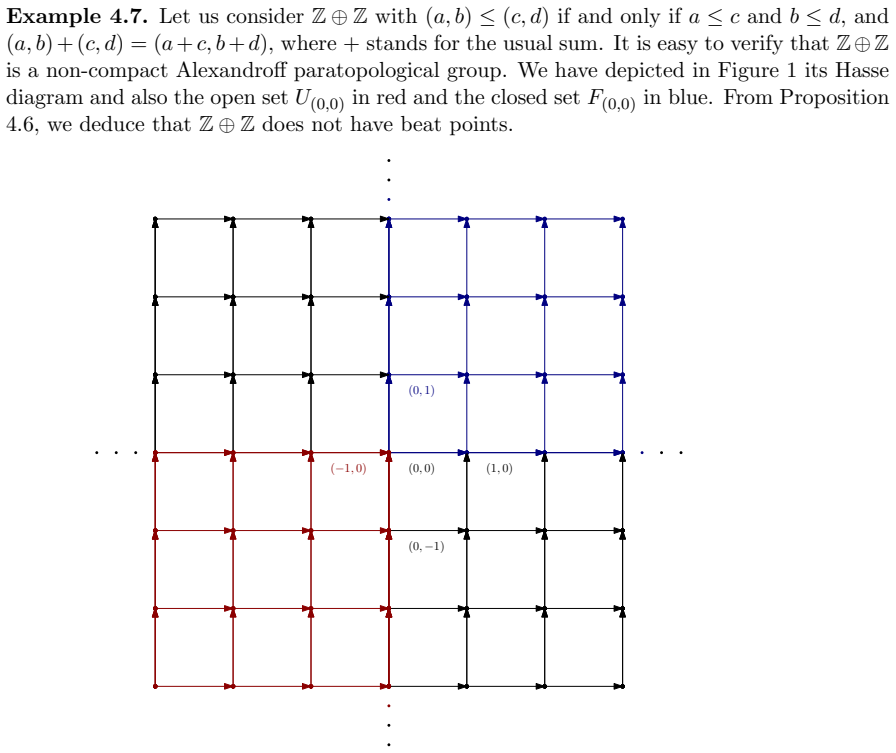
We study groups endowed with Alexandroff topologies and show that no non-discrete Alexandroff topology can turn a group into a topological group. This settles negatively the basic existence problem for Alexandroff topological groups. Motivated by this obstruction, we turn to the broader setting of Alexandroff paratopological groups. We establish several fundamental properties of these spaces and provide explicit non-compact $T_0$ examples, showing that the Alexandroff framework is rich enough to capture nontrivial paratopological phenomena. As applications, we address two classical open questions concerning feebly bounded subsets in paratopological groups, proving that non-compact Alexandroff paratopological groups offer a positive solution both for products of feebly bounded sets and for the feebly boundedness of $B^2$ when $B$ is a feebly bounded subset.
Editorial analysis
A structured set of objections, weighed in public.
Referee Report
Summary. The paper proves that no non-discrete Alexandroff topology on a group makes the group operations continuous, negatively settling the existence question for Alexandroff topological groups. It then develops the theory of Alexandroff paratopological groups, establishes basic properties, constructs explicit non-compact T0 examples, and applies these constructions to resolve two open questions on feebly bounded subsets (products of feebly bounded sets remain feebly bounded, and B² is feebly bounded whenever B is).
Significance. If the non-existence result holds under the intended hypotheses, it would cleanly resolve a basic existence problem for Alexandroff topological groups. The explicit constructions of non-compact T0 Alexandroff paratopological groups and the positive solutions to the two open questions on feebly bounded sets would supply concrete examples and new techniques useful to researchers working on paratopological groups and boundedness properties.
major comments (1)
- [Abstract] Abstract: The central claim that 'no non-discrete Alexandroff topology can turn a group into a topological group' is false as stated. The indiscrete topology on any group G with |G|>1 is Alexandroff (arbitrary intersections of open sets remain open), non-discrete, and yields a topological group because the preimage of the only nonempty open set G under multiplication or inversion is the entire domain. The paper invokes T0 only for the later paratopological examples, indicating that a separation axiom is likely intended but omitted from the topological-group non-existence theorem; this omission is load-bearing for the headline result.
Simulated Author's Rebuttal
We thank the referee for the careful reading and for highlighting the need to clarify the separation axioms in the statement of our non-existence result. We agree that the abstract as written is imprecise and will revise the manuscript accordingly.
read point-by-point responses
-
Referee: [Abstract] Abstract: The central claim that 'no non-discrete Alexandroff topology can turn a group into a topological group' is false as stated. The indiscrete topology on any group G with |G|>1 is Alexandroff (arbitrary intersections of open sets remain open), non-discrete, and yields a topological group because the preimage of the only nonempty open set G under multiplication or inversion is the entire domain. The paper invokes T0 only for the later paratopological examples, indicating that a separation axiom is likely intended but omitted from the topological-group non-existence theorem; this omission is load-bearing for the headline result.
Authors: We appreciate the referee's observation. The indiscrete topology is indeed a non-discrete Alexandroff topological group. Our proof in the body of the paper actually establishes the non-existence result under the additional T0 separation axiom (which is used to obtain the contradiction with continuity of the group operations in the non-discrete case). This hypothesis was inadvertently omitted from the abstract and the formal statement of the theorem, although it is consistent with the T0 examples constructed for the paratopological case. We will revise the abstract, the introduction, and the theorem statement to explicitly include the T0 assumption, rendering the claim accurate. revision: yes
Circularity Check
No significant circularity; derivation is self-contained.
full rationale
The paper establishes non-existence of non-discrete Alexandroff topological groups via direct analysis of continuity of group operations under the Alexandroff intersection property, then shifts to explicit constructions of T0 Alexandroff paratopological groups and applications to feebly bounded sets. No step reduces by definition to its own output, no parameters are fitted and relabeled as predictions, and no load-bearing premise rests on a self-citation chain or imported uniqueness theorem. The central non-existence argument relies on standard topological and algebraic properties without circular reduction, consistent with the reader's assessment of only minor or absent circular elements.
Axiom & Free-Parameter Ledger
axioms (1)
- standard math Standard axioms of group theory and point-set topology
Reference graph
Works this paper leans on
-
[1]
P. S. Alexandroff. Diskrete R¨ aume.Mathematiceskii Sbornik (N.S.), 2:501–518, 1937
1937
-
[2]
Arhangel’skii and M
A. Arhangel’skii and M. Tkachenko.Topological Groups and Related Structures: An Introduction to Topological Algebra, volume 1 ofAtlantis Studies in Mathematics. Atlantis Press / World Scientific, 2008
2008
-
[3]
Banakh and A
T. Banakh and A. Ravsky. On feebly compact paratopological groups.Topol. Appl., 284:107363, 2020
2020
-
[4]
J. A. Barmak.Algebraic topology of finite topological spaces and applications.Lecture Notes in Mathematics 2032. Springer, 2011
2032
-
[5]
J. A. Barmak, M. Mrozek, and T. Wanner. Conley index for multivalued maps on finite topological spaces.Found. Comput. Math., 2024
2024
- [6]
-
[7]
Chocano, M.A
P.J. Chocano, M.A. Mor´ on, and F.R. Ruiz del Portal. Coincidence theorems for finite topological spaces.Topol. Methods Nonlinear Anal., 65(1):219–263, 2025
2025
-
[8]
Chocano and L.P
P.J. Chocano and L.P. Prieto-Mart´ ınez. Negative-dimensional simplicial complexes via the grothendieck group of the join monoid.To appear, 2026
2026
-
[9]
J. P. May. Finite spaces and larger contexts.Unpublished book, 2016
2016
-
[10]
S´ anchez Romero.Grupos Paratopol´ ogicos
I. S´ anchez Romero.Grupos Paratopol´ ogicos. PhD thesis, Universidad Aut´ onoma Metropolitana, 2013. 16
2013
-
[11]
Tkachenko
M. Tkachenko. Embedding paratopological groups into topological products.Top. Appl., 156(0):1298–1305, 2009
2009
-
[12]
Tkachenko.Paratopological and Semitopological Groups Versus Topological Groups
M. Tkachenko.Paratopological and Semitopological Groups Versus Topological Groups. In: Hart, K., van Mill, J., Simon, P. (eds) Recent Progress in General Topology III. Atlantis Press, Paris., 2014. P.J. Chocano, Departamento de Matem´atica Aplicada, Ciencia e Ingenier ´ıa de los Materi- ales y Tecnolog´ıa Electr´onica, ESCET Universidad Rey Juan Carlos, 2...
2014
discussion (0)
Sign in with ORCID, Apple, or X to comment. Anyone can read and Pith papers without signing in.