Recognition: unknown
Analytically Characterized Optimal Power Control for Signal-Level-Integrated Sensing, Computing and Communication in Federated Learning
Pith reviewed 2026-05-07 10:40 UTC · model grok-4.3
The pith
A variable transformation turns the non-convex joint power and scaling problem for sensing-integrated AirComp federated learning into an equivalent convex form solvable optimally in polynomial time.
A machine-rendered reading of the paper's core claim, the machinery that carries it, and where it could break.
Core claim
The joint power and receive-scaling control problem for uplink signal-level integrated sensing, computing and communication in AirComp-based federated learning is non-convex in the original variables yet admits an equivalent convex reformulation after a suitable variable transformation. Exploiting analytical optimality properties, the authors derive a robust optimal algorithm of polynomial-time complexity that computes the transmit powers and receive scaling factor minimizing AirComp aggregation distortion subject to the joint target-detection requirement.
What carries the argument
The variable transformation that produces an equivalent convex problem, together with the closed-form optimality properties derived from it, which together enable direct computation of the optimal transmit powers and receive scaling factor.
If this is right
- The minimal AirComp aggregation distortion is attained while the target detection constraint is satisfied.
- Transmit powers and the receive scaling factor are obtained directly without numerical search over the original non-convex surface.
- Federated learning convergence improves relative to heuristic or separate-design baselines.
- The procedure remains numerically stable across varying channel and noise conditions.
Where Pith is reading between the lines
- Similar variable changes may convexify power-allocation problems in other integrated sensing and computing scenarios that use over-the-air aggregation.
- The polynomial-time property makes real-time re-optimization feasible when device channels or detection thresholds change between learning rounds.
- Energy consumed per learning iteration could be reduced by reusing the same waveform for sensing, potentially lengthening battery life in large-scale IoT deployments.
Load-bearing premise
The joint target-detection requirement stays feasible for some choice of powers that also keeps the AirComp distortion finite.
What would settle it
A channel realization and detection threshold for which the algorithm outputs powers that violate the required detection probability, or for which a feasible point in the original variables achieves strictly lower distortion than the algorithm's output.
Figures


read the original abstract
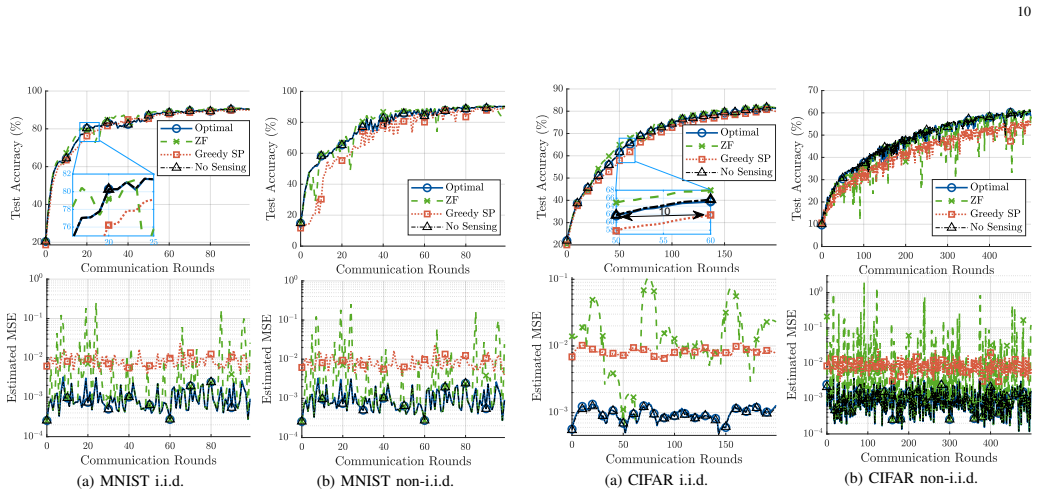
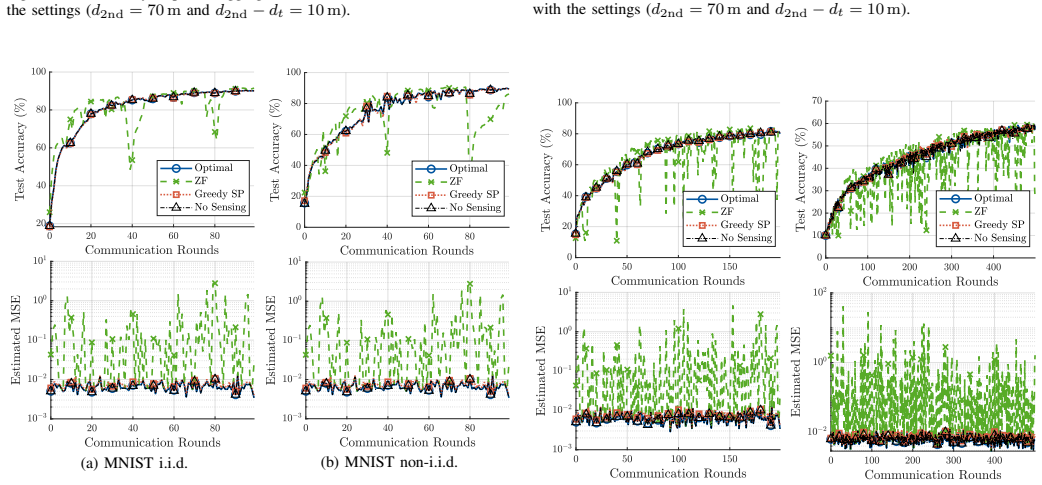
In the Internet-of-Things (IoT) era, efficient functionality integration is essential to address the growing demands of communication, computation, and sensing. Signal-level integrated sensing, computing, and communication (Sig-ISCC) is envisioned, where a single waveform simultaneously supports sensing, computing and communication via over-the-air computation (AirComp). Meanwhile, federated learning (FL) is widely regarded as a promising distributed machine learning framework that enables network intelligence in a privacy-preserving and secure manner, and exhibits strong synergy with AirComp, which alleviates the communication bottleneck of FL. In this paper, we study uplink Sig-ISCC design for AirComp-FL with joint target detection. We formulate the joint power and receive-scaling control problem, where edge devices' transmitted signals should serve both sensing and AirComp purposes. The goal is to minimize the AirComp aggregation distortion subject to a joint target-detection requirement. Although the resulting problem is non-convex in the original variables, we show that it admits an equivalent convex reformulation after a suitable variable transformation. By exploiting analytical optimality properties, we develop a robust, optimal, and polynomial-time-complexity algorithm that efficiently achieves the optimal transmit powers and receive scaling factor. Simulation results validate the optimality and numerical robustness of the proposed algorithm and show its superior FL performance compared to baseline methods.
Editorial analysis
A structured set of objections, weighed in public.
Referee Report
Summary. The paper studies uplink signal-level integrated sensing, computing, and communication (Sig-ISCC) design for AirComp-based federated learning with joint target detection. It formulates a joint power and receive-scaling control problem to minimize AirComp aggregation distortion subject to a joint target-detection requirement. The central claim is that although the problem is non-convex in the original variables, it admits an equivalent convex reformulation after a suitable variable transformation; exploiting analytical optimality properties then yields a robust, optimal, polynomial-time algorithm for the transmit powers and receive scaling factor.
Significance. If the reformulation and algorithm hold, the work supplies an analytically characterized, computationally efficient solution for integrating sensing, computing, and communication in FL systems. The polynomial-time complexity and explicit optimality properties are strengths that could support practical deployment in resource-limited IoT settings; simulation validation of optimality and improved FL performance over baselines adds concrete evidence of utility.
major comments (1)
- [Optimization Problem and Reformulation] The equivalence of the convex reformulation after variable transformation is load-bearing for the central claim. The manuscript should explicitly verify that the transformation preserves optimality and feasibility for the full range of channel realizations and detection thresholds stated in the problem setup (typically around the optimization-problem section), including any implicit assumptions on noise and sensing models.
minor comments (2)
- [Abstract and Introduction] The abstract and introduction would benefit from a brief, explicit statement of the channel and detection models (e.g., Rayleigh fading parameters, detection probability thresholds) used to ensure the joint requirement remains feasible.
- [Notation and Algorithm] Notation for the transformed variables and the receive scaling factor should be cross-checked for consistency between the problem statement, the reformulation, and the algorithm pseudocode.
Simulated Author's Rebuttal
We thank the referee for the positive evaluation and the constructive comment on the optimization reformulation. We address the major comment below and will incorporate the requested clarification to strengthen the manuscript.
read point-by-point responses
-
Referee: [Optimization Problem and Reformulation] The equivalence of the convex reformulation after variable transformation is load-bearing for the central claim. The manuscript should explicitly verify that the transformation preserves optimality and feasibility for the full range of channel realizations and detection thresholds stated in the problem setup (typically around the optimization-problem section), including any implicit assumptions on noise and sensing models.
Authors: We agree that an explicit verification of the transformation's properties across the full problem domain will reinforce the central claim. In the current manuscript, the equivalence is established analytically in the proof of Theorem 1 (Section III-B), where the substitution p_k = exp(x_k) (with x_k real-valued) is shown to be bijective, the objective becomes convex, and the detection constraint is equivalently reformulated while preserving the feasible set and optimal value. To make this fully explicit as requested, we will add a dedicated verification paragraph (or short appendix) that (i) confirms bijectivity and optimality preservation for all channel realizations with |h_k| > 0 (as implicitly assumed in the uplink model), (ii) covers the complete range of detection thresholds 0 ≤ γ ≤ 1, and (iii) states the modeling assumptions (AWGN noise for both AirComp and sensing links, and a standard linear matched-filter sensing model for target detection). Boundary cases (e.g., γ = 0 or γ approaching the maximum feasible value) will be briefly discussed. This addition will be included in the revised manuscript. revision: yes
Circularity Check
No significant circularity; derivation relies on standard convex reformulation
full rationale
The paper poses a joint power and receive-scaling optimization problem whose objective (AirComp distortion) and constraints (target detection) are defined externally via channel and sensing models. It then applies a variable transformation to obtain an equivalent convex form and exploits analytical optimality conditions to derive a polynomial-time algorithm. No step reduces by construction to a fitted parameter, self-defined quantity, or load-bearing self-citation; the equivalence is a standard mathematical change-of-variables argument whose validity can be verified independently of the paper's results. The derivation chain is therefore self-contained against external benchmarks.
Axiom & Free-Parameter Ledger
axioms (2)
- domain assumption Standard additive white Gaussian noise and fading channel models for uplink transmission
- domain assumption Over-the-air computation accurately aggregates model updates via signal superposition
Reference graph
Works this paper leans on
-
[1]
Over-the-air federated learning client selection in integrated sensing, computing and commu- nication,
P. Zheng, Y . Zhu, Y . Hu, and A. Schmeink, “Over-the-air federated learning client selection in integrated sensing, computing and commu- nication,” inIEEE Int. Conf. Commun. (ICC) Workshops, 2024, pp. 804– 809
2024
-
[2]
Communication-efficient learning of deep networks from decentralized data,
H. B. McMahan, E. Moore, D. Ramage, S. Hampson, and B. A. Y . Arcas, “Communication-efficient learning of deep networks from decentralized data,” inAISTATS, Fort Lauderdale, Florida, USA, 2017
2017
-
[3]
From distributed machine learning to federated learning: a survey,
J. Liu, J. Huang, Y . Zhou, X. Li, S. Ji, H. Xiong, and D. Dou, “From distributed machine learning to federated learning: a survey,”Knowl. Inf. Syst., vol. 64, p. 885–917, 2022
2022
-
[4]
A review of applications in federated learning,
L. Li, Y . Fan, M. Tse, and K.-Y . Lin, “A review of applications in federated learning,”Computers & Industrial Engineering, vol. 149, p. 106854, 2020
2020
-
[5]
Federated Learning for Mobile Keyboard Prediction
A. Hard, K. Rao, R. Mathews, S. Ramaswamy, F. Beaufays, S. Augen- stein, H. Eichner, C. Kiddon, and D. Ramage, “Federated learning for mobile keyboard prediction,” 2019, arXiv:1811.03604
work page Pith review arXiv 2019
-
[6]
Distributed learning in wireless networks: Recent progress and future challenges,
M. Chen, D. G ¨und¨uz, K. Huang, W. Saad, M. Bennis, A. V . Feljan, and H. V . Poor, “Distributed learning in wireless networks: Recent progress and future challenges,”IEEE J. Sel. Areas Commun., vol. 39, no. 12, pp. 3579–3605, 2021
2021
-
[7]
Federated learning via over- the-air computation,
K. Yang, T. Jiang, Y . Shi, and Z. Ding, “Federated learning via over- the-air computation,”IEEE Trans. Wireless Commun., vol. 19, no. 3, pp. 2022–2035, 2020
2022
-
[8]
Machine learning at the wireless edge: Distributed stochastic gradient descent over-the-air,
M. M. Amiri and D. G ¨und¨uz, “Machine learning at the wireless edge: Distributed stochastic gradient descent over-the-air,”IEEE Trans. Signal Process., vol. 68, pp. 2155–2169, 2020
2020
-
[9]
Broadband analog aggregation for low-latency federated edge learning,
G. Zhu, Y . Wang, and K. Huang, “Broadband analog aggregation for low-latency federated edge learning,”IEEE Trans. Wireless Commun., vol. 19, no. 1, pp. 491–506, 2020
2020
-
[10]
Harnessing interference for analog function computation in wireless sensor networks,
M. Goldenbaum, H. Boche, and S. Sta ´nczak, “Harnessing interference for analog function computation in wireless sensor networks,”IEEE Trans. Signal Process., vol. 61, no. 20, pp. 4893–4906, 2013
2013
-
[11]
Transmission power control for over-the-air federated averaging at network edge,
X. Cao, G. Zhu, J. Xu, and S. Cui, “Transmission power control for over-the-air federated averaging at network edge,”IEEE J. Sel. Areas Commun., vol. 40, no. 5, pp. 1571–1586, 2022
2022
-
[12]
Gradient statistics aware power control for over- the-air federated learning,
N. Zhang and M. Tao, “Gradient statistics aware power control for over- the-air federated learning,”IEEE Trans. Wireless Commun., vol. 20, no. 8, pp. 5115–5128, 2021
2021
-
[13]
Optimized power control design for over-the-air federated edge learning,
X. Cao, G. Zhu, J. Xu, Z. Wang, and S. Cui, “Optimized power control design for over-the-air federated edge learning,”IEEE J. Sel. Areas Commun., vol. 40, no. 1, pp. 342–358, 2022
2022
-
[14]
Over-the-air fed- erated learning from heterogeneous data,
T. Sery, N. Shlezinger, K. Cohen, and Y . C. Eldar, “Over-the-air fed- erated learning from heterogeneous data,”IEEE Trans. Signal Process., vol. 69, pp. 3796–3811, 2021
2021
-
[15]
Integrated sensing and communications: Toward dual-functional wire- less networks for 6G and beyond,
F. Liu, Y . Cui, C. Masouros, J. Xu, T. X. Han, Y . C. Eldar, and S. Buzzi, “Integrated sensing and communications: Toward dual-functional wire- less networks for 6G and beyond,”IEEE J. Sel. Areas Commun., vol. 40, no. 6, pp. 1728–1767, 2022
2022
-
[16]
Integrating sensing and communi- cations for ubiquitous IoT: Applications, trends, and challenges,
Y . Cui, F. Liu, X. Jing, and J. Mu, “Integrating sensing and communi- cations for ubiquitous IoT: Applications, trends, and challenges,”IEEE Network, vol. 35, no. 5, pp. 158–167, 2021
2021
-
[17]
Integrating sensing, computing, and communication in 6G wireless networks: Design and optimization,
Q. Qi, X. Chen, A. Khalili, C. Zhong, Z. Zhang, and D. W. K. Ng, “Integrating sensing, computing, and communication in 6G wireless networks: Design and optimization,”IEEE Trans. Commun., vol. 70, no. 9, pp. 6212–6227, 2022
2022
-
[18]
Deep reinforcement learning-based resource allocation for integrated sensing, communica- tion, and computation in vehicular network,
L. Yang, Y . Wei, Z. Feng, Q. Zhang, and Z. Han, “Deep reinforcement learning-based resource allocation for integrated sensing, communica- tion, and computation in vehicular network,”IEEE Trans. Wireless Commun., vol. 23, no. 12, pp. 18 608–18 622, 2024
2024
-
[19]
In- tegrated sensing, communication, and computation over-the-air: MIMO beamforming design,
X. Li, F. Liu, Z. Zhou, G. Zhu, S. Wang, K. Huang, and Y . Gong, “In- tegrated sensing, communication, and computation over-the-air: MIMO beamforming design,”IEEE Trans. Wireless Commun., vol. 22, no. 8, pp. 5383–5398, 2023
2023
-
[20]
Integrated sensing, communication, and computation over-the-air in OFDM systems,
B. Dong, B. Cao, and Q. Zhang, “Integrated sensing, communication, and computation over-the-air in OFDM systems,”IEEE Wireless Com- mun. Lett., vol. 14, no. 10, pp. 3054–3058, 2025
2025
-
[21]
Beamforming design for integrated sensing, over-the-air computation, and communication in internet of robotic things,
K. Dong, S. A. V orobyov, H. Yu, and T. Taleb, “Beamforming design for integrated sensing, over-the-air computation, and communication in internet of robotic things,”IEEE Internet Things J., vol. 11, no. 20, pp. 32 478–32 489, 2024
2024
-
[22]
Multi-functional beamforming design for integrated sensing, communication, and computation,
Y . Zhao, Q. Wu, W. Chen, Y . Zeng, R. Liu, W. Mei, F. Hou, and S. Ma, “Multi-functional beamforming design for integrated sensing, communication, and computation,”IEEE Trans. Commun., vol. 73, no. 8, pp. 6322–6336, 2025
2025
-
[23]
Multi- task learning resource allocation in federated integrated sensing and communication networks,
X. Liu, H. Zhang, C. Ren, H. Li, C. Sun, and V . C. M. Leung, “Multi- task learning resource allocation in federated integrated sensing and communication networks,”IEEE Trans. Wireless Commun., vol. 23, no. 9, pp. 11 612–11 623, 2024
2024
-
[24]
Over-the-air FEEL with inte- grated sensing: Joint scheduling and beamforming design,
S. Asaad, P. Wang, and H. Tabassum, “Over-the-air FEEL with inte- grated sensing: Joint scheduling and beamforming design,”IEEE Trans. Wireless Commun., vol. 24, no. 4, pp. 3273–3288, 2025
2025
-
[25]
Integrated sensing, communication, and computation for over-the-air federated learning in 6G wireless networks,
M. Du, H. Zheng, M. Gao, X. Feng, J. Hu, and Y . Chen, “Integrated sensing, communication, and computation for over-the-air federated learning in 6G wireless networks,”IEEE Internet Things J., vol. 11, no. 21, pp. 35 551–35 567, 2024
2024
-
[26]
Integrated sensing, communication, and computation for over-the-air federated edge learning,
D. Wen, S. Xie, X. Cao, Y . Cui, J. Xu, Y . Shi, and S. Cui, “Integrated sensing, communication, and computation for over-the-air federated edge learning,”IEEE Trans. Wireless Commun., vol. 25, pp. 2748–2762, 2026
2026
-
[27]
Integrated sensing-communication-computation for over-the-air edge AI inference,
Z. Zhuang, D. Wen, Y . Shi, G. Zhu, S. Wu, and D. Niyato, “Integrated sensing-communication-computation for over-the-air edge AI inference,” IEEE Trans. Wireless Commun., vol. 23, no. 4, pp. 3205–3220, 2024
2024
-
[28]
Integrated sensing-communication- computation based online federated learning with limited cache,
Q. Hu, N. Zhang, and D. Wen, “Integrated sensing-communication- computation based online federated learning with limited cache,” in IEEE Wireless Commun. & Netw. Conf. (WCNC), 2025, pp. 1–6
2025
-
[29]
Joint design of sensing, commu- nication, and computation for multi-AA V-enabled over-the-air federated learning,
Y . Fu, P. Qin, G. Tang, and X. Zhao, “Joint design of sensing, commu- nication, and computation for multi-AA V-enabled over-the-air federated learning,”IEEE Trans. Veh. Technol., vol. 74, no. 9, pp. 13 909–13 924, 2025
2025
-
[30]
Over-the-air fusion of sparse spatial features for integrated sensing and edge AI over broadband channels,
Z. Liu, Q. Lan, and K. Huang, “Over-the-air fusion of sparse spatial features for integrated sensing and edge AI over broadband channels,” IEEE Trans. Wireless Commun., vol. 24, no. 4, pp. 2999–3013, 2025
2025
-
[31]
On the view-and-channel aggregation gain in integrated sensing and edge AI,
X. Chen, K. B. Letaief, and K. Huang, “On the view-and-channel aggregation gain in integrated sensing and edge AI,”IEEE J. Sel. Areas Commun., vol. 42, no. 9, pp. 2292–2305, 2024
2024
-
[32]
AI-in- the-loop sensing and communication joint design for edge intelligence,
Z. Cai, X. Cao, X. Chen, Y . Cui, G. Zhu, K. Huang, and S. Cui, “AI-in- the-loop sensing and communication joint design for edge intelligence,” 2025, arXiv:2502.10203
-
[33]
Joint resource optimization for federated edge learning with integrated sensing, communication, and computation,
Y . Liang, Q. Chen, and H. Jiang, “Joint resource optimization for federated edge learning with integrated sensing, communication, and computation,”IEEE Internet Things J., vol. 12, no. 5, pp. 5274–5288, 2025
2025
-
[34]
Task- oriented sensing, computation, and communication integration for multi- device edge AI,
D. Wen, P. Liu, G. Zhu, Y . Shi, J. Xu, Y . C. Eldar, and S. Cui, “Task- oriented sensing, computation, and communication integration for multi- device edge AI,”IEEE Trans. Wireless Commun., pp. 1–1, 2023
2023
-
[35]
To- ward ambient intelligence: Federated edge learning with task-oriented sensing, computation, and communication integration,
P. Liu, G. Zhu, S. Wang, W. Jiang, W. Luo, H. V . Poor, and S. Cui, “To- ward ambient intelligence: Federated edge learning with task-oriented sensing, computation, and communication integration,”IEEE J. Sel. Topics Signal Process., vol. 17, no. 1, pp. 158–172, 2023
2023
-
[36]
Integrated sensing, computation, and communication enabled federated edge learn- ing,
Y . Zhou, Q. An, Z. Wang, H. Shan, Y . Shi, and H. Zhou, “Integrated sensing, computation, and communication enabled federated edge learn- ing,”IEEE Trans. Wireless Commun., vol. 25, pp. 7117–7131, 2026
2026
-
[37]
Semantic reliability maximization: A cooperative perspective in integrated sensing, commu- nication and computation networks,
Y . Zhu, X. Yuan, Y . Hu, and A. Schmeink, “Semantic reliability maximization: A cooperative perspective in integrated sensing, commu- nication and computation networks,” inIEEE Global Commun. Conf. (GLOBECOM), 2023, pp. 5073–5079
2023
-
[38]
Differentially private wireless federated learning with integrated sens- ing and communication,
S. Hu, X. Yuan, W. Ni, X. Wang, E. Hossain, and H. Vincent Poor, “Differentially private wireless federated learning with integrated sens- ing and communication,”IEEE Trans. Wireless Commun., vol. 24, no. 8, pp. 6690–6704, 2025
2025
-
[39]
Sensing- communication-computation integration for federated edge learning with controllable model dropout,
X. Jiao, G. Zhu, W. Jiang, L. Chen, W. Luo, and D. Wen, “Sensing- communication-computation integration for federated edge learning with controllable model dropout,”IEEE Internet Things J., vol. 12, no. 12, pp. 19 767–19 781, 2025
2025
-
[40]
Vertical federated edge learning with distributed integrated sensing and communication,
P. Liu, G. Zhu, W. Jiang, W. Luo, J. Xu, and S. Cui, “Vertical federated edge learning with distributed integrated sensing and communication,” IEEE Commun. Lett., vol. 26, no. 9, pp. 2091–2095, 2022
2091
-
[41]
Communication-sensing- computing integration-enabled multi-source cooperative perception in connected vehicular networks,
L. Li, W. Zhang, T. Cui, and C. Sun, “Communication-sensing- computing integration-enabled multi-source cooperative perception in connected vehicular networks,” inIEEE Veh. Technol. Conf. (VTC2025- Fall), 2025, pp. 1–7
2025
-
[42]
Hierarchical federated learning with integrated sensing-communication-computation over space-air-ground integrated networks,
Z. Yang, P. Zhang, J. Zhu, D. Wen, Y . Shi, and W. Chen, “Hierarchical federated learning with integrated sensing-communication-computation over space-air-ground integrated networks,” inIEEE Int. Conf. Commun. (ICC), 2025, pp. 1163–1168
2025
-
[43]
FLISC3: Federated learning-oriented resource optimization in ISCC-enabled edge collaborative networks,
A. Du, J. Jia, S. Dustdar, A. Morichetta, J. Chen, and X. Wang, “FLISC3: Federated learning-oriented resource optimization in ISCC-enabled edge collaborative networks,”IEEE Trans. Services Comput., vol. 19, no. 1, pp. 364–379, 2026. 12
2026
-
[44]
Integrating AirComp with ISAC over federated- learning 6G mobile wireless networks,
G. Pang and X. Zhang, “Integrating AirComp with ISAC over federated- learning 6G mobile wireless networks,” inIEEE Int. Conf. Commun. (ICC), 2025, pp. 4571–4576
2025
-
[45]
Federated learning with integrated over-the-air computation and sensing in IRS-assisted networks,
P. Zheng, Y . Zhu, M. Bouchaala, Y . Hu, S. Stanczak, and A. Schmeink, “Federated learning with integrated over-the-air computation and sensing in IRS-assisted networks,” inWSA, Braunschweig, Germany, 2023
2023
-
[46]
Pushing AI to wireless network edge: an overview on integrated sensing, communication, and computation towards 6G,
G. Zhu, Z. Lyu, X. Jiao, P. Liu, M. Chen, J. Xu, S. Cui, and P. Zhang, “Pushing AI to wireless network edge: an overview on integrated sensing, communication, and computation towards 6G,”Science China Information Sciences, vol. 66, no. 130301, 2023
2023
-
[47]
Coordinated transmit beamforming for multi- antenna network integrated sensing and communication,
G. Cheng and J. Xu, “Coordinated transmit beamforming for multi- antenna network integrated sensing and communication,” inIEEE Int. Conf. Commun. (ICC), Rome, Italy, 2023
2023
-
[48]
Over-the-air computation systems: Optimization, analysis and scaling laws,
W. Liu, X. Zang, Y . Li, and B. Vucetic, “Over-the-air computation systems: Optimization, analysis and scaling laws,”IEEE Trans. Wireless Commun., vol. 19, no. 8, pp. 5488–5502, 2020
2020
-
[49]
Federated learning via intelligent reflecting surface,
Z. Wang, J. Qiu, Y . Zhou, Y . Shi, L. Fu, W. Chen, and K. B. Letaief, “Federated learning via intelligent reflecting surface,”IEEE Trans. Wireless Commun., vol. 21, no. 2, pp. 808–822, 2022
2022
-
[50]
Integrated sensing, communication, and computation over the air: Beampattern design for wireless sensor networks,
S. Wang, Y . Gong, X. Li, and Q. Li, “Integrated sensing, communication, and computation over the air: Beampattern design for wireless sensor networks,”IEEE Internet Things J., vol. 11, no. 6, pp. 9681–9692, 2024
2024
-
[51]
Optimal coordinated transmit beamforming for networked integrated sensing and communi- cations,
G. Cheng, Y . Fang, J. Xu, and D. W. K. Ng, “Optimal coordinated transmit beamforming for networked integrated sensing and communi- cations,”IEEE Trans. Wireless Commun., vol. 23, no. 8, pp. 8200–8214, 2024
2024
-
[52]
signSGD: compressed optimisation for non-convex problems,
J. Bernstein, Y .-X. Wang, K. Azizzadenesheli, and A. Anandkumar, “signSGD: compressed optimisation for non-convex problems,” inIn- ternational Conference on Machine Learning, 2018
2018
-
[53]
Optimized power control for over-the-air computation in fading channels,
X. Cao, G. Zhu, J. Xu, and K. Huang, “Optimized power control for over-the-air computation in fading channels,”IEEE Trans. Wireless Commun., vol. 19, no. 11, pp. 7498–7513, 2020
2020
-
[54]
D. R. Kincaid and E. W. Cheney,Numerical analysis: mathematics of scientific computing. American Mathematical Soc., 2009, vol. 2
2009
-
[55]
MNIST handwritten digit database,
Y . LeCun and C. Cortes, “MNIST handwritten digit database,” 2010
2010
-
[56]
Learning multiple layers of features from tiny images,
A. Krizhevsky, “Learning multiple layers of features from tiny images,” Tech. Rep., 2009
2009
-
[57]
Deep residual learning for image recognition,
K. He, X. Zhang, S. Ren, and J. Sun, “Deep residual learning for image recognition,” in2016 IEEE Conf. Computer Vision and Pattern Recognition (CVPR), 2016, pp. 770–778
2016
-
[58]
On the implementation of a primal- dual interior point filter line search algorithm for large-scale nonlinear programming,
A. W ¨achter and L. T. Biegler, “On the implementation of a primal- dual interior point filter line search algorithm for large-scale nonlinear programming,”Math. Program., vol. 106, no. 1, pp. 25–27, 2006. APPENDIXA PROOF OFTHEOREM2 The proof proceeds in two lemmas: first establishing ex- istence under the closed constraintα≥0, then proving equivalence of...
2006
discussion (0)
Sign in with ORCID, Apple, or X to comment. Anyone can read and Pith papers without signing in.