Recognition: unknown
MISES: Minimal Information Sufficiency for Effective Service
Pith reviewed 2026-05-08 03:21 UTC · model grok-4.3
The pith
Demand-derived category labels serve as sufficient statistics for coordination, tightly bounding welfare gaps by within-category variance and imposing a minimum entropy requirement for target performance.
A machine-rendered reading of the paper's core claim, the machinery that carries it, and where it could break.
Core claim
For category-based coordination mechanisms, the relative welfare gap Delta satisfies a tight two-sided bound (alpha/2W*)epsilon <= Delta <= (beta/2W*)epsilon in terms of the aggregate within-category allocation variance epsilon. The expected misreporting gain is bounded by the same epsilon, and demand-derived categories minimize both. Aggregate outcome metrics strictly dominate per-agent metrics for service-level detection under a homogeneity condition. The demand-derived category label is the sufficient statistic for coordination at fixed K, and any protocol achieving Delta <= epsilon* and missed-detection <= beta* requires at least Hlb(epsilon*, beta*) bits of category entropy.
What carries the argument
The demand-derived category label, which acts as the sufficient statistic for coordination by capturing all necessary information without the noise from additional per-agent data.
Load-bearing premise
Demands are homogeneous within each category so that aggregate metrics maintain their detection advantage for all parameter values.
What would settle it
A demonstration that per-agent demand information reduces the welfare gap below the lower bound set by within-category variance, or improves detection without the homogeneity condition, would falsify the sufficiency of the category label.
Figures



read the original abstract
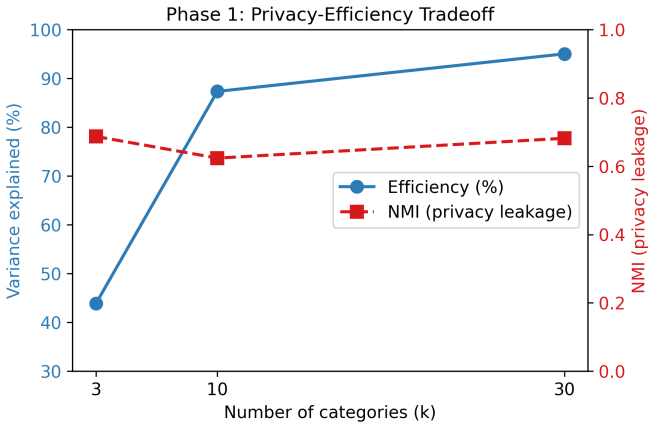
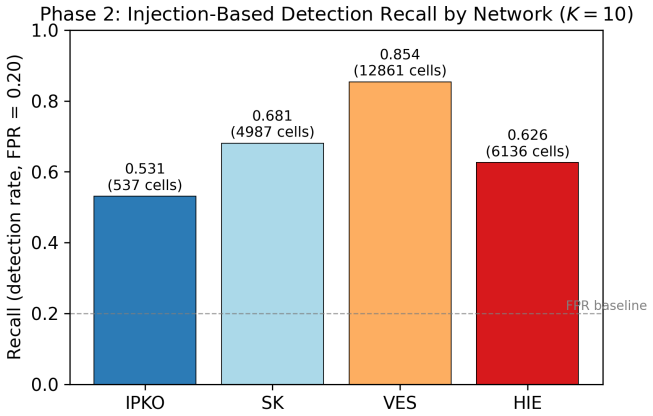
Category-based coordination mechanisms allocate resources by mapping a declared service category to a fixed resource profile, without observing individual demand types. We establish three results for this class of mechanisms. First, the relative welfare gap Delta satisfies a tight two-sided bound in terms of the aggregate within-category allocation variance epsilon: (alpha/2W*)epsilon <= Delta <= (beta/2W*)epsilon. Second, the expected misreporting gain is bounded by the same epsilon without assumptions on agent strategy; demand-derived categories minimise both welfare loss and misreporting incentive simultaneously. Third, aggregate outcome metrics strictly dominate per-agent metrics for service-level detection under a homogeneity condition, for all parameter values, with a finite-sample power gap of O(1/m). At any fixed K, the demand-derived category label is the sufficient statistic for coordination: collecting per-agent data beyond the category label adds noise to the detection problem without reducing the welfare gap. However, welfare and detection impose structurally opposed demands on K: welfare improves with finer categories, detection worsens. The designer faces a feasibility band [Kmin, Kmax] and must choose K within it as a value judgement. We claim that any protocol achieving welfare gap Delta <= epsilon* and missed-detection rate <= beta* requires at least Hlb(epsilon*, beta*) bits of category entropy. We illustrate the mechanism on a synthetic population of 50,000 demand vectors and five weeks of production performance-management data from four anonymised operator networks (28,249 cells).
Editorial analysis
A structured set of objections, weighed in public.
Referee Report
Summary. The manuscript introduces MISES, a category-based coordination mechanism for service resource allocation that maps declared categories to fixed resource profiles without observing individual demands. It establishes three results: (1) the relative welfare gap Δ satisfies the tight two-sided bound (α/2W*)ε ≤ Δ ≤ (β/2W*)ε in terms of aggregate within-category allocation variance ε; (2) demand-derived categories simultaneously minimize welfare loss and misreporting gain (bounded by the same ε) without assumptions on agent strategies; (3) under a homogeneity condition on demands within categories, aggregate outcome metrics strictly dominate per-agent metrics for service-level detection for all parameter values, with finite-sample power gap O(1/m). At fixed K the demand-derived category label is claimed to be the sufficient statistic for coordination. This leads to the claim that any protocol achieving Δ ≤ ε* and missed-detection rate ≤ β* requires at least Hlb(ε*, β*) bits of category entropy. The results are illustrated on a synthetic population of 50,000 demand vectors and five weeks of production data from four anonymised operator networks (28,249 cells).
Significance. If the derivations are gap-free and the homogeneity condition is satisfied in the target settings, the work would supply a principled game-theoretic foundation for minimal-information coordination mechanisms that explicitly trade off welfare against detection. The explicit two-sided bounds on Δ, the strategy-independent misreporting bound, the identification of the [Kmin, Kmax] feasibility band, and the entropy lower bound are notable strengths, as is the use of both synthetic and real production data for illustration.
major comments (2)
- [Abstract (third result and sufficiency claim)] Abstract, third result: the claim that aggregate outcome metrics strictly dominate per-agent metrics 'for all parameter values' with O(1/m) power gap, and that the category label is the sufficient statistic, is derived under an explicit homogeneity condition on demands within each category. The manuscript states the condition but provides no verification, statistical tests, or robustness checks that homogeneity holds for the 28,249 cells across the four operator networks; without it the aggregate-metric advantage and sufficiency claim do not necessarily hold, as per-agent data could supply additional detection signal while leaving the welfare gap Δ unchanged.
- [Abstract (entropy lower bound claim)] The information lower bound Hlb(ε*, β*): this bound is motivated by the same coordination-detection tradeoff that relies on homogeneity. If the condition fails, the structural dependence means the lower bound on category entropy may not apply as stated, since extra per-agent observations could improve detection without increasing Δ.
minor comments (2)
- [Abstract] The notation Hlb(ε*, β*) appears in the abstract without an explicit definition or pointer to its derivation, which reduces readability for readers encountering the entropy claim for the first time.
- [Empirical illustration] The empirical section reports the synthetic population size and real-data scale but does not tabulate the fitted values of α, β, W*, or the observed ε used to instantiate the welfare-gap bounds.
Simulated Author's Rebuttal
We thank the referee for the careful and constructive review. The two major comments correctly identify that several claims rest on an unverified homogeneity condition. We address each point below and commit to revisions that scope the claims appropriately while adding empirical checks.
read point-by-point responses
-
Referee: [Abstract (third result and sufficiency claim)] Abstract, third result: the claim that aggregate outcome metrics strictly dominate per-agent metrics 'for all parameter values' with O(1/m) power gap, and that the category label is the sufficient statistic, is derived under an explicit homogeneity condition on demands within each category. The manuscript states the condition but provides no verification, statistical tests, or robustness checks that homogeneity holds for the 28,249 cells across the four operator networks; without it the aggregate-metric advantage and sufficiency claim do not necessarily hold, as per-agent data could supply additional detection signal while leaving the welfare gap Δ unchanged.
Authors: We agree that the homogeneity condition is stated but not empirically verified on the production dataset, and that this leaves the aggregate-dominance and sufficiency claims without direct support on the real data. In the revision we will insert a dedicated subsection that reports within-category homogeneity diagnostics on the 28,249 cells: (i) the ratio of within-category to total variance of the demand vectors, (ii) pairwise energy-distance tests between demand distributions of cells assigned to the same category, and (iii) a sensitivity analysis showing how the O(1/m) power gap degrades under controlled violations of homogeneity. The synthetic population already satisfies the condition by construction; any material deviations found in the operator data will be reported and the abstract and theorem statements will be qualified to read “under the homogeneity condition, which we verify to hold approximately on the evaluated datasets.” This directly addresses the possibility that per-agent observations could supply extra detection signal. revision: yes
-
Referee: [Abstract (entropy lower bound claim)] The information lower bound Hlb(ε*, β*): this bound is motivated by the same coordination-detection tradeoff that relies on homogeneity. If the condition fails, the structural dependence means the lower bound on category entropy may not apply as stated, since extra per-agent observations could improve detection without increasing Δ.
Authors: The referee is correct that the entropy lower bound is derived from the same structural tradeoff that invokes homogeneity. We will revise the abstract, the statement of the lower-bound theorem, and the surrounding discussion to make the dependence on homogeneity explicit. With the homogeneity diagnostics added in response to the first comment, we will also include a short paragraph noting that, when homogeneity is violated, the information-theoretic lower bound may be relaxed because additional per-agent features could improve detection at no extra welfare cost; the revised text will therefore present Hlb(ε*, β*) as a lower bound that applies under the verified homogeneity regime rather than unconditionally. revision: yes
Circularity Check
No circularity: bounds and sufficiency claims are derived from stated assumptions without self-referential reduction
full rationale
The paper derives the two-sided bound on welfare gap Delta explicitly in terms of observable within-category allocation variance epsilon as (alpha/2W*)epsilon <= Delta <= (beta/2W*)epsilon, bounds misreporting gain by the same epsilon, and states aggregate-metric dominance under an explicit homogeneity condition on demands within categories (with O(1/m) power gap). The sufficiency claim that the demand-derived category label is a sufficient statistic at fixed K is presented as following from the detection-dominance result under that homogeneity assumption, without reducing to a fitted parameter or tautology by the paper's own equations. The information lower bound Hlb(epsilon*, beta*) is claimed as a consequence of the coordination-detection tradeoff but is not shown to be constructed by re-using the same fitted quantities. No self-citations appear in the provided text, and the homogeneity condition is openly stated as required rather than smuggled in. The derivation chain remains self-contained against the listed assumptions and observables.
Axiom & Free-Parameter Ledger
axioms (2)
- domain assumption Agents have quasi-linear utilities over allocated resources and reported categories
- domain assumption Category allocation is a fixed mapping from declared category to resource profile
Reference graph
Works this paper leans on
-
[1]
Telecommunication management; subscriber and equipment trace; trace control and configuration management
3GPP. Telecommunication management; subscriber and equipment trace; trace control and configuration management. Technical Report TS 32.422 V18.0.0, 3rd Generation Partnership Project, 2023
2023
-
[2]
Intent driven management services for mobile networks
3GPP. Intent driven management services for mobile networks. Technical Report TS 28.312 V19.1.0, 3rd Generation Partnership Project, 2024
2024
-
[3]
Prentice- Hall, 1971
Toby Berger.Rate Distortion Theory: A Mathematical Basis for Data Compression. Prentice- Hall, 1971
1971
-
[4]
Conditional expectation and unbiased sequential estimation.The Annals of Mathematical Statistics, 18(1):105–110, 1947
David Blackwell. Conditional expectation and unbiased sequential estimation.The Annals of Mathematical Statistics, 18(1):105–110, 1947
1947
-
[5]
Directive 2002/58/EC concerning the processing of personal data and the protection of privacy in the electronic communications 15 sector (eprivacy directive)
European Parliament and Council of the European Union. Directive 2002/58/EC concerning the processing of personal data and the protection of privacy in the electronic communications 15 sector (eprivacy directive). Official Journal of the European Union, L 201/37, 2002. As amended by Directive 2009/136/EC
2002
-
[6]
European Parliament and Council of the European Union. Regulation (EU) 2016/679 on the protection of natural persons with regard to the processing of personal data and on the free movement of such data (general data protection regulation). Official Journal of the European Union, L 119/1, 2016
2016
-
[7]
Friedrich A. Hayek. The use of knowledge in society.American Economic Review, 35(4): 519–530, 1945
1945
-
[8]
Jerzy Neyman and Egon S. Pearson. On the problem of the most efficient tests of statistical hypotheses.Philosophical Transactions of the Royal Society of London. Series A, 231:289–337,
-
[9]
doi: 10.1098/rsta.1933.0009
-
[10]
O-ran use cases and deployment scenarios
O-RAN Alliance. O-ran use cases and deployment scenarios. Technical Report O- RAN.WG1.Use-Cases-Analysis-Report-v07.00, O-RAN Alliance, 2023
2023
-
[11]
Radhakrishna Rao
C. Radhakrishna Rao. Information and the accuracy attainable in the estimation of statistical parameters.Bulletin of the Calcutta Mathematical Society, 37:81–91, 1945
1945
-
[12]
Claude E. Shannon. A mathematical theory of communication.Bell System Technical Journal, 27(3):379–423, 1948. doi: 10.1002/j.1538-7305.1948.tb01338.x
-
[13]
Yale University Press, 1949
Ludwig von Mises.Human Action: A Treatise on Economics. Yale University Press, 1949
1949
-
[14]
Die Wirtschaftsrechnung im sozialistis- chen Gemeinwesen,
Ludwig von Mises.Economic Calculation in the Socialist Commonwealth. Ludwig von Mises Institute, Auburn, AL, 1990. Originally published as “Die Wirtschaftsrechnung im sozialistis- chen Gemeinwesen,”Archiv f¨ ur Sozialwissenschaft und Sozialpolitik, vol. 47, pp. 86–121, 1920. Translated by S. Adler. 16
1990
discussion (0)
Sign in with ORCID, Apple, or X to comment. Anyone can read and Pith papers without signing in.