Recognition: unknown
MAEO: Multiobjective Animorphic Ensemble Optimization for Scalable Large-scale Engineering Applications
Pith reviewed 2026-05-08 04:54 UTC · model grok-4.3
The pith
MAEO ensembles four evolutionary algorithms in an island architecture to match or exceed individual optimizers on multiobjective benchmarks and nuclear reactor design.
A machine-rendered reading of the paper's core claim, the machinery that carries it, and where it could break.
Core claim
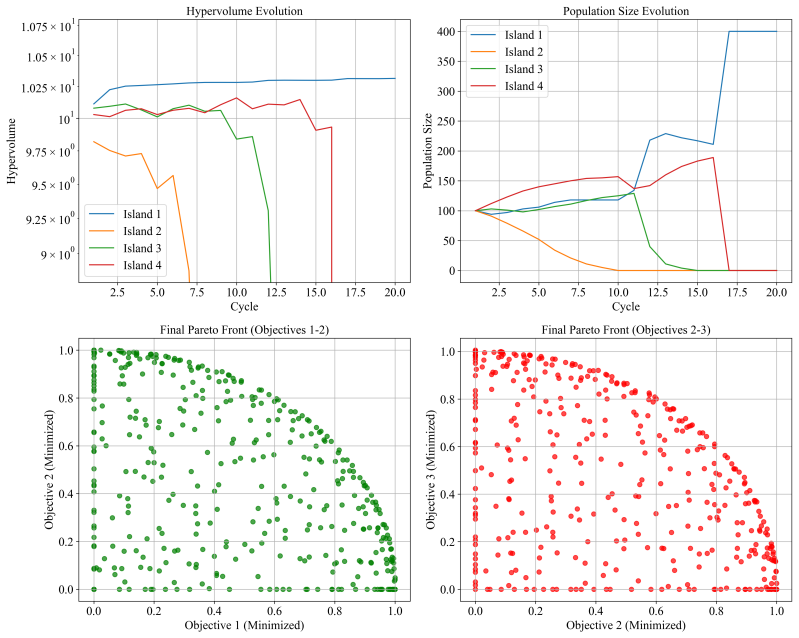
MAEO is a parameter-free ensemble framework that integrates NSGA-III, CTAEA, AGEMOEA2, and SPEA2 within an island-based parallel architecture. Islands are ranked by a hypervolume indicator while individuals inside each island receive a strict Pareto-rank score that incorporates crowding distance and proximity to the nadir point. Extensive tests on twelve DTLZ/ZDT functions under thirty-six dimensionality settings demonstrate that MAEO achieves balanced convergence-diversity performance and matches or outperforms the constituent algorithms according to Wilcoxon signed-rank tests on both hypervolume and inverse generational distance. When applied to the equilibrium-cycle optimization of a 8, 3
What carries the argument
The island-based ensemble architecture with hypervolume-based island performance assessment and Pareto-rank individual scoring that includes crowding distance and nadir-point proximity.
Load-bearing premise
That the specific combination of NSGA-III, CTAEA, AGEMOEA2 and SPEA2 inside the island architecture with the described hypervolume-based island assessment and Pareto-rank scoring will deliver consistent gains over individual algorithms without problem-specific tuning.
What would settle it
A head-to-head comparison on the same benchmark suite and evaluation budget in which any one of the four constituent algorithms, such as NSGA-III alone, produces statistically superior hypervolume or inverse generational distance results than the full MAEO ensemble.
Figures





read the original abstract
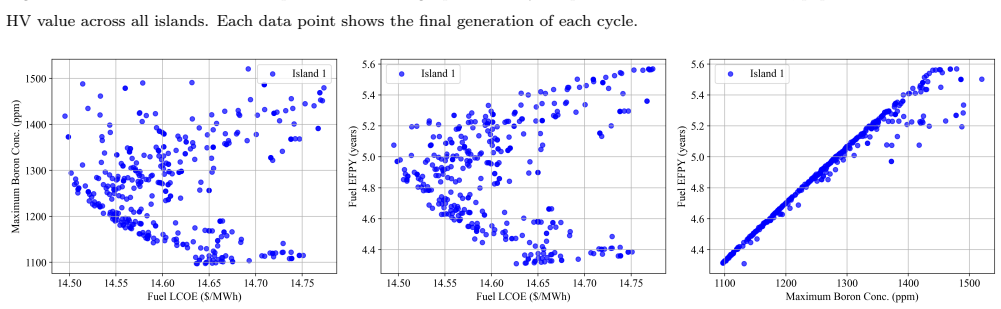
Multiobjective optimization remains challenging for many scientific and engineering problems due to the need to balance convergence, diversity, and computational efficiency across high-dimensional objective landscapes. This work presents the Multiobjective Animorphic Ensemble Optimization (MAEO) framework, a parallelizable ensemble strategy that unifies state-of-the-art evolutionary algorithms within an island-based architecture, overcoming the limitations of relying on a single optimizer, as implied by the No Free Lunch theorem. MAEO uses a parameter-free hypervolume indicator for island performance assessment and a strict Pareto-rank-based individual scoring formulation that incorporates crowding distance and nadir-point proximity to ensure consistent selection pressure within each front. The framework is initiated using four algorithms (NSGA-III, CTAEA, AGEMOEA2, SPEA2) and evaluated through extensive benchmarking on 12 DTLZ/ZDT functions under 36 dimensionality settings using Wilcoxon signed-rank tests with both hypervolume and inverse generational distance metrics. Results show that MAEO achieves balanced convergence-diversity performance, outperforming or matching some of the leading multiobjective optimization algorithms across different benchmark problems. To demonstrate practical applicability, MAEO is applied to the equilibrium-cycle optimization of a small modular nuclear reactor. Eight discrete design variables (and three objectives (levelized cost of electricity, peak soluble boron concentration, fuel cycle length) are optimized under two safety constraints. The algorithm carried out roughly 40000 evaluations using computer simulations. MAEO identifies core designs that lower both the levelized cost of electricity and the peak boron concentration, while preserving fuel cycle length and meeting all safety constraints.
Editorial analysis
A structured set of objections, weighed in public.
Referee Report
Summary. The manuscript proposes the Multiobjective Animorphic Ensemble Optimization (MAEO) framework, which integrates NSGA-III, CTAEA, AGEMOEA2, and SPEA2 within a parallel island-based architecture. It employs a hypervolume indicator for island performance assessment and a strict Pareto-rank scoring that incorporates crowding distance and nadir-point proximity. The approach is benchmarked on 12 DTLZ/ZDT functions across 36 dimensionality settings using Wilcoxon signed-rank tests on hypervolume and IGD metrics, with claims of balanced convergence-diversity performance. MAEO is further applied to equilibrium-cycle optimization of a small modular nuclear reactor (8 discrete design variables, 3 objectives, 2 safety constraints) after approximately 40000 evaluations, identifying designs that reduce levelized cost of electricity and peak boron concentration while preserving fuel cycle length.
Significance. If the performance claims are substantiated, MAEO provides a practical, parallelizable ensemble strategy for multiobjective optimization that addresses the No Free Lunch theorem by combining multiple algorithms with consistent selection pressure. The nuclear-reactor case study demonstrates applicability to large-scale engineering simulations, offering potential for improved design trade-offs in energy systems. The use of Wilcoxon tests and dual metrics (HV/IGD) on a broad benchmark suite strengthens the empirical support.
major comments (1)
- [Benchmarking and results sections] Benchmarking and results sections: the central claim that MAEO 'outperforms or matches' leading algorithms and delivers 'balanced convergence-diversity performance' rests on the ensemble providing gains over its constituent algorithms (NSGA-III, CTAEA, AGEMOEA2, SPEA2). However, the reported comparisons appear limited to external leading algorithms rather than direct head-to-head results against the individual island components under identical settings; without these, it remains unclear whether the hypervolume-based island assessment and Pareto-rank scoring deliver consistent additive value, which is load-bearing for the ensemble-advantage argument.
minor comments (3)
- [Abstract and methods] Abstract and methods: the description of a 'parameter-free hypervolume indicator' requires explicit clarification on reference-point selection or normalization, as standard hypervolume computations depend on such choices; this affects reproducibility of the island assessment rule.
- [Nuclear application section] Nuclear application section: the constraint-handling mechanism (e.g., penalty functions, repair operators, or feasibility archiving) for the two safety constraints is not detailed in the provided description; adding this would strengthen the practical-applicability claim.
- [Results presentation] Results presentation: inclusion of error bars, exact baseline algorithm versions, and per-problem win counts (beyond aggregate Wilcoxon outcomes) would improve clarity of the 'outperforming or matching' statement across the 36 settings.
Simulated Author's Rebuttal
We thank the referee for their constructive feedback and recommendation of minor revision. We address the single major comment point by point below.
read point-by-point responses
-
Referee: Benchmarking and results sections: the central claim that MAEO 'outperforms or matches' leading algorithms and delivers 'balanced convergence-diversity performance' rests on the ensemble providing gains over its constituent algorithms (NSGA-III, CTAEA, AGEMOEA2, SPEA2). However, the reported comparisons appear limited to external leading algorithms rather than direct head-to-head results against the individual island components under identical settings; without these, it remains unclear whether the hypervolume-based island assessment and Pareto-rank scoring deliver consistent additive value, which is load-bearing for the ensemble-advantage argument.
Authors: We agree that direct head-to-head comparisons of MAEO against each of its constituent algorithms (NSGA-III, CTAEA, AGEMOEA2, and SPEA2) executed independently under identical benchmark settings, population sizes, and evaluation budgets would provide clearer evidence that the hypervolume-based island assessment and strict Pareto-rank scoring deliver additive value beyond any single component. The current manuscript focuses on positioning MAEO against other state-of-the-art multiobjective algorithms, but we acknowledge this leaves the ensemble-specific gains less directly substantiated. We will therefore add a new set of experiments and tables in the revised benchmarking section that run each constituent algorithm in isolation on the same 12 DTLZ/ZDT functions across the 36 dimensionality settings, applying the same Wilcoxon signed-rank tests on hypervolume and IGD. This will allow explicit quantification of whether the parallel island architecture with parameter-free hypervolume assessment improves upon the best single-island performance. revision: yes
Circularity Check
No significant circularity in derivation chain
full rationale
The MAEO framework is constructed as an explicit ensemble of four pre-existing multiobjective evolutionary algorithms (NSGA-III, CTAEA, AGEMOEA2, SPEA2) placed inside a described island architecture, with the hypervolume-based island assessment and Pareto-rank scoring (incorporating crowding distance and nadir proximity) presented as newly specified, parameter-free selection rules. These rules are not derived from any equation that reduces to the inputs by construction, nor do they rely on load-bearing self-citations, uniqueness theorems imported from the authors' prior work, or ansatzes smuggled via citation. Benchmarking results on DTLZ/ZDT functions (with Wilcoxon tests on hypervolume and IGD) and the nuclear-reactor application are empirical performance claims that remain externally falsifiable through the stated experimental protocol; no step equates a prediction to a fitted parameter or renames a known result as a novel derivation. The central claim of balanced convergence-diversity therefore rests on verifiable comparisons rather than internal self-reference.
Axiom & Free-Parameter Ledger
axioms (1)
- domain assumption No single optimizer is sufficient for all multiobjective problems (No Free Lunch theorem)
Reference graph
Works this paper leans on
-
[1]
L. C. Høghøj, C. Conlan-Smith, C. S. Andreasen, O. Sigmund, Simultaneous shape and topology optimization of wings, Structural and Multidisciplinary Optimizationdoi:10.1007/s00158-023-03569-x
-
[2]
M. Hasan, C. Conlan-Smith, et al., Aerodynamic optimization of aircraft wings using machine learning, Aeronautical Journaldoi:10.1016/j.somejournal.whatever
-
[3]
Jeong, E.-B
M. Jeong, E.-B. Cho, H.-S. Byun, C.-H. Kang, Maximization of the power production in lng cold energy recovery plant via genetic algorithm, Korean Journal of Chemical Engineering 38 (2) (2021) 380–385
2021
-
[4]
P. R. Wilding, N. R. Murray, M. J. Memmott, The use of multi-objective optimization to improve the design process of nuclear power plant systems, Annals of Nuclear Energy 137 (2020) 107079
2020
-
[5]
M. D. DeChaine, M. A. Feltus, Fuel management optimization using genetic algorithms and expert knowledge, Nuclear Science and Engineering 124 (1) (1996) 188–196
1996
-
[6]
Zaheer, T
Q. Zaheer, T. Yonggang, F. Qamar, Literature review of bridge structure’s optimization and it’s development over time, International Journal for Simulation and Multidisciplinary Design Optimization 13 (2022) 5
2022
-
[7]
A. R. Conn, K. Scheinberg, L. N. Vicente, Introduction to derivative-free optimization, SIAM, 2009.doi:10.1137/1. 9780898718751
work page doi:10.1137/1 2009
-
[8]
J. H. Holland, Adaptation in Natural and Artificial Systems, University of Michigan Press, 1975
1975
-
[9]
Back, Evolutionary algorithms in theory and practice: evolution strategies, evolutionary programming, genetic algorithms, Oxford university press, 1996
T. Back, Evolutionary algorithms in theory and practice: evolution strategies, evolutionary programming, genetic algorithms, Oxford university press, 1996
1996
-
[10]
Kennedy, R
J. Kennedy, R. Eberhart, Particle swarm optimization, in: Proceedings of ICNN’95-international conference on neural networks, Vol. 4, ieee, 1995, pp. 1942–1948
1995
-
[11]
Mirjalili, S
S. Mirjalili, S. M. Mirjalili, A. Lewis, Grey wolf optimizer, Advances in engineering software 69 (2014) 46–61
2014
-
[12]
S. Mirjalili, Moth-flame optimization algorithm: A novel nature-inspired heuristic paradigm, Knowledge-Based Systems 89 (2015) 228–249.doi:10.1016/j.knosys.2015.07.006
-
[13]
Mirjalili, A
S. Mirjalili, A. Lewis, Whale optimization algorithm, Advances in Engineering Software 95 (2016) 51–67.doi:10.1016/ j.advengsoft.2016.01.008
2016
-
[14]
J. R. Ray, Jaya: a simple and new optimization algorithm for solving constrained and unconstrained optimization problems, International Journal of Industrial Engineering Computations 7 (1) (2016) 19–34.doi:10.5267/j.ijiec. 2015.8.004
-
[15]
M. I. Radaideh, H. Tran, L. Lin, H. Jiang, D. Winder, S. Gorti, G. Zhang, J. Mach, S. Cousineau, Model calibration of the liquid mercury spallation target using evolutionary neural networks and sparse polynomial expansions, Nuclear Instruments and Methods in Physics Research Section B: Beam Interactions with Materials and Atoms 525 (2022) 41–54
2022
-
[16]
H. Zhang, K. Sugiyama, A. Yamamoto, Multiobjective optimization of nuclear fuel management with evolutionary algorithms, Annals of Nuclear Energy 85 (2015) 23–33.doi:10.1016/j.anucene.2015.05.019. 30
-
[17]
Seurin, K
P. Seurin, K. Shirvan, Multi-objective reinforcement learning-based approach for pressurized water reactor optimization, Annals of Nuclear Energy 205 (2024) 110582
2024
-
[18]
Erdem, K
O. Erdem, K. Daley, G. Hoelzle, M. I. Radaideh, Multi-objective combinatorial methodology for nuclear reactor site assessment: A case study for the united states, Energy Conversion and Management: X 26 (2025) 100923
2025
-
[19]
Fortin, F.-M
F.-A. Fortin, F.-M. De Rainville, M.-A. G. Gardner, M. Parizeau, C. Gagné, Deap: Evolutionary algorithms made easy, The Journal of Machine Learning Research 13 (1) (2012) 2171–2175
2012
-
[20]
Blank, K
J. Blank, K. Deb, Pymoo: Multi-objective optimization in python, Ieee access 8 (2020) 89497–89509
2020
-
[21]
M. I. Radaideh, K. Du, P. Seurin, D. Seyler, X. Gu, H. Wang, K. Shirvan, Neorl: Neuroevolution optimization with reinforcement learning—applications to carbon-free energy systems, Nuclear Engineering and Design 412 (2023) 112423
2023
- [22]
-
[23]
P. Seurin, K. Shirvan, Assessment of reinforcement learning algorithms for nuclear power plant fuel optimization, Applied Intelligence 54 (6) (2024) 2100–2135.doi:10.1007/s10489-023-04645-0. URLhttps://doi.org/10.1007/s10489-023-04645-0
-
[24]
M. I. Radaideh, L. Tunkle, D. Price, K. Abdulraheem, L. Lin, M. Elias, Multistep criticality search and power shaping in nuclear microreactors with deep reinforcement learning, Nuclear Science and Engineering (2025) 1–13
2025
-
[25]
M. I. Radaideh, K. Shirvan, Rule-based reinforcement learning methodology to inform evolutionary algorithms for constrained optimization of engineering applications, Knowledge-Based Systems 217 (2021) 106836
2021
-
[26]
M. I. Radaideh, I. Wolverton, J. Joseph, J. J. Tusar, U. Otgonbaatar, N. Roy, B. Forget, K. Shirvan, Physics-informed reinforcement learning optimization of nuclear assembly design, Nuclear Engineering and Design 372 (2021) 110966
2021
-
[27]
Seurin, K
P. Seurin, K. Shirvan, Physics-informed reinforcement learning optimization of pwr core loading pattern, Annals of Nuclear Energy 208 (2024) 110763
2024
-
[28]
M. I. Radaideh, B. Forget, K. Shirvan, Large-scale design optimisation of boiling water reactor bundles with neuroevo- lution, Annals of Nuclear Energy 160 (2021) 108355
2021
-
[29]
D. H. Wolpert, W. G. Macready, No free lunch theorems for optimization, IEEE Transactions on Evolutionary Com- putation 1 (1) (1997) 67–82.doi:10.1109/4235.585893
-
[30]
Seurin, K
P. Seurin, K. Shirvan, Surpassing legacy approaches to pwr core reload optimization with single-objective reinforcement learning, Nuclear Science and Engineering (2025) 1–32
2025
-
[31]
Zhang, H
Y. Zhang, H. Wang, J. Wang, X. Cheng, T. Wang, Z. Zhao, Ensemble optimization approach based on hybrid mode decomposition and intelligent technology for wind power prediction system, Energy 292 (2024) 130492
2024
-
[32]
Z. Ye, J. Luo, W. Zhou, M. Wang, Q. He, An ensemble framework with improved hybrid breeding optimization-based feature selection for intrusion detection, Future Generation Computer Systems 151 (2024) 124–136
2024
-
[33]
S. S. Rezk, et al., Metaheuristic-based ensemble learning: an extensive review, Soft Computingdoi:10.1007/ s00521-024-10203-4
-
[34]
X.-S. Yang, A new metaheuristic bat-inspired algorithm: Follow the leader (ftl), in: Proceedings of the International Conference on Nature Inspired Cooperative Strategies for Optimization, 2007, pp. 411–423
2007
-
[35]
S. Mirjalili, S. M. Mirjalili, A. Hatamlou, The multi-verse optimizer (mvo): A nature-inspired algorithm for global optimization, Neural Computing and Applications 27 (2) (2016) 495–513.doi:10.1007/s00521-015-1870-7
-
[36]
S. Mirjalili, A. H. Gandomi, Salp swarm algorithm: A bio-inspired optimizer for engineering design problems, Advances in Engineering Software 114 (2017) 163–191.doi:10.1016/j.advengsoft.2017.07.002. 31
-
[37]
M. I. Radaideh, K. Shirvan, Pesa: Prioritized experience replay for parallel hybrid evolutionary and swarm algorithms- application to nuclear fuel, Nuclear Engineering and Technology 54 (10) (2022) 3864–3877
2022
-
[38]
Singh, R
P. Singh, R. Kottath, An ensemble approach to meta-heuristic algorithms: comparative analysis and its applications, Computers & Industrial Engineering 162 (2021) 107739
2021
-
[39]
J. Jie, W. Wang, C. Liu, B. Hou, Multi-swarm particle swarm optimization based on mixed search behavior, in: 2010 5th IEEE Conference on Industrial Electronics and Applications, IEEE, 2010, pp. 605–610
2010
-
[40]
Price, M
D. Price, M. I. Radaideh, Animorphic ensemble optimization: a large-scale island model, Neural Computing and Applications 35 (4) (2023) 3221–3243
2023
-
[41]
Mallipeddi, P
R. Mallipeddi, P. N. Suganthan, Q.-K. Pan, M. F. Tasgetiren, Differential evolution algorithm with ensemble of param- eters and mutation strategies, Applied soft computing 11 (2) (2011) 1679–1696
2011
-
[42]
K. Li, A. Fialho, S. Kwong, Q. Zhang, Adaptive operator selection with bandits for a multiobjective evolutionary algorithm based on decomposition, IEEE Transactions on Evolutionary Computation 18 (1) (2013) 114–130
2013
-
[43]
K. M. Sallam, N. M. Ferguson, V. Babovic, Landscape-based adaptive operator selection mechanism, Information Sciences 418 (2017) 586–602
2017
-
[44]
N. Lynn, P. N. Suganthan, Ensemble particle swarm optimizer, Applied Soft Computing 55 (2017) 533–548
2017
-
[45]
Akkaya, M
A. Akkaya, M. Azizi, An effective approach for adaptive operator selection and particle swarm optimization probability matching (psopm), Soft Computing
-
[46]
N. Shaukat, et al., Multiobjective core reloading pattern optimization of nuclear reactor, Journal of Nuclear Engineering & Radiation Sciencedoi:10.1155/2021/1802492. URLhttps://onlinelibrary.wiley.com/doi/10.1155/2021/1802492
-
[47]
Price, M
D. Price, M. I. Radaideh, B. Kochunas, Multiobjective optimization of nuclear microreactor reactivity control system operation with swarm and evolutionary algorithms, Nuclear Engineering and Design 393 (2022) 111776
2022
-
[48]
Tunkle, K
L. Tunkle, K. Abdulraheem, L. Lin, M. I. Radaideh, Nuclear microreactor transient and load-following control with deep reinforcement learning, Energy Conversion and Management: X (2025) 101090
2025
-
[49]
Ehrgott, X
M. Ehrgott, X. Gandibleux, Multiple criteria optimization: state of the art annotated bibliographic surveys
-
[50]
K. Deb, A. Pratap, S. Agarwal, T. Meyarivan, A fast and elitist multiobjective genetic algorithm: Nsga-ii, IEEE Transactions on Evolutionary Computation 6 (2) (2002) 182–197.doi:10.1109/4235.996017
-
[51]
K. Deb, H. Jain, An evolutionary many-objective optimization algorithm using reference-point-based nondominated sorting approach, part i: solving problems with box constraints, IEEE transactions on evolutionary computation 18 (4) (2013) 577–601
2013
-
[52]
Zitzler, M
E. Zitzler, M. Laumanns, L. Thiele, Spea2: Improving the strength pareto evolutionary algorithm, in: Evolutionary Methods for Design, Optimization and Control, 2001, pp. 95–100
2001
-
[53]
R. Cheng, Y. Jin, M. Olhofer, B. Sendhoff, A reference vector guided evolutionary algorithm for many-objective opti- mization, IEEE Transactions on Evolutionary Computation 20 (5) (2016) 773–791.doi:10.1109/TEVC.2016.2519378
-
[54]
K. Deb, J. Sundar, P. Udayakumar, Reference point based nsga-iii for preferred solutions, Evolutionary Computation 27 (3) (2019) 421–447
2019
-
[55]
Q. Zhang, H. Li, Moea/d: A multiobjective evolutionary algorithm based on decomposition, IEEE Transactions on Evolutionary Computation 11 (6) (2007) 712–731.doi:10.1109/TEVC.2007.892759
-
[56]
Beume, B
N. Beume, B. Naujoks, M. Emmerich, Sms-emoa: Multiobjective selection based on dominated hypervolume, European journal of operational research 181 (3) (2007) 1653–1669. 32
2007
-
[57]
J. Zhao, B. Knight, E. Nissan, A. Soper, Fuelgen: a genetic algorithm-based system for fuel loading pattern design in nuclear power reactors, Expert Systems with Applications 14 (4) (1998) 461–470
1998
-
[58]
Seurin, A
P. Seurin, A. Halimi, K. Shirvan, Impact of including fuel performance as part of core reload optimization: Application to power uprates, Nuclear Engineering and Design 433 (2025) 113844
2025
-
[59]
J. Zhang, A. Lamont, Optimization of pressurized water reactor reload design using simulated annealing, Nuclear Technology 111 (1) (1995) 109–118.doi:10.13182/NT95-1-9
-
[60]
C. M. Pereira, C. M. Lapa, Coarse-grained parallel genetic algorithm applied to a nuclear reactor core design optimiza- tion problem, Annals of Nuclear Energy 30 (5) (2003) 555–565
2003
-
[61]
Yang, M.-J
J.-E. Yang, M.-J. Hwang, T.-Y. Sung, Y. Jin, Application of genetic algorithm for reliability allocation in nuclear power plants, Reliability Engineering & System Safety 65 (3) (1999) 229–238
1999
-
[62]
X. Gu, M. I. Radaideh, J. Liang, Openneomc: A framework for design optimization in particle transport simulations based on openmc and neorl, Annals of Nuclear Energy 180 (2023) 109450
2023
-
[63]
M. I. Radaideh, C. Pigg, T. Kozlowski, Y. Deng, A. Qu, Neural-based time series forecasting of loss of coolant accidents in nuclear power plants, Expert Systems with Applications 160 (2020) 113699
2020
-
[64]
M. I. Radaideh, T. Kozlowski, Surrogate modeling of advanced computer simulations using deep gaussian processes, Reliability Engineering & System Safety 195 (2020) 106731
2020
-
[65]
M. I. Radaideh, C. Pappas, M. Wezensky, P. Ramuhalli, S. Cousineau, Early fault detection in particle accelerator power electronics using ensemble learning, International Journal of Prognostics and Health Management 14 (1)
-
[66]
Y. Che, J. Yurko, P. Seurin, K. Shirvan, Machine learning-assisted surrogate construction for full-core fuel performance analysis, Annals of Nuclear Energy 168 (2022) 108905
2022
-
[67]
E. Fridman, Y. Bilodid, V. Valtavirta, Definition of the neutronics benchmark of the nuscale-like core, Nuclear Engi- neering and Technology 55 (10) (2023) 3639–3647.doi:10.1016/j.net.2023.06.029
-
[68]
E. Zitzler, L. Thiele, Multiobjective evolutionary algorithms: A comparative case study and the strength pareto ap- proach, IEEE Transactions on Evolutionary Computation 3 (4) (1999) 257–271.doi:10.1109/4235.797969
-
[69]
Bringmann, T
K. Bringmann, T. Friedrich, Parameterized average-case complexity of the hypervolume indicator, in: Proceedings of the 15th annual conference on Genetic and evolutionary computation, 2013, pp. 575–582
2013
-
[70]
D. I. Price, Animorphic ensemble optimization: Theory and applications, Master’s thesis, Massachusetts Institute of Technology, Cambridge, MA (2022). URLhttps://dspace.mit.edu/handle/1721.1/147754
2022
-
[71]
Rempe, K
K. Rempe, K. S. Smith, A. Henry, Simulate-3 pin power reconstruction: methodology and benchmarking, Nuclear Science and Engineering 103 (4) (1989) 334–342
1989
-
[72]
M. R. Abdusammi, I. Khaleb, F. Gao, A. Verma, Evaluation of nuclear microreactor cost-competitiveness in current electricity markets considering reactor cost uncertainties, Nuclear Engineering and Design 443 (2025) 114295.doi: https://doi.org/10.1016/j.nucengdes.2025.114295. URLhttps://www.sciencedirect.com/science/article/pii/S0029549325004728
-
[73]
Asuega, B
A. Asuega, B. J. Limb, J. C. Quinn, Techno-economic analysis of advanced small modular nuclear reactors, Applied Energy 334 (2023) 120669
2023
-
[74]
Halimi, K
A. Halimi, K. Shirvan, Scale effects on core design, fuel costs, and spent fuel volume of pressurized water reactors, Annals of Nuclear Energy 209 (2024) 110847
2024
-
[75]
UxC, LLC, Nuclear fuel cost calculator,https://www.uxc.com/p/tool/fuel-cost-calculator, accessed: 17 Septem- ber 2025 (2025). 33
2025
discussion (0)
Sign in with ORCID, Apple, or X to comment. Anyone can read and Pith papers without signing in.