Recognition: unknown
Dwarf Galaxies Hosting Extreme Star-Forming Regions and (Variable) AGNs at Radio Wavelengths
Pith reviewed 2026-05-07 10:11 UTC · model grok-4.3
The pith
Dwarf galaxies contain extreme young HII regions powered by up to 100,000 O-type stars and show radio variability consistent with AGNs.
A machine-rendered reading of the paper's core claim, the machinery that carries it, and where it could break.
Core claim
In dwarf galaxies, the compact radio sources resolved at 0.25 arcsec are thermal HII regions with ages less than 10 Myr whose ionizing output reaches the equivalent of tens of thousands of O-type stars, while sources detected only at 5 arcsec resolution exhibit radio excess relative to the infrared-radio correlation and strong variability between FIRST and VLASS epochs whose luminosities cannot be explained by supernovae, indicating AGN activity.
What carries the argument
Comparison of FIRST (5 arcsec) and VLA high-resolution (0.25 arcsec) detections, augmented by the infrared-radio correlation parameter q_IR and the absence of VLASS counterparts to flag variability.
Load-bearing premise
That non-detections in VLASS combined with FIRST detections indicate genuine variability from AGNs rather than differences in survey sensitivity, resolution, or calibration.
What would settle it
A new VLA observation at 1.4 GHz with 5-arcsec resolution taken near the VLASS epoch that recovers the original FIRST flux densities would falsify the variability interpretation.
Figures



read the original abstract
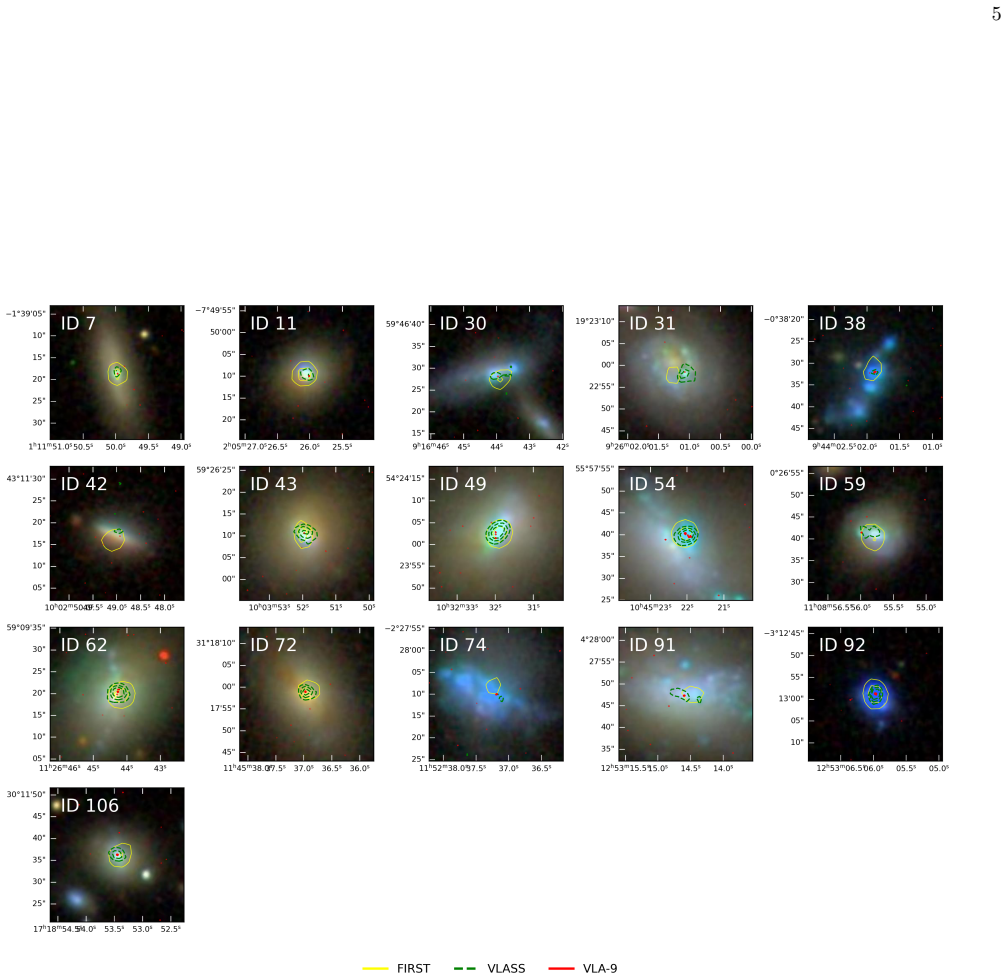
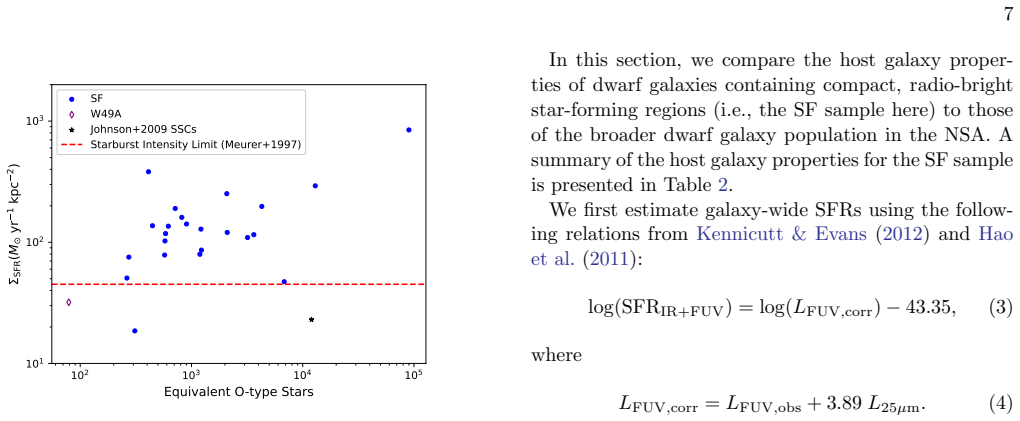
We present a detailed study of radio-detected dwarf galaxies (with stellar masses less than 3 billion solar masses) to characterize extreme star formation and search for (variable) radio AGNs. Our sample comes from Reines et al. (2020) (arXiv:1909.04670), who used the Karl G. Jansky Very Large Array (VLA) with 0.25 arcsecond resolution to observe 111 dwarf galaxies with lower-resolution (5 arcsecond) detections in the Faint Images of the Radio Sky at Twenty Centimeters (FIRST) survey. While that work identified and focused on 13 compact radio AGN candidates in dwarf galaxies, here we focus on 16 compact radio sources consistent with star formation in dwarf galaxies. We find that these objects are dominated by thermal HII regions with ages less than 10 Myr, and the most extreme sources have ionizing luminosities requiring the equivalent of around 10,000 to 100,000 O-type stars. We also investigate the dwarf galaxies detected in FIRST but not detected in the high-resolution follow-up observations. Using the infrared-radio correlation parameter, we identify eight sources consistent with radio-excess AGNs. Five of these objects plus another 15 dwarf galaxies have no corresponding detections in the VLA Sky Survey (VLASS) indicating variability between the FIRST and VLASS observations. The FIRST radio luminosities of these sources are significantly higher than expected for supernova-related emission, suggesting the radio variability is likely associated with AGNs. Together, these results provide new context for the presence of compact star formation and massive black holes in dwarf galaxies, and highlight the utility of radio variability and multi-resolution data for identifying the dominant power sources in low-mass systems.
Editorial analysis
A structured set of objections, weighed in public.
Referee Report
Summary. The manuscript studies radio-detected dwarf galaxies (M_* < 3e9 M_sun) drawn from Reines et al. (2020), focusing on 16 compact VLA sources consistent with star formation. It concludes these are dominated by thermal HII regions younger than 10 Myr, with the most extreme requiring ionizing luminosities equivalent to 10,000–100,000 O-type stars. It further identifies eight radio-excess AGN candidates via the IR-radio correlation and attributes FIRST detections without VLASS counterparts (20 sources total) to AGN variability, since the radio luminosities exceed supernova expectations.
Significance. If the interpretations hold after validation, this work supplies useful observational constraints on extreme star formation and possible AGN activity in low-mass galaxies. It illustrates how multi-resolution and multi-epoch radio data can help separate star-formation and AGN contributions, extending prior samples and providing context for massive black holes in dwarfs.
major comments (3)
- [Results on the 16 compact radio sources consistent with star formation] In the results on the 16 compact radio sources: the quantitative claims of HII-region ages <10 Myr and ionizing luminosities equivalent to 10,000–100,000 O-stars are stated without error bars, explicit model assumptions for the radio/IR correlations, or supporting data tables, which limits assessment of robustness for these central numbers.
- [Investigation of sources detected in FIRST but not VLASS] In the investigation of FIRST-detected but VLASS non-detected sources: the claim that variability indicates AGNs rests on the assumption that non-detections reflect intrinsic changes rather than beam-size differences (FIRST ~5″ vs VLASS ~2.5″), flux-scale offsets, or other transients; no quantitative tests of these alternatives are described, undermining the load-bearing interpretation.
- [Identification of radio-excess AGNs] In the identification of the eight radio-excess AGN candidates: the infrared-radio correlation is applied to classify radio excess without discussion or validation of its applicability to dwarf galaxies, where deviations from the standard relation are known to occur; this assumption is load-bearing for the AGN classification.
minor comments (2)
- The abstract and summary could include a brief table or explicit ranges for the derived luminosities and ages to improve clarity and reproducibility.
- Ensure consistent citation of survey parameters (resolutions, frequencies) and prior references for the IR-radio correlation throughout the text.
Simulated Author's Rebuttal
We thank the referee for their constructive comments on our manuscript investigating radio-detected dwarf galaxies. We address each of the major comments in detail below and have revised the manuscript accordingly to improve the clarity and robustness of our findings.
read point-by-point responses
-
Referee: In the results on the 16 compact radio sources: the quantitative claims of HII-region ages <10 Myr and ionizing luminosities equivalent to 10,000–100,000 O-stars are stated without error bars, explicit model assumptions for the radio/IR correlations, or supporting data tables, which limits assessment of robustness for these central numbers.
Authors: We agree that including error bars, explicit model assumptions, and a supporting data table would enhance the transparency of our analysis. In the revised version, we will provide error bars on the derived ages and ionizing luminosities based on the measurement uncertainties in radio fluxes and distances. We will detail the assumptions in the conversion from radio luminosity to ionizing photon rate, drawing from standard thermal bremsstrahlung models for HII regions. Furthermore, we will add a table listing the relevant parameters for the 16 sources to allow independent verification of our calculations. revision: yes
-
Referee: In the investigation of FIRST-detected but VLASS non-detected sources: the claim that variability indicates AGNs rests on the assumption that non-detections reflect intrinsic changes rather than beam-size differences (FIRST ~5″ vs VLASS ~2.5″), flux-scale offsets, or other transients; no quantitative tests of these alternatives are described, undermining the load-bearing interpretation.
Authors: We appreciate this point and acknowledge that alternatives to intrinsic variability should be quantitatively evaluated. In the revision, we will include an analysis comparing the beam sizes and estimating potential flux losses for any extended components, noting that our high-resolution VLA observations show compact sources. We will also address possible flux-scale differences between FIRST and VLASS and discuss the improbability of other transient events given the luminosities involved. These additions will bolster our interpretation that the non-detections are likely due to AGN variability. revision: yes
-
Referee: In the identification of the eight radio-excess AGN candidates: the infrared-radio correlation is applied to classify radio excess without discussion or validation of its applicability to dwarf galaxies, where deviations from the standard relation are known to occur; this assumption is load-bearing for the AGN classification.
Authors: While we used the standard infrared-radio correlation as a diagnostic tool, we recognize the potential for deviations in dwarf galaxies. We will revise the manuscript to include a dedicated discussion on the applicability of this correlation to low-mass systems, referencing studies that explore such deviations. We will explain our choice of threshold for identifying radio excess and note that this classification is preliminary, requiring confirmation with additional observations. This will provide better context for our AGN candidates. revision: yes
Circularity Check
No circularity: observational classification using external surveys and established correlations
full rationale
The paper is a follow-up observational study that selects a sample from prior work (Reines et al. 2020) and classifies sources via direct comparison to VLASS non-detections, FIRST luminosities, and the standard infrared-radio correlation parameter. No equations, fitted parameters, or derivations are present that reduce any claim to a self-defined input or prior result by construction. The self-citation is limited to sample provenance and does not bear the load of the new conclusions about HII region ages, ionizing luminosities, or AGN variability interpretations, which rest on independent survey data and established empirical relations.
Axiom & Free-Parameter Ledger
free parameters (2)
- stellar mass cut for dwarf galaxies
- radio-excess threshold via IR-radio correlation
axioms (2)
- domain assumption Infrared-radio correlation applies to dwarf galaxies for separating star formation from AGN emission
- domain assumption Non-detection in VLASS while detected in FIRST indicates intrinsic variability rather than observational artifact
Reference graph
Works this paper leans on
-
[1]
2012, MNRAS, 420, 1825, doi: 10.1111/j.1365-2966.2011.19805.x
Adamo, A., ¨Ostlin, G., & Zackrisson, E. 2011, MNRAS, 417, 1904, doi: 10.1111/j.1365-2966.2011.19377.x
-
[2]
D., van Velzen, S., Horesh, A., & Zauderer, B
Alexander, K. D., van Velzen, S., Horesh, A., & Zauderer, B. A. 2020, SSRv, 216, 81, doi: 10.1007/s11214-020-00702-w 19
-
[3]
Baldwin, J. A., Phillips, M. M., & Terlevich, R. 1981, PASP, 93, 5, doi: 10.1086/130766
-
[4]
Bentz, M. C., & Manne-Nicholas, E. 2018, ApJ, 864, 146, doi: 10.3847/1538-4357/aad808
-
[5]
Berg, D. A., James, B. L., King, T., et al. 2022, ApJS, 261, 31, doi: 10.3847/1538-4365/ac6c03
-
[6]
M., & Frail, D
Berger, E., Soderberg, A. M., & Frail, D. A. 2003, IAUC, 8157, 2
2003
-
[7]
Bonzini, M., Padovani, P., Mainieri, V., et al. 2013, MNRAS, 436, 3759, doi: 10.1093/mnras/stt1879
-
[8]
2016, in Astrophysics and Space Science
Bournaud, F. 2016, in Astrophysics and Space Science
2016
-
[9]
Galactic Bulges , year = 2016, editor =
Library, Vol. 418, Galactic Bulges, ed. E. Laurikainen, R. Peletier, & D. Gadotti, 355, doi: 10.1007/978-3-319-19378-6 13
-
[10]
Cendes, Y., Berger, E., Alexander, K. D., et al. 2024, ApJ, 971, 185, doi: 10.3847/1538-4357/ad5541
-
[11]
Chandra, P., & Frail, D. A. 2012, ApJ, 746, 156, doi: 10.1088/0004-637X/746/2/156
-
[12]
Chomiuk, L., & Wilcots, E. M. 2009, ApJ, 703, 370, doi: 10.1088/0004-637X/703/1/370
-
[13]
Condon, J. J. 1992, ARA&A, 30, 575, doi: 10.1146/annurev.aa.30.090192.003043
-
[14]
Condon, J. J., Cotton, W. D., & Broderick, J. J. 2002, AJ, 124, 675, doi: 10.1086/341650
-
[15]
Condon, J. J., Cotton, W. D., Greisen, E. W., et al. 1998, AJ, 115, 1693, doi: 10.1086/300337
-
[16]
Corsi, A., Ofek, E. O., Gal-Yam, A., et al. 2014, ApJ, 782, 42, doi: 10.1088/0004-637X/782/1/42
-
[17]
Corsi, A., Gal-Yam, A., Kulkarni, S. R., et al. 2016, ApJ, 830, 42, doi: 10.3847/0004-637X/830/1/42 de Jong, T., Klein, U., Wielebinski, R., & Wunderlich, E. 1985, A&A, 147, L6 Del Moro, A., Alexander, D. M., Mullaney, J. R., et al. 2013, A&A, 549, A59, doi: 10.1051/0004-6361/201219880
-
[18]
2017, A&A, 602, A4, doi: 10.1051/0004-6361/201629430 22
Delhaize, J., Smolˇ ci´ c, V., Delvecchio, I., et al. 2017, A&A, 602, A4, doi: 10.1051/0004-6361/201629430
-
[19]
Delvecchio, I., Daddi, E., Sargent, M. T., et al. 2021, A&A, 647, A123, doi: 10.1051/0004-6361/202039647
-
[20]
2024, ApJ, 973, 133, doi: 10.3847/1538-4357/ad6568
Dong, Y., Eftekhari, T., Fong, W., et al. 2024, ApJ, 973, 133, doi: 10.3847/1538-4357/ad6568
-
[21]
Duchesne, S., Ross, K., Thomson, A. J. M., et al. 2025, PASA, 42, 38, doi: 10.1017/pasa.2025.2
-
[22]
Duchesne, S. W., Grundy, J. A., Heald, G. H., et al. 2024, PASA, 41, e003, doi: 10.1017/pasa.2023.60
-
[23]
Eberhard, J.-M., & Reines, A. E. 2025, ApJ, 994, 1, doi: 10.3847/1538-4357/ae0c0d
-
[24]
Greene, J. E. 2025, ApJ, 978, 158, doi: 10.3847/1538-4357/ad9584
-
[25]
Alexander, K. D. 2018, ApJ, 854, 86, doi: 10.3847/1538-4357/aaa8e0
-
[26]
Elmegreen, D. M., Elmegreen, B. G., Marcus, M. T., et al. 2009, ApJ, 701, 306, doi: 10.1088/0004-637X/701/1/306
-
[27]
Flesch, E. W. 2023, The Open Journal of Astrophysics, 6, 49, doi: 10.21105/astro.2308.01505
-
[28]
Goodwin, A. J., Alexander, K. D., Miller-Jones, J. C. A., et al. 2023, MNRAS, 522, 5084, doi: 10.1093/mnras/stad1258
-
[29]
Greene, J. E., Strader, J., & Ho, L. C. 2020, ARA&A, 58, 257, doi: 10.1146/annurev-astro-032620-021835
-
[30]
Gulati, A., Murphy, T., Kaplan, D. L., et al. 2026, ApJ, 1000, 118, doi: 10.3847/1538-4357/ae4351
-
[31]
Hainline, K. N., Reines, A. E., Greene, J. E., & Stern, D. 2016, ApJ, 832, 119, doi: 10.3847/0004-637X/832/2/119
-
[32]
Hale, C. L., McConnell, D., Thomson, A. J. M., et al. 2021, PASA, 38, e058, doi: 10.1017/pasa.2021.47
-
[33]
Hao, C.-N., Kennicutt, R. C., Johnson, B. D., et al. 2011, ApJ, 741, 124, doi: 10.1088/0004-637X/741/2/124
-
[34]
Hardcastle, M. J., Williams, W. L., Best, P. N., et al. 2019, A&A, 622, A12, doi: 10.1051/0004-6361/201833893
-
[35]
1956, AJ, 61, 178, doi: 10.1086/107409
Haro, G. 1956, AJ, 61, 178, doi: 10.1086/107409
-
[36]
Helou, G., Soifer, B. T., & Rowan-Robinson, M. 1985, ApJL, 298, L7, doi: 10.1086/184556
-
[37]
Hickox, R. C., & Alexander, D. M. 2018, ARA&A, 56, 625, doi: 10.1146/annurev-astro-081817-051803
-
[38]
Hildebrand, R. H. 1983, QJRAS, 24, 267
1983
-
[39]
Hills, J. G. 1975, Nature, 254, 295, doi: 10.1038/254295a0 Hinojosa-Go˜ ni, R., Mu˜ noz-Tu˜ n´ on, C., & M´ endez-Abreu, J. 2016, A&A, 592, A122, doi: 10.1051/0004-6361/201527066
-
[40]
Hodge, J. A., Becker, R. H., White, R. L., & Richards, G. T. 2013, ApJ, 769, 125, doi: 10.1088/0004-637X/769/2/125
-
[41]
H., Cohen, M., Masci, F., et al
Jarrett, T. H., Cohen, M., Masci, F., et al. 2011, ApJ, 735, 112, doi: 10.1088/0004-637X/735/2/112
-
[42]
Jarrett, T. H., Masci, F., Tsai, C. W., et al. 2013, AJ, 145, 6, doi: 10.1088/0004-6256/145/1/6
-
[43]
Johnson, K. E., Hunt, L. K., & Reines, A. E. 2009, AJ, 137, 3788, doi: 10.1088/0004-6256/137/4/3788
-
[44]
E., Indebetouw, R., Watson, C., & Kobulnicky, H
Johnson, K. E., Indebetouw, R., Watson, C., & Kobulnicky, H. A. 2004, AJ, 128, 610, doi: 10.1086/422017
-
[45]
Kennicutt, R. C., & Evans, N. J. 2012, ARA&A, 50, 531, doi: 10.1146/annurev-astro-081811-125610
work page internal anchor Pith review doi:10.1146/annurev-astro-081811-125610 2012
-
[46]
Kennicutt, Jr., R. C. 1998, ARA&A, 36, 189, doi: 10.1146/annurev.astro.36.1.189
work page Pith review doi:10.1146/annurev.astro.36.1.189 1998
-
[47]
Kewley, L. J., Groves, B., Kauffmann, G., & Heckman, T. 2006, MNRAS, 372, 961, doi: 10.1111/j.1365-2966.2006.10859.x 20
-
[48]
Tidal disruption of stars by supermassive black holes: Status of observations
Komossa, S. 2015, Journal of High Energy Astrophysics, 7, 148, doi: 10.1016/j.jheap.2015.04.006
-
[49]
Kormendy, J., & Ho, L. C. 2013, ARA&A, 51, 511, doi: 10.1146/annurev-astro-082708-101811
work page Pith review doi:10.1146/annurev-astro-082708-101811 2013
-
[50]
1985, A&A, 142, 411
Kunth, D., & Joubert, M. 1985, A&A, 142, 411
1985
-
[51]
Lacy, M., Baum, S. A., Chandler, C. J., et al. 2020, PASP, 132, 035001, doi: 10.1088/1538-3873/ab63eb
-
[52]
Latimer, L. J., Reines, A. E., Hainline, K. N., Greene, J. E., & Stern, D. 2021, ApJ, 914, 133, doi: 10.3847/1538-4357/abfe0c
-
[53]
Latimer, L. J., Reines, A. E., Plotkin, R. M., Russell, T. D., & Condon, J. J. 2019, ApJ, 884, 78, doi: 10.3847/1538-4357/ab3289
-
[54]
Lehmer, B. D., Eufrasio, R. T., Tzanavaris, P., et al. 2019, ApJS, 243, 3, doi: 10.3847/1538-4365/ab22a8
-
[55]
Leitherer, C., Schaerer, D., Goldader, J. D., et al. 1999, ApJS, 123, 3, doi: 10.1086/313233
-
[56]
Lyke, B. W., Higley, A. N., McLane, J. N., et al. 2020, ApJS, 250, 8, doi: 10.3847/1538-4365/aba623
-
[57]
McConnell, N. J., & Ma, C.-P. 2013, ApJ, 764, 184, doi: 10.1088/0004-637X/764/2/184
-
[58]
Merloni, A., Lamer, G., Liu, T., et al. 2024, A&A, 682, A34, doi: 10.1051/0004-6361/202347165
work page internal anchor Pith review doi:10.1051/0004-6361/202347165 2024
-
[59]
Meurer, G. R., Heckman, T. M., Lehnert, M. D., Leitherer, C., & Lowenthal, J. 1997, AJ, 114, 54, doi: 10.1086/118452
-
[60]
Mingozzi, M., James, B. L., Arellano-C´ ordova, K. Z., et al. 2022, ApJ, 939, 110, doi: 10.3847/1538-4357/ac952c
-
[61]
Mingozzi, M., James, B. L., Berg, D. A., et al. 2024, ApJ, 962, 95, doi: 10.3847/1538-4357/ad1033
-
[62]
2021, The Astrophysical Journal, 922, 155, doi: 10.3847/1538-4357/ac1ffa
Salehirad, S. 2021, ApJ, 922, 155, doi: 10.3847/1538-4357/ac1ffa
-
[63]
2023, A&A, 674, A210, doi: 10.1051/0004-6361/202345891 Moti˜ no Flores, S
Kollatschny, W., & Maseda, M. 2023, A&A, 674, A210, doi: 10.1051/0004-6361/202345891 Moti˜ no Flores, S. M., Wiklind, T., & Eufrasio, R. T. 2021, ApJ, 921, 130, doi: 10.3847/1538-4357/ac18cc
-
[64]
Murphy, E. J., Condon, J. J., Schinnerer, E., et al. 2011, ApJ, 737, 67, doi: 10.1088/0004-637X/737/2/67
-
[65]
1998, Nature, 392, 253, doi: 10.1038/32596
Noguchi, M. 1998, Nature, 392, 253, doi: 10.1038/32596
-
[66]
Nyland, K., Dong, D. Z., Patil, P., et al. 2020, ApJ, 905, 74, doi: 10.3847/1538-4357/abc341 O’Connell, R. W. 2004, in Astronomical Society of the Pacific Conference Series, Vol. 322, The Formation and Evolution of Massive Young Star Clusters, ed. H. J. G. L. M. Lamers, L. J. Smith, & A. Nota, 551, doi: 10.48550/arXiv.astro-ph/0405038
-
[67]
2016, A&A Rv, 24, 13, doi: 10.1007/s00159-016-0098-6
Padovani, P. 2016, A&A Rv, 24, 13, doi: 10.1007/s00159-016-0098-6
-
[68]
Padovani, P., Bonzini, M., Kellermann, K. I., et al. 2015, MNRAS, 452, 1263, doi: 10.1093/mnras/stv1375
-
[69]
Palliyaguru, N. T., Corsi, A., Frail, D. A., et al. 2019, ApJ, 872, 201, doi: 10.3847/1538-4357/aaf64d
-
[70]
Parker, K. S., Berg, D. A., Chisholm, J., et al. 2026, ApJ, 997, 98, doi: 10.3847/1538-4357/ae22d9
-
[71]
Pettini, M., & Pagel, B. E. J. 2004, MNRAS, 348, L59, doi: 10.1111/j.1365-2966.2004.07591.x
-
[72]
Pietka, M., Fender, R. P., & Keane, E. F. 2015, MNRAS, 446, 3687, doi: 10.1093/mnras/stu2335
-
[73]
Radcliffe, J. F., Beswick, R. J., Thomson, A. P., et al. 2019, MNRAS, 490, 4024, doi: 10.1093/mnras/stz2748
-
[74]
Reines, A. E. 2022, Nature Astronomy, 6, 26, doi: 10.1038/s41550-021-01556-0
-
[75]
Reines, A. E., Condon, J. J., Darling, J., & Greene, J. E. 2020, ApJ, 888, 36, doi: 10.3847/1538-4357/ab4999
-
[76]
Reines, A. E., Greene, J. E., & Geha, M. 2013, ApJ, 775, 116, doi: 10.1088/0004-637X/775/2/116
-
[77]
Reines, A. E., Johnson, K. E., & Goss, W. M. 2008a, AJ, 135, 2222, doi: 10.1088/0004-6256/135/6/2222
-
[78]
Reines, A. E., Johnson, K. E., & Hunt, L. K. 2008b, AJ, 136, 1415, doi: 10.1088/0004-6256/136/4/1415
-
[79]
Reines, A. E., & Volonteri, M. 2015, ApJ, 813, 82, doi: 10.1088/0004-637X/813/2/82
-
[80]
Rowland, L. E., McLeod, A. F., Fattahi, A., et al. 2024, A&A, 685, A46, doi: 10.1051/0004-6361/202348029
discussion (0)
Sign in with ORCID, Apple, or X to comment. Anyone can read and Pith papers without signing in.